Best Shower Diverter
As an Amazon Associate we earn from qualifying purchases. Details
If you are looking for the best shower diverter, the choice comes down to the valve type and the fitting, not the finish. A diverter sends water to a fixed head, a handheld or both, and the listing’s thread size and outlet count decide whether it fits your shower arm. This guide compares six listings from five brands. We read each listing’s title, bullets and spec table, and we give the figures as the listings state them, with the gaps marked, including the scald claims that the sources we opened do not rate.
Quick answer
- Match the fitting before the finish. The listings here use 1/2 inch IPS and NPT threads, and some use 3/4 inch inlets on a thermostatic valve. A diverter that does not match your shower arm will leak or will not seal.
- Choose by the valve type. A three-way valve sends water to two outlets or both, a shower arm diverter switches between a fixed head and a handheld, and a thermostatic three-way valve adds temperature control at the valve.
- Treat scald claims with care. The HOMEDEC bullets say it features scald prevention. The sources we opened say the risk of scalds is real, and they describe anti-scald valves as a type, but they do not rate that brand.
- Plan for the shutoff. The G-Promise three-way valve says it has no shut-off setting, so the diverter does not turn the water off.
Three kinds of diverter in this group
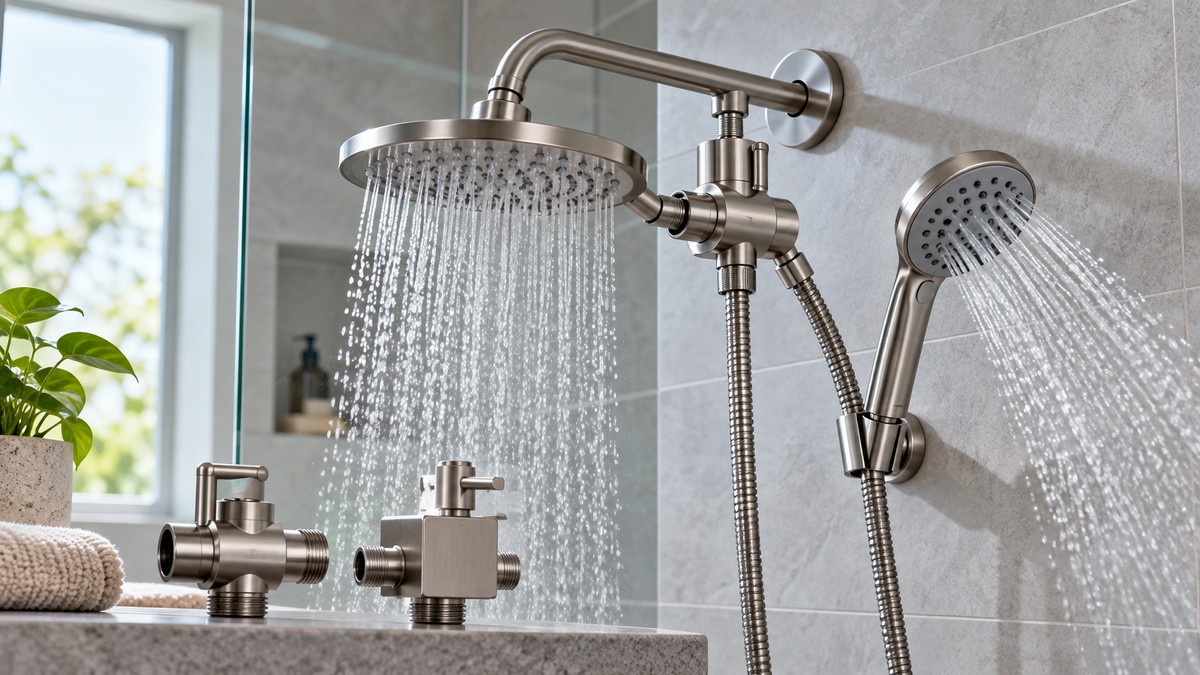
The word diverter covers three different parts, and the listings in this group fall into all three. A three-way diverter valve is installed where the shower arm meets the hose, and it sends water to the fixed head, the handheld or both. The G-Promise, Gicyiit and G-Promise high-flow listings are of this type. A shower arm diverter is a T-shaped part that screws onto the arm and switches the flow between the overhead head and a handheld, and the NearMoon and Delta listings fall here. A thermostatic three-way valve mixes hot and cold water as well as diverting it, and the HOMEDEC listing is this type.
If your setup adds a longer hose for the handheld, our extension hose guide covers that part, and our dual shower head with slide bar guide covers a dual-head arrangement that needs a diverter.
Each type needs a different check. A diverter valve needs the right inlet and outlet threads for the arm and hose you have. A shower arm diverter needs a standard straight shower arm connection, and it adds no temperature control. A thermostatic valve changes the water temperature at the valve, so the listing’s safety claims matter more, and it has to be installed with a plumber’s knowledge of your supply lines.
Why scald claims need a source
Scalding is the reason many buyers look at a thermostatic valve. The CPSC’s tap water scald guidance says that “Most adults will suffer third-degree burns if exposed to 150 degree water for two seconds.” It also says that the CPSC “urges all users to lower their water heaters to 120 degrees Fahrenheit.” Those are guidance figures for the water heater, not for a diverter, and a diverter does not replace a sensible water heater setting.
Scald-type shower valves are a subject of engineering study. An Iowa State University master’s thesis by George Randall Wandling compares pressure balancing valves, tempering valves, automatic mixing valves and anti-scald type shower valves, and its contents include a chapter titled “CHAPTER 8. ANTI-SCALD VALVES.” The thesis is a long technical document, and this guide does not use its results or models, so it supports the idea that such valves are a separate category, not any claim for a particular diverter.
The EPA’s WaterSense FAQ offers the practical point. Its archived page says, “To provide maximum safety, purchase a showerhead and automatic-compensating mixing valve that are marked with the same flow rate at a pressure of 45 psi.” That is a note about matching components, which matters when you add a diverter to an existing mixing valve. Check your mixing valve and your head, not just the diverter.
The six listings side by side
Table 1 sets out what each listing states about its valve type, outlets, fitting and listed figures. Where a listing gives no figure, the table says so.
| Listing (brand) | Valve type, as written | Inlet and outlets, as written | Listed pressure or flow | Scald or safety wording |
|---|---|---|---|---|
| G-Promise, chrome, 3-way | Three-way valve, smooth knob switch | One 1/2 IPS inlet, two 1/2 NPT outlets | None stated | None stated |
| HOMEDEC, brushed nickel, 3-way | Thermostatic three-way valve | Two 3/4 inch inlets, three 1/2 inch outlets | None stated | Scald prevention per the bullets |
| Gicyiit, 3-way G1/2 | Three-way valve, lever | G1/2 IPS inlet and outlets | None stated | None stated |
| NearMoon, chrome, shower arm | T-shape shower arm diverter | Standard G1/2 straight arm connection | None stated | None stated |
| Delta, chrome, hand shower | Shower arm diverter with lever | 1, 2 IPS male outlet, per the bullets | None stated | None stated |
| G-Promise, high flow, extending holder | Three-way valve with a holder | Standard G1/2 showers | Bullets say high pressure, no figure | None stated |
Read the table as a set of maker claims. None of the six gives a flow rate in litres or gallons per minute, and only the HOMEDEC bullets mention scald prevention. The sources we opened do not cover any of these brands.
Listing notes
G-Promise, chrome three-way valve
This is a plain three-way valve in solid metal. Its bullets say it is solid metal so the parts will not snap, that it has one 1/2 IPS female inlet and two 1/2 NPT male outlets, and that water runs to one outlet, the other or both. The listing says the diverter has no shut-off setting, which means it does not stop the water flow to the shower. The bullets say the simple wrench included makes installation easy at any angle. Choose it for a simple head and handheld setup, and check the outlet threads against your hose and head before you buy.
HOMEDEC, brushed nickel thermostatic three-way valve
The HOMEDEC valve is the only thermostatic unit here. Its bullets describe a universal thermostatic shower valve and a pressure balancing diverter, and they say it features scald prevention. The inlets are 3/4 inch hot and cold, with three 1/2 inch outlets, and one or more outlets can run at a time. The spec table gives 12.87 pounds and a brass material, and the bullets say the valve meets industry standards and certification without naming them. The scald prevention claim is the listing’s own. The sources we opened do not rate the valve, so treat the claim as a statement to confirm with your plumber.
Gicyiit, three-way G1/2 valve
The Gicyiit valve is a three-way diverter for adding a second shower head to an existing arm. Its bullets say it lets you connect a handheld shower, a rain shower head, a shower wand or a pet sprayer, and that a smooth lever switches water between two outlets or runs both at once. Installation is tool-free: a rubber washer goes into the female inlet, and the swivel nut allows the angle to be set. The spec table gives a two year warranty and 4.3 ounces in weight. The bullets say the outlets keep steady flow when used separately, but they give no flow figure.
NearMoon, chrome shower arm diverter
The NearMoon part is a T-shape diverter that sits on a standard G1/2 straight shower arm. Its bullets describe solid brass with an ABS handle and a multi-layer chrome finish. They say it works with a handheld and a fixed head, that a washer is included, and that the flow switches from the overhead head to the handheld without restricting flow to the head, as the listing says. The bullets name no pressure or temperature rating. Use it when the shower arm is standard and you want to add a handheld.
Delta, chrome shower arm diverter
The Delta part is a brass diverter with a lever, sized for a hand shower. The bullets say brass construction, lever control and chrome, and the spec table gives a weight of 4 ounces and a size of 3 by 2.3 by 3 inches. The bullets also describe a 1, 2 IPS male outlet, which is the fitting to check against your arm. The listing gives no installation steps and no flow figure, so confirm the thread with the shower arm before you buy.
G-Promise, high flow with extending holder
The high-flow G-Promise kit adds a holder that extends down 6.1 inches, so a handheld sits at a lower height. Its bullets say the valve core is designed to reduce flow resistance, so that the pressure is not lost as it is in some plastic diverters. They say the holder clicks in place for hands-free use, the valve runs both outlets together, and the kit fits standard G1/2 showers and takes under 10 minutes to install. The bullets give no flow rate, so the high-flow claim cannot be checked against a figure on the page.
Installation: threads and washers
The thread is the first check. The listings here use 1/2 inch IPS and NPT threads, and the Delta and G-Promise valves name the outlet types in their bullets. A diverter that fits the arm can still leak if the washer is wrong or the fitting is not tightened. The Gicyiit and NearMoon listings include a washer, and the Gicyiit bullets say the washer goes into the female inlet before the nut is hand-tightened.
Make sure the connection is sealed before you use the shower at full pressure. The Gicyiit bullets describe a tool-free fit, and the G-Promise bullets describe a wrench, so decide which method your fitting needs. The bullets do not describe a leak check, so check every joint and wipe it dry after the first run.
Scald risk and the mixing valve
If you install a diverter with a thermostatic valve, the valve’s settings matter more than the diverter’s outlet count. The CPSC’s guidance focuses on the water heater, and it says that “Most adults will suffer third-degree burns if exposed to 150 degree water for two seconds.” The same guidance says that a lower water heater setting, at 120 degrees Fahrenheit, lowers the risk of burns. A diverter sits downstream of that setting, so the water heater is still the first control.
A simple diverter does not regulate temperature. If your shower already has a mixing valve, the EPA’s matching advice applies: buy components that are marked for the same flow and pressure, and check your mixing valve with your plumber before you add a second head. The sources we opened do not cover how a diverter changes the performance of a mixing valve.
A checklist before you buy
- Measure the shower arm thread and the hose thread. Check whether the listing states 1/2 inch IPS, NPT or G1/2.
- Decide the valve type: a three-way valve for two outlets, a shower arm diverter for a single arm, or a thermostatic valve for temperature control.
- Count the outlets you need. A fixed head and a handheld need two, and a rain head with a handheld needs a valve that runs both.
- Read the shut-off wording. The G-Promise valve has no shut-off setting, so plan the shutoff elsewhere.
- Check any scald claim with a plumber and the valve’s own instructions, since the sources we opened do not rate the brands here.
Mistakes to avoid
- Buying by the finish. The brushed nickel, chrome and brushed gold options look different, and their threads are what matter.
- Assuming the diverter controls temperature. Only the HOMEDEC unit is described as a thermostatic valve, and the others are not.
- Counting on a scald claim without a rating. The HOMEDEC bullets say scald prevention, but no figure is given.
- Ignoring the outlet count. A two-outlet valve will not run a head and a handheld and a rain shower together.
- Skipping the leak check. Tighten, run the water and check each joint.
How we chose
We searched Amazon.com for “best shower diverter” in Chrome on 21 October 2026 and read the first page of results. Most of the results were three-way diverter valves and shower arm diverters, so we kept those. We chose six listings from five brands. Two G-Promise listings are in the set because they are different products, a three-way valve and a high-flow kit with a holder. We left out other G-Promise and NearMoon variants, including a NearMoon brushed nickel listing, and a second HOMEDEC listing in brushed gold, which is a thermostatic trim kit rather than a diverter we could compare on the same terms.
For each listing we read the title, the first four bullets and the spec table. Chrome did not give us prices, rankings or ratings in a form we could use, so this guide does not use them.
What we could not verify
- Whether any listing’s flow rate is correct, since none of the six gives a flow figure in the bullets we read.
- The HOMEDEC scald prevention claim and its certification, which the bullets describe without naming a standard.
- Whether the Delta 1, 2 IPS outlet fits a given shower arm, since the bullets give the thread without a size.
- Whether the G-Promise high-flow kit delivers stronger pressure than a standard diverter, since the bullets make a pressure claim without a figure.
- The material and finish claims beyond what the bullets say. We did not check those claims.
- Whether any of the sources we opened cover these brands or their fittings. They cover water heater settings, anti-scald valve types and matching components, not diverter products.
1. G-Promise Solid Metal 3-Way Shower Diverter Valve (Chrome), Smooth Knob Switch, Spray Separately or (Chrome three-way metal diverter with a smooth knob)
Pros
- The bullets say the valve is solid metal, so the parts will not snap off
- The bullets describe one 1/2 IPS inlet and two 1/2 NPT outlets
- The bullets say water can run to one outlet, the other, or both
Cons
- The bullets say the diverter has no shut-off setting
- The bullets name no pressure or scald rating
Best for: A fixed head and handheld setup that uses standard 1/2 inch fittings
Skip if: You need the valve to shut off the water, since the listing says it does not
View on Amazon (affiliate link)
2. 3 Way Shower Diverter Valve, 3 Outlets Multi Function Thermostatic Shower Brass Valve Can Run (Brushed nickel thermostatic three-way valve with three outlets)
Pros
- The bullets describe a pressure balancing diverter with scald prevention
- The bullets give 3/4 inch hot and cold inlets and three 1/2 inch outlets
- The bullets say one or more outlets can run at a time
Cons
- The bullets name certification and industry standards without naming them
- The spec table gives a weight of 12.87 pounds, a heavy valve to fit
Best for: A multi-outlet shower that needs temperature control at the valve
Skip if: Your plumber has not confirmed that the valve matches your inlets and mixing valve
View on Amazon (affiliate link)
3. 3 Way G1/2 Shower Diverter Valve, Solid Metal Shower Head Splitter (Tool-free three-way G1/2 valve with a two-year warranty)
Pros
- The bullets say a rubber washer and a hand-tightened swivel nut make installation tool-free
- The bullets describe a smooth lever that runs both outlets together
- The spec table lists a two year warranty
Cons
- The bullets describe a shower arm valve, so a fixed head needs an outlet check
- The bullets name no scald or pressure rating
Best for: An added handheld on a shower arm with G1/2 threads and no tools
Skip if: Your shower arm does not take a G1/2 inch IPS fitting
View on Amazon (affiliate link)
4. NearMoon Solid Brass G1/2 Shower Arm All Metal Universal 3-Way Diverter Valve for Handheld (Brass T-shape shower arm diverter for handheld and fixed heads)
Pros
- The bullets describe solid brass with an ABS handle
- The bullets say it uses a standard G1/2 straight shower arm connection with a washer
- The bullets say switching from the overhead head to the handheld is easy
Cons
- The bullets name an ABS handle, a plastic part in the switch
- The bullets give no flow figure through the valve
Best for: A single shower arm that needs a quick switch to a handheld
Skip if: Your shower arm is not a standard G1/2 straight connection
View on Amazon (affiliate link)
5. Delta Faucet Shower Arm Diverter for Hand Shower, Chrome (Chrome lever diverter for a Delta hand shower)
Pros
- The bullets describe brass construction with a lever control
- The spec table lists a weight of 4 ounces and a size of 3 by 2.3 by 3 inches
- The title names it for a hand shower arm
Cons
- The bullets name a 1, 2 IPS male outlet with no fitting size beside it
- The listing gives no installation steps in the bullets
Best for: A shower arm that feeds a hand shower through a Delta-style diverter
Skip if: Your shower arm uses a thread size different from the one the bullets name
View on Amazon (affiliate link)
6. G-Promise High Flow Metal Shower Diverter Valve with Extending Holder (High-flow metal diverter with a 6.1 inch extending holder)
Pros
- The bullets say the holder extends down 6.1 inches and clicks in place
- The bullets describe a metal construction and a smooth diverter valve
- The bullets say the kit fits standard G1/2 showers and installs in under 10 minutes
Cons
- The bullets give no flow rate, so the high-flow claim cannot be checked on the page
- The listing gives a weight of 1.32 pounds and no fitting diagram
Best for: A handheld owner who wants the holder set lower on the wall
Skip if: Your wall has no space for a holder that drops 6.1 inches
View on Amazon (affiliate link)
FAQ
What is the best shower diverter for a handheld shower?
Among these listings, the Gicyiit and G-Promise three-way valves and the NearMoon and Delta shower arm diverters are built for a fixed head and a handheld. Choose by the thread on your shower arm and the number of outlets you need. The G-Promise high-flow kit adds a holder that lowers the handheld.
Does a shower diverter prevent scalding?
The diverter itself is not described as a scald control, except for the HOMEDEC thermostatic valve, whose bullets claim scald prevention without a rating. The CPSC’s guidance points to the water heater setting, and it says that “Most adults will suffer third-degree burns if exposed to 150 degree water for two seconds.” Check any scald claim with your plumber.
Do I need a thermostatic diverter?
Only if you want temperature control at the valve. The thermostatic HOMEDEC valve is the one listing here that describes that function. A plain three-way valve or shower arm diverter switches water between outlets and does not regulate temperature.
How do I know the thread will fit?
Measure the shower arm and the hose thread before you order, and compare them with the listing’s inlet and outlet sizes. The listings here use 1/2 inch IPS, NPT and G1/2 threads, and a mismatch causes leaks. Ask your plumber if the thread is unclear.
Bottom line
Choose the diverter by its valve type and thread, then count the outlets you need. Treat any scald claim as a claim to confirm with a plumber, because the water heater setting and the matching of your mixing valve do more to control temperature than the diverter’s finish.
Sources
- U.S. Consumer Product Safety Commission, “Avoiding Tap Water Scalds” (PDF): https://www.cpsc.gov/s3fs-public/5098-Tap-Water-Scalds.pdf
- Iowa State University, master’s thesis by George Randall Wandling (1996), “An evaluation, characterization and comparison of pressure balancing valves, tempering valves, automatic mixing valves and anti-scald type shower valves” (PDF): https://behost.lib.iastate.edu/DR/Wandling_ISU-1996-W353.pdf
- U.S. Environmental Protection Agency, WaterSense “Frequently Asked Questions: WaterSense Labeled Showerheads” (archived 2017 snapshot): https://19january2017snapshot.epa.gov/www3/watersense/pubs/faq_showerheads.html