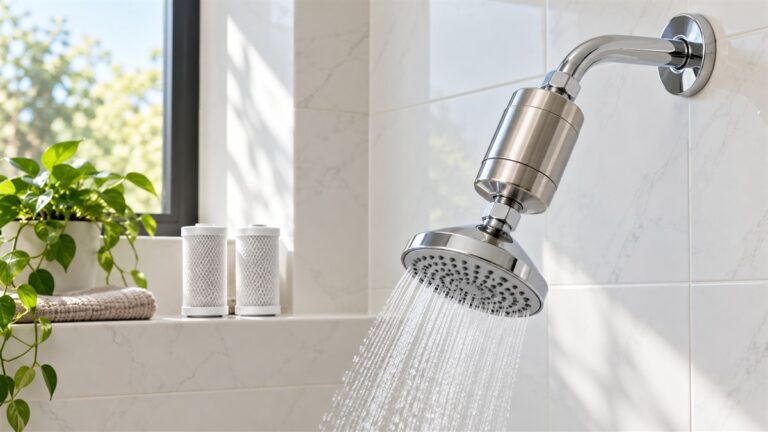
Black Friday Shower Head Checklist: Flow, Fit and Filters
As an Amazon Associate we earn from qualifying purchases.
A black friday shower head checklist is a short list of checks to run before you buy a head or a bathroom fitting in the Black Friday season, whatever the listing says that week. This guide covers flow rate and the federal rule that sets it, pressure, thread and connection, fixed versus handheld heads, hose and bracket length, filter claims, installation steps, and what listings leave out. It does not quote prices, percentages or ratings. The timing advice is about when to run the checks, not whether a price is good.
Quick answer
- Read the flow figure first. EPA describes 2.5 gallons per minute as the flow of standard showerheads, and a WaterSense label requires no more than 2.0 gpm. The federal rule sets a maximum of 2.5 gpm measured at 80 psi.
- Do not read gpm as pressure. EPA’s WaterSense criteria are spray force and pressure compensation, and the sources we opened do not say that a head raises the pressure from the supply.
- Check the fit before the holiday week: the connection on your arm, the hose length, and any docked height the listing states.
- Treat “softener” and filter wording as a claim until the listing names the media and any certification. None of the sources we opened describes a shower filter as a water softener.
Timing: what the Black Friday week changes
Black Friday in 2026 falls on November 27, the day after Thanksgiving on November 26. Thanksgiving is the fourth Thursday of November, so the checks are best finished before that week begins.
The checks themselves do not depend on the date. What the week changes is the text a reader sees. The listings in this guide were read on different days, from October 11 to October 19, 2026, and a title and a spec table on the same listing can disagree. The Delta listing covered below shows that: its title says 6-setting and its spec table says 5. A later read may show different text, so the checklist has to be repeated on the day of purchase.
Write down three fields when you first read a listing: the model number, the flow figure, and the hose or arm length. Compare the same three fields on the day you buy. If any one of them has changed, start the checklist again from the top.
This post does not state prices or stock levels. We did not check price history, stock or return rules for any listing, so no date mentioned here is a recommended day to buy. The holiday week is only the deadline for finishing the checks.
1. Flow rate: read the number and the rule
Flow rate is the volume of water a head delivers each minute, written as gallons per minute (gpm). It is the first figure to check because two rules are built around it. One is a federal ceiling. The other is a labeling threshold. A listing’s number has to be read against both.
The federal rule is in the Department of Energy’s showerhead standard, which Cornell’s Legal Information Institute publishes at 10 CFR 430.32. It says the maximum water use for “any showerheads manufactured after January 1, 1994″ is “2.5 gallons per minute (9.5 liters per minute) when measured at a flowing pressure of 80 pounds per square inch gage.” For a head made after that date, 2.5 gpm at 80 psi is the top of the allowed range.
The lower line is the WaterSense label. EPA’s WaterSense page says that “Water-saving showerheads that earn the WaterSense label must demonstrate that they use no more than 2.0 gpm.” The same page describes 2.5 gpm as the flow of standard showerheads. A WaterSense product also “must be independently certified,” so a listing that says WaterSense is making a claim that can be checked against EPA’s product database. We did not open that database for any listing in this post.
Read the number the listing actually states. The listings here give flow in three places: in the title, in the spec table, or not at all. The table below uses only the figures the listings state. Its one calculation is gallons = gpm × minutes, using an eight-minute shower. Eight minutes is our assumption, because the sources do not give a typical shower length and no listing states one. Each result assumes the head runs at its stated flow for the whole eight minutes.
| Listing as read | Flow the listing states, and where | Gallons in an 8-minute shower (gpm × 8) |
|---|---|---|
| High Sierra CLASSIC solid metal shower head | 1.25 GPM (title) | 10 |
| Delta 52535 fixed shower head | 1.75 gpm (spec table) | 14 |
| Earth Showerhead handheld, Niagara Conservation | 1.75 GPM (title) | 14 |
| Moen 26009 Engage Magnetix rain and handshower | 2.5 gpm max (spec table) | 20 |
| Magichome filtered handheld | not stated | not calculated |
The gap between the lowest and highest figure in the table is 10 gallons over an eight-minute shower, from 10 to 20. The gap between the WaterSense ceiling and the federal ceiling is 4 gallons over the same eight minutes, from 16 to 20. These are arithmetic results. Real use depends on how the head is set, the pressure at the valve, and how long the shower runs, and none of the listings states those conditions.
The Delta listing has a pause setting that “reduces the water to a trickle.” A shower with pauses would use less than the table shows, because the table assumes the head runs at its stated flow the whole time.
For a wider set of heads, see our main shower head guide. Use it to find the flow figure first, then come back to the checks below.
2. Pressure is not the same as flow
Pressure and flow are different measurements, and a “high pressure” label does not settle either one. The federal rule and the WaterSense label both put their limits on the head’s flow, not on the supply pressure to the house. EPA’s WaterSense page describes two performance criteria. Its “spray force” criterion ensures that spray force is “sufficient to provide user satisfaction.” Its “pressure compensation” criterion “ensures the showerhead will provide for a minimum flow across a range of household water pressures,” which treats pressure as a condition of the house. Neither criterion says a head adds supply pressure.
The Delta 52535 title includes the words “High Pressure Spray,” and the listing gives 1.75 gpm. The listing does not say what supply pressure the head needs, and it does not say what spray force it produces. A reader cannot tell from the title whether that head will feel stronger in a given house.
The Magichome listing says its air-induction design can “deliver a strong and consistent water flow even under low water pressure.” That is the listing’s own statement. The listing gives no measurement, no pressure range and no flow figure to check it against, so this post treats it as a claim only.
If the house has low pressure, the head is only one part of the cause, and the sources we opened do not say which part to change first. For heads aimed at low supply, see the guide to shower heads for low water pressure. For heads that list a high-pressure feature alongside water saving, see the companion guide on high-pressure, water-saving heads.
The check, then, is three questions. What is the flow figure? What is the spray type? Does the listing say anything about the supply pressure it needs? If the listing answers none of the three, the word “high pressure” on the page has not told you anything you can use.
3. Thread, connection and clearance
A head screws onto the end of the shower arm, and the arm is threaded into the wall. The thread and the connection decide whether a head fits at all, so this check comes before the purchase, not after it. The only standard thread figure in our sources comes from a manufacturer’s installation guide. Kohler’s showerhead installation guide, document 113280-2-AB, has the installer “install a 1/2 NPT nipple” as the connection for its own shower arm. That is a description of Kohler’s installation. It is not a description of any head in this guide.
None of the listings we captured states a thread size for the head itself. For each head, the thread check is a measurement at home. Look at the end of the arm where the head will go, and check the head’s packaging or manual for its connection type. A listing photo is not a measurement, so do not assume a fit from it.
Kohler’s guide also says to “Use thread sealant on all threaded connections.” Apply the sealant the way the head’s own manual describes. If the manual names a different sealant, follow the manual.
Clearance is the other half of the fit. The Moen 26009 listing states that the combination is “approximately 17-3/4 inches tall when docked.” Measure from the arm to the top of the head’s dock, and check that figure against the space above the shower. A tall dock can fail on clearance before it fails on flow. Check the same kind of measurement on a fixed head too. The Delta listing gives its dimensions as 3.69 in L x 6 in W, and those numbers describe the head only, not the space around it. For a rain-style fixed head with its own fit notes, see our SparkPod 6-inch rain head review.
4. Fixed, handheld or combo
Choosing between a fixed head, a handheld on a hose, and a combo is a question of use, not of price or ranking. A fixed head stays where the arm puts it. A handheld moves on its hose and bracket. A combo has a diverter that sends water to a fixed head, a handheld, or both.
The Moen 26009 is a combo, and its listing gives the diverter as “3-way (rainshower, handshower or both).” The Delta 52535 is listed as a “Fixed shower head, wall mounted.” The Earth Showerhead from Niagara Conservation is a handheld according to its title. Each type covers a different task, so decide the task first and then pick the type.
Ask three questions before you choose. Who will use the head: one adult standing under it, or someone seated, a child or a pet? What cleaning do you need: rinsing a tub or wall, or only the body? Will the head need to move often? The Moen listing describes a “long kink-free metal hose for rinsing, cleaning and bathing pets.” The Delta listing says its pause setting is for “lathering a pet or shaving.” Those are the listings’ own descriptions of use. For more handheld listings, see our water-efficient handheld heads guide.
A combo gives more options and more to check. For the Moen, the figure to match against the ceiling in section 1 is the listing’s 2.5 gpm maximum. The listing gives an item weight of 1.5 pounds, and it gives no load rating for the arm or the bracket, so the arm’s capacity cannot be checked from the listing.
5. Hose and bracket length
A handheld is only as useful as its reach, and hose length is the first number to compare. The captured listings give 60 inches of metal hose for the Moen 26009, a spec-table hose length of 59 inches for the Magichome, and a 72-inch stainless steel hose for the Earth Showerhead according to its bullet text.
Measure the reach you need before you compare. Stand where the person using the head will stand. Measure from the wall outlet to the spot the head must reach, and from the bracket to the far side of the tub or the shower floor. The hose must cover the longer of the two distances, and the bracket must hold the head at the height you need. The listings do not state bracket height ranges, so the bracket is a check you make with a tape measure.
Length is not the only fit. A slide bar lets a handheld move up and down, and the bar is a separate part with its own length and mounting. Our 24-inch slide bar guide covers the bar side. Check the bar’s length and the handheld’s bracket together before you buy either one.
Measure the hose path as well as the reach. The listings do not show how the hose lies in a real shower, so that path is a check for you to make.
6. Filters: read the claim and the media
Filter claims need the closest reading. A filter cartridge in a shower head is not the same product as a water softener, but a listing can blur the two. The Magichome title uses the phrase “Water Softener Filter Beads for Hard Water.” Its bullets say the head uses “100 pieces Steel plate water outlets that prevent limescale and hard water buildup.” Those are listing claims. The fields we captured name no certification and no filter media specification for the head.
Penn State Extension explains the difference between softening and a filter. It says that “hard water causes gray or white deposits when water is heated.” It describes a “water softener, also called an ion exchange unit,” and says that “a physical and chemical process filters the water through an exchange media known as resin or zeolite.” That describes a softening unit working on the water supply. None of the sources we opened describes a shower filter as a softener. When a listing uses the word “softener,” ask which media it names and which process it describes.
Certification is the second check. The Delta 52535 bullet says the finish is “third-party certified” but does not name the body that certified it. Ask for a name, a standard number or a certificate. If the listing gives none of these, the claim has no name to check, so treat it as unnamed.
Replacement is the third check. The captured Magichome fields give no replacement interval for the filter media. Look for the interval in the manual before buying, and do not rely on a guess.
A filtered head still has a flow figure, and the filter claim does not answer the WaterSense question. The Magichome fields we captured give no flow figure, so that head cannot be placed in the table in section 1, and it should be checked for flow in the same way as any other head. For a filtered head covered on its own, see our shower filter post.
7. Installation caveats
A head swap is a small job, but the plumbing behind it is not something to guess at. The Kohler guide sets out the order of work, and the steps below follow it where the guide says so. Kohler’s guide is written for its own installation, so use it as the order of work, not as a manual for another brand’s head.
Start with the rules. Kohler’s guide says to “Observe all local plumbing and building codes.” It then says to “Shut off the main water supply.” Read both lines before you touch anything. We did not confirm whether every home needs the main supply turned off for a head swap, so the safe reading is the guide’s reading.
Remove the old head and check the arm’s threads. EPA’s WaterSense page offers a repair tip for the same job: “check and, if needed, replace the washer or “o” ring inside the showerhead while making this repair.” Check that seal while the old head is off.
Apply the sealant and thread the head. Kohler’s guide says to “Apply thread sealant tape to the shower arm, and thread the showerhead to the shower arm.” Its tightening step is written for the arm, and the guide says to “Carefully tighten with a clean strap wrench.” For the head itself, follow the head’s manual on how far to turn it.
Finish with a leak check. The Kohler guide says to “Turn on the water supply and check for leaks.” Run the shower and look at the joint before you leave the bathroom.
This post covers swapping a head, not replacing a valve, a supply line or the arm itself. If the arm is loose in the wall, or you are unsure what sits behind it, stop and call a licensed plumber. The local code applies to any work you do yourself.
8. What the listing leaves out
Every card below has at least one gap. The gaps are the questions to put to the packaging or the seller before you buy, and they matter more when a listing is read quickly in a holiday week. The gaps we saw in the captured fields are these.
- Thread size: none of the five cards gives the head’s connection type in the fields we captured.
- Warranty terms: the Delta and Moen fields give “Lifetime limited” and “Limited lifetime.” Neither listing field says what the warranty covers.
- Settings: the Delta title says 6-setting, and its spec table says 5.
- WaterSense: the Earth Showerhead bullet says “WATERSENSE CERTIFIED,” but the same bullet describes “The Earth non-handheld showerhead,” which does not match a handheld title.
- Flow: the Magichome fields give no flow figure. The High Sierra entry was read from a search-results page and shows only its title.
- Filter media and replacement: none is named for the Magichome head in the fields we captured.
Product cards: five listings to check against this list
Each card uses only the listing fields we captured. Read the card’s “Skip if” line before you read its facts, because it is the quickest way to rule a head in or out.
Delta 52535 Chrome Fixed Shower Head
Listing facts: Fixed, wall mounted. The spec table gives 1.75 gpm. Plastic body, chrome finish, 3.69 in L x 6 in W, item weight 1.19 pounds. The listing’s warranty is “Lifetime limited.” The pause setting “reduces the water to a trickle,” which the listing says is for lathering a pet or shaving.
Good for: a fixed head where the flow figure sits in the spec table, and a pause setting for short tasks.
Skip if: you need a handheld or a combo, or you need the setting count to be exact before you buy.
One limitation: the title says 6-setting and the spec table says 5, so check the packaging or manual for the count.
High Sierra CLASSIC Solid Lead-Free Metal Shower Head
Listing facts: The title reads “1.25 GPM Ultra Low Flow Shower Head, Patented Nozzle,” and it includes the words “Solid Lead-Free Metal.” We captured only the title, from a search-results page. No spec table, thread, dimensions or warranty is in the listing data.
Good for: a reader who wants a metal fixed head with the flow figure in the title, and who wants to compare it with the 2.0 gpm WaterSense figure.
Skip if: you need the connection, the size or the warranty before buying, since none of them is in the captured fields.
One limitation: 1.25 GPM is under the 2.0 gpm figure, but the title does not say WaterSense, and we did not check for a label.
Moen 26009 Engage Magnetix Chrome 2-in-1 Rain Shower Head and Handshower
Listing facts: The spec table gives “2.5 gpm (9.5 L/min) max,” a 60-inch metal hose, and a “3-way (rainshower, handshower or both)” diverter. The spray face is approximately 6.75 inches wide. The listing says the combination is “approximately 17-3/4 inches tall when docked,” with an item weight of 1.5 pounds and a limited lifetime warranty.
Good for: a combo where a long metal hose and a choice of rain, hand, or both matter more than the lowest flow figure.
Skip if: the arm and the space above the shower leave less room than the docked height, or you need a head at or under 2.0 gpm.
One limitation: the 2.5 gpm figure is the listing’s maximum. It equals the federal ceiling and is above the 2.0 gpm WaterSense figure, and we did not see a WaterSense claim in the captured fields.
Earth Showerhead Handheld by Niagara Conservation
Listing facts: The title reads “Energy & Water Saving Handheld Showerhead (1.75 GPM) High-Efficiency.” One bullet says the head “comes with a 72-inch stainless steel hose and mounting bracket,” and another lists “three spray functions.” A bullet reads “WATERSENSE CERTIFIED,” but the same bullet describes “The Earth non-handheld showerhead.”
Good for: a handheld with a stated 72-inch hose and a stated flow of 1.75 gpm, which is under the 2.0 gpm WaterSense figure. That makes the label claim worth checking.
Skip if: you need the label confirmed, since we did not open the EPA product database for this listing, or you need a connection size, which the captured fields do not state.
One limitation: the bullet calls the product “non-handheld” while the title says handheld. Check the box or the manual before you rely on either word.
Magichome Filtered Shower Head with Handheld
Listing facts: The title reads “10-Mode Adjustable Detachable Chrome Showerhead w/Stainless Hose, Water Softener Filter Beads for Hard Water.” The spec table gives a 59-inch hose and wall-mounted installation. The bullets name “10 distinct patterns” and “90 anti-clog nozzles.” The fields we captured give no flow figure, no certification and no filter replacement interval.
Good for: a handheld with a long hose and a filter, for a reader who will check the filter claim before buying.
Skip if: you need a named certification, a flow figure to compare with the table in section 1, or a replacement schedule.
One limitation: the title’s “Water Softener” wording is a listing claim, and none of the sources we opened describes a shower filter as a softener.
How we chose
We worked from saved listing fields: eight shower head listings in a file checked on October 17, 2026, five entries from a search-results file checked on October 19, 2026, and nine handheld listings checked on October 11, 2026. We chose five cards by three rules. Each card has a flow figure, a hose length or a dimension stated in the listing, so the checklist has a number to test. Each card covers a different type: fixed, combo, handheld, or a filtered handheld. And each card shows at least one limitation in the captured text.
We left out a listing whose title gives a range instead of a figure: a Niagara Conservation head titled “0.5-1.5 GPM.” A range has no single number to check against the ceiling, so it cannot be placed in the table. The Delta listing is kept even though its title and spec table disagree, because the disagreement is itself one of the checks. This is not a ranking, and the order of the cards does not reflect quality.
What we could not verify
- Stock, price history and return rules for any listing, including during the Black Friday week.
- Whether any WaterSense claim is valid. We did not search EPA’s product database for the Earth Showerhead or any other listing.
- The thread size for any card. The Kohler guide gives the connection for its own installation only.
- The actual flow and spray in any home. The figures are the listings’ figures or the federal rule’s figures, not measurements.
- Supply pressure. The sources give no pressure figure for any reader’s house, so no head is matched to one.
- Filter performance and media. The Magichome fields name no certification and no replacement interval.
- Whether a head swap needs the main water shut off in every home. The Kohler guide says to shut off the main supply, and we did not check other installation guides.
- The setting count on the Delta 52535. The title says 6 and the spec table says 5, and no second source settles it.
FAQ
Should I wait for Black Friday to buy a shower head?
This post cannot say. The checks here do not depend on the date. We did not check price history or stock for any listing, so we cannot say whether a given day is a better time to buy. Write down the model number, the flow figure and the hose length when you first read a listing, and compare the same fields on the day you buy.
What is the federal flow limit for a new shower head?
The federal rule at 10 CFR 430.32 sets the maximum for showerheads manufactured after January 1, 1994 at 2.5 gallons per minute, measured at a flowing pressure of 80 pounds per square inch gage. EPA’s WaterSense label requires no more than 2.0 gpm.
Does a higher gpm number mean stronger water pressure?
Not by itself. Flow is how much water a head delivers each minute, and pressure comes from the supply to the house. EPA’s page describes spray force and pressure compensation as performance criteria. None of the sources we opened says that a head raises the supply pressure.
Will a shower filter soften hard water?
The sources we opened do not describe a shower filter as a softener. Penn State Extension describes ion exchange, in which “a physical and chemical process filters the water through an exchange media known as resin or zeolite.” If a listing uses the word softener, check which media it names and which process it describes.
Do I need to shut off the water before I change a shower head?
Kohler’s installation guide for its own showerhead says to “Shut off the main water supply” and to “Observe all local plumbing and building codes.” We did not confirm whether every home needs the main supply shut off for a head swap, so follow the guide and your local code.
Bottom line
Buy a shower head only after the listing states a flow figure you can place against the 2.5 gpm federal maximum and the 2.0 gpm WaterSense figure, a connection that matches your arm, and a named certification for any filter or WaterSense claim. If any of those is missing, the listing has not answered the question, and the holiday week is not a reason to skip the check.
Sources
- U.S. Environmental Protection Agency, WaterSense, “Showerheads,” https://www.epa.gov/watersense/showerheads (page last updated March 3, 2026), opened 2026-10-20.
- Cornell Law School Legal Information Institute, 10 CFR 430.32 (energy and water conservation standards, showerheads), https://www.law.cornell.edu/cfr/text/10/430.32, opened 2026-10-20.
- Penn State Extension, “Water Softening,” https://extension.psu.edu/water-softening, opened 2026-10-20.
- Kohler Co., Installation Guide, Showerhead (document 113280-2-AB), https://resources.kohler.com/onlinecatalog/pdf/113280_2.pdf, opened 2026-10-20. Cited only for the installation order of work for Kohler’s own showerhead, not for any product in this post.
Disclosure: the Amazon links in this post are affiliate links that may earn a commission on qualifying purchases.