Shower Filter or Whole-House Filter: What Each Does
As an Amazon Associate we earn from qualifying purchases.
Shower filter or whole-house filter: the sources answer the category question, not the product question. In the EPA guide, a point-of-use device treats water at the tap or where it is used, and a point-of-entry device treats water where it enters the building. A point-of-entry device covers showering. The EPA guide does not describe a shower filter, and one of the two EPA documents is archived, so the answer for a specific product has to come from its own certification and performance data.
Quick answer
- A point-of-use device sits at the tap or where water is used. The EPA guide says these devices are best suited to water used for drinking and cooking.
- A point-of-entry, or whole-house, system treats water for all uses, including showering. The EPA guide says these systems treat large quantities of water and may need plumbing alterations and professional maintenance.
- The archived EPA document says some contaminants turn into gases that may pose a risk when inhaled, such as when showering, and that a point-of-entry device can reduce them.
- The sources do not describe a shower filter. Choose by the concern you are trying to solve, and check the product’s certification for that concern.
The two categories in the EPA guide
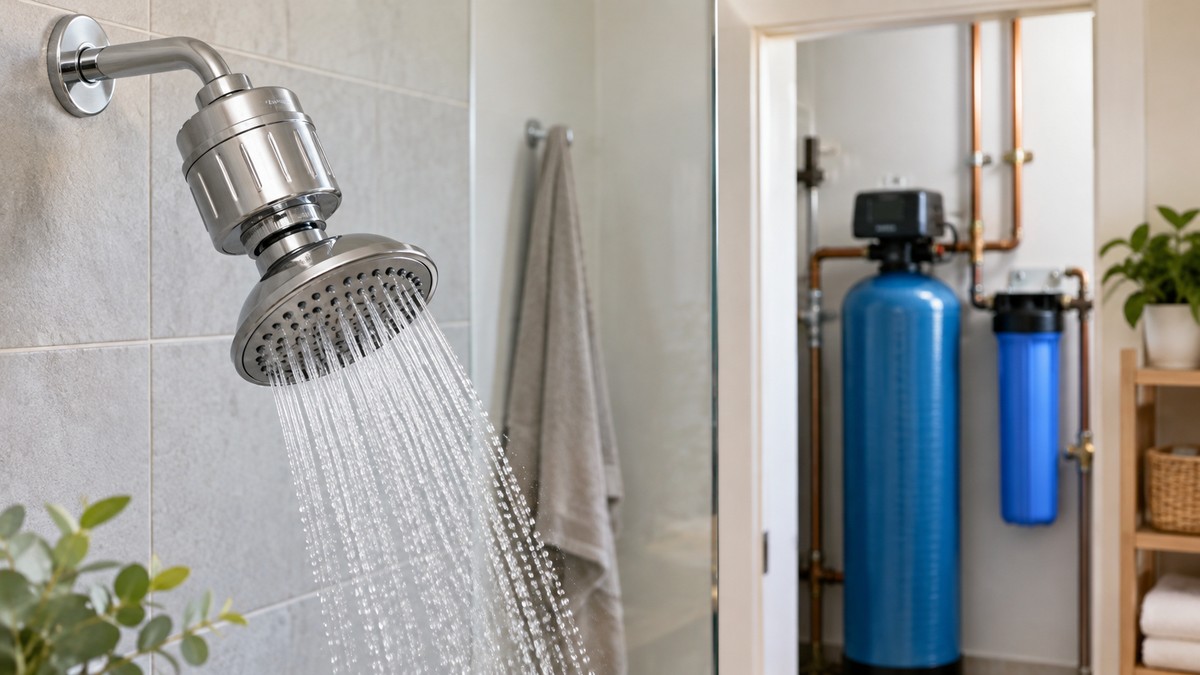
The current EPA guide sorts home devices by where they treat water. Point-of-use devices treat water at the tap or where it is used. The guide’s examples include pitchers with filters, faucet-mounted filters, refrigerator filters, faucets with built-in filters and under-sink systems. Point-of-entry devices, which the guide also calls whole-house systems, treat water where it enters the building and distribute the treated water for all uses, including toilet flushing, showering and clothes washing.
| Feature | Point-of-use (at the tap or where used) | Point-of-entry (whole house) |
|---|---|---|
| Where it sits | Pitcher, faucet-mounted unit, refrigerator line, faucet with built-in filter, or under the sink (EPA guide) | Where water enters the building (EPA guide) |
| Water it treats | Water used for drinking and cooking (EPA guide) | All water used in the building, including showering (EPA guide) |
| Covers a shower | Not described for shower filters | Yes, showering is named (EPA guide) |
| Amount of water treated | Not stated | Large quantities (EPA guide) |
| Installation | A pitcher is filled by hand; a faucet unit can be switched on and off; an under-sink unit uses a separate faucet (EPA guide) | May require plumbing alterations and professional maintenance (EPA guide) |
| Upkeep | Filters replaced per the manufacturer’s instructions (EPA guide) | Changing filters, disinfecting units, removing mineral buildup and backwashing (EPA guide) |
The EPA guide adds that no single treatment system removes all contaminants, and that many systems combine technologies to treat several kinds of contaminant. The archived EPA document makes the same point from a different angle: different units remove different contaminants, and sophisticated units may use several technologies so that one can back up another.
Why the EPA guide says to treat only some of the water
The current guide does not recommend treating all the water in a home. It says to think about where treated water is needed most and how much water needs treatment each day, and it advises against oversizing a system. It also notes that many water-consuming activities, such as flushing toilets and washing clothes, do not require additional treatment, and that the guide’s advice is to stick to treating water used for cooking and drinking.
The archived EPA document reads differently for showering. It says some contaminants, such as radon, disinfection byproducts and some organic chemicals, easily turn into gases and may pose a risk when inhaled, such as when showering. That is a narrower point than a general case for whole-house treatment, and the sources do not say how large the showering risk is in a typical home.
The two EPA documents therefore do not treat showering the same way. The current guide says laundry and toilets generally do not need treatment, and the archived document names showering as a route of exposure for one group of contaminants. Neither document gives a showering level, and neither compares a shower filter with a whole-house system.
What the archived document says about showering
The archived EPA filtration fact sheet dates from the 2005 era. It states that a point-of-use device is effective for treating only the water that is consumed. For contaminants that turn into gases, it adds that they may pose a risk when inhaled, such as when showering. It then says a point-of-entry device can reduce concentrations of these contaminants and of others that cause aesthetic problems such as scaling, staining or odor.
That statement is the only place in the sources that connects a device category to the shower. It supports a point-of-entry device for shower air and water quality questions, but it is an older document. The sources do not give current measurements of shower air, and they do not say which contaminants a given home would see.
Where a shower filter fits
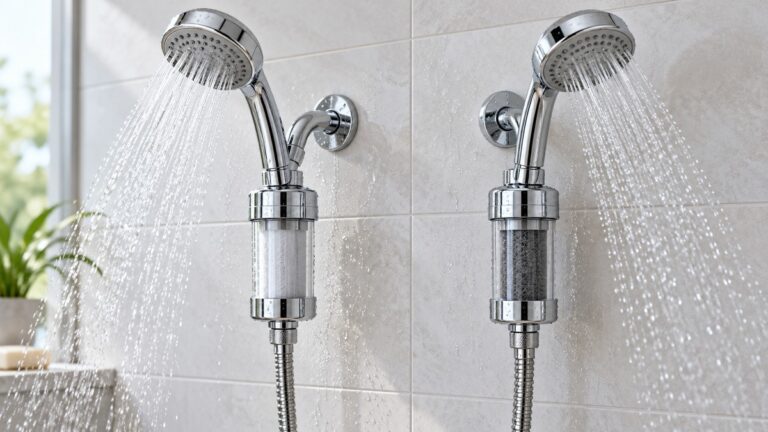
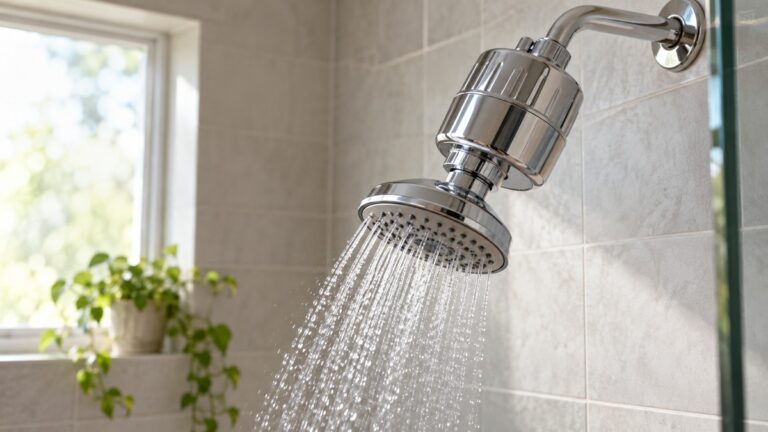
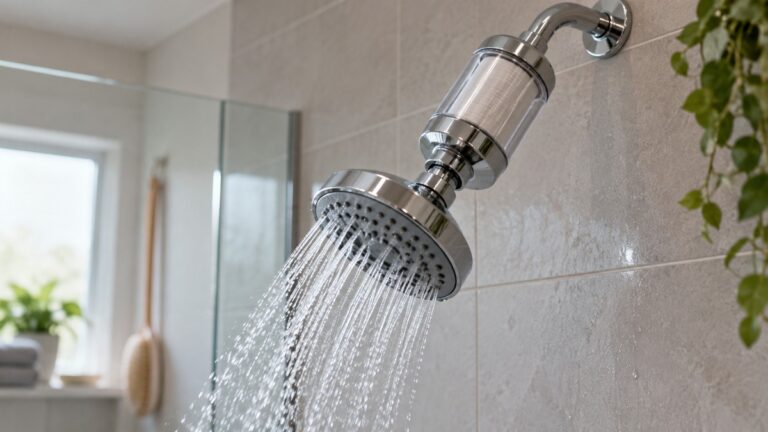
A shower filter is not one of the categories the EPA guide names. The closest category is point-of-use, and the guide describes point-of-use devices for drinking and cooking water. If you install a device at the shower, the sources do not say what it treats, how much it removes, or whether it changes any contaminant the archived document mentions.
This is the main gap in the category question. The sources describe where devices sit and what water they are meant for. They do not describe filters installed at a shower outlet, and they do not give removal results for showering. A shower filter should be judged on its own certification and performance data for the specific contaminant you care about.
Softening: the whole-house question for hard water
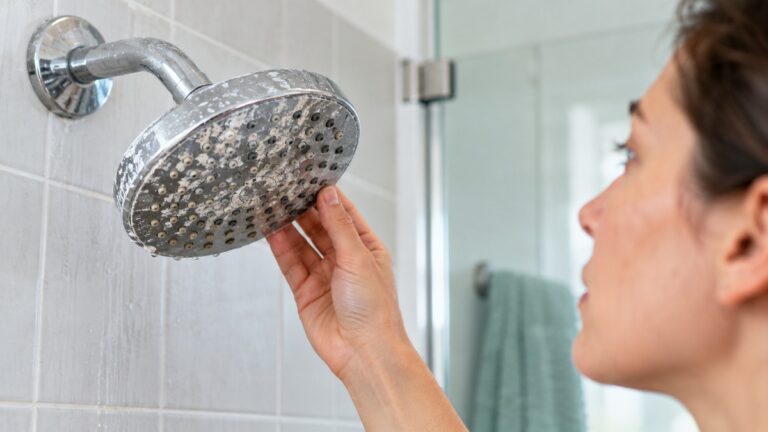
For hard water, the Virginia Tech publication describes whole-house options in plain terms. A water softener can treat all of the water entering a house, or only the water that is heated and used for washing. Its advice depends on the problem. For scale in a water heater, soften only the hot water. For scale on cookware or small appliances, soften the water used for cooking and coffee makers, which typically means softening all the water entering the house. If hard water limits soaps and detergents, or you are left with a soapy film feeling after showering or bathing, the publication says to consider softening all of the water entering the house.
The Virginia Tech publication also says water used for drinking or cooking does not necessarily need to be softened, although treating the whole supply means that water is softened too. It notes that a sodium-based softener increases the sodium in the water, and that if that is a concern you can soften only the hot water and drink and cook with the unsoftened cold water. It adds that a water treatment specialist can help determine the best installation scheme for each household.
The archived EPA document adds that ion exchange water softeners remove hardness and, at the same time, radium and barium. That is a whole-house treatment type, not a shower filter. The current guide describes softening as a way to reduce hardness effects on plumbing, and it names certifications for softeners and scale reduction devices.
Certification and what to check on the label
The current EPA guide says to choose a system certified to the applicable NSF/ANSI standard for the contaminant you are targeting. It says to review the system’s performance data sheet and confirm that the system is certified to treat the targeted contaminant. It also says certification marks are often printed on packaging or supporting documents. For softeners, the guide names NSF/ANSI 44 and, for scale reduction devices, IAPMO/ANSI Z601.
The archived EPA document says to make sure the unit you intend to buy can address your concerns, and that the label, instructions and independent certification of manufacturers’ claims all matter. The Virginia Tech publication names the Water Quality Association gold seal and the National Sanitation Foundation certification mark for softening equipment.
Maintenance and replacement
The current EPA guide says every water treatment system needs some level of ongoing maintenance, and that unmaintained systems may make water quality worse. Maintenance may include changing filters, disinfecting treatment units, removing mineral buildup and backwashing. Filters should be replaced according to the manufacturer’s schedule. The guide also says periodic testing with a home test kit can help show whether a system is working, and that some owners hire a service that visits to replace filters and clean the system.
The archived document makes the filter point more specific for carbon filters. An activated carbon filter is designed to handle a certain amount of water, after which it becomes clogged and ineffective. Carbon filters also have a specified shelf life and should be replaced regularly according to the manufacturer’s instructions. The sources do not give a replacement interval that applies to any product.
Choosing by concern
| Main concern | What the sources point to | What the sources leave open |
|---|---|---|
| Taste or odor in drinking and cooking water | A point-of-use device certified to a named taste-and-odor standard (EPA guide) | Shower use is not covered |
| Hard water, scale and soap film | Whole-house softening for soap film and appliances (Virginia Tech; EPA guide) | How much film is removed is not stated |
| Byproducts that may be inhaled while showering | A point-of-entry device can reduce them (archived EPA document) | Showering levels and removal figures are not stated |
| Contaminants at the tap that a device must address | Match the device to the stated contaminant and its certification (EPA guide) | No single system covers all contaminants |
Head choice is a separate question from the filter category. If you are comparing heads at the same time, the high-pressure and water-saving roundup and the water-efficient handheld roundup cover head designs. For designs with a slide bar, see the sliding shower head roundup and the dual shower head with slide bar roundup. This guide does not cover how any head works with a filter or a softener.
How we chose
This guide answers one question: how point-of-use and point-of-entry devices differ, and which one the sources connect to showering. We chose sources by three tests. First, the publisher had to be a government agency or a university extension service. Second, the page had to define device categories, describe showering, or explain softening in plain text. Third, we left out product claims and sales pages. We opened each page with curl on 2026-10-21 and read the saved text.
We used three publications: the current EPA WaterSense guide to selecting water treatment systems, dated November 2024; the archived EPA filtration fact sheet (an archive copy whose text we opened does not print a date); and the Virginia Tech Extension hardness publication. That makes three sources in total. Two of them are from the EPA, one of which is archived and older, so the showering point rests on the archived document. The guide does not rank products and does not name a best option.
What we could not verify: what the sources do not say
- Whether a shower filter treats any contaminant. None of the sources describes one.
- Removal results for a point-of-entry device on showering. The sources give no figure.
- How large the showering risk is for any contaminant in a typical home. The archived document names the route but gives no level.
- A replacement interval for any filter. The sources say to follow the manufacturer’s schedule and give no number.
- Installation requirements for a specific whole-house system. The sources describe plumbing work in general terms.
- Whether a point-of-entry system and a point-of-use device should be combined. The sources do not address combinations.
Frequently asked questions
Which one should I buy for a shower?
The sources do not describe a shower filter, so they cannot say which one suits a shower. The point-of-entry category is the one the EPA sources connect to showering, through the archived document’s statement about contaminants that may pose a risk when inhaled. The current guide says point-of-use devices suit drinking and cooking water.
Does a whole-house system treat water for showering?
Yes, by definition. The current EPA guide says a point-of-entry system treats water for all uses, including showering. The sources do not give removal figures for the showering route.
Do I need to treat all the water in my house?
Not according to the current EPA guide, which says many activities such as flushing toilets and washing clothes do not require additional treatment. Its advice is to treat water used for cooking and drinking, unless another concern applies.
Does a whole-house softener remove the soap film in a shower?
The Virginia Tech publication says to consider softening all of the water entering the house if you are left with a soapy film feeling after showering. It gives that as advice, not as a removal figure. The sources do not say how much film a softener removes.
Is point-of-use enough if I only care about taste?
For taste and odor in drinking and cooking water, the current EPA guide describes point-of-use devices, and it names NSF/ANSI 42 as the standard for taste and odor products. Check that the product carries that certification for taste and odor.
How often do I replace the filter?
Follow the manufacturer’s schedule. The current EPA guide says to replace filters that way, and the archived document says carbon filters have a specified shelf life. The sources do not give a replacement interval for any product.
Bottom line
Use the category to match the water to the concern. Point-of-use devices treat drinking and cooking water in the sources, and point-of-entry devices treat water for showering. Before you buy either, confirm the product’s certification for the contaminant you care about, and test the water if you have not already.
Sources
U.S. Environmental Protection Agency, “WaterSense Guide to Selecting Water Treatment Systems,” November 2024. https://www.epa.gov/system/files/documents/2025-01/ws-products-home-water-treatment-guide_v2_508.pdf (opened 2026-10-21).
U.S. Environmental Protection Agency (archived), “Water Health Series: Filtration Facts,” 2005 era. https://archive.epa.gov/dclead/web/pdf/fs_healthseries_filtration.pdf (opened 2026-10-21).
Virginia Tech Extension, “Virginia Household Water Quality Program: Hardness in Household Water,” publication 442-664. https://www.pubs.ext.vt.edu/442/442-664/442-664.html (opened 2026-10-21).