How to Clean a Shower Head: Vinegar, Soda and Nozzles
As an Amazon Associate we earn from qualifying purchases.
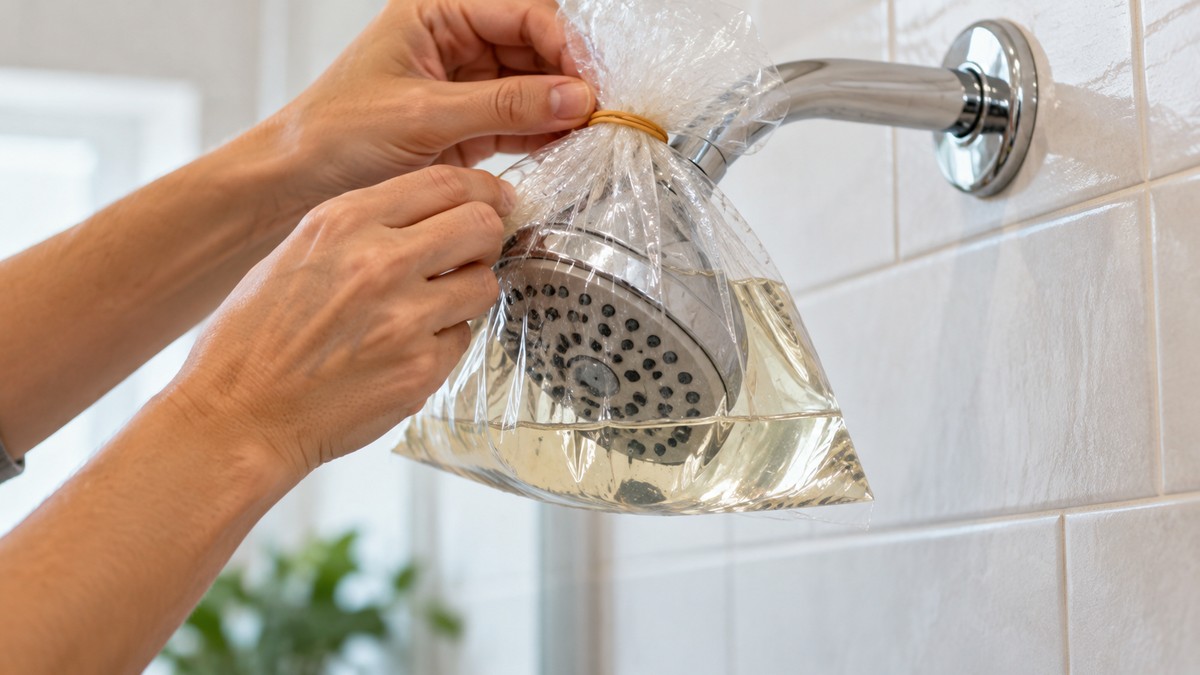
How to clean a shower head without removing it: fill a plastic bag about two-thirds full with white distilled vinegar, tie it over the shower arm so the head sits in the liquid, and let it soak. Ferguson suggests overnight, and American Standard says at least an hour if you need the head clean right away. Then remove the bag, run the shower to flush out the vinegar, and scrub the face and nozzles with an old toothbrush. For everyday grime, Moen’s care pages describe mild soap, warm water and a soft cloth. This guide covers each method and what the sources leave open.
Quick answer
- Head stays on the arm: use the vinegar bag. Soak overnight, or at least an hour if you need it sooner.
- Light grime or film: warm water, a mild soap and a soft cloth. Moen uses mild soap for everyday buildup and vinegar for stubborn buildup.
- Clogged spray holes: start with a fingernail or a toothbrush. Use a toothpick only in the correct holes.
- Removable head with heavy buildup: take it off, soak it in a vinegar and water mix, brush the nozzles, then rinse.
- Finish care: skip abrasive cleaners, fibrous pads, polish and harsh chemicals.
Before you start
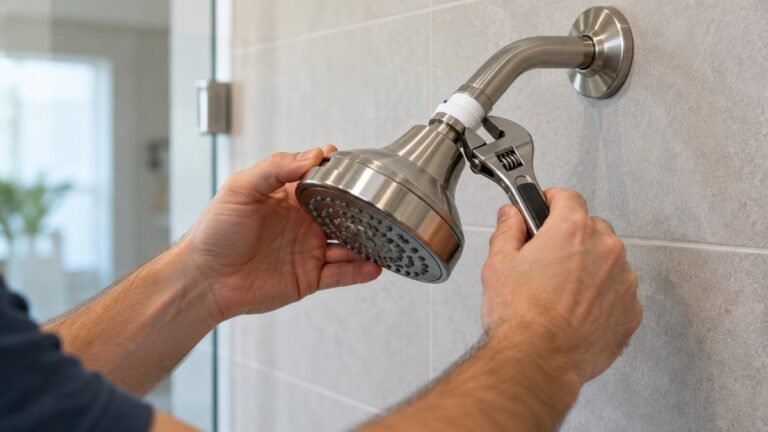
Make sure the water is off before you unscrew a head, as Ferguson advises for its soak method. When you use a wrench, wrap the nut and the arm in a small cloth to protect the finish, as American Standard advises. When you reattach, do not overtighten. Kohler’s installation sheet gives the same caution for its fittings. If a head is stuck, leaks at the connection, or the arm needs repair, that is plumbing work beyond this guide, so call a licensed plumber. For removal, see the guide to removing a stuck shower head.
How to clean a shower head without removing it
The vinegar bag keeps the head attached. You need a re-sealable plastic bag, distilled white vinegar, a rubber band or twist tie, and an old toothbrush. American Standard gives about 12 oz for a standard head and adds: “Add more if you have a large shower head.”
- Pour in the vinegar. Ferguson suggests filling the bag about two-thirds full.
- Submerge the face and nozzles in the bag, then tie the open end over the shower arm so it stays put.
- Soak overnight, or for at least an hour if you need it sooner.
- Remove the bag and run the shower hot for 5 to 10 minutes to clear the vinegar, as American Standard describes.
- Scrub the face and nozzles with the toothbrush to remove any remaining deposits.
Ferguson notes that after a few hours, grime and minerals may start to flake off, but that does not finish the job, so scrub after the soak. For a thicker crust, Ferguson says a deep cleanse may need the head unscrewed, which the buildup section covers. For a fuller vinegar routine, see the vinegar guide for shower heads.
How to clean a shower head with baking soda
Ferguson is the only opened source with a baking soda method, and it calls baking soda “a gentle abrasive that can break down grime and dirt.” Mix it with warm water into a scrub paste, put on a glove, and rub the paste into the nozzles and across the face. Use a toothbrush for spots or deposits that are hard to remove. Then wipe with a soft cotton cloth and run the shower to clear the nozzles.
Abrasives need care. Moen warns against “abrasive cleaners or fibrous pads that could scratch or damage the finish.” Delta’s care wording says harsh abrasives or polish can damage its finishes. American Standard and Moen describe vinegar for mineral deposits and list no baking soda step, so the sources do not show baking soda removing scale on its own.
How to clean a shower head with dish soap
None of the opened sources uses the words dish soap. Moen’s care page describes the everyday method as mild soap, a clean-water flush and a soft cloth. A mild liquid dish soap fits that description, but no source names it.
Moen recommends removing the head for cleaning: “We recommend removing your showerhead from the shower arm for easier cleaning.” Use warm water, a soft cloth and a small amount of soap, rinse well, and reattach by hand. Moen’s Spot Resist sheet lists lime scale removers among the harsh chemicals to avoid on that finish, so check your finish before using any stronger product.
How to clean shower head nozzles with a toothpick
The toothpick is the last step, not the first. Ferguson suggests rubbing the nozzles with a fingernail first. If nozzles stay blocked, it recommends a toothpick or pin “to poke into the spray holes.” American Standard scrubs with a toothbrush after the soak, then uses “a toothpick to make sure all of the shower nozzles are unclogged.”
Work one hole at a time. Ferguson warns to “insert the sharp point into the correct holes to prevent any damage.” Push gently, stop if a nozzle resists, and rinse with the shower on afterward. The sources do not say how deep to push or which material is best, so use the gentlest tool that works. If a nozzle stays blocked after brushing and soaking, check the manufacturer’s guidance.
How to unclog shower head holes
Patchy or thin spray usually means some holes are partly covered. Ferguson describes buildup as “covering up the holes and blocking water from leaving the fixture,” and says clogged nozzles can prevent water flow or change shower pressure. A clean head does not add pressure that the plumbing does not supply.
- Rub the face and nozzles with a fingernail or toothbrush while the head is on the arm.
- For light to moderate buildup, use the vinegar bag.
- For stubborn buildup on a removable head, Moen suggests soaking it in “a solution of 50% water and 50% distilled white vinegar.”
- Last, clear the holes with a toothpick and flush the head with clean water.
Moen’s DIY page links low pressure to “a clogged aerator or mineral buildup.” That is a clue worth checking, but the sources do not say a head cleaning fixes low pressure in every home. The guide to clearing clogged shower head nozzles covers the same steps in more detail.
How to clean rain shower head nozzles
Mira Showers, a UK maker, gives the most detailed rain head method among the sources, so check it against your head’s manual. Remove the head, put it in a plastic container of distilled white vinegar, and leave it “for at least half an hour, though preferably for a full hour.” Then use an old toothbrush to “remove any stubborn limescale from the shower head and the nozzles,” reattach the head, and run the shower to flush.
For a rain head that stays on the pipe, Mira describes a bag method: half fill a bag with vinegar, tie it around the pipe, and soak for the same half hour to an hour. Rubber nozzles are a different case, covered in how to clean a rain shower head with rubber nozzles. None of the opened sources describes a special method for them, so this post does not give one.
How to clean handheld shower head
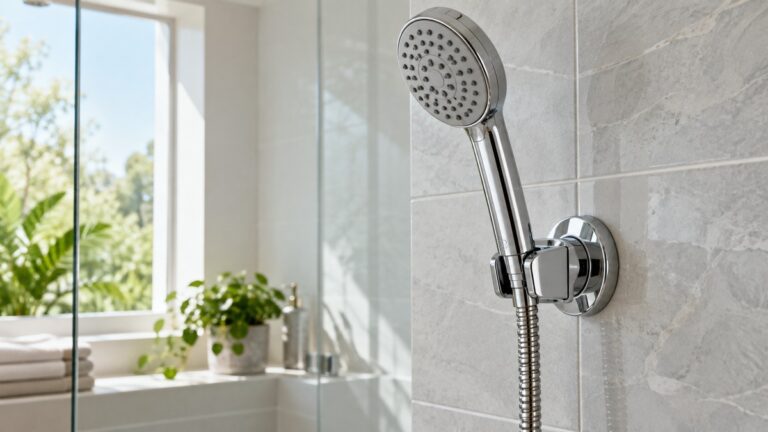
The nozzle steps above apply to a handheld face: a soft toothbrush, a toothpick only in the correct holes, and a rinse. Delta’s care wording is to “simply wipe gently with a damp cloth,” and Moen’s is mild soap, warm water and a soft cloth.
None of the sources describes taking a handheld off its hose for cleaning, or soaking one with the hose attached. Follow the manufacturer’s instructions first. For reattaching, see the guide to installing a handheld shower head.
How to remove water spots from shower head
Ferguson uses “water spots” in its baking soda section, but no opened source gives a separate method for them. Ferguson suggests a toothbrush and paste for spots, stains or mineral deposits “that are hard to remove.” Moen describes the same problem as hard water and mineral buildup, and suggests a vinegar and water soak.
Treat spots as mineral buildup: start with mild soap and a soft cloth, then soak with vinegar if they stay. Brush gently and avoid abrasive pads, as Moen warns.
How to remove calcium from shower head without vinegar
The opened sources describe vinegar as the method for calcium and mineral buildup. None gives a steps-based method that avoids it, so this post does not include one. Penn State Extension says scale is caused by calcium and magnesium, and describes water softening as the hard water treatment. That treats the water, not the head, so it is outside this post.
Ferguson suggests “a cleaner that specifically removes mineral deposits” as an alternative. The sources do not name one or explain how it works. Check the finish first: Moen’s Spot Resist sheet lists lime scale removers among the harsh chemicals that may damage that finish.
How to get rid of hard water deposits on shower head
Moen’s advice is about timing: clean the head “when you start to notice hard water buildup.” Clean when the spray changes or spots appear, starting with the gentlest method above.
Ferguson also suggests a shower filter as a preventive measure. A filter is not a cleaning method, and the sources do not show that one removes scale already on a head. Read the guide to what a shower filter can and cannot do with hard water before you buy one. For anti-scale heads, see whether anti-scale shower heads work, and for why buildup forms, see why shower heads get mineral buildup.
How to clean a chrome shower head
The sources do not give chrome steps by name. Moen’s Spot Resist sheet covers one finish family, and Delta’s care wording covers its own finishes. Both warn against harsh abrasives, polish and harsh chemicals. The safe default is mild soap, warm water and a soft cloth, then dry the head.
Moen names abrasive sponges and steel wool among the cleaners to avoid. For spotting, the vinegar soak is the only method the sources describe. Keep to the soak times above, rinse well, and dry the head afterward.
How to clean a massage shower head
No opened source covers a massage or pulsating head. The brush and toothpick steps apply to the spray face. The sources do not say whether internal parts can be opened, soaked or disassembled, so do not take a massage head apart. Check the manual, and if it does not allow soaking, use the brush and toothpick only.
How to clean shower head threads
The sources do not describe cleaning the threads where the head meets the arm. Kohler’s installation sheet gives one caution that applies to any reattachment: do not overtighten. Its 1/2-inch NPT figure is for its own wall adapter, not for every head.
When the head is off, wipe the threads with a soft cloth and remove loose debris. Check the manual before you add tape or a gasket, because the sources do not say which fitting needs it. Reattach by hand, then tighten gently. For the tape question, see the install guide on tape, tightening and leaks.
How we chose
We started from the 13 keywords in this group and matched each to a method, a nozzle step, a finish caution or a hard water point. We opened care and installation pages from American Standard, Moen, Delta, Kohler and Mira Showers, a plumbing retailer’s guide from Ferguson, and Penn State Extension on 2026-10-22. Only the steps and cautions those pages state were kept, and product listings and cleaning product sellers were left out.
The sources differ in scope. Moen’s Spot Resist sheet covers one finish family, Mira’s guide is for UK rainfall heads, and Ferguson is a retailer article. We kept those limits in the text. This post does not rank or name any product.
What we could not verify: what the sources do not say
- No opened source gives a descaling method that avoids vinegar, so this post does not include one.
- Baking soda appears only in Ferguson’s paste method, and no source gives a soak time for it.
- No source covers massage or pulsating heads, chrome by name, or cleaning the threads.
- No source gives a maximum vinegar soak time. The times above are the minimums the sources state.
- No source says how often to clean a head. Moen ties cleaning to when buildup starts to show.
- No source says cleaning raises the pressure your plumbing supplies. Clean nozzles restore the spray the head was built to give.
FAQ
Can I leave vinegar on a shower head overnight?
Yes, in the bag method. Ferguson suggests overnight, and American Standard lists overnight as its standard soak, with at least an hour for quicker results. The sources give no maximum soak time.
Will vinegar damage the finish on my shower head?
The sources do not say that vinegar damages finishes. They warn against abrasive cleaners, fibrous pads, polish and harsh chemicals. Moen recommends a vinegar and water soak for nozzles and for stubborn buildup. If your finish is special, check the care sheet first and rinse well after the soak.
Can I use baking soda and vinegar together?
The sources describe them as separate methods, and none combines them, so this post does not suggest it. Use one, rinse well, and use the other later if the first does not clear the buildup.
Do I need to remove the shower head to clean it?
No, not for light buildup, because the bag method keeps the head on the arm. Moen recommends removing the head “for easier cleaning,” and Ferguson says a deep cleanse may need the fixture unscrewed. If you remove it, turn the water off first and protect the finish with a cloth.
How do I know the nozzles are clear?
Run the shower and look at the spray. American Standard uses a toothpick to make sure all the nozzles are unclogged, so use the same check. If a nozzle still looks blocked after soaking, brushing and gentle picking, the sources give no further step, so check the manufacturer’s guidance.
Bottom line
Clean the head where it sits when buildup is light, using the vinegar bag. Remove it when buildup is heavy, soak it in a vinegar and water mix, and brush the nozzles. Use a toothpick only in the correct holes, and keep to mild soap, a soft cloth and no abrasives.
Sources
- Ferguson, “5 Do-it-Yourself Ways to Clean Showerheads”. Opened 2026-10-22. Supports the vinegar bag steps, the baking soda paste, the fingernail and toothpick sequence, and the deep cleanse note.
- American Standard, “How to clean a shower head”. Opened 2026-10-22. Supports the 12 oz vinegar figure, the overnight and one-hour soak times, the 5 to 10 minute hot rinse, the toothbrush and toothpick steps, and the cloth-and-wrench advice.
- Moen, DIY care page. Opened 2026-10-22. Supports removing the head for cleaning, mild soap and warm water, the 50/50 vinegar soak for stubborn buildup, and the low pressure note on aerators and mineral buildup.
- Moen, bathroom care page. Opened 2026-10-22. Supports the mild soap method, the vinegar soak for hard water and mineral buildup, and the warning against abrasive cleaners and fibrous pads.
- Moen, Spot Resist finish care sheet (ins10875). Opened 2026-10-22. Supports the mild soap and soft cloth method for that finish, and the list of harsh chemicals including lime scale removers.
- Delta, care and cleaning wording (document 67508 Rev D). Opened 2026-10-22. Supports the warning that harsh abrasives or polish can damage the finish, and wiping gently with a damp cloth.
- Kohler, shower arm installation sheet (1211608-2). Opened 2026-10-22. Supports the do not overtighten caution and the 1/2-inch NPT nipple for its own wall adapter.
- Mira Showers, how to clean rainfall shower heads. Opened 2026-10-22. Supports the at-least-half-hour vinegar soak, the toothbrush on nozzles, and the bag method for a head on the pipe.
- Penn State Extension, hard water and water softening. Opened 2026-10-22. Supports the description of scale from calcium and magnesium and water softening as the hard water treatment.