How to Clear Clogged Shower Head Nozzles
As an Amazon Associate we earn from qualifying purchases.
This guide explains how to clear clogged shower head nozzles: take the head off, clear the blocked holes with a needle or straightened paper clip, flush the arm, reassemble, and check the spray across every hole. The New Jersey Department of Health guide says minerals can build up and block the holes that water passes through. This guide stays on blocked holes and spray pattern. The full vinegar soak is a separate method, and the sources do not say whether a needle alone clears heavy blockage.
Quick answer
- Minerals can block the holes. Clear them with a needle or straightened paper clip, as the New Jersey guide describes.
- Take the head apart as needed, and clean the filter screen if the head has one.
- Flush the arm with the head off before you reattach it, then clean and re-wrap the arm threads.
- After reassembly, turn the water on and check the spray across every hole. The sources do not give a home method for spray pattern.
What blocks the holes
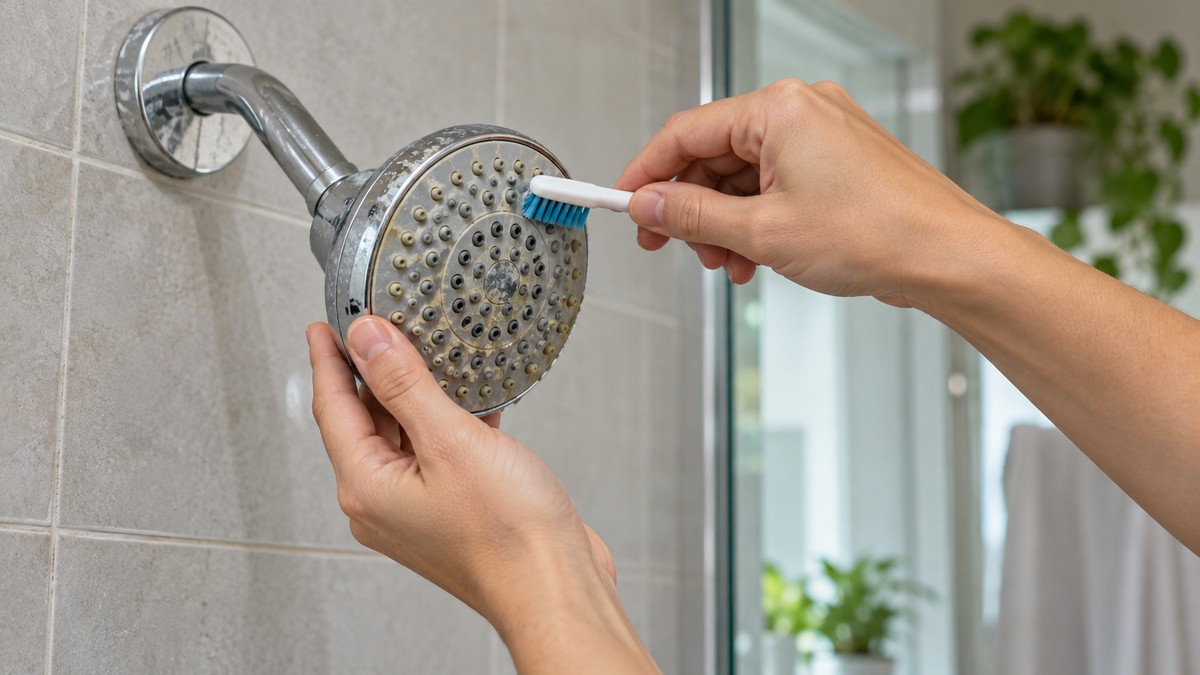
Mineral deposits are the cause the sources name for blocked holes. The New Jersey guide says naturally occurring minerals can build up and block the nozzles, the holes that water passes through. For the head, the same guide describes a filter screen inside many heads that can collect sticky debris. The screen is a separate part from the holes, so check both.
The sources also describe scale further back in the plumbing. The Virginia Tech publication says excessive mineral scaling in pipes can reduce water flow and pressure. The University of Nebraska-Lincoln guide says pipes can become clogged with scale that reduces water flow. NDSU says scale deposits also accumulate to plug plumbing fixtures. This guide does not cover clearing scale from pipes, valves or the supply line, because none of the sources describes how to do that at home.
The pattern of the blockage helps you sort the two causes. Blocked holes in one part of the face point to deposits in those holes, which the New Jersey guide describes. Weak flow from every hole at once may point further back in the supply, which is the scale the Virginia Tech and Nebraska publications describe. The sources do not say how to tell the two apart with certainty, so treat this as a working guide, not a diagnosis.
Clear the blocked holes, step by step
1. Remove the head
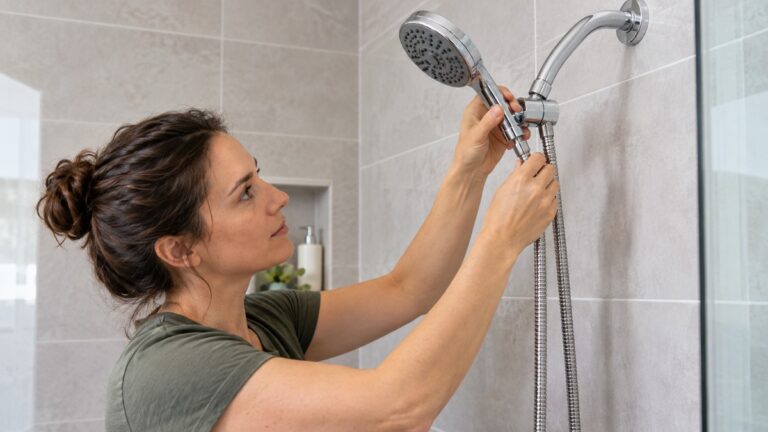
Try the head by hand first. The New Jersey guide says to grip the head or the connecting nut, depending on the design, and turn it counterclockwise. If it will not turn, wrap the shower arm with a rag or cloth, hold it with pliers, and use an adjustable wrench on the head. Then unscrew it completely by hand.
2. Take the head apart
Disassemble the head so you can reach the holes and the screen. The New Jersey guide says that if you no longer have the owner’s manual, you should “take photos to help you remember how the pieces go back together.” The guide’s reason for the photos is reassembly, so keep them until the head is back together.
3. Clear the filter screen
Remove the screen with needle nose pliers. The guide says you can clean it by rinsing it with water, or by using a toothbrush with an all-purpose cleaner or dish soap for stubborn, sticky debris. Check the screen again before you put it back.
4. Clear the blocked holes
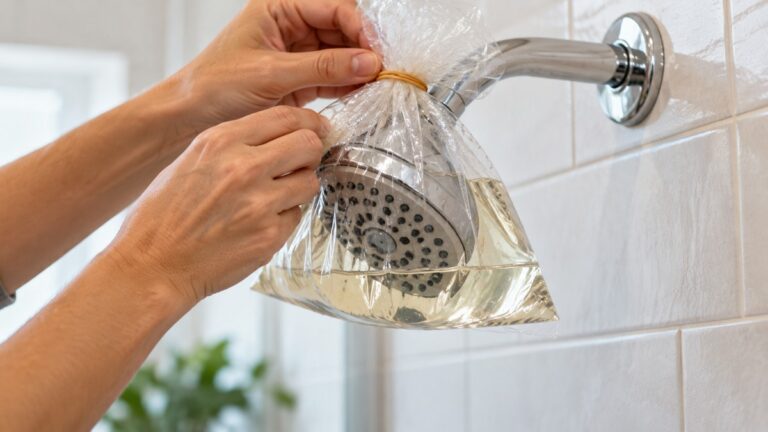
Use a needle or straightened paper clip to unblock any holes still clogged by mineral deposits. The New Jersey guide puts this step after its overnight vinegar soak, for holes that the soak has not cleared. The sources do not say whether a needle alone clears heavy blockage. The vinegar cleaning guide covers the soak in full, so this guide does not repeat it.
5. Flush the arm before you reattach
With the head off, the New Jersey guide says to flush the plumbing with water so the flow is not restricted by the head. After that, turn off the water and dry the arm completely. Clean any visible rust or mineral deposits off the arm threads with a cloth or toothbrush, then re-wrap the threads with thread seal tape two or three times clockwise, or as many times as the manufacturer recommends.
6. Reassemble and check the spray
Reinstall the filter screen when it is clean. Screw the head back onto the arm by turning it clockwise. If the arm is not sturdy, hold it with a rag and pliers while you screw the head on. Turn the water on and check for leaks, as the New Jersey guide says. DOE’s job aid asks you to verify proper water flow and that there are no leaks. If the connection leaks after reassembly, re-wrap the threads with thread sealant tape and carefully tighten again with an adjustable wrench, as the guide describes. Then check the spray as described in the next section. If you move the head to a bar mount rather than the arm, see shower bar mounts for a handheld head.
Check the spray pattern and the flow
The sources do not give a home method for judging spray pattern. What they do say concerns what users notice. EPA’s WaterSense page says that spray force and spray coverage were the criteria that most influenced user satisfaction. EPA’s specification sets a minimum spray force of 2.0 ounces for labeled heads and describes how that force is measured in its appendix. The sources do not explain how a homeowner could do the same. EPA’s page says spray coverage is assessed over the bather, to make sure coverage is adequate.
A practical check is to look at the face of the head once the water is on. Note whether every hole is putting out water and whether the spray covers the area you need. The sources do not define a pass mark, so this is a visual check and nothing more.
Flow is a separate question from spray. EPA says a WaterSense labeled head must demonstrate that it uses no more than 2.0 gallons per minute, and that standard showerheads use 2.5 gallons per minute. The specification also requires the maximum flow rate to be marked in gallons per minute and liters per minute. The specification PDF is labelled Version 1.0, dated March 4, 2010, and EPA says Version 1.1 made minor changes. A labeled head that delivers less than an old standard head is therefore not automatically clogged. Check the gpm marking before you decide.
Symptom-by-cause table
| What you see | Cause the sources name | What the sources say to do |
|---|---|---|
| Some holes blocked, spray patchy | Minerals block the nozzles (New Jersey guide) | Unblock the holes with a needle or straightened paper clip (New Jersey guide) |
| Weak flow from every hole | Scale in pipes can reduce water flow (Virginia Tech; University of Nebraska-Lincoln) | Clean the head and flush the arm (New Jersey guide). The sources do not describe clearing scale from pipes. |
| Debris stuck in the screen | Sticky debris on the filter screen (New Jersey guide) | Remove the screen and rinse or brush it clean (New Jersey guide) |
| Lower flow than an older head | A labeled head must not exceed 2.0 gpm (EPA) | Check the gpm marking (EPA specification). The sources do not say how to judge spray strength at home. |
| Spray does not cover the area well | Spray coverage affects user satisfaction (EPA) | not stated as a home check; look at the spray after reassembly |
| Leak at the connection after reassembly | Threads not sealed or connection not tight (New Jersey guide) | Re-wrap the threads with thread sealant tape and tighten carefully (New Jersey guide) |
| Holes still blocked after clearing | not stated | not stated for this step; the New Jersey guide offers a new head as an alternative |
Mistakes to avoid
- Reassembling without flushing the arm. The New Jersey guide says to flush the plumbing while the head is off.
- Taping over old tape. The guide says to remove any existing thread sealant tape first.
- Skipping the screen. The guide says the screen can hold stubborn, sticky debris.
- Treating a lower flow from a labeled head as a clog without checking its marking.
- Expecting a head cleaning to clear scale in the pipes. The sources describe scale there, but not a home method for it.
How we chose
This guide relies on seven published sources, each opened on 2026-10-21. The New Jersey guide is the main source, because it covers the steps for removing, clearing and reassembling a head. The DOE job aid adds the flow and leak check at reassembly. It is an installer document rather than a consumer page, so it is cited only for that check. The Virginia Tech and University of Nebraska-Lincoln publications explain how scale reaches the plumbing, and NDSU adds the point about fixtures. The EPA WaterSense page and the EPA specification cover spray force, coverage and flow markings. The specification is used for one number, the minimum spray force, and its version is noted in the text. We did not rank shower heads or pick a best product.
What we could not verify: what the sources do not say
- A home method for judging spray pattern or spray force. Not stated.
- Whether a needle alone clears heavily blocked holes. Not stated.
- How to clear scale in pipes, valves or the supply line. Not stated.
- Whether clogged holes damage the head. Not stated.
- Whether the holes stay clear after reassembly. Not stated.
- How often to clean the head. The New Jersey guide gives no schedule.
- The replacement criteria for a head. The New Jersey guide names a new head as an alternative but gives no criteria.
Frequently asked questions
Why are my shower head nozzles clogged?
The New Jersey guide says naturally occurring minerals can build up and block the holes. Virginia Tech and the University of Nebraska-Lincoln describe scale in pipes that reduces water flow, and NDSU says scale can plug plumbing fixtures. The sources name minerals as the cause in the head.
Do I need vinegar to clear the holes?
The New Jersey guide pairs the needle with an overnight vinegar soak for holes that stay blocked. It does not say a needle alone is enough, and it does not say a needle is harmful. Use the needle first, then the soak if holes still stay blocked.
Is weak spray from a WaterSense head a clog?
Not necessarily. EPA says a labeled head must demonstrate it uses no more than 2.0 gallons per minute, so lower flow than an older head can be expected. Clear the holes if some are blocked, and check the gpm marking. Judging spray strength at home is left open by these sources.
What tool should I use in the holes?
The New Jersey guide names a needle or a straightened paper clip. It names no other tool for the holes, so the sources do not recommend anything else.
Should I replace the head instead?
The New Jersey guide names a new head as an alternative to cleaning, and it asks that the old one be recycled. It gives no criteria for choosing. If you do replace it, the guide to water-saving shower head options lists choices, and the water-efficient handheld heads guide covers handheld units. The sources do not rank either. For a head that moves along a bar, see the sliding shower head options.
Can cleaning the head fix low flow from the pipes?
The sources do not say so. They describe scale in pipes that reduces water flow and pressure, but they do not describe a fix for it at home, so cleaning the head is not shown to fix pipe scale. Pipe scale is a plumbing question that these sources describe but do not resolve.
Bottom line
Clear the holes with a needle or straightened paper clip, flush the arm, reassemble, and check the spray across every hole. If the spray stays patchy, check the gpm marking and consider replacing the head, since the sources do not describe another fix.
Sources
New Jersey Department of Health, Guidance for Removing and Cleaning a Shower Head. https://nj.gov/health/cd/documents/topics/legion/ShowerHead_Cleaning_Guidance.pdf (opened 2026-10-21)
U.S. Department of Energy, Install a Low-Flow Showerhead, Weatherization Installer Job Aid 24-1. https://www.energy.gov/sites/default/files/2024-07/24-1_install-low-flow-showerhead.pdf (opened 2026-10-21)
Virginia Tech Extension, Virginia Household Water Quality Program: Hardness in Household Water, publication 442-664. https://www.pubs.ext.vt.edu/442/442-664/442-664.html (opened 2026-10-21)
University of Nebraska-Lincoln Extension, G1274 Drinking Water: Hard Water (revised May 2016). https://extensionpubs.unl.edu/publication/g1274/na/html/view (opened 2026-10-21)
North Dakota State University Extension, Water Softening (Ion Exchange), WQ1031 (revised May 2022). https://www.ndsu.edu/agriculture/extension/publications/water-softening-ion-exchange (opened 2026-10-21)
U.S. EPA, WaterSense: Showerheads. https://www.epa.gov/watersense/showerheads (opened 2026-10-21)
U.S. EPA, WaterSense Specification for Showerheads (PDF labelled Version 1.0, March 4, 2010). https://www.epa.gov/sites/default/files/2017-01/documents/ws-products-spec-showerheads.pdf (opened 2026-10-21)