Why Shower Water Pressure Drops Suddenly
As an Amazon Associate we earn from qualifying purchases.
Why shower water pressure drops suddenly is usually a question of where the drop happens. If one shower is weak while the other taps run normally, the cause is most likely at that outlet or its supply valve. If every tap drops at once, the causes move to the pressure reducing valve, a leak, water use nearby, or work on the utility’s line. The sources below start with that same split, and each gives checks you can run before you call anyone.
Quick answer
- Check one fixture or the whole house first. Waitsfield’s low-pressure FAQ says that when low pressure is confined to one area, “This indicates a problem at that specific fixture.”
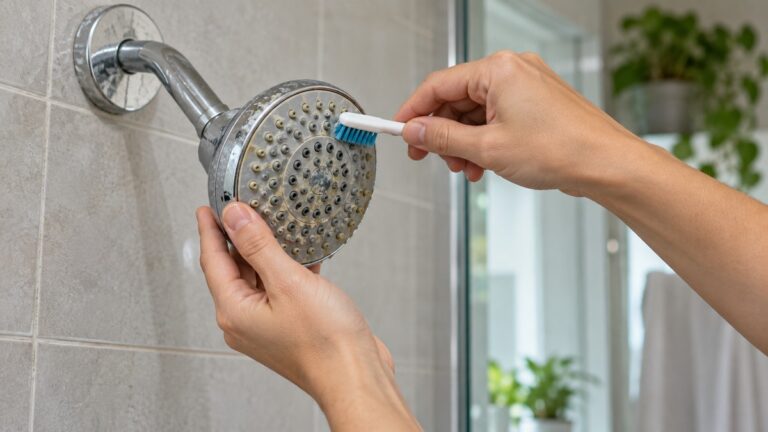
- A clogged outlet is the usual single-shower cause. Remove the screens or the head and look for blockages, and clean them before you put them back.
- A sudden drop across the whole house can point to the supply side. Lowell’s page says that if water pressure suddenly drops to almost nothing, “it could be a result of a broken water line.”
- Other people’s water use can cause a temporary drop. East Valley Water says a fluctuation in pressure is usually a sign of peak demand on the water system.
Step 1: Find out whether it is one shower or the whole house
The first question is the one utilities ask most often. Waitsfield asks, “Is the water pressure only low in one area of the home?” If the answer is yes, the same FAQ says the problem is at that specific fixture. East Valley Water asks the same question in a different form: is the condition “the same throughout the house, or isolated to just 1 area / fixture?”
A sudden drop has a different pattern from a constant weak flow. Howard County says that if water pressure is low all the time, on all taps, the pressure reducing valve likely needs adjusting. Its page also describes a pattern it calls spurting: “Spurting is when there is good pressure for a few seconds, and then the pressure lowers and flow slows down.” If the flow starts strong and then fades, the outlet and the valve are both worth a look.
Run the two taps side by side. Turn on the hot tap in the kitchen or bathroom sink, then the shower, and watch whether both fall together. A drop at both points toward the house supply. A drop only at the shower points toward that outlet.
Step 2: Check the outlet at the shower
The outlet is the cheapest check and the easiest to fix. Waitsfield’s FAQ says to “Remove any filters, faucet screens (aerators) or showerheads to” look for blockages, and it adds: “It is best practice to clean them thoroughly before re-installing.” Its advice covers filters too, which matters if a filter sits between the shower arm and the head.
Lowell’s page makes the same point for faucets: “A clogged aerator on a faucet can slow the flow.” East Longmeadow’s page starts with the one-faucet case: “Low water pressure at one faucet? A clogged aerator on a faucet can slow the flow.” Those pages are about faucets, but Waitsfield’s advice names showerheads directly.
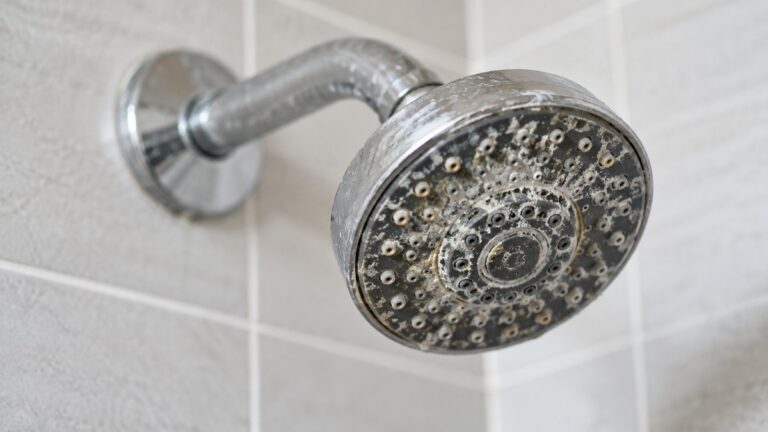
Mineral buildup is a common cause in the outlet itself. The New Jersey Department of Health guidance says naturally occurring minerals can build up and block the nozzles of a shower head. It also says some shower heads have a filter screen inside that can be removed. The guidance also describes clearing clogged holes with a needle or straightened paper clip, and it does not give a cleaning schedule.
The Virginia Tech publication on household hardness makes the pipe version of the same point. It says that in pipes, “excessive mineral scaling can reduce water flow and pressure.” That is a whole-house cause, so it fits a drop at every tap rather than one shower.
Step 3: Check the pressure reducing valve
A pressure reducing valve, often called a PRV, sits between the main line and the house plumbing. Southwest Metropolitan Water and Sanitation District describes it as a valve that lowers the pressure coming from the main lines to a level the household plumbing can handle. The same district page says a PRV is located typically where the service line enters the house, and that a failing one “can also cause a sudden loss or gradual reduction in water pressure.”
Lowell’s page says that if you have a PRV installed to protect your plumbing, “it may need adjusting.” East Valley Water is more blunt about the device itself: “These regulators do occasionally go bad.” Howard County says the valve is typically near the household shut-off valve and water meter, which gives you a place to look.
Adjusting a PRV is not a homeowner task in most of these sources. Lowell says to “Talk to a plumber before adjusting it.” Howard County puts it this way: “If you do not feel confident in doing this work,” and it points readers to a local plumber for the job. Waitsfield says a licensed plumber should evaluate the condition of the PRV and determine whether it is affecting the pressure.
Step 4: Check for a leak, utility work, or a recent shut-off
Southwest Metropolitan describes a simple meter check for a leak. The district’s page says to “shut off all water taps both inside and outside of your home, and then record the meter.” Then, after a short wait, you check whether the meter has moved: “Come back a short time later to see whether the meter has registered usage.” If it has, the district says there is a good chance of a leak that a plumber should repair.
The same page explains why a leak lowers pressure everywhere. “A leak in your home’s plumbing system will reduce the water pressure throughout the home simply because not all of the water is flowing toward its proper place.” East Longmeadow’s page is shorter but says the same: a water leak in plumbing can also affect pressure.
Utility work is a common reason for a sudden drop across a neighborhood. Southwest Metropolitan suggests you “Find out if the District is doing any work in your area or if there has been a water main break” before you assume the problem is inside the house. Waitsfield asks the same question: have you confirmed whether any work is being done in your neighborhood?
A recent shut-off or plumbing job can also leave a valve partly closed. Waitsfield asks, “Have you recently been doing internal plumbing work?” and advises that the shut-off valve after the meter must be turned back on fully, “after your meter was turned back on fully to restore proper flow.” That check takes a minute and it rules out a common cause.
Step 5: Look at demand from other water use
A pressure drop that comes and goes may be demand rather than a fault. East Valley Water says fluctuation of water pressure is usually a sign of peak demand on the water system. It names two high-demand times each day: one in the morning, when people are getting ready for work, and one in the afternoon or evening, when they come home. At those times, its page says, “people are trying to shower, water lawns, wash clothes, etc.” Then it adds: “When all of these things happen at once, there is a large demand on the system.”
That explains why a shower can feel weaker at busy times and normal at others. It also helps you test the cause. If the drop happens only at the busy times, and the rest of the day is normal, peak demand is a reasonable explanation. If the drop is at the same time every day and at the same tap, check the outlet and the valve as well.
Neighbors are the second check. Southwest Metropolitan says that if neighbors have a similar issue, the cause may be in the neighborhood, and if they do not, it may indicate a problem with your private plumbing.
Filters and softeners
East Longmeadow says that water softeners or filters may reduce water pressure if they were recently added or need service. Waitsfield asks whether you have a filtration system after the meter, and it notes that filters require maintenance. If a filter is not cleaned and maintained according to the manufacturer’s guideline, it will not perform well, and the FAQ says that can include a reduction in pressure.
This matters for anyone who added a filter recently. The sudden drop may start the week the filter went in, or the week it was last serviced. Check the filter’s own instructions before you assume the problem is the head or the house.
What the pressure numbers mean
Two figures in these sources disagree, and they should be read in context. Southwest Metropolitan says that “Average water pressure for a home in our district is about 75 psi, however this will vary depending on your location.” Oklahoma State’s fact sheet, which is about home irrigation, says that “Residential water pressure is ideally about 40 to 60 psi.” The two numbers come from different places and different purposes. Neither sets a rule for one home.
The fixture minimum is a different kind of number. A copper tube handbook from the Copper Development Association, hosted on a university page, says a minimum pressure of 8 psi should be available at each fixture. The same handbook says a difference in height of 30 feet reduces the available pressure by 13 psi. That is one reason fixtures on upper floors can have less pressure.
Southwest Metropolitan also says that “If your home is at a higher elevation relative to a water source location, you will have lower pressure.” That is a useful reminder for a shower on an upper floor. Elevation explains a steady difference, which the district describes; it does not describe a sudden change.
When to call a plumber or the utility
Call the utility when the drop reaches beyond your home, or when the checks point outside the house, such as to utility work or a main break. Ask about work and about any recent changes in the system. Lowell’s page says a sudden drop to almost nothing could be a broken water line, and that is a question for the utility.
Call a licensed plumber when the cause points to the house. East Longmeadow says low water pressure only with hot water is a reason to consult a plumber. Waitsfield says a licensed plumber should evaluate a PRV. Howard County recommends a local plumber for any PRV work if you are not confident.
A high-pressure shower head does not appear in any of these sources as a fix. None of the sources opened for this post says a shower head can raise the pressure the house receives. The checks above come first, and the sources give no reason to expect a new head to fix a supply problem.
If the outlet and valve checks come back normal and you still want a stronger spray, the guide to high-pressure shower heads that save water covers that choice. For a handheld with a stronger spray, see the guide to high-pressure handheld shower heads. A water-efficient handheld is covered in the guide to water-efficient handheld shower heads.
How we chose
This explainer uses ten sources. Seven were opened on 2026-10-22: six utility, town and handbook pages, plus a copper handbook copy. Three come from the existing source library and were opened on 2026-10-21: the Virginia Tech and New Jersey pages, and the Oklahoma State sheet, which is used only for the irrigation-based range, with that caveat stated. The criteria were government and utility pages, university extension material, and one copper handbook for the fixture minimum and the height figure. Pages that returned errors were left out, along with a drip-irrigation extension sheet that was opened but does not address shower pressure. The post does not rank products or recommend a model.
What we could not verify: what the sources do not say
- None of the pages that opened is an extension fact sheet on sudden shower pressure drops. The sources are utility, town and handbook pages.
- No source gives a time limit that separates a sudden drop from a normal fluctuation.
- No source gives a shower-specific pressure range. The 40 to 60 psi figure is an irrigation fact sheet’s general residential figure, and the 75 psi figure is a district average. They disagree and do not set a rule for any one home.
- No source says a shower head can raise the pressure the house receives.
- The sources do not say how to tell a failing pressure regulator from a partly closed main valve without a gauge.
- The sources do not describe how to report a drop to a utility, or the response time.
Frequently asked questions
Why did my shower pressure drop suddenly while the kitchen tap is fine?
Waitsfield says that low pressure in only one area points to a problem at that fixture. Its advice is to remove any filters, screens or showerheads and look for blockages. Howard County describes a spurting pattern, with good pressure for a few seconds and then slower flow, which is worth noting when you check.
Can other people using water cause a sudden drop?
East Valley Water says it can. It says pressure fluctuation is usually a sign of peak demand, with high-demand times in the morning and evening when people shower, water lawns and do laundry. If the drop fits those times and clears up after, demand is a reasonable explanation.
What if every tap drops at once?
Check the pressure reducing valve, look for a leak, and ask the utility about work or a water main break. Southwest Metropolitan says a failing valve can cause a sudden loss of pressure. Lowell says a sudden drop to almost nothing could be a broken water line.
Can a filter or water softener cause the drop?
East Longmeadow says water softeners or filters may reduce pressure if they were recently added or need service. Waitsfield says filters need maintenance under the manufacturer’s guidance, and that poor maintenance can reduce pressure.
Should I adjust the pressure reducing valve myself?
Lowell says to talk to a plumber before adjusting it. Howard County recommends a local plumber if you do not feel confident in the work.
Will a high-pressure shower head fix a sudden drop?
None of the sources opened for this post says a shower head adds supply pressure. Check the outlet, the valve, and the leak and utility questions first.
Bottom line
If one shower is weak, clean that outlet first. If every tap drops together, check the pressure reducing valve, look for a leak, and ask the utility about work before you change any hardware.
Sources
- Southwest Metropolitan Water and Sanitation District, “Are You Experiencing Low Water Pressure? Or too High?” (August 2024), https://www.swmetrowsdco.gov/2024-08-20-are-you-experiencing-low-water-pressure-or-too-high (opened 2026-10-22)
- Lowell, NC, “Why is my water pressure low?” https://lowellnc.gov/question/low-water-pressure/ (opened 2026-10-22)
- East Longmeadow, MA, “Water Pressure in My Home,” https://www.eastlongmeadowma.gov/DocumentCenter/View/14418/Water-Pressure-In-My-Home- (opened 2026-10-22)
- Waitsfield, VT, “Low Water Pressure FAQ,” https://www.waitsfieldvt.gov/fileadmin/files/Boards/Water_Commission/General/2025/04/Low_Water_Pressure_FAQ.pdf (opened 2026-10-22)
- Howard County, MD, “Household Water Pressure Problems,” https://www.howardcountymd.gov/public-works/household-water-pressure-problems (opened 2026-10-22)
- East Valley Water District, “Water Pressure Help,” https://www.eastvalleywater.gov/customers/service/water-pressure-help/ (opened 2026-10-22)
- Copper Development Association, “The Copper Tube Handbook,” copy hosted on a university site, https://pages.mtu.edu/~fmorriso/cm3215/copper_tube_handbook.pdf (opened 2026-10-22)
- Virginia Tech Extension, Publication 442-664, “Hardness in Household Water,” https://www.pubs.ext.vt.edu/442/442-664/442-664.html (opened 2026-10-21)
- New Jersey Department of Health, “Guidance for Removing and Cleaning a Shower Head,” https://nj.gov/health/cd/documents/topics/legion/ShowerHead_Cleaning_Guidance.pdf (opened 2026-10-21)
- Oklahoma State University Extension, “Managing Pressure in the Home Irrigation System,” https://extension.okstate.edu/fact-sheets/managing-pressure-in-the-home-irrigation-system (opened 2026-10-21)