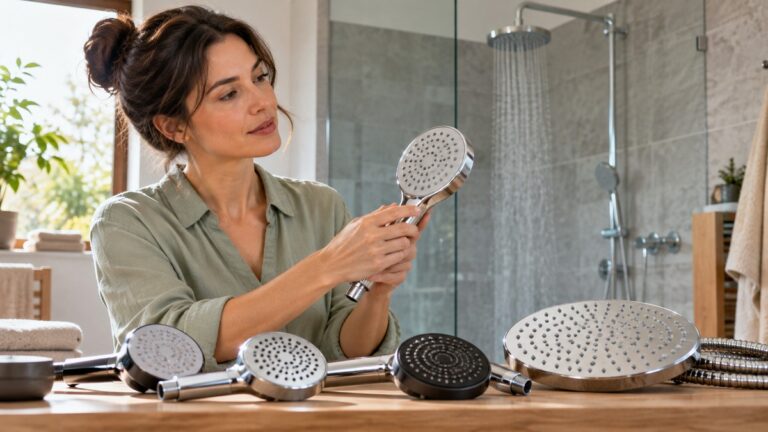
Kohler Prosecco Multifunction Handheld Shower R28719 Review
As an Amazon Associate we earn from qualifying purchases.
The Kohler Prosecco multifunction handheld shower R28719 is a handheld head with three sprays and a magnetic docking holder. This page explains what the manufacturer’s listing says about the R28719, what federal and university sources say about the rules and practices that apply to handheld heads like it, and where those sources stop. The listing gives a flow rate of 1.75 gallons per minute, a 72-inch hose and a G 1/2 inch by 14 connection. Check those numbers against the product you receive before you buy.
Quick answer
- Model: Kohler Prosecco multifunction handheld shower, model R28719. The listing description gives the model as K-R28719-G.
- Listed flow: 1.75 gallons per minute maximum at 80 psi, which is below the 2.0 gpm ceiling in the EPA WaterSense showerhead specification.
- Sprays: full coverage, powerful massage and intense rinse, chosen with three buttons on the handshower face.
- Hose and connection: a 72-inch hose and a G 1/2 inch by 14 connection, with no-tool installation by hand-tightening.
- Finish on the listing read: brushed nickel.
- Biggest gaps: the sources do not give a shower-specific pressure range, a thread standard for your shower arm, or cleaning limits for brushed nickel finishes.
How we chose
This page covers one product: the Kohler Prosecco multifunction handheld shower, model R28719. The Amazon listing was read on October 22, 2026. Its title names the Prosecco, and its description gives the model as K-R28719-G. If the listing had shown a different model, or a bundle without the handheld, this page would not have been written. Other Kohler models are outside its scope.
The outside sources are federal, state and university pages held in the site’s research library. Each quotation used in this draft was checked against a saved copy of its page. Where a claim comes from the listing, this page calls it the manufacturer’s claim and does not confirm it. Where a source gives no number, the page says the number is missing rather than filling it in from memory.
The page does not rank the R28719 against other handheld heads. It describes what the listing states, what the sources explain, and what a buyer should check on the unit itself.
The Kohler Prosecco R28719 at a glance
The listing names the product as a Kohler magnetic docking Prosecco multifunction handheld shower head in brushed nickel. Its description gives the model as K-R28719-G and describes a three-function handshower with a maximum flow rate of 1.75 gallons per minute at 80 psi, which is 5.5 bar. The metric figure in the listing is 6.6 liters per minute.
The handshower uses a magnetic docking system the listing calls DockNetik. According to the listing, the docking system holds the sprayhead in place when the unit is not in use. The box, according to the listing, includes the handshower, the magnetic docking system, a 72-inch hose and sealant tape. The hose is listed at 1,829 millimeters, which is the same length in metric units.
Three sprays are offered. The listing names them full coverage, powerful massage and intense rinse. Full coverage is described as an encompassing spray for everyday use. The powerful massage setting is described as a focused stream, and the listing also says it can serve as a utility spray for rinsing kids, pets and the shower itself. The intense rinse is described as a forceful spray for rinsing soap thoroughly. Three buttons on the handshower face switch between the sprays. These are the manufacturer’s descriptions of each setting. The sources on this page do not rate spray quality, so no ranking of the sprays is given here. The full listing is at View on Amazon.
The listing also makes several claims about materials and care. It says the sprayface has a surface that is easy to clean and withstands mineral buildup. It says KOHLER finishes resist corrosion and tarnishing. It says select KOHLER finishes carry ScratchShield technology, but the listing text read does not say which finishes those are. These are the manufacturer’s claims, and the sources on this page do not confirm them.
When the listing was read, it showed the item as currently unavailable. The sources here do not cover stock, so check the seller page before you plan around this unit.
What the 1.75 gpm figure means
The EPA WaterSense specification for showerheads says a qualifying product must be equal to or less than 2.0 gallons per minute. The EPA consumer page says standard showerheads use 2.5 gallons per minute, and that a WaterSense product must demonstrate it uses no more than 2.0 gpm. The R28719’s listed 1.75 gpm sits below that 2.0 gpm ceiling. The listing text read does not say the R28719 carries the WaterSense label, and this page does not claim that it does. According to the EPA consumer page, a WaterSense product must also be independently certified to meet the EPA’s water efficiency and performance criteria.
A note on versions: the EPA specification PDF saved in the research library is labeled Version 1.0. EPA’s showerhead page says Version 1.1 made minor changes. The 2.0 gpm figure on this page comes from the Version 1.0 text, and this page does not compare the R28719 against any later version.
The same specification says a showerhead must be marked with its maximum flow rate in gallons per minute and in liters per minute. The listing gives both, 1.75 gpm and 6.6 L/min. The marking on the product itself is the one to check. The EPA technical sheet for WaterSense homes also tells installers to verify the gpm marking on the showerhead, so the listing figure should be matched against the head once it arrives.
The federal rules cover handheld heads too. The Department of Energy says the Energy Policy Act of 1992 amended the Energy Policy and Conservation Act to add water conservation standards for showerheads. It also says the federal definition of a showerhead includes a handheld showerhead, and that the water use standards for showerheads have not been amended. The DOE installer job aid lists the showerhead rate as 2.5 gallons per minute. So the federal definition covers a handheld model like the R28719.
The flow figure in the listing is given at 80 psi. The EPA specification says WaterSense performance is checked at flowing pressures of 20, 45 and 80. The listing does not explain how its figure was reached beyond that single pressure point, and this page does not infer it.
Pressure: what the sources say and what they do not
The sources in the research library do not give a shower-specific pressure range. The only general range comes from an Oklahoma State University Extension fact sheet about irrigation. That sheet says residential water pressure is ideally about 40 to 60 psi. It is a general residential figure from an irrigation fact sheet, not a shower standard, and it should be read that way.
The same sheet says high water pressure causes a different set of problems. It says that if pressure to the house is more than 80 psi, a protective option should be considered to protect the plumbing and appliances inside the home, and it advises contacting a licensed plumber for that project. The R28719 listing rates the head at 80 psi, which happens to be the same figure the sheet uses as a threshold. The sources do not link the two, and this page does not link them either.
The sources also do not say whether a shower head can raise the pressure coming into a house. None of the opened sources describes a shower head adding supply pressure, so this page makes no claim in either direction.
Installing the R28719
The listing says the R28719 installs with no tools and needs only hand-tightening at the G 1/2 inch by 14 connection. The Department of Energy installer job aid describes a fuller process for a showerhead in general. It says to remove the old showerhead carefully, using channel locks or a similar tool to loosen it if needed. It says to clean the threads of the shower arm well, to wrap new thread tape, and to use thread tape at all connections. It also says to make sure the connections will not leak, and that there is no water leakage upon completion. The job aid is written for showerheads in general, and the R28719 is not named in it.
The listing includes sealant tape in the box. The DOE job aid says to use thread tape at all connections. The New Jersey Department of Health guidance says to wrap thread seal tape in a clockwise direction two or three times around the threads of the shower arm. If a connection leaks, the same guidance says to re-wrap the threads with thread sealant tape and carefully tighten again with an adjustable wrench. The listing says hand-tightening is enough, and the sources advise thread tape on every connection. This page does not settle which one a given shower needs. The sensible reading of the sources is to tape the arm threads, tighten by hand, and check for leaks as the job aid describes.
Thread size is one of the main gaps. The listing gives G 1/2 inch by 14 as the connection. None of the opened sources states the standard thread size for a shower arm, and none says which thread standard the R28719 uses on the arm side. Check the existing arm, and any instructions that come with the unit, before ordering. Do not assume a thread size from a different standard.
On the hose, the listing gives 72 inches. The official ADA text on handheld shower hose length was not reached, so this page does not state a hose length from it and does not compare the 72-inch hose against any accessibility rule. Check the distance you need in the actual shower before relying on that length. For related reading on hose length and extension options, see handheld shower head extension hoses.
Cleaning the spray face
The New Jersey Department of Health guidance explains why nozzle cleaning matters. Naturally occurring minerals can build up and block the nozzles, which are the holes through which water passes. The guidance says to use a needle or a straightened paper clip to unblock any holes that are still clogged by mineral deposits. For removing and cleaning a shower head in general, it describes fully submerging the head in a bowl of distilled white vinegar and letting it soak overnight. It also says cleaning reduces the amount of harmful waterborne bacteria, including Legionella, on the shower head. The guidance does not give a cleaning schedule, and this page does not give one.
The listing says the MasterClean sprayface withstands mineral buildup. That is the manufacturer’s statement. None of the sources on this page checks a Kohler finish against vinegar or any other cleaner. The sources do not give soak limits for brushed nickel, brass, matte black or other finishes, and the manufacturer care pages that were tried for this review were refused or not reached. Before any soak, read the cleaning instructions that come with the unit. If none are given, do not assume the vinegar method is safe for the finish without confirming it with the manufacturer.
Mineral buildup is the problem the sources describe most often. The University of Nebraska-Lincoln extension says heated hard water forms a scale of calcium and magnesium minerals. The North Dakota State University extension says a whitish buildup on the ends of faucets and shower heads is probably the most obvious result of hard water. The NDSU publication WQ1031 converts one grain per gallon to 17 parts per million, with hardness stated as calcium carbonate. That is the only hardness scale this page uses. The USGS hardness page was not reached, so this page does not give a second scale.
Who the R28719 may suit
The listing points to buyers who want a handheld head with three sprays, a magnetic holder and a long hose. The features fit that description on paper. This page does not rank the head against others, and it does not say the spray settings perform better than a single-spray handheld, because the sources do not compare them.
Buyers who want a fixed head with a different spray pattern may find a related comparison useful. For a broader look at low-flow options, see water-efficient handheld shower heads. For a high-pressure option, see high-pressure shower heads that save water. Buyers who want a handheld on a slide bar can read the best handheld shower heads on a slide bar.
A buyer who needs a specific arm thread, a hose length for an accessibility need, or a verified pressure range should not rely on this page for those answers. The sources in the research library cover flow standards, cleaning steps and one general pressure figure. They do not cover every check a buyer needs.
Buyer checks before you order
- Match the model number on the box and the listing to R28719 and K-R28719-G.
- Look for the gpm and L/min marking on the head itself, as the EPA specification requires.
- Check the shower arm thread and the connection before buying. Do not assume it matches the listing.
- Confirm the hose distance you need in the actual shower.
- Read any finish care instructions that come with the unit before soaking it.
What we could not verify: what the sources do not say
- Shower arm thread size: no opened source states the thread standard for a shower arm. Check the arm and any instructions that come with the unit.
- Finish-specific cleaning: the sources do not give soak limits for brushed nickel, brass, matte black or other finishes. The manufacturer care pages that were tried were refused or not reached.
- WaterSense status: the listing text read does not say the R28719 carries the WaterSense label, and this page does not claim it does.
- WaterSense version: the EPA specification in the library is labeled Version 1.0, and EPA says Version 1.1 made minor changes. This page uses the Version 1.0 text.
- Shower-specific pressure range: the only general range in the sources is a 40 to 60 psi figure from an irrigation fact sheet.
- Shower head effect on house pressure: no opened source says whether a shower head can raise house water pressure.
- Shower head height above the floor: no opened source gives a standard height.
- Cleaning schedule: the New Jersey guidance says cleaning reduces harmful bacteria but gives no schedule, so this page gives none.
- ADA handheld hose length: the official ADA text was not reached, so no hose length is stated from it.
- Spray force and coverage for this model: the listing does not state them. The EPA specification sets a minimum spray force of 2.0 ounces for qualifying products, but no figure is given here for this unit.
- Stock: the listing showed the item as currently unavailable when it was read, and the sources do not cover availability.
Frequently asked questions
Does the Kohler Prosecco R28719 have a filter?
The listing text read does not describe a filter. The sources on this page do not discuss this model’s filter status, so check the box and the unit before assuming either way.
What is the flow rate?
The listing gives a maximum of 1.75 gallons per minute, which is 6.6 liters per minute, at 80 psi. That is below the 2.0 gpm ceiling in the EPA WaterSense specification in the library. The listing does not say the unit is WaterSense labeled.
Does the R28719 fit a standard shower arm?
The listing gives a G 1/2 inch by 14 connection. The sources do not state a standard arm thread size, so check the arm before ordering.
How long is the hose?
The listing gives a 72-inch hose. Check whether the distance in your shower suits that length. This page does not compare the hose against ADA guidance, because the ADA text was not reached.
Does the magnetic docking system hold the head in place?
The listing says the DockNetik magnetic docking system holds the sprayhead in place when not in use. The listing does not give a holding force, and the sources here do not describe one.
Can I clean the spray face with vinegar?
The New Jersey guidance describes a vinegar soak for shower heads in general, with the head fully submerged and left overnight. The sources do not give soak limits for brushed nickel or other finishes, so check the unit’s own care instructions first.
Bottom line
The Kohler Prosecco multifunction handheld shower R28719 is a handheld head with three sprays, a magnetic docking holder, a 72-inch hose and a listed flow rate of 1.75 gallons per minute. That flow figure sits below the 2.0 gpm ceiling in the EPA WaterSense specification, but the listing does not claim the label. The listing’s cleaning and finish claims are manufacturer statements that the sources here do not confirm. Before you buy, check the model number, the gpm marking, the shower arm thread, the hose distance and the finish care instructions. You can read the full listing on View on Amazon.
Sources
- Amazon listing, Kohler Magnetic Docking Prosecco Multifunction Handheld Shower Head (Brushed Nickel), read 2026-10-22: https://www.amazon.com/dp/B0CTJ47G6S
- U.S. EPA, WaterSense Specification for Showerheads (PDF; text labelled Version 1.0): https://www.epa.gov/sites/default/files/2017-01/documents/ws-products-spec-showerheads.pdf (opened 2026-10-21)
- U.S. EPA, WaterSense: Showerheads: https://www.epa.gov/watersense/showerheads (opened 2026-10-21)
- U.S. EPA, WaterSense Homes TRM 4: Showerheads Tech Sheet (July 2023): https://www.epa.gov/system/files/documents/2023-08/ws-homes-TRM-4-ShowerheadsTechSheet.pdf (opened 2026-10-21)
- U.S. Department of Energy, Showerheads: https://www.energy.gov/eere/buildings/showerheads (opened 2026-10-21)
- U.S. Department of Energy, Install a Low-Flow Showerhead, Weatherization Installer Job Aid 24-1 (July 2024): https://www.energy.gov/sites/default/files/2024-07/24-1_install-low-flow-showerhead.pdf (opened 2026-10-21)
- New Jersey Department of Health, Guidance for Removing and Cleaning a Shower Head: https://nj.gov/health/cd/documents/topics/legion/ShowerHead_Cleaning_Guidance.pdf (opened 2026-10-21)
- University of Nebraska-Lincoln Extension G1274, Drinking Water: Hard Water (revised 2016): https://extensionpubs.unl.edu/publication/g1274/na/html/view (opened 2026-10-21)
- North Dakota State University Extension WQ1031, It’s All in Your Water (revised May 2022): https://www.ndsu.edu/agriculture/sites/default/files/2022-05/wq1031.pdf (opened 2026-10-21)
- North Dakota State University Extension, Water Softening (Ion Exchange): https://www.ndsu.edu/agriculture/extension/publications/water-softening-ion-exchange (opened 2026-10-21)
- Oklahoma State University Extension, Managing Pressure in the Home Irrigation System (irrigation focus): https://extension.okstate.edu/fact-sheets/managing-pressure-in-the-home-irrigation-system (opened 2026-10-21)