How to Choose a Shower Head: Flow, Spray, Fit and Pressure
As an Amazon Associate we earn from qualifying purchases.
How to choose a shower head comes down to four checks: flow rate, the spray settings you will use, the finish, and whether the fit and thread match your arm. Start with flow. Standard showerheads are described by EPA as using 2.5 gallons per minute, and a WaterSense label requires 2.0 gpm or less. Pressure is a separate question. It comes from your water supply and pipes, and a new head does not add to it. This guide covers each choice factor, what the sources say, and what they leave open.
Quick answer
- Flow: the federal ceiling for new showerheads is 2.5 gpm, measured at 80 psi. A WaterSense label means 2.0 gpm or less.
- Spray: choose by how you shower. WaterSense tests spray force, spray coverage and pressure compensation, but no source names a best setting for you.
- Finish: the cleaning you are willing to do should decide the finish. Manufacturer care sheets warn against abrasives on several finishes.
- Fit: confirm the arm connection, follow the manual on tape or putty, and do not overtighten.
- Pressure: a head can change the spray and the flow it delivers. It cannot raise the pressure your supply provides.
Start with flow rate: the WaterSense and federal limits
Flow is the one choice factor with a legal number attached. The federal energy rule at 10 CFR 430.32(p), as published by the Cornell Legal Information Institute, sets the maximum for showerheads made after January 1, 1994. The limit is stated as 2.5 gallons per minute, measured at a flowing pressure of 80 psi. That is the ceiling for a new head sold in the United States, not a target.
EPA’s WaterSense program sets a tighter bar for labeled products. Its showerhead page says that water-saving showerheads that earn the label “must demonstrate that they use no more than 2.0 gpm.” The same page describes standard showerheads as using 2.5 gpm, which is the figure most people compare against.
| Benchmark | Figure | Where it comes from |
|---|---|---|
| Federal maximum for new showerheads | 2.5 gpm at 80 psi | 10 CFR 430.32(p), Cornell LII copy |
| WaterSense label | 2.0 gpm or less | EPA WaterSense showerheads page |
| Standard showerhead, as EPA describes it | 2.5 gpm | EPA WaterSense showerheads page |
Read a gpm figure as a test result under stated conditions, not a prediction of how strong the shower will feel at your house. Check the spec sheet for a WaterSense label or a stated gpm. The label is the simplest signal for lower use, because EPA says WaterSense products must be independently certified.
Spray settings: what to check before you buy
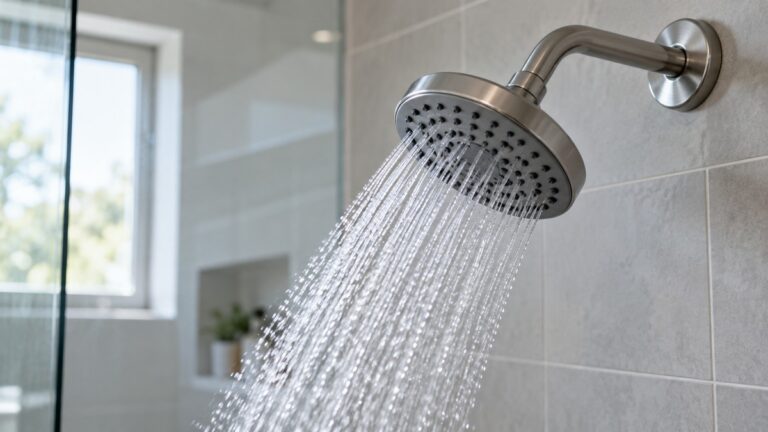
Spray settings decide how the water lands on you, and they are where a labeled low-flow head and a standard head can differ most in feel. WaterSense does not set a single preferred pattern. It tests three attributes. Spray force is the strength of the stream, and the standard is meant to ensure the spray is sufficient for user satisfaction. Spray coverage is how evenly the water is distributed over the bather. Pressure compensation is the head’s ability to deliver a minimum flow across a range of household pressures.
EPA’s own summary says that “spray force and spray coverage were the criteria that most influenced user satisfaction.” That is useful because it tells you what to look for in a spec sheet: a description of the spray pattern and its coverage, not only the flow figure.
When you compare settings, check these points against the manufacturer’s listing:
- Number of modes. Count the spray modes the maker states. Some heads offer a single full stream; others offer a rain pattern, a pulse or a mix. Only buy the number of modes you will use.
- How the mode changes. Check whether you switch by a lever, a button or a twist ring. A stiff or hard-to-reach control matters more on a fixed head than a handheld.
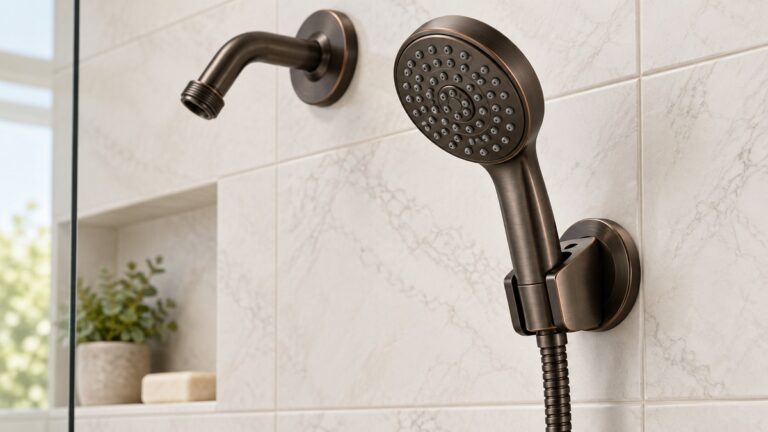
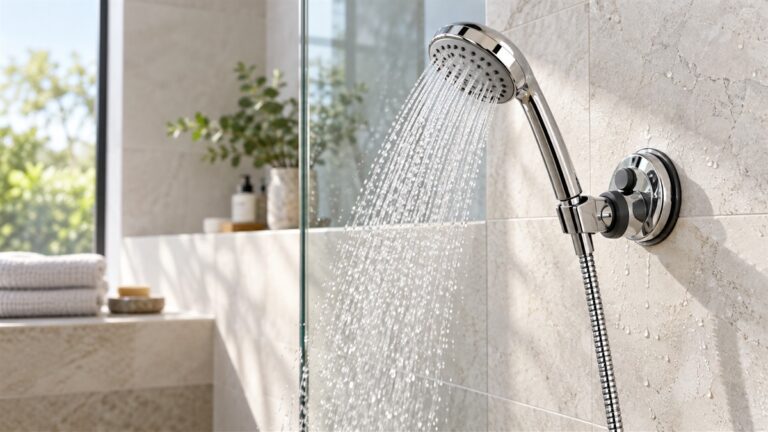
- Fixed, handheld or both. A fixed head sends water from one point over your head. A handheld moves with you, which helps for rinsing hair, cleaning the tub or bathing a child. If you want both, a combination head or a dual-head set is the category to look at. For handheld options with a slide bar, see our guide to handheld heads that run on a slide bar.
No source we opened recommends a particular setting for a particular body or hair type, and this guide does not make that call. Health or comfort claims about a spray mode should be treated as the manufacturer’s claim unless a source you can check supports them.
Finish: what the care sheets say
Finish affects cleaning more than performance, and it is the choice factor that most often surprises owners. Manufacturer care sheets give cleaning rules that differ by finish.
Moen’s care sheet for its Spot Resist stainless and brushed nickel finishes says to clean with mild soap and warm water, and adds: “Never use cleaners containing abrasives” (the same sheet also lists abrasives, ammonia, bleach and lime scale removers as cleaners to avoid). Delta’s care sheet says its finish “can be damaged by harsh abrasives or polish,” and recommends wiping gently with a damp cloth and blotting dry with a soft towel. Kohler’s care guide, in its faucet guidance, says “Never use cleaners containing ammonia, bleach or acid,” and recommends a soft cloth after each use.
The sources disagree in tone on scale, and the reader should see both. EPA’s commercial WaterSense guide says that “Certain cleaning products or white vinegar can dissolve scale” from showerheads. Moen’s Spot Resist sheet names lime scale removers among cleaners to avoid. A finish-specific sheet should decide the method for your head. If the sheet is silent, a soft cloth and mild soap is the safe default the sources support.
Finish choice is therefore a maintenance decision. A finish you will not wipe after use, or that you can only clean with harsh products, is a poor fit for a hard-water home. The sources we opened do not rate how long any finish lasts, so compare finishes on the care instructions in the manual.
Fit and thread: what has to match
Fit starts at the wall, not at the head. A fixed head or handheld screws onto a shower arm, and the arm screws into a pipe nipple in the wall. The head has to match the arm’s connection, and the arm has to match the nipple.
The manufacturer guides we opened describe the connection as a 1/2-inch NPT thread. Kohler’s installation sheet for its shower arm calls for a male 1/2-inch NPT pipe to be installed to extend beyond the finished wall, with sealant tape on the exposed threads. A second arm guide, from Waterworks, also calls for a 1/2-inch NPT nipple roughed in at the right depth. These are arm guides, not a universal rule. The sources we opened do not establish that every head or arm uses this thread.
Check the connection before you buy
Read the listing’s stated connection and the thread on the arm you already have. If the listing gives no connection type, look at the old head and arm at the wall. If the arm is an older or non-standard fitting, a head with an adapter may be the simpler route. If you are unsure whether the thread matches, a plumber can confirm it in a few minutes.
Tape, putty and gaskets follow the manual
Do not apply tape by habit. Moen’s installation sheet for one of its combination heads says, “Thread seal tape is not recommended for this project,” and adds “Do not overtighten.” The Kohler sheet uses sealant tape on the pipe nipple and plumbers putty behind the arm. Those are different joints. Follow the sheet that comes with your head, and use the joint method it names.
Head swap steps
- Turn off the water supply to the shower, or the whole house if you cannot isolate it.
- Unscrew the old head. Use a wrench only if it is stuck, and wrap the arm if the finish is delicate.
- Clean the arm threads and remove old tape or putty as the manual directs.
- Apply tape or gasket as the new head’s sheet says, then hand tighten the head. Moen’s sheet for its combination head says to hand tighten the fixed head to the front of the diverter.
- Turn the water on, run the shower, and check the connection for drips. Tighten a small amount only if it drips and the manual allows it.
Stop at a head, arm, hose or cartridge swap. If the arm is leaking inside the wall, the nipple is loose, or the connection needs new plumbing, call a licensed plumber.
How to pick a shower head with good pressure
The second question readers bring to this topic is pressure. The short answer is that a shower head can change how water is shaped and how much it delivers within the limits above, but it cannot increase the pressure your home supplies. Pressure is set by the supply, any pressure-reducing valve and the pipes.
What a new head can change
A new head can change the spray pattern, the coverage and the flow, up to the federal ceiling. A head marketed as “high pressure” is making a claim about the spray, not the supply. Ask the listing what it measures. EPA’s performance criteria are built around spray force and coverage for that reason. If the listing gives no spray force or coverage description, the spray feel is not something you can compare from the spec sheet alone.
A scaled head can also lose flow at the head itself. EPA’s commercial WaterSense guide says scale buildup restricts flow and recommends periodic inspection, so cleaning may restore flow without buying anything.
What a new head cannot change
The supply pressure sets the ceiling. EPA’s WaterSense service pressure guide says that “WaterSense recommends incoming service pressure to be between 45 and 60 psi,” and that most U.S. plumbing codes require pressure-regulating valves “where the pressure of the supplied water exceeds 80 psi.” The same guide states that “High water pressure can damage plumbing piping, fixtures, and appliances.” It also notes that supply mains can reach about 100 psi, which is why a regulator is common. A head that claims to make your shower stronger than your supply allows is describing a change in spray, not a change in pressure.
That matters because the fix for weak pressure is often outside the head. EPA’s guide recommends attaching a pressure gauge to a hose bibb or a cold-water faucet to read the service pressure. If the reading is low, the cause may be the supply, a pressure-reducing valve set too low, or a restriction in the pipes. Adjusting or replacing a regulator is plumbing work beyond a head swap, so call a licensed plumber for it.
A simple sequence
- Read the service pressure with a gauge at a hose bibb or cold faucet.
- If the pressure is in the 45 to 60 psi range that EPA recommends, the supply is not the first suspect.
- Inspect the current head for scale and clean it if the sheet allows.
- Only then choose a new head for its spray and flow, within the label and federal limits.
How we chose
This guide does not rank products, and no product is named or linked. It sets out the choice factors that the sources we opened describe. We opened the sources listed below with curl on 2026-10-23 and checked every quoted sentence against the downloaded text. Pages that returned error codes were excluded: energy.gov returned 404, and the eCFR page returned an automated-access check, so the federal rule is cited from the Cornell Legal Information Institute copy of 10 CFR 430.32.
The criteria: a federal agency, a federal regulation, or a manufacturer’s own installation or care document. Each figure in the body traces to one of them, and where two sources disagree, both are shown.
What we could not verify
What the sources do not say
- No source we opened ranks shower heads or says which spray setting feels best.
- No source gives a formula that turns a listed gpm into the shower feel at a given pressure.
- The 1/2-inch NPT connection appears in the arm guides we opened. No source we opened sets it as a universal standard for every head.
- No source we opened rates how long a finish lasts or how well it resists hard water.
- No source we opened says a head can raise pressure above what the supply provides. The sources say the opposite.
- This guide does not cover filters, water quality or health effects, because the sources we opened on those topics were not part of this group.
FAQ
Is a 2.0 gpm head enough for a good shower?
The sources define WaterSense as no more than 2.0 gpm and say labeled heads must provide a satisfactory shower. They do not say whether that flow is enough for you. Decide from the spray pattern you like and the spec sheet’s description of coverage.
Will a high-pressure shower head increase the water pressure in my house?
No. The supply and pipes set the pressure. A head changes the spray and the flow within the federal ceiling of 2.5 gpm at 80 psi. EPA recommends 45 to 60 psi at the service, and it warns that high water pressure can damage plumbing and fixtures.
Do I need Teflon tape on a new shower head?
It depends on the joint. Follow the manual. Moen’s sheet for one combination head says thread seal tape is not recommended for that project. The Kohler arm guide calls for sealant tape on the pipe nipple. Use the method the sheet for your head names.
Can I clean my shower head with vinegar?
EPA says that certain cleaning products or white vinegar can dissolve scale from showerheads. Before you soak, check the finish care sheet. Moen warns against lime scale removers on its Spot Resist finish, and Delta warns against harsh abrasives. If the sheet is unclear, use a soft cloth and mild soap and avoid soaking.
When should I call a plumber instead of changing the head myself?
Swapping a head, arm or hose is a reasonable job once the water is off. Call a licensed plumber for a leaking connection inside the wall, a loose nipple, or a pressure-reducing valve.
Bottom line
Choose flow by the label and the federal ceiling, choose spray and finish by how you will use and clean the head, and confirm the connection against the arm and the manual. Treat pressure as a property of your supply. If the shower is weak, read the service pressure first, and only then decide whether the head is the problem.
Related guides: heads for low-pressure homes covers the pressure side in more detail, and water-efficient handheld heads covers the low-flow handheld category.
Sources
- EPA WaterSense, showerheads: https://www.epa.gov/watersense/showerheads (opened 2026-10-23). WaterSense label at 2.0 gpm or less; standard showerheads described at 2.5 gpm; spray force, spray coverage and pressure compensation criteria.
- 10 CFR 430.32(p), Cornell Legal Information Institute copy: https://www.law.cornell.edu/cfr/text/10/430.32 (opened 2026-10-23). Federal maximum of 2.5 gpm at 80 psi for showerheads made after January 1, 1994.
- EPA WaterSense service water pressure technical sheet: https://www.epa.gov/system/files/documents/2023-08/ws-homes-TRM-12-ServiceWaterPressureTechSheet.pdf (opened 2026-10-23). 45 to 60 psi recommendation; PRVs above 80 psi; high pressure can damage plumbing; gauge at a hose bibb or cold faucet.
- EPA WaterSense commercial guide, Section 3.4, showerheads and diverters: https://www.epa.gov/system/files/documents/2023-06/ws-commercial-watersense-at-work_Section_3.4_Showerheads_and_Diverters.pdf (opened 2026-10-23). Scale restricts flow; periodic inspection; white vinegar or cleaning products dissolve scale; do not bore holes in the head.
- Moen instruction sheet ins10820: https://assets.moen.com/shared/docs/instruction-sheets/ins10820.pdf (opened 2026-10-23). Thread seal tape not recommended for that project; hand tighten; do not overtighten.
- Moen instruction sheet ins10875: https://assets.moen.com/shared/docs/instruction-sheets/ins10875.pdf (opened 2026-10-23). Spot Resist cleaning: no abrasives, ammonia, bleach or lime scale removers.
- Delta care and cleaning sheet: https://images.thdstatic.com/catalog/pdfImages/db/dbfb1089-e405-4309-98b0-70f18dead2d2.pdf (opened 2026-10-23). Finish can be damaged by harsh abrasives or polish; damp cloth and soft towel.
- Kohler care and cleaning guide: https://images.thdstatic.com/catalog/pdfImages/6f/6f5798e0-86c1-42ef-8a4d-f6c86e5cbec7.pdf (opened 2026-10-23). Faucet guidance: no ammonia, bleach or acid cleaners; soft cloth after use.
- Kohler installation sheet 1226929-2 (shower arm): https://techcomm.kohler.com/techcomm/pdf/1226929-2.pdf (opened 2026-10-23). Male 1/2 NPT pipe nipple; sealant tape on exposed threads; putty behind the arm.
- Waterworks shower arm guide: https://assets.waterworks.com/wasset/15/original/90815.pdf (opened 2026-10-23). Well-supported 1/2-inch NPT nipple roughed in at the right depth.