Best Catty Corner Shelves for Shower Corners
As an Amazon Associate we earn from qualifying purchases. Details
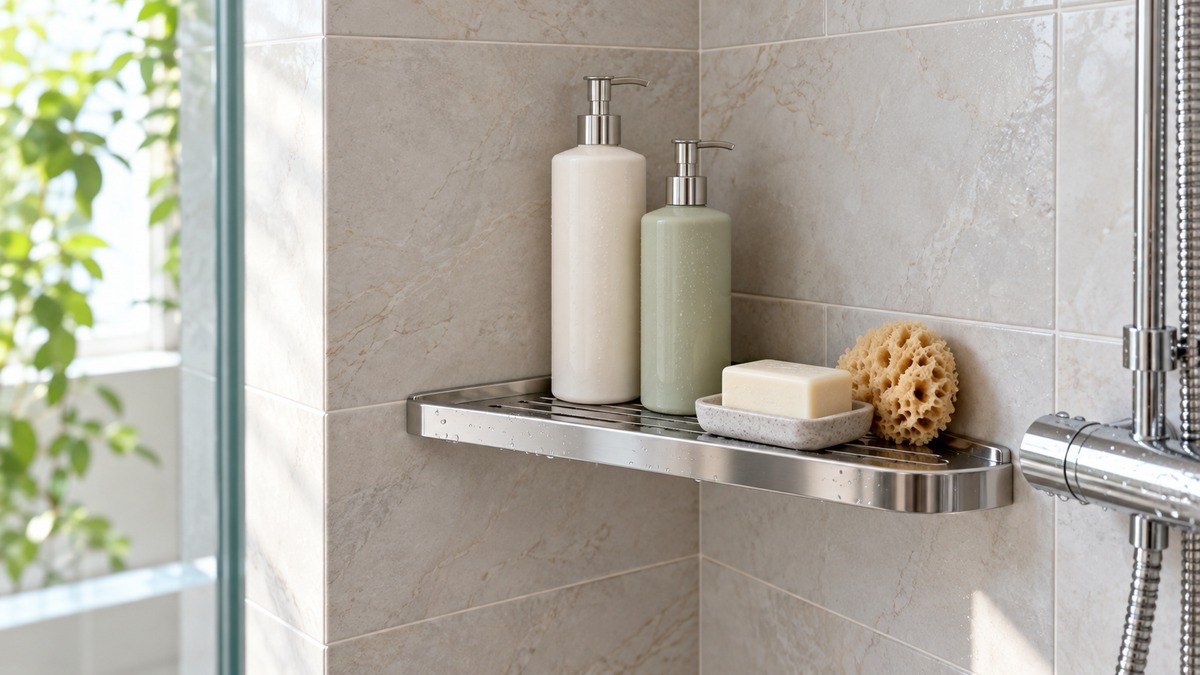
Catty corner shelves are shelves set on the diagonal of a corner, so they sit where two walls meet. This guide helps you pick one by the wall you have, how it mounts and how much weight it can take. None of the listings below use the words catty-corner. They are described as corner shelves, which is the same product family, so every pick here is a corner shelf you can place in a shower or bath corner. Read the mounting method first, because it decides which walls will work. Tiled walls with grout lines, smooth tile or glass, painted drywall and rental walls each need a different option.
Quick answer
Choose the shelf by the wall first. If your corner is tile with a visible grout line, an insert shelf that sits in the gap is the option the listings describe. If the tile or glass is smooth, an adhesive or suction shelf can work, provided the mounting spot is flat and has no grout line under it. If you rent or cannot drill, a tension pole or a freestanding corner stand avoids drilling into the wall. Last, check the weight limit against the bottles you plan to keep, and leave room for more. A corner shelf does not fix a bad layout, so measure your corner before you choose.
What matters for catty corner shelves
Corner angle and footprint
A catty-corner shelf has to sit on the diagonal of a corner, so its front edge needs room to clear both walls. Use the dimensions printed on each listing and compare them with the space you have. Measure the two walls that form your corner, and note how far the shelf will stick out into the shower. A shelf that is too deep blocks the shower opening, while one that is too narrow leaves gaps where bottles tip. Tall units need height as well. A tension pole or a standing unit must fit between the floor and the ceiling, and a wall shelf needs a clear, flat run of tile where it will sit.
Wall surface and mounting method
The wall decides the mount. Tile with a grout line suits an insert shelf that sits in the gap between tiles. Smooth tile, glass and some stone suit adhesive or suction mounts, but those need a flat, clean spot. Painted drywall is a different case. Drywall is a panel of calcium sulfate dihydrate between paper facers, so a screw has nothing solid to grip unless it lands on framing. A stud finder helps you locate the wood or metal framing behind the wall. Where a screw must go into a material that cannot hold it alone, a wall plug, also called an anchor, gives the screw something to grip. One listing says its shelf is not recommended for hollow walls or plasterboard, so read the mounting note before you drill.
Material and rust resistance
Material changes how a shelf ages in a wet room. Stainless steel is an iron-based alloy with chromium, and that chromium is what makes it resist rust and corrosion. Its corrosion resistance comes from a chromium content of 10.5 percent or more, which forms a passive film that protects the metal. Aluminium forms its own protective oxide layer when exposed to air, and its density is about one third that of steel, so an aluminium shelf is lighter to lift and mount. Marble is a different case. It is a metamorphic rock made mostly of carbonate minerals, most often calcite, so it is soft and porous. Colored liquids can stain it and acids can etch it, which is why vinegar and other acidic cleaners should stay away from marble shelves.
Weight limits and what you store
Each listing gives a weight figure, but the figures do not describe the same thing. Some list a capacity for the whole piece, some list a maximum per shelf, and one lists a figure far above the rest. Add up what you plan to store, then compare the total with the lowest limit that applies to the shelf you are considering. Keep a margin below that limit, because a shelf that runs at its maximum has no room for the bottle you buy next. The worked example below shows the sum.
Height, shelf count and reach
Height decides which units work. The tension poles here list height ranges, and a shelf set too high will not reach the bottles you use every day. Count the shelves you need. Some listings show four tiers and others show two. More tiers hold more bottles, but they also add load to the pole or the wall. Think about reach as well. A shelf above your head is harder to use with wet hands, so place the most-used bottles on the lowest shelf that still clears the shower floor.
Installation and waiting time
Adhesive and suction options go up fast, but they need preparation. Clean the surface, press the mount firmly, and let the adhesive set before you load it. One listing says to wait 24 hours before use, so do not load it straight away. Tension poles skip the wall but depend on a firm floor-to-ceiling fit. Tile inserts use the grout line itself, so they are a more permanent choice than a suction cup. Plan for the day you move out, too, since a lease or a future remodel may settle the choice for you.
Renters and removal
If you rent, the best corner shelf is the one you can take with you without damage to the wall. Suction and adhesive options depend on the surface they stick to, and removing them takes care. A tension pole skips the wall but needs a secure floor-to-ceiling fit. A freestanding stand does not touch the wall at all, though it takes floor space in the shower. Read the mounting note before you commit, and check your lease before you drill or fix anything permanent.
1. YACVCL Light Gold Corner Shower Shelf 304 Stainless Steel 10″ Recessed Corner Shelf Bathroom (Best for tiled corners with grout)
Specs from the listing (checked 2026-10-11):
- Shelf Type: Corner Shelf
- Mounting Type: Insert Mount
- Weight Capacity Maximum: 15 pounds
- Product Dimensions: 10″D x 10″W x 0.47″H
Pros
- Listing says it grouts into the tile gap, with no drilling, screws or adhesives.
- Listing gives 15 pounds as its weight limit and an item depth of 10 inches.
Cons
- Built for standard tiled corners, so a painted or plain wall has no grout gap to use.
- The installation bullet is cut short in the copy we have, so read the full wording on the listing before you grout anything.
Best for: Tiled corners with a visible grout line, where you want nothing fixed to the surface.
Skip if: Your corner is painted drywall, plain wall or tile with no grout line.
View on Amazon (affiliate link)
2. 2 Pcs White Marble Corner Shower Shelf for Bathroom, 9'' x 9'' x 0.8'' Marble Corner Shelves (Best marble option for solid walls)
Specs from the listing (checked 2026-10-11):
- Material: Stone Marble
- Product Dimensions: 9″D x 9″W x 0.63″H
- Item Weight: 4.5 pounds
- Mounting Type: Wall Mount
Pros
- Listing describes natural marble pieces that are polished on both sides.
- Listing gives each piece as 9 inches deep and 9 inches wide, a small footprint for a corner.
Cons
- Listing gives 4.5 pounds in one field and about 5 pounds in a bullet, so check the weight before you rely on either.
- Marble is soft and porous, so colored liquids can stain it and acidic cleaners should stay off it.
Best for: Solid walls where you want a stone look and will fix the shelf with a structural adhesive.
Skip if: Your wall is hollow or plasterboard, or you cannot use adhesive.
View on Amazon (affiliate link)
3. Adhesive Corner Shelf Bathroom Shower Caddy Organizer for Kitchen Toilet No Drilling 2-Tier (Best adhesive option for smooth tile or glass)
Specs from the listing (checked 2026-10-11):
- Number of Compartments: 2
- Maximum Weight Recommendation: 22 pounds
- Mounting Type: Wall Mount
- Included Components: 1 * Installation Instruction, 1 * Screw Mounting Kit, 2 * Shower Corner Shelf for Bathroom, 4 * Shower Caddy Hooks, 4 * Strong Self-Adhesive
Pros
- Listing says the shelf can be fixed with adhesive or drilled, so you choose the method.
- Listing gives a maximum weight of 22 pounds and includes four hooks.
Cons
- Listing says to use a smooth surface with no tile joint or grout line under the adhesive sticker.
- Listing asks for 24 hours of waiting before use, so plan for that before you load it.
Best for: Smooth tile, glass or a similar flat wall where you want no drilling.
Skip if: Your corner has a grout line under the mounting spot, or you need more than 22 pounds.
View on Amazon (affiliate link)
4. VOLPONE Corner Shower Caddy Suction Cup, 2 Pack Shower Shelves No Drilling, Showers Organizer (Best suction option for renters)
Specs from the listing (checked 2026-10-11):
- Mounting Type: Suction Cup Mount
- Capacity: 40 pounds
- Unit Count: 2 Count
- Product Dimensions: 8.82″D x 11.97″W x 1.73″H
Pros
- Listing gives a capacity of 40 pounds and comes as a 2 pack with a towel bar and removable hooks.
- Listing says the suction base can be removed by gently prying its edge, so no tools are needed to take it down.
Cons
- Suction works only on flat, smooth surfaces, and the listing names tile, glass and marble.
- A grouted or textured wall gives the suction base too little flat contact, so it is a poor fit there.
Best for: Renters who want no drilling and have a flat tile or glass wall.
Skip if: You plan to hang heavy bottles on a textured or grouted wall.
View on Amazon (affiliate link)
5. HAMITOR Corner Shower Caddy Tension Pole: Rustproof Stable 4-Tier Bathroom Organizer Shelves (Best tension pole for tall corners)
Specs from the listing (checked 2026-10-11):
- Mounting Type: Tension Mount
- Product Dimensions: 11.5″D x 8.4″W x 124.02″H
- Weight Capacity Maximum: 20 pounds
- Number of Shelves: 4
Pros
- Listing gives a 47-121 inch fit range, four shelves and a 20 pound maximum weight.
- Listing says it is stainless steel with a hollow design for drainage.
Cons
- The bullet about tension poles is cut short in our copy, so read the full note on the listing before you order.
- A tension pole relies on floor-to-ceiling pressure for support, so your room height decides whether it fits.
Best for: Corners where you cannot drill and the ceiling height sits within the listed range.
Skip if: Your ceiling falls outside the listed range, or you want shelves screwed to the wall.
View on Amazon (affiliate link)
6. HuggieGems 4 Tier Floor Standing Corner Shower Caddy Organizer Shelf with Hooks, Bathroom Shelves (Best freestanding corner stand)
Specs from the listing (checked 2026-10-11):
- Mounting Type: Corner Stand
- Number of Compartments: 4
- Material: Stainless Steel
- Maximum Weight Recommendation: 750 pounds
Pros
- Listing says it is stainless steel, rustproof and has four tiers with hooks for brushes.
- Listing says it is easy to assemble and includes adhesive strips.
Cons
- Listing gives 750 pounds for both capacity and maximum weight, a figure far above the others in this group, so check it before relying on it.
- As a floor stand it takes floor room in the shower, and the listing gives an item weight of 1.87 kg.
Best for: Corners where you cannot fix anything to the wall and have floor room.
Skip if: You need a shelf that sits off the floor, or your shower base has little room for a stand.
View on Amazon (affiliate link)
How to choose a catty corner shelf
Use these rules in order. They are the checks that change with this keyword, because the corner angle and the wall decide most of the outcome. Start with the wall you have, not with the shelf you like best.
- Choose an insert shelf if your corner is tile with visible grout lines and you want nothing fixed to the surface.
- Choose an adhesive shelf if the spot is smooth, flat and has no grout line under the sticker, and you accept a wait before use.
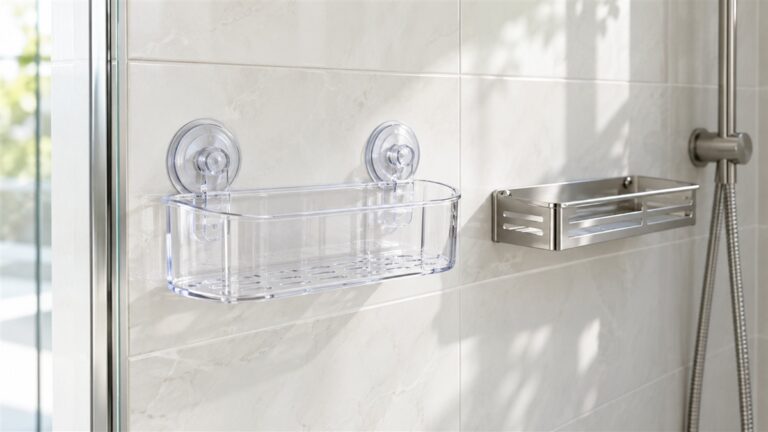
- Choose a suction shelf if the surface is smooth tile, glass or a similar non-porous wall and you need no tools.
- Choose a tension pole or a freestanding corner stand if you cannot drill and your ceiling falls inside the listed height range, or you have floor room for a stand.
- Choose a marble piece only if the wall is solid, you will fix it with a structural adhesive, and you can keep acidic cleaners away from it.
Whatever you pick, add up the bottles you plan to keep, compare the total with the lowest weight figure on the listing, and check the mounting note before you order. If your corner is not a standard right-angle corner, measure it twice, since none of the listings below describe an irregular corner.
Worked example: how much load a corner shelf can take
Our planning estimate: suppose you keep eight bottles on one corner shelf, and each bottle weighs about one pound. That is our planning estimate, not a figure from any listing. Eight bottles at one pound each comes to eight pounds. Compare that with a shelf rated at fifteen pounds. Fifteen minus eight leaves seven pounds of room (15 – 8 = 7). Now add two heavier bottles at two pounds each, which is four more pounds. Eight plus four makes twelve pounds (8 + 4 = 12), still under fifteen, but with only three pounds to spare (15 – 12 = 3). If a bottle weighs more than estimated, the margin shrinks quickly. Weigh your own bottles before you rely on this sum.
Mistakes that waste a good shelf
The first mistake is buying an insert shelf for a painted wall. The insert needs a grout gap to sit in, and without one the shelf has nothing to hold it.
The second mistake is trusting one weight figure. One listing gives a figure that looks far too high for a shower caddy. Check that number against the other figures and the manufacturer’s manual before you load the shelf.
The third mistake is using suction on a textured or grouted wall. The suction base needs a flat contact area, and grout lines break that contact.
The fourth mistake is mounting on hollow walls or plasterboard. Use a stud finder to locate framing, and use a wall plug only where the listing allows a fixing of that kind.
The fifth mistake is cleaning a marble shelf with vinegar. Acidic cleaners can etch and stain marble, so choose a gentler cleaner.
The last mistake is loading an adhesive shelf the same day you mount it. One listing asks for 24 hours before use, so let the adhesive set first.
For more shelf types, see self-adhesive shower shelves, corner shower shelf tension pole options, stainless steel corner shower shelves and ceramic shower shelves.
FAQ
Is a catty corner shelf the same as a corner shelf?
In practice, yes. Catty-corner describes the diagonal placement, and the listings here are corner shelves set into the corner of a shower or bath. None of them use the term catty-corner, so check each listing’s dimensions against the corner you have before you order.
Can I put a corner shelf on painted drywall?
Only if you can fix it to framing or use a fixing the listing allows for your surface. Drywall is gypsum between paper facers, so a stud finder helps you find the framing behind it. If you rent or cannot drill, choose a tension pole, a freestanding stand or an adhesive option that the listing allows on your surface.
Which surface suits a suction corner shelf?
A flat, smooth surface. The suction option here names tile, glass and marble, and its listing says to press the base against a flat, smooth surface. A textured or grouted wall gives the cup too little contact, so choose a different mount for that wall.
How do I know a corner shelf will hold my bottles?
Add up the weight of everything you plan to keep, then compare it with the limit on the listing. Where a listing shows two different figures, use the lower one until you check the manual. The planning estimate in the example above shows how quickly the margin shrinks when bottles are heavier.
Can I clean a marble corner shelf with vinegar?
No. Marble reacts with acids, and vinegar is an acid. Use a gentler cleaner, rinse it, and dry the shelf after use. Keep vinegar and other acidic solutions off the stone.
Do I need tools to fit a tension pole corner caddy?
Some listings say no tools and no drilling are needed. For the tension pole here, the listing says the pole installs without tools, but you still need to set it firmly between the floor and the ceiling. Check the height range before you buy.
Is an adhesive corner shelf ready to use right away?
Not always. One listing asks you to wait 24 hours before use. Follow the instructions in your own listing, and load the shelf with light items until the adhesive has set.
Bottom line
Choose the wall first, then the mount, then the weight. Insert shelves suit tile with grout lines. Adhesive and suction mounts suit smooth, flat surfaces. Tension poles and freestanding stands suit rentals and walls you cannot drill. Compare each weight figure with the bottles you plan to keep, and use the lower figure when a listing gives two. A catty corner shelf that fits your corner and your wall will serve you better than the biggest unit on the page.
Sources
- Marble on Wikipedia: marble is soft and porous, and acids react with it.
- Stainless steel on Wikipedia: chromium forms a passive film that resists rust.
- Aluminium on Wikipedia: a protective oxide layer and a density about one third that of steel.
- Drywall on Wikipedia: gypsum panel between paper facers.
- Stud finder on Wikipedia: locates framing behind walls.
- Wall plug on Wikipedia: an anchor that lets a screw grip a material that cannot hold it alone.