Suction Wall Shelf Comparison: When Suction Works and When to Drill
As an Amazon Associate we earn from qualifying purchases. Details
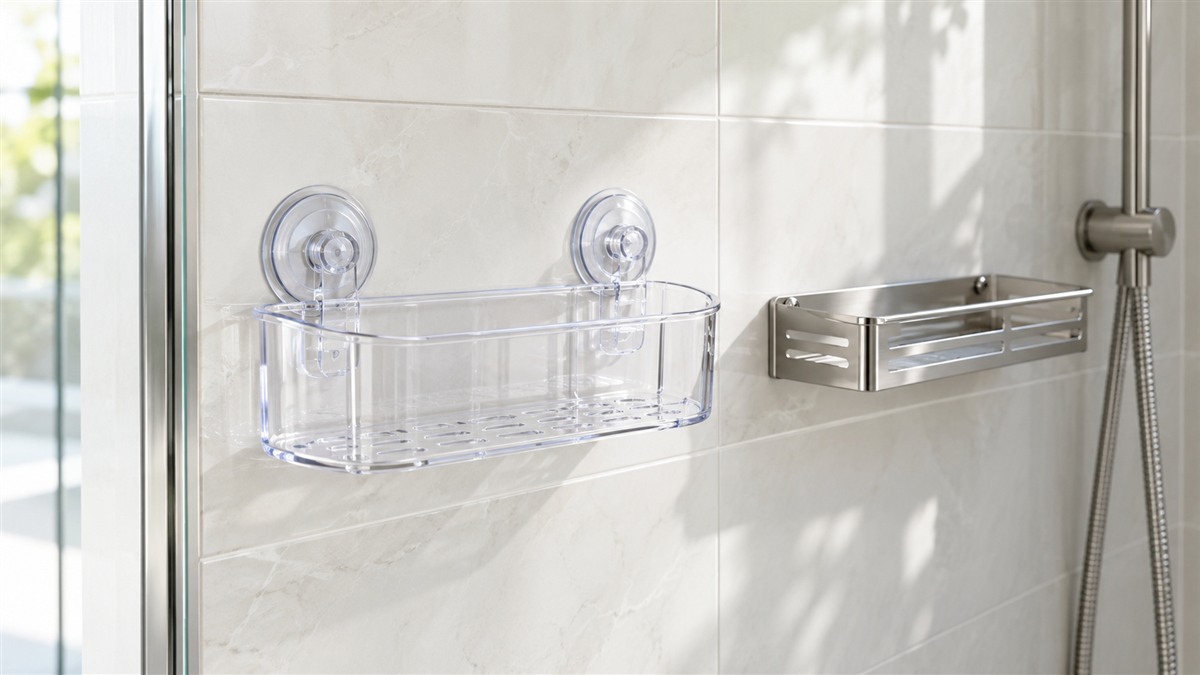
A suction wall shelf is a no-drill caddy that holds to a smooth wall with a suction cup, and this comparison explains when that makes sense and when it does not. The suction option covered here is the Onemake suction cup shower caddy, described by its own listing. The guide sets it against a drilled shelf, names the surfaces that suit suction, and shows how to check a wall before you rely on the cups. Read the quick answer first, then check your wall. A suction hold depends on the surface as much as on the product, so treat each figure below as the manufacturer’s statement, not a promise for your bathroom.
Quick answer
Choose a suction wall shelf if you rent, cannot drill, or want a shelf you can move, and your wall is smooth, clean, dry and flat. Choose a drilled shelf if you own the wall, can find a stud or use a suitable wall plug, and want the shelf in one fixed place for heavier loads. The suction caddy in this comparison lists a capacity of 22 pounds, six detachable hooks and a removal method that uses a bank card. Its weak point is the wall. The listing asks you to make sure the wall has no water stains and dirt before installing, and it does not say how long a cup holds.
Choose suction, choose drilled, or skip both
Choose suction if
You rent, or your landlord does not allow drilling. You want the option to move the caddy later. Your wall is a smooth, clean, dry, flat surface, which is the surface type the listing names. Your load is light to moderate and stays within the listed 22 pounds.
Choose a drilled shelf if
You own the wall and can locate a stud or fix into a wall plug. You need a shelf in one place for a long time. You want to carry a heavier load than a suction caddy’s listed capacity, and you can confirm the fixing’s rated load with its maker before you buy.
Skip both if
Your wall is textured, cracked or rough, because suction needs a smooth surface and a drilled fixing needs a solid base. In that case, check the wall before you spend money on either option. A rough wall can defeat a suction cup, and a weak base can defeat a fixing.
Products that fit this
The product card below holds the listing’s specifications, pros and cons for the suction caddy. It is the only suction option in this comparison, so the sections that follow judge it against a drilled shelf and against the wall you have.
At a glance: the Onemake caddy’s own listing fields
| Specification | Listed value | Flag |
|---|---|---|
| Mount | Suction cup, no drilling/screws/holes/glue | — |
| Material | Aluminum, rust-resistant finish | — |
| Dimensions | 4.7″D x 12.5″W x 2.55″H (description text separately says 4.5″ depth) | Not confirmed — measure before buying |
| Weight | 392 g | — |
| Capacity | 22 lbs (10 kg) | — |
| Compartments | 1, plus 6 detachable hooks | — |
| Removal method | Bank card, no wall damage described | — |
| Included components field | Lists screws and a towel bar | The listing does not say what the screws fasten |
| Suction hold duration | Not stated | — |
Specs are from the product’s Amazon listing, checked 2026-10-11. The depth conflict (4.7″ field vs. 4.5″ description) and the unexplained screws in the included-components list are worth confirming before ordering. The wall must be smooth, clean, and dry for the suction to hold.
Side-by-side comparison
The points below compare the two approaches on the points that matter most. The suction column relies on the listing. The drilled column relies on general references where the listing has nothing to say.
- Installation. The listing says the suction caddy needs no drilling, screws, holes or glue. A drilled shelf needs a fixing suited to the wall. A wall plug, also called an anchor, is a fibre or plastic insert that lets a screw attach to a porous or brittle material, and it is used to fit screws into masonry walls.
- Wall material. The listing names smooth, clean, dry, flat surfaces. Drywall, by contrast, is a gypsum board panel used in interior walls and ceilings, so a drilled fixing in drywall needs a stud or a fixing made for that panel.
- Finding a stud. A stud finder locates wood or metal framing behind a wall. Magnetic models detect the metal fasteners that hold wallboard to studs, while electronic models sense changes in wall density. A stud is the usual base for a heavy drilled shelf.
- Load. The listing states a capacity of 22 pounds, which it also gives as 10 kg. A drilled shelf’s load depends on its fixing and its wall, and the listing for the suction caddy does not apply to it. Check the fixing’s rated load with its maker.
- Removal. The listing says you can use a bank card to remove the suction cup gently without damaging the wall. A drilled shelf leaves holes that you must fill or cover when you take it down.
- Material. The listing describes aerospace aluminum with a rust-resistant finish. Aluminium forms a protective layer of oxide on its surface when exposed to air, which is why aluminum parts resist corrosion in a humid room.
- Drainage. The listing describes multiple drainage holes and says the design prevents water from collecting. A drilled shelf’s drainage depends on its own design, so compare that on the product page you are considering.
What the suction caddy’s listing states
The listing gives a set of specifications. Some are clear, and one pair of figures disagrees, so read this section with the measuring tape in hand.
- Capacity: 22 pounds, which the description also gives as up to 10 kg (22 lbs).
- Size: the description gives 12.5 x 4.5 x 2.55 inches. The dimensions field gives 4.7 inches deep, 12.5 inches wide and 2.55 inches high.
- Weight: the caddy weighs 392 g on its own, according to the item weight field.
- Hooks: six detachable hooks for small items such as razors, loofahs and hairbands.
- Material and finish: aluminum with a matte finish.
- Mounting: the mounting type field reads wall mount, suction cup, suction cups.
- Special features: the listing describes the caddy as waterproof and rust resistant. These are the manufacturer’s descriptions.
- Uses: the description lists the shower, bathroom, bathtub, kitchen and countertop as places to use it.
- Reuse: the description calls the design reusable, with a removable suction cup.
The depth figure is the one to resolve first. The dimensions field gives 4.7 inches deep, while the description gives 4.5 inches. Rely on neither number until you measure the space where the caddy will sit.
The included components field lists a caddy, hooks, a manual, screws and a towel bar. The listing says the caddy needs no screws, so the screws probably belong to another part of the set. The listing does not say what the screws fasten, so do not assume the caddy itself is drilled.
How the listing says to install and remove it
The listing gives a short sequence for installation. Follow it in order, and check the wall at each step.
- Choose a surface. The listing says to attach the caddy to any smooth, clean, dry, flat, and non-porous surface.
- Check for stains and dirt. The listing asks you to make sure the wall has no water stains and dirt before you install the caddy.
- Remove the protective film, open the buckle, press firmly against the wall, and close the buckle to ensure a secure hold.
- Let it sit. The listing does not give a cure time, so do not treat the first press as a confirmed hold. Check it later and again the next morning before you load it.
For removal and reuse, the listing gives two steps. Use a bank card to gently remove the suction cup without damaging the wall. Then clean and dry the suction cup before you reinstall it in a new spot. Those two steps matter most if you plan to move the caddy, because a cup that is not clean and dry will not reseal reliably.
Checking the wall before you rely on suction
Suction depends on the wall in front of it. Before you buy, look at the spot where the caddy will go, and run a simple check.
- Look for texture. A smooth glazed tile or glass surface suits suction better than a rough or pebbled finish.
- Look for cracks and grout lines. The listing describes a smooth, flat, non-porous surface, so a spot with a crack or a raised line may not meet that description.
- Look for water marks and dirt. The listing asks for a clean and dry surface, so wipe the spot and let it dry fully first.
- Test with a light object. Press the cup, add one light item, and check the hold later the same day. Add more items only after the cup has held through that check.
If the cup slips, do not force it harder. Remove it, clean and dry the spot and the cup, and try a different position on the same smooth surface. If the cup still slips, the wall is probably not a suitable surface for suction.
Drilled shelves: what to check
A drilled shelf is the right choice when suction cannot meet the wall or the load. Before you drill, confirm three things.
- Find the framing. A stud finder locates the framing behind the wall, and it is the best base for a heavy shelf. Use a magnetic model if you want to find the fasteners, or an electronic model if you want to sense the density change.
- Choose a fixing for the wall. Drywall is a gypsum board panel, so a plain screw in drywall is not a load plan. Use a stud where you can, or a fixing rated for that panel.
- Confirm the rated load. The suction caddy’s 22 pounds does not apply to a drilled shelf. Read the rated load on the fixing and on the shelf, and keep your load under the lower of the two.
Drilling also leaves holes when you take the shelf down. Plan for that before you choose the drilled route, especially in a rented home.
Use cases
Renters are the clearest case for suction. A reversible install suits a lease, and the listing’s removal steps let you take the caddy down without a repair. Check your lease for any rule about fixtures, but the no-drill install is usually the first point people raise.
Smooth tiled showers with a clean, flat wall are a good test case for suction. Check the tile first, then the grout lines, then the cup. If the spot passes the checks above, suction can work well for shampoo and soap.
Owners who change their bathroom often may prefer suction because the caddy moves with them. A drilled shelf stays where it is, and the holes stay too.
Heavy bottles, a full set of products or a shelf that must hold a weight over the listed capacity point toward a drilled shelf. The listing’s 22 pounds is the ceiling for the suction caddy, and a full load of wet products can reach that ceiling quickly.
Kitchen, bathtub and countertop use is possible with the same caddy, according to the description. Those surfaces need the same smooth, clean, dry, flat check before you rely on them.
Load arithmetic for a full shelf
These bottle weights are made-up numbers for illustration, not figures from the listing.
- Step 1: 8 x 1.5 = 12 lb of product on the shelf.
- Step 2: 12 ÷ 22 = 0.55, so the load is about 55 percent of the listed 22 lb capacity.
- Step 3: 22 – 12 = 10 lb of headroom remains before the listed limit.
- Result: the load fits inside the listed capacity. Water adds weight, so check the load when the bottles are wet, and keep the total under the listed figure with room to spare.
Re-check the arithmetic against your own bottles. If your bottles weigh more, the headroom shrinks quickly, and a load near the limit is the point to switch to a drilled shelf.
Common mistakes
The most common mistake is installing on a wall that has not been cleaned and dried. The listing asks for a clean, dry, stain-free surface, and a skipped step there is the usual reason a cup fails.
The second mistake is trusting the first press. The listing does not state a hold time, so check the cup after the first install and again later.
The third mistake is loading the shelf to the full listed figure at once. Keep a margin under the 22 pound capacity, and remember that wet products weigh more than dry ones.
The fourth mistake is assuming the included screws belong to the caddy. The listing says the caddy needs no screws, so check which part of the set the screws are for before you drill anything.
The fifth mistake is ignoring the depth figure. The dimensions field and the description disagree on depth, so measure the space before you order.
Related guides on this site
If you want a different suction design or an option built for tile, these guides cover the neighbouring choices:
FAQ
Will a suction wall shelf stay up in a shower?
It can, if the wall is smooth, clean, dry and flat, as the listing says. The listing does not state how long a cup holds, so check the cups after the first few days and again after a few weeks of use.
Can I move a suction wall shelf later?
Yes, according to the listing. It describes a reusable design, and the cup comes off with a bank card. Clean and dry the cup before you reinstall it in a new spot, because a dirty cup will not hold well.
Does a suction caddy damage paint or wall surfaces?
The listing says removal does not damage the wall when you use a bank card gently. It says nothing about paint or grout, so test a hidden spot first, and check the wall after removal.
How much weight can it hold?
The listing states a capacity of 22 pounds, or 10 kg. Treat that as the manufacturer’s figure, and keep the total load well under it, since wet products weigh more.
Is a drilled shelf better than a suction one?
Neither is better in every case. A drilled shelf suits an owned wall with a stud or proper fixing and a heavier load. A suction shelf suits renters and smooth walls. Use the quick answer at the top of this page to choose.
Why does the depth figure differ on the listing?
The dimensions field says 4.7 inches deep and the description says 4.5, with no explanation. Measure the space before you buy, since a few tenths of an inch can decide whether it fits.
What comes in the box?
Listed: caddy, hooks, manual, screws and towel bar.
Bottom line
Choose the suction caddy if you rent or want a reversible shelf, your wall is smooth, clean, dry and flat, and your load stays under 22 pounds. Choose a drilled shelf if you own the wall and can fix into a stud or a suitable wall plug, or if you need more load than suction can safely carry.
Short rule: test the wall first. If the cup holds after a clean, dry install and a light test load, suction is a fair fit for that spot. If it does not hold, switch to a drilled option rather than forcing suction.
Sources
- Wikipedia: Wall plug: a wall plug, or anchor, lets a screw attach to a porous or brittle material.
- Wikipedia: Drywall: drywall is a gypsum board panel used in interior walls and ceilings.
- Wikipedia: Stud finder: stud finders locate framing behind walls, using magnetic or electronic sensing.
- Wikipedia: Aluminium: aluminium forms a protective oxide layer when exposed to air.