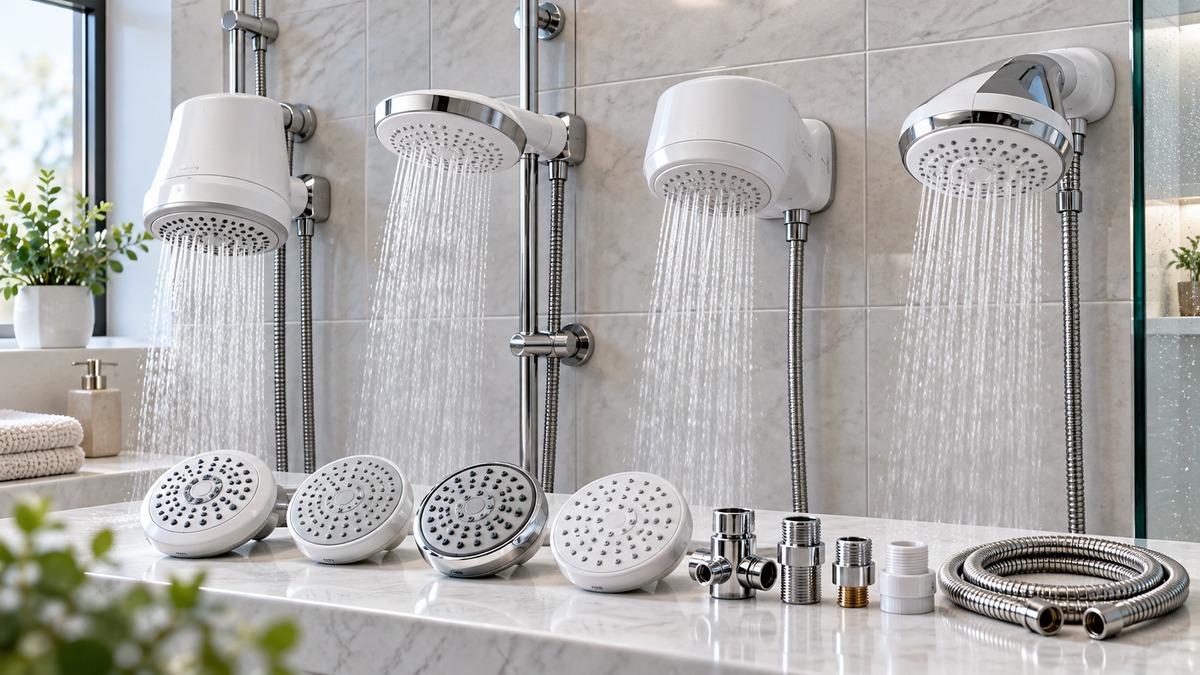
Best Electric Shower Head Replacement: Six Heads Compared by Breaker, Voltage and Fit
As an Amazon Associate we earn from qualifying purchases. Details
The best electric shower head replacement is a point-of-use unit whose voltage and breaker match the circuit your bathroom has, or can get from an electrician, and whose mount fits the wall where it will hang. This guide compares six electric shower heads from four brands. It uses the voltage, wattage, breaker size, wiring, settings and fitting details that each listing gives, and it lists the questions an electrician should settle before anyone connects one.
Quick answer
- Match the head to the circuit first. Four of the six listings name a 40 amp breaker, one LORENZETTI model names 30 amps, and the Foset listing states no breaker size.
- Expect a dedicated circuit, not a plug-in. Five listings call for a dedicated breaker and 10 AWG wiring, and Iowa State Extension says GFCIs “should be installed by a qualified electrician.”
- Check watts against volts before you trust the breaker. The FAME listing’s 4,400 watts at 110 volts works out to 40 amps, and the BOCCHERINI dual system’s 4,320 watts works out to 39.3 amps.
- Decide whether you want a handheld. Two of the six include a hand hose or handheld shower, and the other four are fixed heads.
What the electrical safety sources say
The sources we opened agree on the basic idea. The National Fire Protection Association’s home checklist says that “Ground-fault circuit interrupters (GFCIs) reduce the risk of shock by shutting off an electrical circuit when the circuit could be a shock hazard.” The same checklist says “Your home should have GFCIs in the kitchen, bathroom(s), laundry, basement, garage, and outdoor areas.”
Iowa State University Extension gives the same message in plainer words. It advises that you “Install ground fault circuit interrupters or GFCIs in bathrooms, laundry rooms, kitchens, and outdoors.” It also says “GFCIs should be installed by a qualified electrician.” That second sentence matters for a shower head, because the listings here call for a dedicated breaker and fixed wiring rather than a plug.
The Occupational Safety and Health Administration’s wiring rule covers bathrooms too, but only for workplaces and only for a narrow class of circuits. Its text says “All 125-volt, single-phase, 15- and 20-ampere receptacles installed in bathrooms or on rooftops shall have ground-fault circuit-interrupter protection for personnel.” The listings here call for 30 or 40 amp circuits, so the OSHA rule shows the bathroom principle but does not decide the question for these heads.
None of the three sources addresses point-of-use water heaters or electric shower heads by name. They tell you where GFCIs belong and who should install them. Whether a particular head needs its own GFCI-protected circuit is a question for the manufacturer’s manual and the local inspector, and this guide cannot answer it.
The listings’ electrical requirements
| Head (brand) | Stated voltage | Stated power | Breaker and wiring | Temperature settings | Pressure |
|---|---|---|---|---|---|
| BOCCHERINI 110 volt point-of-use | 110 volts | 28 psi maximum pressure | 40 amp dedicated breaker, 10 AWG, hardwired | 3 | 28 psi maximum |
| BOCCHERINI 110 volt dual system | 110 volts | 4.32 kW | 40 amp dedicated breaker, 10 AWG, hardwired | 3 | Not stated |
| LORENZETTI 120 volt tankless head | 120 volts | Not stated | 40 amp breaker, 10 AWG | 3 power settings | 2 to 100 psi |
| LORENZETTI 240 volt tankless head | 240 volts | Not stated | 30 amp breaker, 10 AWG | 3 power settings | 2 to 100 psi |
| FAME 110 volt head with hand hose | 110 volts | 4,400 watts | 40 amp breaker, 10 AWG | 4 | Not stated |
| Foset 16.5 cm wide spray head | Not stated in bullets | Not stated in bullets | Not stated in bullets | 4 | Not stated |
The table reports what each listing says. Two rows leave the voltage out, and the Foset row leaves out the breaker, so that head cannot be checked against your circuit from its bullets. The LORENZETTI 120 volt and 240 volt models are not interchangeable: one needs a 40 amp breaker and the other a 30 amp breaker, and each is tied to its own voltage.
Watts, volts and amps
The one calculation you can run from these listings is the current a head draws. Current is watts divided by volts. The formula uses only the wattage and voltage each listing states, and the result is a check against the breaker, not a code calculation.
The FAME head is rated at 4,400 watts on 110 volts, so 4,400 watts ÷ 110 volts = 40 amps. That result matches the 40 amp breaker the listing requires exactly.
The BOCCHERINI dual system is rated at 4.32 kW, which is 4,320 watts, on 110 volts. So 4,320 watts ÷ 110 volts = 39.3 amps. That is close to the 40 amp breaker its listing names, and the margin is small.
The listings do not say whether either load is continuous, and the sources we opened do not cover the rule that would apply. A load that runs close to its breaker rating is a question to put to an electrician, who can check the breaker against the heater’s rating and your local code. Do not treat the arithmetic above as a sizing decision.
The LORENZETTI 240 volt and 120 volt models give no wattage, so no current can be calculated for them. Their breaker sizes come from the bullets alone.
Fitting the head to the wall
The kits differ in what they include for mounting. The BOCCHERINI 110 volt point-of-use bullets say the head “INCLUDES WALL SUPPORT,” and the LORENZETTI bullets say the wall support arm and tube are included. The FAME bullets list a 30 centimeter installation tube. The Foset bullets describe a matching rigid extension mounting arm for wall placement, along with the head.
Head size and spray pattern vary as well. The FAME head is described as 8 inches, the Foset head as 16.5 centimeters with a wide spray, and the BOCCHERINI 110 volt specifications give an item size of 7.87 inches wide by 5.11 inches high. The listings do not all state a head size, so measure the wall and the existing supply before you compare.
Two listings also include a hand hose or handheld shower. The BOCCHERINI dual system includes an overhead head and a handheld shower with a diverter. The FAME set includes a 5.2 foot hand hose. If you want a fixed head only, those two are the wrong choice, and the other four fit that use.
Breakers, circuits and what to ask an electrician
Bring the listing to the electrician before you buy. Ask four things. First, does your bathroom have a dedicated circuit that matches the breaker the listing names, 30 amps or 40 amps? Second, is the wiring 10 AWG, as five of the six listings require? Third, does the head need its own GFCI-protected circuit, and if so, which breaker type will protect it? Fourth, is the load continuous, and does the breaker size account for it?
The NFPA checklist supports the GFCI question in general. It says GFCIs “reduce the risk of shock” and belong in the bathroom. The Iowa State guidance supports the installation question. Neither source answers how a point-of-use head should be protected, which is why the electrician’s answer matters more than the listing’s.
Do not treat a bullet’s breaker figure as a substitute for that conversation. A listing states what the maker requires. Your panel, your wiring and your local code decide what you can actually install.
Settings and what the dials control
Four listings give three temperature or power settings, and two give four. The LORENZETTI bullets describe “3 Power Temperature Settings” and say you can “adjust between power levels.” A power level is not the same as a temperature, so ask the seller what the dial changes before you assume the two LORENZETTI heads behave like the others. The FAME bullets name the steps as “cold, warm, hot and super hot,” which states the temperatures. The Foset bullets describe a “4-position selector dial,” which gives the number of positions but not the temperature at each one.
The BOCCHERINI listings describe “3 TEMPERATURE SETTINGS” with a selector that moves between “cold, warm, and higher temperature levels.” That wording is closer to the FAME description than to the LORENZETTI one, but neither BOCCHERINI listing gives the temperature at each step.
Pressure figures are not directly comparable
The two pressure figures in this set describe different things. The BOCCHERINI 110 volt point-of-use head lists a maximum pressure of 28 psi. The LORENZETTI heads list a range of 2 PSI up to 100 PSI. One is a ceiling and the other a range, so putting them side by side as if they measured the same thing would mislead you.
If your water pressure is low, measure it before you choose, and compare your reading with the pressure figure in the listing you are considering. The listings do not describe how any head performs at low pressure, and the Foset and FAME listings give no pressure figure at all.
Questions to put to the seller
Ask the seller these questions in writing before you buy. Which breaker size and type does the head need, and does the listing figure match the circuit in your bathroom? Does the manufacturer’s manual require a GFCI on the head’s own circuit? Is the load continuous, and does the listed breaker account for it? Is 10 AWG the only wire size the head accepts? Does the kit include the mount your shower arm or wall needs?
A seller who cannot answer those questions in writing is a reason to choose a different listing. The questions apply to every head in this set, whatever the listing says about its own installation.
Mistakes to avoid
- Buying by the wattage alone. Compare the listing’s breaker size with your own circuit, not just the wattage.
- Assuming a plug-in fit. Two listings say the unit must be hardwired, and the others call for a dedicated breaker. Iowa State Extension says GFCIs should be installed by a qualified electrician.
- Mixing the 120 volt and 240 volt LORENZETTI models. They take different breakers, so the voltage at your bathroom sets the choice.
- Skipping the GFCI question. The NFPA checklist names the bathroom as a place that should have GFCIs, and the question applies to the circuit a new head uses.
- Buying a hand shower by mistake. Two listings include a handheld, and one Foset listing in the search was a hand shower with a 5 foot hose, which we left out of this set.
If the water pressure at your shower is the problem rather than the wiring, see our low pressure shower head and hose guide and our best showerheads for low water pressure guide.
What we could not verify
- Whether any head meets the local electrical code or the National Electrical Code for point-of-use heating. The sources we opened do not cover that point.
- Whether the stated breaker size is correct for each head’s load. The breaker figures come from the listings, not from a test.
- Whether any point-of-use head needs its own GFCI-protected circuit. The NFPA and Iowa State pages cover bathrooms in general.
- Whether the BOCCHERINI dual system’s 4.32 kW load runs continuously, and whether a 40 amp breaker covers it under the rule that applies.
- Certification marks. The bullets make safety statements, and the FAME bullets describe insulation and surge protection, and the listing names no certification or test report.
- Water flow and temperature performance. The listings give pressure ranges for two heads and no flow rate for any head.
- The full bullets for several heads. The extracted text ends partway through some sentences, so claims later in those bullets are not part of this comparison.
FAQ
Do electric shower heads need a GFCI?
The sources we opened say GFCIs belong in bathrooms in general and should be installed by a qualified electrician. NFPA’s checklist says “Your home should have GFCIs in the kitchen, bathroom(s), laundry, basement, garage, and outdoor areas.” None of the sources addresses point-of-use heads by name, so ask the electrician whether the head’s circuit needs a GFCI.
Can I install one of these heads myself?
The listings call for a dedicated 30 or 40 amp breaker with 10 AWG wiring, and two of them say the unit must be hardwired. Iowa State Extension says GFCIs “should be installed by a qualified electrician,” and the connection here goes well beyond swapping a shower head on an existing arm. Hire an electrician for the connection, and check the listing’s requirements with them first.
What amperage do these heads need?
Four listings name a 40 amp breaker, one LORENZETTI model names a 30 amp breaker, and the Foset listing states none. At 110 volts, the FAME head’s 4,400 watts works out to 40 amps (4,400 watts ÷ 110 volts = 40 amps), which matches its breaker. The BOCCHERINI dual system’s 4,320 watts works out to 39.3 amps, close to its 40 amp breaker.
Is a handheld head a replacement for a fixed head?
It can be, but it is a different product. Two listings include a hand hose or handheld shower: the BOCCHERINI dual system and the FAME set. The others are fixed heads with a wall support or a mounting arm, and they suit a bathroom where you want the head to stay in one place.
Does the OSHA bathroom rule settle the question for these heads?
No. The OSHA rule covers workplace receptacles of 15 and 20 amperes, while these listings call for 30 or 40 amp circuits. It supports the bathroom GFCI principle, but the heads’ own circuits still need an electrician’s review.
The six picks
1. Electric Shower Head 110V – Point-of-Use Shower Unit for Bathroom, Ducha Eléctrica, 3 Temperature Se (110 volt point-of-use head with three settings and wall support included)
Pros
- The bullets describe a 110 volt point-of-use unit with a wall support included
- The bullets name three temperature settings, selected with a built-in selector
- The specifications list a 28 psi maximum pressure and a wall mount
Cons
- The bullets require a dedicated 40 amp breaker and 10 AWG wiring, so an electrician must do the connection
- The bullets say it is not a tank water heater but give no flow rate
Best for: A bathroom that already has a 40 amp circuit ready for a hardwired head
Skip if: Your bathroom has no dedicated 40 amp circuit and no electrician to add one
View on Amazon (affiliate link)
2. Electric Shower Head 110V – Point-of-Use Shower Unit for Bathroom, Ducha Eléctrica, 3 Temperature (Dual system with an overhead head and a handheld shower on a 40 amp circuit)
Pros
- The bullets describe an overhead shower and a handheld shower with a diverter
- The specifications list 4.32 kW, and 4,320 watts at 110 volts works out to 39.3 amps
- The bullets describe three temperature settings with an adjustable selector
Cons
- The bullets require a dedicated 40 amp breaker
- The listing does not say whether the 4.32 kW load runs continuously, a point an electrician should check against the breaker
Best for: A household that wants an overhead head and a handheld on one electric unit
Skip if: You want a fixed head only
View on Amazon (affiliate link)
3. LORENZETTI 120 Volt Electric Showerhead with Free Wall support Tube (120 volt tankless head with three power settings and a wall tube)
Pros
- The bullets say the wall support arm and tube come with the kit
- The bullets give a pressure range of 2 PSI up to 100 PSI
- The bullets name three power temperature settings
Cons
- The bullets require a 40 amp breaker and 10 AWG wiring
- The listing gives no wattage, so the breaker cannot be checked against a load
Best for: An owner on a 120 volt supply who wants a kit with the wall tube included
Skip if: Your bathroom wiring is 240 volt
View on Amazon (affiliate link)
4. LORENZETTI 240 Volt Electric Showerhead with Free Wall support Tube (240 volt version of the same tankless head, on a 30 amp breaker)
Pros
- The bullets name a 30 amp breaker, a smaller breaker than the 120 volt model needs
- The bullets give the same 2 PSI up to 100 PSI pressure range
- The bullets say the wall support tube is included
Cons
- The listing gives no wattage, so the 30 amp breaker cannot be checked against a load
- The title says 240 volt, so the bathroom must already have 240 volt wiring
Best for: A bathroom with 240 volt wiring and a 30 amp circuit
Skip if: Your bathroom only has 120 volt wiring
View on Amazon (affiliate link)
5. FAME – Tankless Water Heater Electric – EVIDENCE Ducha Electrica 110V, 4 temperatures. Includes Head (110 volt head with four settings, an 8 inch head and a hand hose)
Pros
- The specifications list 4,400 watts at 110 volts, which works out to 40 amps
- The bullets describe four temperature levels from cold to super hot
- The bullets include an 8 inch shower head, a 5.2 foot hand hose and a 30 cm installation tube
Cons
- The hand hose lets the set act as a handheld, which some buyers do not want
Best for: An owner who wants a four setting head with a hand hose in one kit
Skip if: You want a fixed head with no hose
View on Amazon (affiliate link)
6. Foset 16.5cm Electric Shower Head with Wide Spray (Model 40237 / REGEL-6) (16.5 centimeter wide spray head with four settings and a mounting arm)
Pros
- The bullets describe a 16.5 cm wide spray pattern
- The bullets describe a polypropylene body that is non-conductive
- The bullets say the kit includes a matching rigid extension mounting arm
Cons
- The bullets do not state a voltage, wattage or breaker size
- The non-conductive body is a listing claim, and no test report is named
Best for: A buyer who wants a fixed head with a mounting arm and a wide spray
Skip if: You need the voltage and breaker size confirmed in the listing before buying
View on Amazon (affiliate link)
How we chose
We searched Amazon.com in Chrome on 21 October 2026 for “best electric shower head replacement.” Most of the first results page was filtered shower heads, handheld sprayers and rain heads, so we ran two narrower searches: “electric shower head” and “electric tankless shower head.” We read the first results page of each of the three searches, plus the second page of “electric shower head.” The third search returned mostly electric tankless water heaters, which are separate units.
We kept heads whose title or bullets describe a fixed or point-of-use electric shower head. We dropped the tankless water heaters and the filtered and handheld heads that did not run on electricity. One Foset listing, a hand shower with a 5 foot hose, was left out because its title describes a hand shower rather than a fixed head.
We opened six listings from four brands: BOCCHERINI, LORENZETTI, FAME and Foset. Two listings come from BOCCHERINI and two from LORENZETTI. The LORENZETTI pair covers the brand’s 120 volt and 240 volt models. We did not use price, rating or rank, because Chrome did not return those reliably for these listings.
Bottom line
Match the head to the voltage and breaker your bathroom can supply, have an electrician confirm the circuit and whether a GFCI is needed, and skip any listing whose breaker or voltage you cannot provide. Choose a fixed head or a head with a hand hose only after you know which one you want.
Sources
- National Fire Protection Association, Electrical Safety Checklist for the home (opened 2026-10-21): https://content.nfpa.org/-/media/project/storefront/catalog/files/home-fire-safety/electrical/electrical_safety_checklist.pdf
- Iowa State University Extension and Outreach, AnswerLine: Plug Into Safety (opened 2026-10-21): https://blogs.extension.iastate.edu/answerline/2017/05/15/plug-into-safety/
- Occupational Safety and Health Administration, 29 CFR 1910.304, Wiring design and protection (opened 2026-10-21): https://www.osha.gov/laws-regs/regulations/standardnumber/1910/1910.304