Best Shower Filter for Hard Water: What University Extension Says
As an Amazon Associate we earn from qualifying purchases. Details
If you are looking for the best shower filter for hard water, the first question is what the filter is supposed to change. Hard water is mostly dissolved calcium and magnesium. University extension pages describe what those minerals do: they leave scale, they form soap curds, and they make hair feel dull. The extension sources we opened describe whole-house ion exchange softeners as an effective way to reduce hardness. They do not assess a filter that sits only on a showerhead, so this guide explains what the sources support, what they do not, and how to measure your own water before you buy anything.
Quick answer
- Hard water is a nuisance more than a health problem. The University of Maryland Extension page says that “While consuming hard water does not present a health risk,” it can still leave scale and deposits on fixtures.
- Ion exchange water softeners are the treatment the extension sources describe as effective. Penn State Extension says “A water softener, also called an ion exchange unit, will effectively accomplish the latter option.”
- The sources we opened do not test or rate shower-only filter cartridges for hardness reduction, so no hardness claim for a shower filter is made here.
- Measure hardness first. The hardness band tells you whether a shower filter is solving a problem you actually have.
What hard water does in the shower and at home
Hardness is a property of the water, not of the shower. When calcium and magnesium are present, the sources describe several effects that people usually notice first in the bathroom. North Dakota State University Extension says that “Hard water causes films on glass shower doors, walls, and bathtubs.” It also says “Hair washed in hard water may feel sticky and look dull.” The reason is chemical: “Soap curds or soap scum will form as regular soaps combine with dissolved calcium and magnesium.”
Penn State Extension describes the same problem in plainer terms. The minerals “build up on contact surfaces, possibly plug pipes and damage water heaters, and decrease the effectiveness of soaps and detergents.” The University of Maryland Extension page adds that hardness may cause “mineral deposits (scale) on dishes, utensils, and plumbing fixtures,” and that “Hard water can also reduce the efficiency and life span of water heaters.”
That list matters for a shower filter because it separates two kinds of problem. Some problems are visible on the shower surfaces and on your hair and skin. Others happen in pipes, in the water heater and in appliances. A filter fitted to a showerhead only changes the water that comes out of that head. The sources describe scale in water heaters and plumbing, and a shower-only filter does not reach those parts of the system.
How hardness is measured
Hardness is reported in two common units. The Nebraska Extension guide G1274 states: “Water hardness often is expressed as grains of hardness per gallon of water (gpg) or milligrams of hardness per liter of water (mg/L).” Penn State Extension gives the conversion: “A gpg is used exclusively as a hardness unit and equals approximately 17 mg/l or ppm.”
That conversion lets you check a reading against the classes in the extension tables. The G1274 table, which uses the Water Quality Association classes, is summarized below.
| Classification | mg/L (as calcium carbonate) | grains per gallon |
|---|---|---|
| Soft | 0 to 17.1 | 0 to 1 |
| Slightly hard | 17.1 to 60 | 1 to 3.5 |
| Moderately hard | 60 to 120 | 3.5 to 7.0 |
| Hard | 120 to 180 | 7.0 to 10.5 |
| Very hard | 180 and over | 10.5 and over |
The conversion gives a quick check on any reading. A water reading of 10 gpg is in the “Hard” row. Using the approximately 17 mg/L per gpg figure from Penn State Extension, the formula is 10 times 17 equals 170 mg/L, which falls inside the 120 to 180 mg/L band. The two units agree.
Penn State Extension also gives a practical threshold. It says “levels below 7.0 gpg will probably not cause major scaling and soap film.” That sentence does not mean a reading above 7.0 gpg needs treatment for every household. It means that the sources treat 7.0 gpg as a point where scaling and soap film become more likely. Whether you need treatment depends on the problems you see, the appliances you own and your tolerance for them.
What a shower filter can and cannot be expected to do
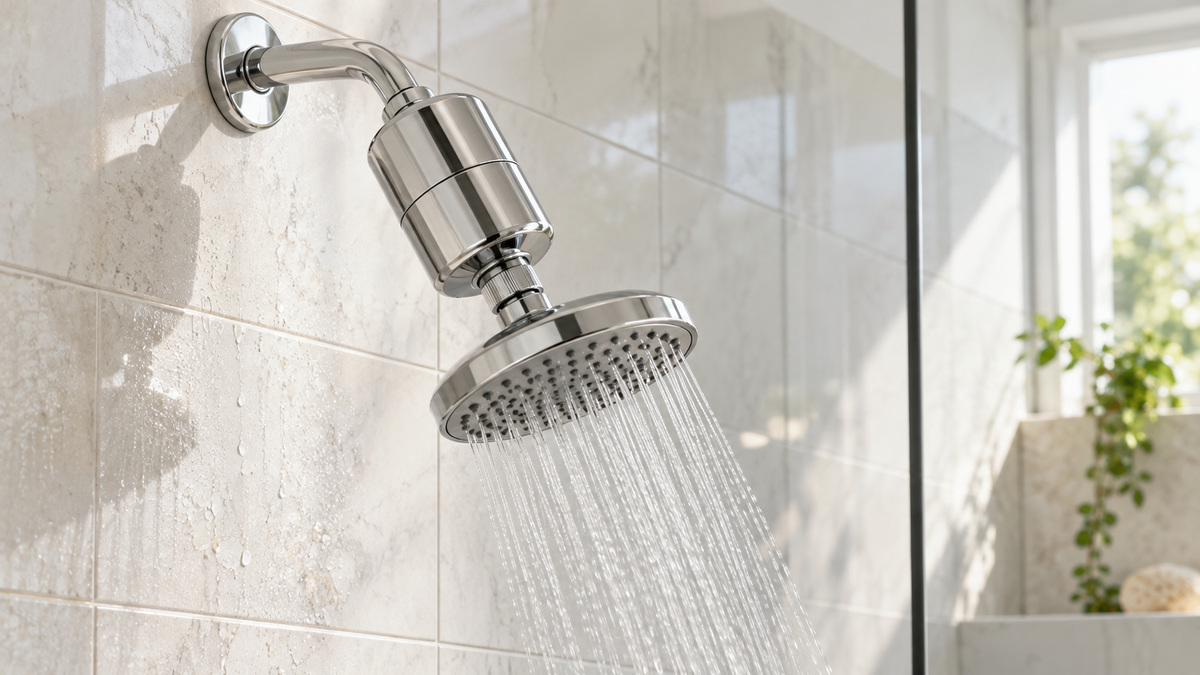
A shower-mounted filter acts on the water that passes through the showerhead. The extension sources describe the effects of hardness across the whole plumbing system, and the treatment they describe as effective acts on the supply. The Penn State page states that “A water softener, also called an ion exchange unit, will effectively accomplish the latter option.” That is a statement about a whole-house softener, not a showerhead cartridge.
Nebraska Extension goes further on the limits of other technologies. It says “Several nonchemical technologies based on a variety of physical phenomena have entered the market” and then states “These technologies do not remove the hardness.” It also says: “The effectiveness of physical water treatment devices to control scale or otherwise manage hardness at the residential level has not been scientifically assessed.”
Those sentences concern physical devices such as electrochemical and magnetic units. They are not a verdict on shower filter cartridges, which are a different technology. We bring them up because they show how careful the extension sources are about claims for devices that have not been assessed. A shower filter for hard water should be judged the same way. If the seller states a specific hardness reduction, ask for the test basis. If the seller states nothing about hardness, the sources give you no basis for assuming one.
Some shower cartridges are marketed for other water problems, such as chlorine. Those claims fall outside the hardness question this guide answers, and the sources we opened do not cover them. Treat any such claim as the manufacturer’s statement unless an independent certification covers that specific reduction.
The sodium trade-off with softeners
Whole-house softening has a cost that the shower-filter discussion usually leaves out. The Nebraska Extension guide explains: “Hard water treated with an ion exchange water softener has sodium added.” It then gives the rate: “the ion exchange softening process adds sodium at the rate of about 8 mg/liter for each grain of hardness removed per gallon of water.”
The G1274 guide works an example for a 10 gpg supply: “For example, if water has a hardness of 10 grains per gallon, it will contain about 80 mg/liter of sodium.” The arithmetic is 10 times 8 equals 80 mg/L of added sodium. The same guide notes that some individuals may be advised by their physician not to install water softeners, to soften only hot water, or to bypass the softener with a cold water line for drinking and cooking.
This matters for the shower decision. A shower filter avoids the sodium issue only if it does not add sodium, and the extension sources we opened do not say what a given cartridge adds. If sodium in drinking water is a concern in your household, ask your doctor before you change the water treatment that reaches your kitchen. A shower-only device does not change the water at the kitchen tap.
Check your water before you choose a filter
The most useful step is a reading, not a product. Nebraska Extension notes that public water suppliers may report hardness. The guide says that the consumer confidence report “may include information about the hardness level of the water delivered,” and that you can also contact the supplier to ask. If you have a private well, the same guide says you can have the water tested, and that “a variety of water hardness test kits and dip strips are available for purchase.”
Kits and strips give an estimate. The guide says that they “are generally easy to use, relatively inexpensive, and can provide a good estimate of hardness,” and that laboratory tests “should be considered if more accurate measurements are needed.” Use the result to place your water in the table above. A reading in the soft or slightly hard rows means a shower filter for hardness will probably not solve a problem you have. A reading in the hard or very hard rows makes a hardness-focused decision more reasonable, but the sources still do not show what a shower-only cartridge removes.
Keep the reading with your notes. If you later compare a cartridge’s claim with your own water, you will have the number you need. Without that number, the claim cannot be checked.
How we chose
This guide is built only from the extension and agency pages listed in the source list. We chose the pages by three rules. First, they had to be written by a university extension service or a government agency, not by a retailer. Second, they had to describe hardness, its effects or its treatment in terms a homeowner can check. Third, each sentence we use had to appear in the text of the page we opened on the date listed.
We did not choose products for this post. No shower filter product data was used, and no ranking of cartridges is given. A product comparison would need manufacturer certification documents and water test results for each model, and the sources we opened do not supply either. The post therefore explains the decision and leaves the product choice to you.
What we could not verify
The sources we opened do not assess shower-mounted filter cartridges for hardness reduction. We could not confirm any percentage of hardness removed by a shower filter, any replacement interval, or any claim about how well a cartridge holds up under your water conditions. The post does not state those things.
The extension pages describe the effects of hardness on hair, skin and surfaces in general terms. NDSU says hair washed in hard water “may feel sticky and look dull.” That is a description of what people report, not a measured outcome from a shower filter trial, and we have not treated it as one.
We also did not verify how a shower filter’s flow rate changes its performance, or whether a filter works at every pressure range. The listing for any product will give its own flow figure. Use that figure with the flow information for showerheads in the sources, but do not assume a filter preserves the spray quality of the head it is mounted on.
Finally, the sources describe water hardness at the state and regional level. Hardness varies from one supply or well to another. A reading from one day is a snapshot, not a full picture of your water.
Where to go next
If the question behind this search is about flow and pressure rather than minerals, the guide to showerheads for low water pressure covers the same EPA flow limits from a different angle. If you are choosing a head that saves water, the guide to high pressure shower heads that save water explains how flow ratings and pressure interact.
FAQ
Does a shower filter soften hard water?
The sources we opened do not say a shower-only filter softens water. They describe ion exchange water softeners as the treatment that effectively reduces hardness, and they describe the sodium that softening adds. A shower filter may treat some other problems, but any claim about hardness should come with a test basis from the manufacturer.
Is a shower filter the same as a water softener?
No. A water softener is an ion exchange unit that treats the water supply, usually for the whole house. A shower filter acts only on the water that leaves the showerhead. The extension sources describe the two as different treatments, and they do not treat a showerhead cartridge as a softener.
How do I know how hard my water is?
Start with your utility’s consumer confidence report or contact the supplier. If you have a private well, have the water tested. Test kits and dip strips can give an estimate, and laboratory tests are more accurate. Compare the reading with the grains per gallon classes in the table in this guide.
Does hard water make hair dull?
North Dakota State University Extension says hair washed in hard water “may feel sticky and look dull.” The same page describes soap curds forming when soap meets calcium and magnesium. The sources describe these effects but do not measure how much a shower filter changes them.
Is hard water a health risk?
The extension sources say hard water is not a health hazard in the usual sense. The University of Maryland Extension page says that “While consuming hard water does not present a health risk,” and it may cause nuisance problems. Nebraska Extension calls it “not a health hazard” but a nuisance. If you have a health question about drinking water or sodium intake, ask your doctor.
Will a shower filter protect my water heater?
The sources describe scale in water heaters as a result of hardness, and they say hard water “can also reduce the efficiency and life span of water heaters.” A shower-only device acts on water at the head and does not treat the water heater. The sources we opened do not say that shower filters protect water heaters.
Bottom line
Measure your hardness before you spend money. If the reading is in the soft or slightly hard range, a shower filter for hardness is unlikely to solve a problem you have. If it is in the hard or very hard range, the extension sources point to whole-house softening as the treatment they describe as effective, and they warn about the sodium that softening adds. A shower-only filter is a narrower tool whose hardness effect the sources we opened do not measure.
Sources
- University of Maryland Extension, Hardness in Household Water: hardness is calcium and magnesium, with nuisance effects on fixtures and water heaters
- North Dakota State University Extension, Hard water issues: films on shower surfaces, soap scum and hair effects
- University of Nebraska-Lincoln Extension, G1274 Water Hardness: units, classification table, sodium added by ion exchange, limits of physical devices
- Penn State Extension, Water Softening: gpg conversion, the 7.0 gpg threshold and the role of ion exchange softeners