Best Shower Heads with Hoses: Flow, Pressure and Setup Guide
As an Amazon Associate we earn from qualifying purchases. Details
If you are looking for the best shower heads with hoses, start with what the hose does and what the head does. A hose lets the head come off its bracket, so you can aim the spray at different parts of your body. The flow rating, measured in gallons per minute (gpm), sets how much water the head uses. The extension and agency pages we opened describe hand-held showers as heads on hoses and give the flow limits that apply to them. This guide explains those numbers, how to turn them into gallons per shower, why water pressure changes the result, and what the sources do not cover, such as hose length and fittings.
Quick answer
- A hand-held shower is a shower head on a hose. The EPA’s archived showerhead FAQ calls it “a hand-held nozzle at the end of a hose,” and the WaterSense specification covers “fixed showerheads and hand-held showers.”
- Standard showerheads use 2.5 gpm, according to EPA. WaterSense labeled models “must demonstrate that they use no more than 2.0 gpm.”
- Low-flow heads “can be sensitive to low water pressure,” so Penn State Extension says “proper pressure-balanced mixing valves are necessary.”
- The sources we opened do not rank heads by hose length, thread size or spray quality, so this guide does not make those comparisons.
What a shower head with a hose is
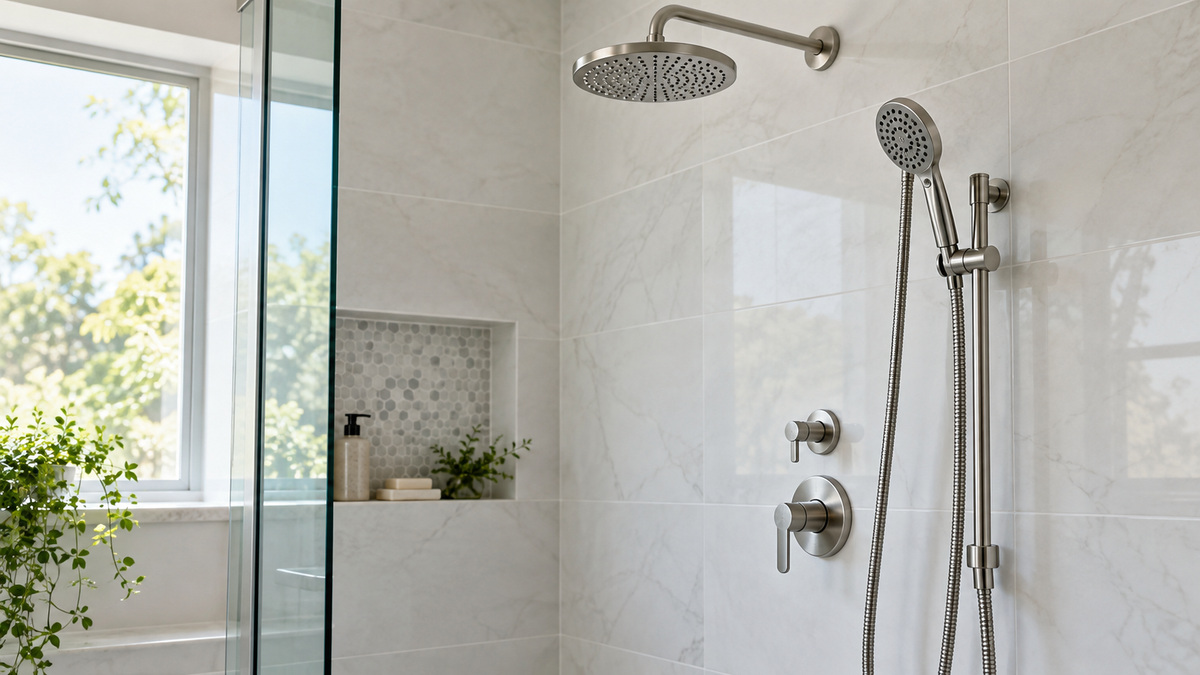
The EPA’s archived FAQ on WaterSense labeled showerheads defines the category in plain terms. It says hand-held showers are “a subset of showerheads with moveable devices for directing water onto a user, usually a hand-held nozzle at the end of a hose.” A fixed head is the same device mounted in one place. Both types are covered by the same flow limit, which means the hose does not change the flow rating. The number on the head does.
That distinction matters when you shop. A hose can be long, short, metal or plastic, but the sources do not tie hose type to water use. What sets the water used is the flow rate the head is designed to deliver. If the flow rating is not stated, the sources we opened give you no way to estimate water use from the hose alone.
The current EPA showerhead page describes what a WaterSense label checks beyond flow. It lists criteria such as “Pressure compensation: Ensures the showerhead will provide for a minimum flow across a range of household water pressures.” That is the part of the label most relevant to a hose head, because the criterion refers to a range of household water pressures rather than one fixed pressure.
Flow rate: the number that drives the water bill
Flow rates for showerheads in the sources fall into three bands. Penn State Extension says that “Conventional showerheads typically deliver 3-8 gallons of water per minute.” EPA says standard heads use 2.5 gpm. For heads that earn the WaterSense label, EPA says they “must demonstrate that they use no more than 2.0 gpm.”
| Head type | Flow figure in the sources | What the source says |
|---|---|---|
| Conventional | 3 to 8 gpm | Penn State Extension, typical delivery |
| Standard | 2.5 gpm | EPA showerhead page |
| WaterSense labeled | 2.0 gpm or less | EPA showerhead page and archived FAQ |
Use those figures to estimate water use for a shower of any length. For a 10-minute shower, 10 times 2.5 equals 25 gallons at the standard rate, and 10 times 2.0 equals 20 gallons at the WaterSense maximum. The difference is 25 minus 20 equals 5 gallons for each 10-minute shower. A hose head with a 2.0 gpm rating therefore saves five gallons per ten-minute shower compared with a 2.5 gpm head, and the saving grows with shower length.
The household figure is the one the EPA page states. It says “The average family could save 2,700 gallons per year by installing WaterSense labeled showerheads.” That is an average across households, so your own saving depends on how many people shower, how long they shower, and what head they replace. Use the per-shower arithmetic above as the check on any figure a seller quotes.
Why low pressure changes the result
A low-flow head is only useful if it still gives an acceptable spray at the pressure in your home. Penn State Extension says that low-flow showerheads, as low as 2 gallons per minute at normal household water pressure, “have been designed to give an acceptable shower and reduce water use.” The same paragraph warns that “They can be sensitive to low water pressure and sudden changes in temperature; consequently, proper pressure-balanced mixing valves are necessary.”
That warning applies directly to hand-held heads because a hose adds a second connection point and a longer water path, and because the head is often used at the end of a long arm. The sources we opened do not measure pressure loss through a hose, so we cannot say how much a given hose changes the spray. What the sources do say is that the valve is part of the system. A head that performs well in one house may feel weak in another if the mixing valve and water pressure do not match the head’s design.
The EPA page states that pressure compensation is one of the performance checks for labeled heads. That check is meant to hold a minimum flow across a range of household water pressures. If you have low pressure at the shower, a head that carries the label has been checked against that requirement, but the sources do not say how far a particular model will hold its flow at the lowest pressure you have.
Penn State’s point about conventional heads adds a related check. Conventional showerheads typically deliver 3 to 8 gpm, so a head that moves from that range to a 2.0 gpm model is a large change. The sources describe the trade-off as acceptable spray at normal pressure, not identical spray at every pressure.
Setup and maintenance on a hose
The EPA page gives one practical maintenance tip for showerheads. It says: “It’s also a good idea to check and, if needed, replace the washer or” the O-ring inside the head while you install a new one. The tip is written for showerheads in general, so it applies to a hand-held head as much as a fixed one.
Check the hose and the connection before you tighten anything, and look for a leak at the joint once the head is in place. The sources we opened do not give hose length, thread size or fitting standards, so the compatibility of a hose with a given head or bracket is something to confirm with the seller or the packaging. The sources also do not say what hose length is best, and this guide does not claim one.
What counts as a WaterSense head with a hose
Not every hose head carries the label. The archived EPA FAQ explains that the specification “applies to fixed showerheads and hand-held showers.” It also excludes some devices from the label. The FAQ says: “Retrofit devices, including aftermarket flow control devices, are also excluded because the intent of the specification is to recognize and label complete, fully functioning fixtures or fittings, and not individual components.”
For a shopper, that means a flow restrictor sold as an add-on is not the same thing as a head that carries the WaterSense label. If a listing says a head uses less water because of an insert, ask whether the head as sold is a complete fixture. The sources give the reason for the rule, but they do not say which listings meet it.
How we chose
This guide uses only the government and extension pages listed in the source list. We chose them for three reasons. They define the category of hand-held showers. They give flow figures that can be checked. They describe pressure in terms a homeowner can apply to a shower.
We did not choose products for this post, and no product data was used. A product ranking would need the flow rating, the pressure rating, the hose and fitting specifications and a certification record for each model. The sources we opened do not supply those for any particular hose head, so the post stops at the flow and pressure rules.
What we could not verify
The sources we opened do not give hose length, hose material, thread size or bracket fit. We could not verify whether a given hose works with a given head, and this post does not claim that any hose fits any head.
The sources do not measure spray quality for hose heads. EPA describes the performance criteria for spray force and spray coverage, but the sources we opened do not report scores for any product. A head that meets the label has passed those criteria, and the sources do not say which head gives the best spray for your body or your water pressure.
The sources do not give a pressure threshold for each head type. We could not confirm the minimum pressure at which a specific hose head holds its flow, or the effect of a long hose on delivered pressure.
Finally, the EPA pages describe the label and its standards, while the Penn State page describes conventional and low-flow heads in general. Neither source states a price or a warranty for any head, and this guide does not address either.
Where to go next
If you are comparing hand-held options in more detail, the guide to hand-held shower head extension hoses covers the hose side of the decision. For a recreational setup that uses a hose and a switch, the guide to RV shower heads with a hose and on-off switch explains what to look for in that category.
FAQ
Does a shower head with a hose use less water than a fixed head?
Not by design alone. The sources define hand-held showers as heads on a hose and apply the same flow limit to fixed and hand-held heads. The water a head uses depends on its flow rating. A 2.0 gpm hand-held head uses less water than a 2.5 gpm fixed head for the same shower time.
What flow rate should I look for?
The EPA sources describe 2.0 gpm as the WaterSense maximum, and 2.5 gpm as the standard rate. Choose a head at or below the rating you want, and check the rating on the head or in the listing. The sources do not recommend a single rate for every household.
Will a low-flow hose head work at low water pressure?
The sources warn that low-flow heads “can be sensitive to low water pressure.” Penn State Extension says proper pressure-balanced mixing valves are necessary. If your pressure is low, check the valve and the pressure in your home before you buy a low-flow head. The sources do not give a pressure figure for each model.
How much water would I save on a 10-minute shower?
At 2.5 gpm, a 10-minute shower uses 25 gallons. At 2.0 gpm, it uses 20 gallons. The difference is 5 gallons per shower. Multiply that by the number of showers in your household to estimate the yearly difference.
Can I add a flow restrictor to my hose head instead of buying a new one?
The archived EPA FAQ says the WaterSense specification excludes “aftermarket flow control devices” because the label applies to complete, fully functioning fixtures. A restrictor may reduce flow, but it does not earn the label, and the sources do not say how a restrictor changes the spray or the pressure. Check your local rules and the manufacturer’s instructions before you add one.
Do I need to replace the washer in my hose head?
The EPA page says it is “a good idea to check and, if needed, replace the washer or” the O-ring while you install a new one. Check the seals if you see a leak at the joint. The sources do not give replacement intervals.
Bottom line
Start with the flow rating, not the hose. A hand-held shower is a head on a hose, and the water it uses is set by its flow figure: 2.5 gpm for a standard head and no more than 2.0 gpm for a WaterSense labeled one. Check your water pressure before you buy a low-flow model, because the sources warn that low-flow heads can be sensitive to low pressure and need the right mixing valve.
Sources
- US EPA, Showerheads (WaterSense): 2.5 gpm standard flow, 2.0 gpm WaterSense maximum, pressure compensation criterion, washer check tip
- US EPA, Frequently Asked Questions: WaterSense Labeled Showerheads (archived 2017 snapshot): scope covers fixed and hand-held showers; aftermarket flow control devices excluded
- Penn State Extension, Household Water Conservation: conventional flow range, low-flow heads and low pressure sensitivity, pressure-balanced mixing valves