are-shower-heads-universal
As an Amazon Associate we earn from qualifying purchases.
Are shower heads universal? Partly. Most shower heads sold in the United States use a common connection size, so many will thread onto a standard shower arm. That does not mean every head fits every bathroom. The listings we opened describe a thread interface, a flow rate, and a hose length, and each of those can block a purchase even when the thread looks right. A fixed head may need a longer arm, a handheld head may need a bracket that matches your wall, and a low-flow head may feel weaker than you expect. This guide explains what the sources say about flow rate and connections, which specs to read before ordering, and where the public information stops.
Quick answer
- Many shower heads use a G 1/2 threaded connection. Several listings in our research set state this in their own text, but a listing is not a measurement, so confirm the thread on your arm before ordering.
- Thread size is only one check. Arm type, arm reach, hose length, and whether the arm is included all decide whether a head will work in your shower.
- Federal rules set a maximum of 2.5 gallons per minute for showerheads made after January 1, 1994. The EPA WaterSense label requires no more than 2.0 gpm.
- Filters and high-pressure labels do not change your home water supply. The sources we opened do not say that a shower head adds pressure to the house.
How we chose
The research set for this question contains eleven listings pulled from public product pages. We did not rank them, and we did not use star ratings, review counts, prices, badges, or seller details. The criteria for the products named below were simple. First, each listing had to state a connection or a flow rate in its own specification fields. Second, the listings had to differ in a way that matters for fit: a fixed head with an arm requirement, a handheld head with a hose, a low-flow head, and a higher-flow head. Third, each product had to be a shower head or handheld shower head rather than an accessory.
For the rules behind those numbers, three non-Amazon sources were checked: the EPA WaterSense showerhead page, the federal showerhead regulation as published by the Legal Information Institute at Cornell, and a Penn State Extension page on water hardness and softening. Retail listings were used only for specification data such as thread text, flow text, and hose length. They were not used for installation steps, health claims, or filter performance.
Why the answer is not a simple yes
People ask whether shower heads are universal because the word is printed on boxes. In practice, the word usually means one thing: the head is built to screw onto a common shower arm. It does not mean the head will match every wall, every arm length, or every flow preference. Three separate questions decide fit.
The first question is the connection. A shower head has a threaded inlet, and the arm has a threaded outlet. If the two threads are not the same size or type, the head will not seal, and forcing it can damage the arm. The listings in this research set describe their connections in different ways. Some say “G 1/2” or “universal G1/2” in the bullet text. One says it hand-tightens onto “any standard 1/2 inch shower arm.” Another says the connection is compatible with “all homes in the US and Canada.” These are manufacturer claims. The sources we opened do not provide a measurement for every arm in every home, so the arm itself is the final check.
The second question is the arm. A fixed shower head needs an arm that places it at the right height and angle. A handheld head needs a wall bracket or holder. Some listings in the set include an arm, and others say the arm must be bought separately. One of the products in this guide states in its title that the shower arm is not included. If you buy a head that does not include an arm and you do not own a compatible one, the head will not do its job until you add the arm.
The third question is flow. A shower head controls how much water leaves it per minute. The EPA page explains that standard showerheads use 2.5 gallons of water per minute (gpm), and that WaterSense-labeled showerheads must use no more than 2.0 gpm. Those are targets for the head itself. They do not describe the pressure coming into your house. A head that is rated at 2.0 gpm will not give you more water than your supply and water heater can deliver.
Thread and connection: what the listings say
Most of the listings in the research set state a connection in their bullet text. A G 1/2 thread appears in several of them, and one listing describes its connection as “G 1/2 connection thread interface to any standard shower arm.” Other listings use phrases such as “universal G1/2 threaded connector” or “universal 1/2 inch connection.” The phrase “universal” in these texts describes the manufacturer’s intent. It is not a measurement, and it does not guarantee a seal on every arm.
The research set does not include a source that states the thread size of a typical shower arm in a standard American bathroom. We did not find an opened source that gives the thread type of a particular arm model, and we did not verify whether a given listing’s thread is tapered or straight. That is a gap, and it matters. A tapered thread and a straight thread can look the same at a glance but seal differently. Before you buy, look at the threaded end of your current arm or check its manual. Compare the diameter and thread count with the head’s listing, and do not assume that “universal” means it will fit without checking.
Plumbing tape or a rubber washer is the usual seal. Several listings include plumber’s tape and a spare washer. The sources we opened do not describe how many wraps of tape to use or how tight a head should be. Follow the instructions that come with the head, and do not tighten past the point where the head stops turning easily by hand. Over-tightening can crack plastic threads and create a leak that is hard to see.
Flow rate: the federal limit and the WaterSense label
Flow rate is the number that most often surprises buyers. The federal regulation on showerheads, as published by Cornell Law School’s Legal Information Institute, sets the maximum for showerheads manufactured after January 1, 1994 at 2.5 gallons per minute, measured at a flowing pressure of 80 pounds per square inch. The regulation text states that the limit applies “when measured at a flowing pressure of 80 pounds per square inch gage.” A head rated at 2.5 gpm sits at the federal ceiling, not below it.
The EPA’s WaterSense program sets a stricter target. The EPA page says that water-saving showerheads that earn the WaterSense label “must demonstrate that they use no more than 2.0 gpm.” The same page explains that the label also checks spray force, spray coverage, and pressure compensation. On pressure compensation, the EPA states that the label “Ensures the showerhead will provide for a minimum flow across a range of household water pressures.” That is a performance check for the head. It is not a claim that the head raises the pressure in your pipes.
Two listings in the research set are rated at 1.75 or 1.8 gallons per minute, and one is rated at 2.5 gpm. A listing for a 1.75 gpm Pfister head says it “Meets or exceeds EPA WaterSense standards.” That is the manufacturer’s statement. We did not open a WaterSense certification record for that model, so the claim is recorded here as the listing’s claim, not as an independent finding.
Water pressure: what a shower head can and cannot do
Many listings use words such as “high pressure,” “power,” “boost,” or “flow boosting.” These words describe how the head shapes the water it receives. A head can change spray force by using smaller nozzles, a different nozzle pattern, or air mixed into the stream. The EPA’s spray force criterion is about whether the spray is strong enough for the user, not about how much pressure the house supplies.
A shower head cannot make water arrive faster than your supply line allows. If your home has low pressure at the tap, a head that claims high pressure will still be limited by that supply. One listing in the set says its nozzles “increase water impact force to form high pressure,” and another describes a “pressure booster.” Those are product descriptions. The sources we opened do not say that a shower head raises house water pressure, and we do not state that it does.
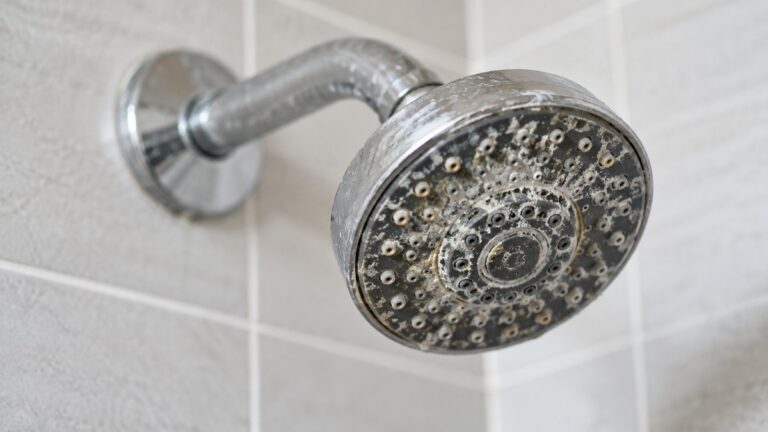
If your shower is weak, check the simple causes first. Look for a clogged inlet screen or mineral buildup in the nozzles. Check whether a water-saving restrictor is already installed in the head or the arm. Check whether other fixtures in the house are running at the same time. A new head can help when the nozzles are clogged or the spray pattern is wrong. It will not fix a supply that is low at the source. For related reading on low flow and high-pressure heads, see showerheads for low water pressure, high pressure shower heads with water saving, and removing a water saver from a shower head.
Filters and hard water
Some shower heads include a filter cartridge. Filters are a separate question from fit, and they carry claims that deserve care. The Penn State Extension page on water softening explains that softening works through an exchange process, in which water passes through an exchange media “known as resin or zeolite.” The page also explains hardness levels in grains per gallon and parts per million. It describes “Less than 17” parts per million as soft, and it gives the grains per gallon classes in a table.
A shower filter is not the same as a water softener. The softener described on the Penn State page is a whole-house system that uses resin. A shower filter sits at one fixture and treats only the water that comes out of that head. Several listings in the research set describe their filters as removing chlorine, heavy metals, or hard water minerals. Some also say they make water “softer.” The sources we opened do not confirm those claims for any listing in the set, and this guide does not repeat them as facts. If a filter is important to you, check the manufacturer’s certification documents, not the bullet text.
Anti-clog nozzles are a different feature. Many listings describe rubber or silicone nozzles that can be wiped clean. That is a design claim about cleaning, and it does not say the head removes minerals from the water. Wiping the nozzles can help keep the spray even, but it does not change the water that enters the head.
Products from the research set
These five listings show the range of fit questions described above. Each is included because its own listing text states a specification that affects whether it will work in a given shower. None is presented as a winner, and no ranking is implied by the order.
Pfister Universal Shower Head, 1.75 GPM. The listing title says the arm is not included. It states a 1.75 gpm flow rate and five spray modes. Before buying, confirm that you have a compatible arm. The listing also says the head “Meets or exceeds EPA WaterSense standards,” which is the manufacturer’s claim. View on Amazon
HammerHead Metal High Pressure Shower Head, 2.5 GPM. The listing gives a 2.5 gpm flow rate, which is the federal ceiling described above rather than the WaterSense target. It describes a 1/2 inch universal connection and includes thread seal tape and a rubber washer. The listing also says the head is adjustable up to 23 degrees on its pivot. If your shower already runs near the federal limit, this head will not reduce water use compared with a 2.5 gpm head. View on Amazon
SparkPod Rain Shower Head, 6 Inch Round. The listing ships set to 1.8 gpm and includes an additional water restrictor rated at 2.5 gpm. Removing the restrictor is a choice the listing describes, so check local rules and your own preference before doing so. The listing also says it hand-tightens onto “any standard 1/2 inch shower arm” and that it is covered by a one-year warranty. The listing describes the head as a rain-style head and recommends an S-shaped extension arm if you want overhead rain. View on Amazon
JDO High-Pressure 6-Setting Handheld Shower Head. This is a handheld set with a 59-inch stainless steel hose and an adjustable holder. The listing says the holder has a brass swivel joint and that the connection is a “universal G1/2” thread. Because it is handheld, check the holder position on your wall before you buy, and check whether your existing hose has the same thread at the wall outlet. The listing gives a 12-month warranty. View on Amazon
VRQUB High Pressure Fixed Showerhead, 1.8 GPM. The listing gives 1.8 gpm, a G 1/2 connection, and a wall-mounted fixed design. The bullet text says the head fits “any standard shower arm in minutes, without plumbers or tools.” Treat that as the seller’s claim, and confirm the thread on your arm before ordering. View on Amazon
How to check fit before you buy
Use this short check before ordering. If you are also comparing handheld models, the guide to hand held shower head extension hoses covers hose length in more detail. First, measure or inspect the threaded outlet on your existing arm. Second, confirm the arm type you have: fixed, adjustable, or none. Third, read the flow rate and compare it with the federal limit and the WaterSense target described above. Fourth, check whether the head includes a hose, a holder, plumber’s tape, or a washer. Fifth, read the warranty and return terms on the listing, since they can differ between sellers.
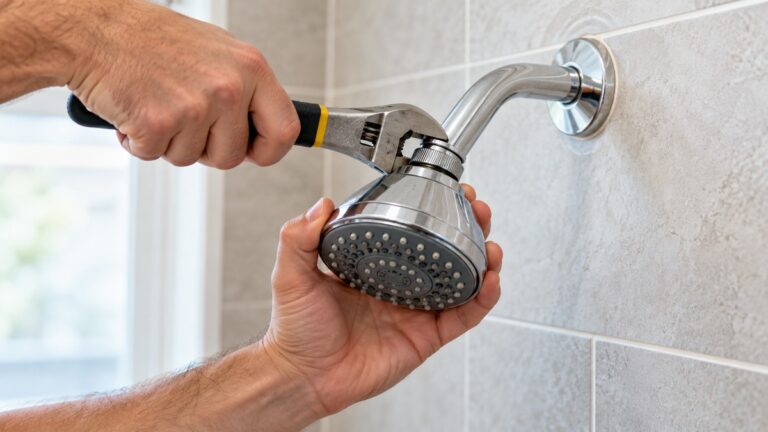
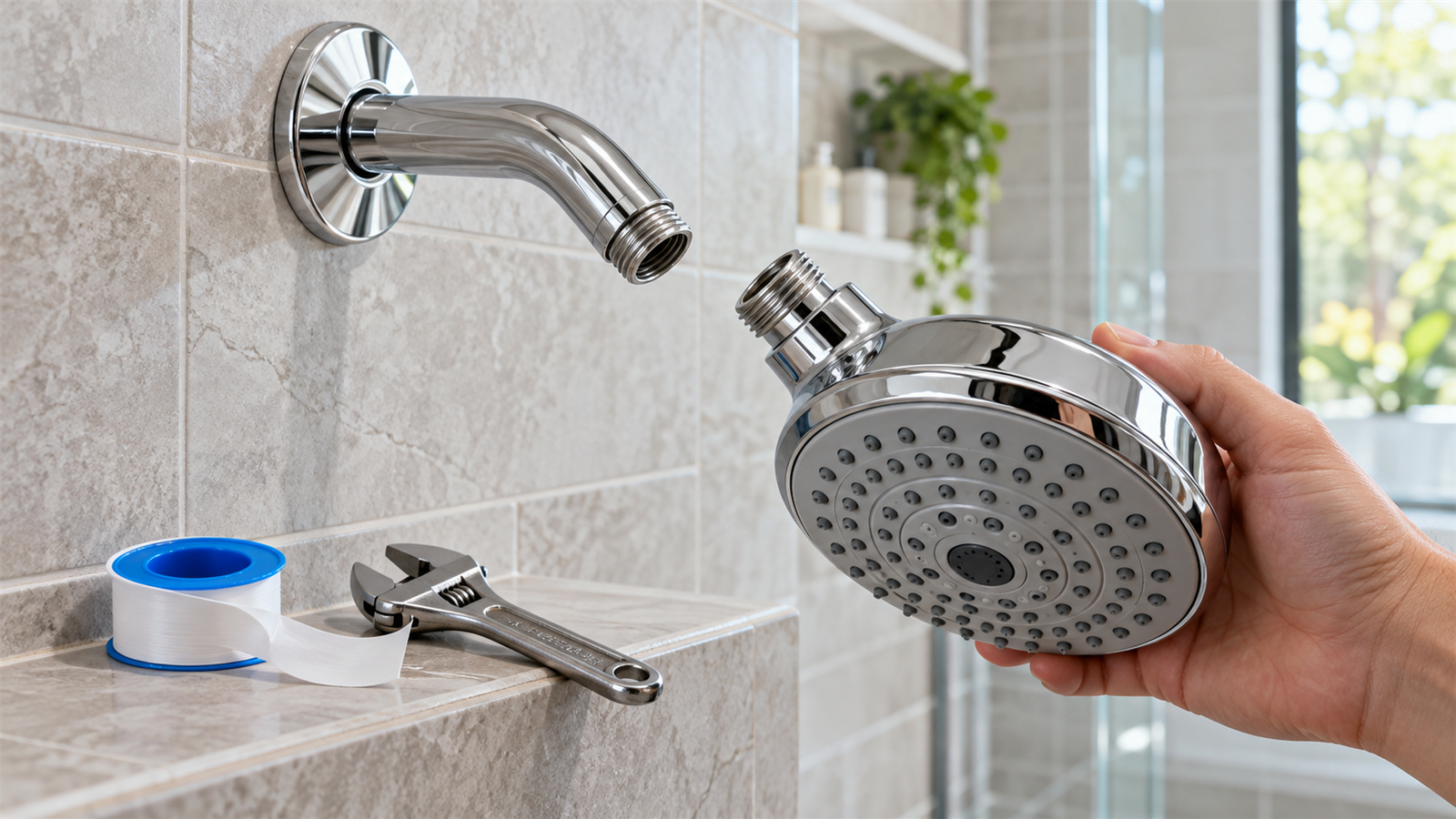
When you install the head, turn the water off at the valve first. Remove the old head by hand, and clean the threads. Wrap tape in the direction the threads turn. Thread the new head on by hand until it stops, then add a small amount of turn with a wrench if the instructions say to. Turn the water on slowly, and check the joint for drips. If the joint leaks, turn the water off, and check the washer and the tape before tightening more.
Do not remove or modify any flow-restricting part to raise the flow rate. A restrictor is part of the head’s design, and changing it can affect warranty coverage and may conflict with local rules. If you want more water, check the head’s stated flow rate first, and then decide whether a different head is the right fix.
What we could not verify: what the sources do not say
The sources we opened do not answer every question a buyer will have. The following points are not stated in any opened source, and this guide does not fill them from memory.
- The sources do not give the thread size of a typical shower arm, and they do not say whether a 1/2 inch NPT thread is the standard for arms. The thread size must be checked on the arm itself or in the arm’s manual.
- No opened source states how many wraps of plumber’s tape to use, or how much torque a shower head can take before the threads crack.
- The sources do not say whether a shower head can raise house water pressure. The EPA describes spray force and pressure compensation for the head only.
- The sources do not give a standard height for a shower head above the floor.
- The listings do not provide independent certification records for the filter claims or for the WaterSense statement on the Pfister listing.
- We did not open a filter cartridge replacement interval. The sources do not give one, so the product’s own stated instructions apply.
- The federal regulation text we opened is the 1994 limit. It does not describe the criteria for rain-style heads, and the sources do not say whether rain-style heads are measured differently.
FAQ
Are all shower heads the same size?
No. Many use a common connection, but the threads, arm types, and hose lengths vary. Check the thread on your existing arm and the connection text on each listing before buying.
Will any shower head fit a standard shower arm?
Many listings say they fit a standard arm, and several state a G 1/2 connection. That is a manufacturer’s claim. The sources we opened do not confirm fit for every arm, so check the threaded end of your arm before ordering.
What is the federal flow limit for showerheads?
The federal rule as published by Cornell’s Legal Information Institute sets the maximum at 2.5 gallons per minute for showerheads manufactured after January 1, 1994, measured at 80 pounds per square inch.
What does the WaterSense label require?
According to the EPA, a WaterSense showerhead must demonstrate that it uses no more than 2.0 gallons per minute. The label also checks spray force, spray coverage, and pressure compensation.
Does a shower filter soften hard water?
The sources we opened do not confirm that a shower filter softens water. Water softening, as described by Penn State Extension, uses an exchange process with resin or zeolite. Check the manufacturer’s certification for any filter claim.
Can a new shower head fix low water pressure?
It can help if clogged nozzles or the spray pattern are the cause. It cannot change the supply coming into your home, and the sources we opened do not say a head raises house pressure.
Bottom line
Shower heads are often universal in the sense that a common connection is widely used, but the word does not settle fit. Check the thread on your arm, check whether an arm or holder is included, and compare the flow rate with the federal limit and the WaterSense target. Treat manufacturer claims about fit and filtering as claims, and confirm the parts that matter before you order.
Sources
U.S. Environmental Protection Agency, WaterSense showerheads page, https://www.epa.gov/watersense/showerheads (opened 2026-10-27).
Legal Information Institute, Cornell Law School, 10 CFR 430.32 showerhead flow limit text, https://www.law.cornell.edu/cfr/text/10/430.32 (opened 2026-10-27).
Penn State Extension, Water Softening, https://extension.psu.edu/water-softening (opened 2026-10-27).