Does a High-Pressure Shower Head Add Water Pressure?
As an Amazon Associate we earn from qualifying purchases.
Does a high pressure shower head increase water pressure? None of the sources in this guide describes a shower head raising the pressure a house receives. WaterSense labelled shower heads are tested on spray force, flow rate and spray coverage. EPA says most users call spray force shower pressure, which is a different measure from the pressure in the supply pipes. This guide explains the difference and what to check on a head before you trust the words “high pressure.”
Quick answer
- The sources describe pressure falling along pipes and valves, not rising at an outlet. No opened source says a shower head raises house supply pressure.
- EPA’s WaterSense tests measure spray force, which most users call shower pressure. A labelled head must reach at least 2.0 ounces of spray force at 20 psi.
- The sources do not define “high pressure” on a box. Check the stated flow rating and any spray force figure the product gives.
Four measures that get mixed up
The word pressure covers several different things. The table separates them, with the figure or statement each source gives.
| Measure | What the sources say | Source |
|---|---|---|
| House supply pressure | Measured in psi; residential figure of about 40 to 60 psi that varies by location | Oklahoma State sheet (irrigation) |
| Pressure drop along pipe and valves | Friction drops pressure as water moves; restrictions increase the drop | Oklahoma State sheet; Alabama test |
| Spray force | Labelled heads must reach at least 2.0 ounces at 20 psi; EPA says most users call it shower pressure | EPA specification; EPA technical sheet |
| Flow rate | Labelled heads 2.0 gallons per minute or less; standard heads 2.5 gallons per minute | EPA specification; EPA consumer page |
Why a head cannot be shown to raise supply pressure
The opened pressure sources describe pressure falling along the line. The Oklahoma State sheet says pressure drops along a pipe as water moves, because of friction. The Alabama Cooperative Extension test says a pressure drop occurs when friction acts against water flowing through a pipe or valve. Restrictions take more pressure to keep the same flow, and the higher the flow through a restriction, the greater the drop. In the Alabama test, adding one hose bibb to the same supply increased the pressure drop to 24 psi and cut flow by 3.6 gallons per minute, or 35.3 percent.
The sources do not describe an outlet adding pressure upstream. A shower head sits at the end of the line, where water leaves the plumbing. When flow or pressure is low in a house with hard water, the Virginia Tech publication points to scale inside pipes: it says excessive mineral scaling can reduce water flow and pressure. That is a plumbing condition, not something a head changes.
What the WaterSense tests measure on a shower head
EPA’s WaterSense specification sets the test points for labelled heads. The table shows each requirement, the test condition, and the section of the specification that states it.
| Test | Requirement for a labelled head | Test condition | Section |
|---|---|---|---|
| Rated maximum flow | 2.0 gallons per minute or less | Highest value at 20, 45 and 80 psi | 3.1.1 and 3.1.2 |
| Minimum flow at 20 psi | At least 60 percent of the rated maximum | 20 psi at the inlet | 3.1.3 |
| Minimum flow at 45 and 80 psi | At least 75 percent of the rated maximum | 45 and 80 psi | 3.1.4 |
| Spray force | At least 2.0 ounces | 20 psi at the inlet, water flowing | 4.1.1 |
| Spray coverage | Limits on the share of water in the 2-inch, 4-inch and 6-inch rings | Test at 45 psi | 5.1 and Appendix B |
EPA’s consumer page says the performance criteria cover spray force, spray coverage and pressure compensation. Pressure compensation is described as keeping a minimum flow across a range of household water pressures. EPA says a user study found spray force and spray coverage were the criteria that most influenced satisfaction.
The specification tests the head at set inlet pressures. It does not test the house supply, and it does not say that a labelled head is designed to push supply pressure higher.
How spray force is tested
The specification mounts the head about 18 inches from a force target, with the spray centred on the target. Water flows at 20 psi at the inlet, measured by a gauge about 8 inches upstream. The head is adjusted only with its standard parts, and the flow runs for at least one minute. The head passes when the force balance rotates to zero or past it, and the balance is calibrated to the 2.0 ounce minimum. If the spray centre cannot reach the centre of the target, the head fails.
How spray coverage is tested
Spray coverage is measured with annular rings set under the head, with the top of the ring gauge about 18 inches from the faceplate. The test runs at 45 psi for at least one minute. The water in each ring is measured, and the share in each ring is calculated. Water in the 2-inch and 4-inch rings may not exceed 75 percent of the total, and the 2-, 4- and 6-inch rings together must hold at least 25 percent. If the total collected differs from the total calculated from flow rate and time by more than 5 percent, the test is repeated.
What “high pressure” can mean on a label
The opened sources do not define “high pressure” on a product page or box. Their own terms are spray force, flow rate and coverage. If a head is marketed as high pressure, the useful question is which figure it means. A spray force figure in ounces, with the test pressure stated, is a comparable number. A general phrase is not. For heads sold with a high-pressure spray, see the water-saving heads with a high-pressure spray roundup.
Spray force and supply pressure are different things. The specification measures spray force at 20 psi at the inlet, so the number describes the head’s output at that test pressure. It does not describe how much pressure the house delivers.
The Oklahoma State sheet shows that flow can rise with pressure at a nozzle. In its irrigation example, a sprinkler’s flow rose from 3.3 to 4.8 gallons per minute when pressure went from 30 to 50 psi. That is an irrigation example. The sources do not say a shower head’s flow rises the same way.
What the flow limit does and does not do
For a labelled head, the flow limit is a ceiling that applies at the tested pressures. The specification says the maximum flow measured at 20, 45 and 80 psi may not exceed the rated maximum, and that rated maximum must be 2.0 gallons per minute or less. A high-pressure label does not change that ceiling for a labelled head.
Standard heads are described differently. EPA says standard showerheads use 2.5 gallons per minute. The DOE installer job aid gives the same 2.5 gallon figure as the flow limit for new showerheads. A head rated above 2.5 gallons per minute is therefore outside both the federal figure and the WaterSense ceiling, but the sources do not say how many heads on the market exceed that figure.
A combination unit follows different rules. The WaterSense specification says each showerhead in a combination unit must meet the requirements, and the whole device must meet the flow limit in every operating mode. A dual unit with a fixed head and a hand-held head should therefore be checked in both modes, as covered in the dual shower head with a slide bar roundup.
What you can check on a box or listing
- The rated flow in gallons per minute, and whether the head carries the WaterSense label. The label means independent certification, according to EPA.
- Any spray force figure, in ounces, with the test pressure stated. A labelled head’s minimum is 2.0 ounces at 20 psi.
- For a head with more than one setting, check the modes. The specification says every mode must meet the flow limit, and at least one mode must meet all the requirements.
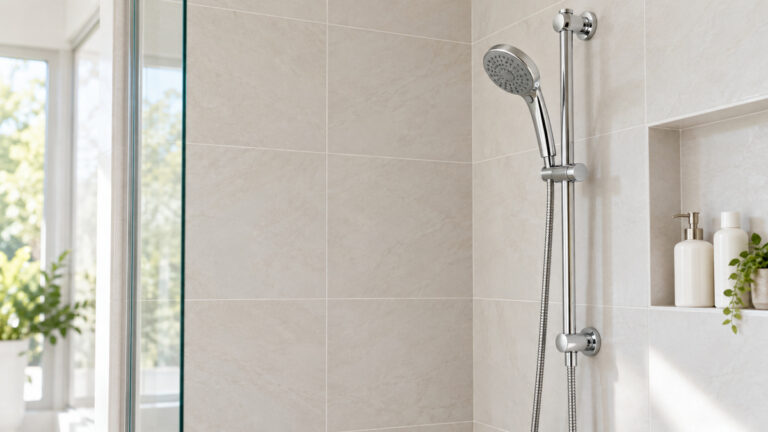
For hand-held models, the water-efficient hand-held shower heads roundup covers that group, and one high-pressure hand-held model has its own page.
The EPA technical sheet describes a home check of a showerhead’s marked flow: confirm that no more than 0.5 gallons is collected over 15 seconds of operation. That check is part of a home certification program, so consult the program for its protocol before you rely on it.
How we chose
This guide uses six sources, all opened on 2026-10-21. The EPA specification and the EPA consumer page describe the test points and the criteria for labelled heads. The EPA technical sheet adds the flow check and the spray force wording. The Oklahoma State sheet and the Alabama test explain pressure drop, and the Oklahoma State sheet is irrigation, so its flow example is labelled as irrigation. The Virginia Tech publication covers scale in pipes. The guide does not rank heads and does not compare products.
What we could not verify: what the sources do not say
- Whether any shower head raises house supply pressure. No opened source says it does.
- What “high pressure” means on any particular product. The sources do not define it.
- Spray force figures for heads that are not labelled. The sources do not give them.
- Spray force at house pressures above 80 psi. The specification tests spray force at 20 psi.
- Whether a shower head mists at high pressure. The Oklahoma State mist finding is for irrigation nozzles.
- The spray force criteria for rain showers. EPA says Version 1.1 changed the test for rain showers, but the criteria are not stated in the opened pages.
- The differences in Version 1.1 of the specification. EPA says the changes are minor, but that version was not opened for this guide.
Frequently asked questions
Does a high-pressure shower head increase water pressure in the house?
None of the opened sources says so. The sources describe pressure falling along pipes, and they describe the head as an outlet with its own flow and spray force. Supply pressure comes from the house plumbing and the utility, not from the head.
What does high pressure mean on a shower head?
The sources do not define it. EPA says most users call spray force shower pressure. For a labelled head, spray force has a minimum of 2.0 ounces at 20 psi. A stated figure with its test pressure is more useful than a general phrase.
Does a high-pressure head use more water?
For a labelled head, the flow measured at the tested pressures cannot exceed the rated maximum, and that maximum must be 2.0 gallons per minute or less. The specification tests 20, 45 and 80 psi. The sources do not give flow figures for unlabelled heads at high pressure.
If the house has low water pressure, will a new head fix it?
The sources do not say a new head raises house pressure. Virginia Tech points to scale inside pipes as a cause of reduced flow and pressure, and the Alabama test shows that restrictions cut flow. Those are plumbing conditions, so the head is not the first place the sources point.
What is the difference between spray force and flow?
Spray force is the force of the spray on a target, measured in ounces at 20 psi. Flow is the volume of water per minute, measured in gallons per minute. A head can have one figure without the other, and the specification tests both separately.
How is spray force measured?
With a force target and a balance fixture, at 20 psi at the inlet, with the head adjusted only through its standard parts. A labelled head must reach at least 2.0 ounces, and the test runs for at least one minute. The sources do not give spray force figures for unlabelled heads.
Bottom line
Judge a head by its stated flow rating and its spray force figure, with the test pressure. If a product gives only the words high pressure, the sources give no basis to expect the head to raise the house supply.
Sources
- U.S. EPA, WaterSense Specification for Showerheads, Version 1.0 (PDF, March 4, 2010). https://www.epa.gov/sites/default/files/2017-01/documents/ws-products-spec-showerheads.pdf (opened 2026-10-21)
- U.S. EPA, WaterSense: Showerheads (consumer page). https://www.epa.gov/watersense/showerheads (opened 2026-10-21)
- U.S. EPA, WaterSense Homes TRM 4: Showerheads Tech Sheet (July 2023, PDF). https://www.epa.gov/system/files/documents/2023-08/ws-homes-TRM-4-ShowerheadsTechSheet.pdf (opened 2026-10-21)
- Oklahoma State University Extension, Managing Pressure in the Home Irrigation System, HLA-6617. https://extension.okstate.edu/fact-sheets/managing-pressure-in-the-home-irrigation-system (opened 2026-10-21)
- Alabama Cooperative Extension System, Do Your Valves and Hose Bibs Restrict Water Capacity? https://www.aces.edu/blog/topics/farming/do-your-valves-and-hose-bibs-restrict-water-capacity/ (opened 2026-10-21)
- Virginia Tech Virginia Cooperative Extension, Hardness in Household Water, publication 442-664. https://www.pubs.ext.vt.edu/442/442-664/442-664.html (opened 2026-10-21)