Where to Find the GPM Marking on a Shower Head
As an Amazon Associate we earn from qualifying purchases.
Where to find the GPM marking on a shower head? For a WaterSense labelled head, EPA’s specification requires the maximum flow to be marked on the product and on the packaging, in gallons per minute and liters per minute. The sources do not say where on the head the mark must sit. This guide starts with the packaging, then the product, and gives the arithmetic for checking the number at home.
Quick answer
- Check the packaging first. For a labelled head, the packaging must carry the maximum flow, plus a minimum flow at 45 psi that the specification sets at 75 percent of the maximum.
- The product itself must be marked with its maximum flow in gallons per minute and liters per minute. The sources do not name a location on the head.
- For a home check, 0.5 gallons collected over 15 seconds equals 2.0 gallons per minute. The technical sheet ties that check to a home certification program.
What the specification requires the marking to say
The specification has four marking rules for labelled showerheads. The product must be marked with its maximum flow rate in gallons per minute and liters per minute, as the manufacturer specifies and as testing verifies. The packaging must carry the same maximum flow in both units. The packaging must also show the minimum flow at 45 psi, which the specification calculates as 75 percent of the maximum. The figures must be written at two or three digits of resolution, with the example given as 2.0 gpm, followed by 7.6 L/min in brackets. The specification also bars packaging or instructions that point to a setting that would override the rated maximum flow, and it requires maintenance instructions to show how to return the head to its intended maximum flow.
| Marking | Where the specification requires it | Example for a 2.0 gpm head |
|---|---|---|
| Maximum flow, gallons per minute and liters per minute | The product | 2.0 gpm [7.6 L/min] |
| Maximum flow, gallons per minute and liters per minute | The packaging | 2.0 gpm [7.6 L/min] |
| Minimum flow at 45 psi, 75 percent of the maximum | The packaging | 1.5 gpm; about 5.7 L/min by the same arithmetic |
The 1.5 gallon figure is simple arithmetic: 75 percent of 2.0 is 1.5. The liter figure is this guide’s own conversion of the same 75 percent, from the specification’s 7.6 liter equivalent of 2.0 gallons. The specification itself gives the 2.0 example in both units.
How to find the number, step by step
- Start with the packaging. The specification requires the maximum flow and the 45 psi minimum on it, so the box or insert is the most likely place to check first.
- Look at the product. The specification requires its maximum flow to be marked in gallons per minute and liters per minute. The sources do not say where on the head the mark appears, so read the whole product and its label.
- Read the figure. A labelled head’s marked maximum should be 2.0 gallons per minute or less, and the liters figure should match it.
- Check the modes. If the head has more than one setting, the specification says every mode must meet the maximum flow requirement, and at least one mode must meet all the requirements.
Mistakes to avoid
- Reading 1.5 as the flow rate. The 1.5 figure on the packaging is the minimum at 45 psi, calculated as 75 percent of the maximum. The maximum is the figure to compare with 2.0.
- Treating 7.6 L/min as a different flow. It is the same rated figure in liters, because 2.0 gallons per minute equals 7.6 liters per minute.
- Assuming a standard head is labelled. EPA says standard showerheads use 2.5 gallons per minute, and only a head that demonstrates 2.0 or less can carry the label.
- Stopping at the packaging. The specification requires the maximum on the product as well, so check both.
- Reading the marking as a guarantee of spray force. The flow marking does not report spray force.
What a marked number is, and is not
The marked maximum is a rating from testing. The specification takes the highest flow measured at 20, 45 and 80 psi, and that highest value may not exceed the rated figure. The sources do not give the pressure of any particular house, so the rating cannot tell you the flow at your own pressure.
The minimum rules apply as well. Flow at 20 psi must be at least 60 percent of the maximum, and the lowest flow at 45 and 80 psi must be at least 75 percent. EPA calls this pressure compensation, and says it ensures a minimum flow across a range of household water pressures. The flow tests also run with water at 100 degrees Fahrenheit, plus or minus 10, according to the specification’s appendix. For one high-pressure hand-held model, see the Yoo Mee hand-held page.
The marking covers flow only. The specification also sets a spray force of at least 2.0 ounces at 20 psi and limits on spray coverage, and the flow marking does not report either one.
Checking the marked number at home
The WaterSense technical sheet lists a verification step for the gallons-per-minute marking. The check is to confirm that no more than 0.5 gallons, or 64 ounces, of water is collected over 15 seconds of operation. That volume over that time is the same as 2.0 gallons per minute, because 60 seconds divided by 15 seconds is four, and 0.5 gallons multiplied by four is 2.0 gallons.
To run the check, collect the water from the head for 15 seconds with a timer, then measure the volume in ounces. The result reflects the flow at the pressure your home delivers, which the sources do not state, so it is not the specification’s test result. If the volume is 64 ounces or less, the head meets the 2.0 figure under this check. If it is more than 64 ounces, the head fails the check.
The technical sheet also says to obtain the make and model of each showerhead and check it in the WaterSense product search tool. This guide did not open that tool, so the sources do not confirm any model’s current status. The technical sheet also says to determine the maximum flow when all devices are operating in a compartment with several showering devices. It advises limiting how many devices can run at the same time. The sheet says to consult the home certification organization for the specific protocol, so treat this 15-second count as a home check, not a laboratory result.
Labelled, unlabelled and the federal figure
The federal figure for new showerheads is 2.5 gallons per minute, according to the DOE installer job aid. Its checklist says rated flows of new fixtures will be no more than 2.5 gallons per minute for showerheads. EPA’s consumer page says standard showerheads use 2.5 gallons per minute, and that a labelled head must demonstrate no more than 2.0.
The marked figure on a head can therefore be read against two thresholds. The table applies the two thresholds to three example markings.
| Marked maximum | Meets the WaterSense 2.0 ceiling? | Meets the 2.5 figure in the DOE checklist? |
|---|---|---|
| 2.0 gpm | Yes | Yes |
| 2.5 gpm | No | Yes, at the figure |
| Above 2.5 gpm | No | No |
The installer checklist also requires that equipment be installed in accordance with manufacturer instructions and applicable building codes, and that fixtures be fully functional, verified by testing. The job aid states the desired outcome as reduced energy and water use while occupant needs for water flow are maintained.
A head marked 2.5 gallons per minute cannot carry the WaterSense label, but it can meet the federal figure as the DOE checklist states it. The sources do not say what marking an unlabelled head must carry. If you are comparing heads, the water-efficient hand-held shower heads roundup covers one group of options, and heads sold with a high-pressure spray are covered in the water-saving heads with a high-pressure spray roundup.
Dual and combination heads
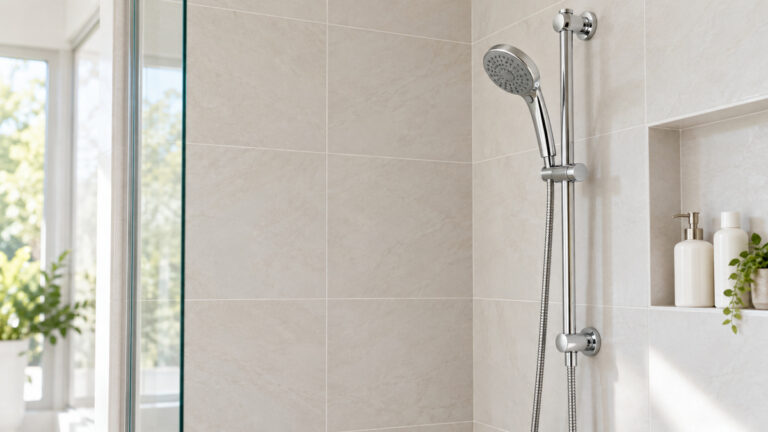
A combination device can carry the WaterSense label only if each showerhead in it meets the specification and the whole device meets the maximum flow in every operating mode. A fixed head and a hand-held head on one unit must each meet the specification, and the device as a whole must meet the flow limit in every mode. The dual shower head with a slide bar roundup covers that kind of unit.
The sources do not say whether a combination unit carries one marked figure or one figure for each outlet. Read the packaging and the product for each outlet’s mode, and check the figure for the mode you use most.
How we chose
This guide uses four sources, all opened on 2026-10-21: the EPA WaterSense specification, the EPA technical sheet, the DOE installer job aid, and the EPA consumer page. The specification is labelled Version 1.0, dated March 4, 2010, and the marking rules here come from that version. EPA’s consumer page says Version 1.1 followed in 2018 and made the marking consistent, but Version 1.1 was not opened for this guide. Each source was chosen because it states a marking rule, a verification step, or a federal figure, and the guide uses only those statements. The guide does not rank heads or name any product.
What we could not verify: what the sources do not say
- Where on the head the gallons-per-minute mark must sit. The specification requires the marking but does not state its location.
- Whether unlabelled heads carry a gallons-per-minute marking. The sources do not say.
- The size, font or wording of the marking on packaging. Not stated.
- The house water pressure during the 15-second check. The sources do not say which pressure the check assumes.
- The home certification organization’s protocol for the check. It was not opened.
- Whether a combination unit carries one figure or one per outlet. Not stated.
- Any change to marking rules in Version 1.1. The version was not opened.
Frequently asked questions
Where is the gpm marking on a shower head?
The specification requires the maximum flow to be marked on the product, in gallons per minute and liters per minute, and on the packaging. The position on the head is not stated in the sources, so check the packaging first, then read the whole product and its label.
Does every shower head have a gpm marking?
A WaterSense labelled head must carry one, because the specification requires it. The sources do not say what unlabelled heads must carry. The technical sheet’s verification step assumes a marked figure exists for a labelled head, which is why it tells the reader to verify the gpm marking on the showerhead itself.
What does 2.0 gpm [7.6 L/min] mean?
It is the same maximum flow written in two units. The specification uses this format as its example, with two or three digits of resolution. The 7.6 liter figure is the metric equivalent of 2.0 gallons per minute.
What is the 1.5 figure on the packaging?
It is the minimum flow at 45 psi. The specification calculates that minimum as 75 percent of the maximum. For a head rated at 2.0 gallons per minute, 75 percent is 1.5 gallons per minute.
How do I check a gpm marking at home?
Collect the water from the head for 15 seconds and measure the volume. If it is 64 ounces or less, the head meets 2.0 gallons per minute under this check. The technical sheet says the home certification organization sets the protocol, so follow that protocol where it applies.
Does a combination shower head have one marking?
The sources do not say. The specification requires each showerhead in a combination unit to meet the requirements, and the whole device to meet the maximum flow in every operating mode. Read the packaging and the product, and check the figure for the mode you use.
Bottom line
Read the packaging first. A WaterSense labelled head should show 2.0 gallons per minute or less, with the 7.6 liter figure in brackets. A labelled head without a marked maximum does not meet the specification’s marking rule.
Sources
- U.S. EPA, WaterSense Specification for Showerheads, Version 1.0 (PDF, March 4, 2010). https://www.epa.gov/sites/default/files/2017-01/documents/ws-products-spec-showerheads.pdf (opened 2026-10-21)
- U.S. EPA, WaterSense Homes TRM 4: Showerheads Tech Sheet (July 2023, PDF). https://www.epa.gov/system/files/documents/2023-08/ws-homes-TRM-4-ShowerheadsTechSheet.pdf (opened 2026-10-21)
- U.S. Department of Energy, Install a Low-Flow Showerhead, Weatherization Installer Job Aid 24-1 (PDF, July 2024). https://www.energy.gov/sites/default/files/2024-07/24-1_install-low-flow-showerhead.pdf (opened 2026-10-21)
- U.S. EPA, WaterSense: Showerheads (consumer page). https://www.epa.gov/watersense/showerheads (opened 2026-10-21)