Best Non Rust Shower Shelves for Five Installation Styles
As an Amazon Associate we earn from qualifying purchases. Details
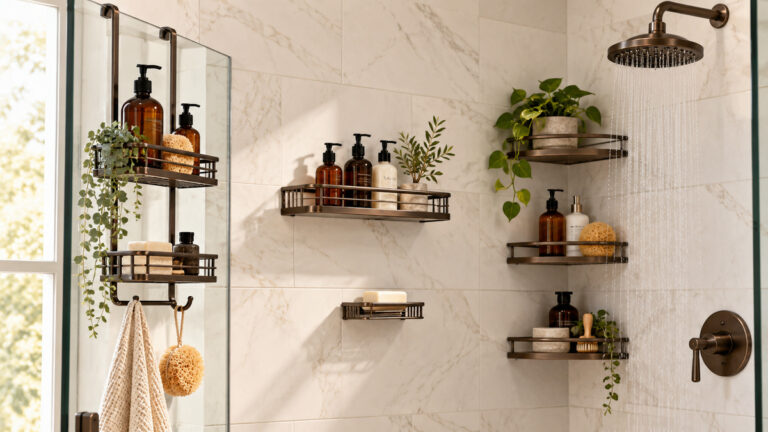
Non rust shower shelves should match both the wet setting and the surface that will support them. This guide helps you choose among a floor stand, suction-mounted baskets, adhesive corner shelves, a tension pole, and adhesive wall baskets. The key decision is not simply whether a listing says “rust resistant.” You also need a mounting method that suits your tile or wall, enough usable storage, and a drainage design that does not trap shower water. The five picks below use stainless steel or aluminum and make an explicit rust-related claim. Their installation demands differ sharply, so identify your surface and decide whether you can drill before comparing shelf count or accessories.
Quick answer
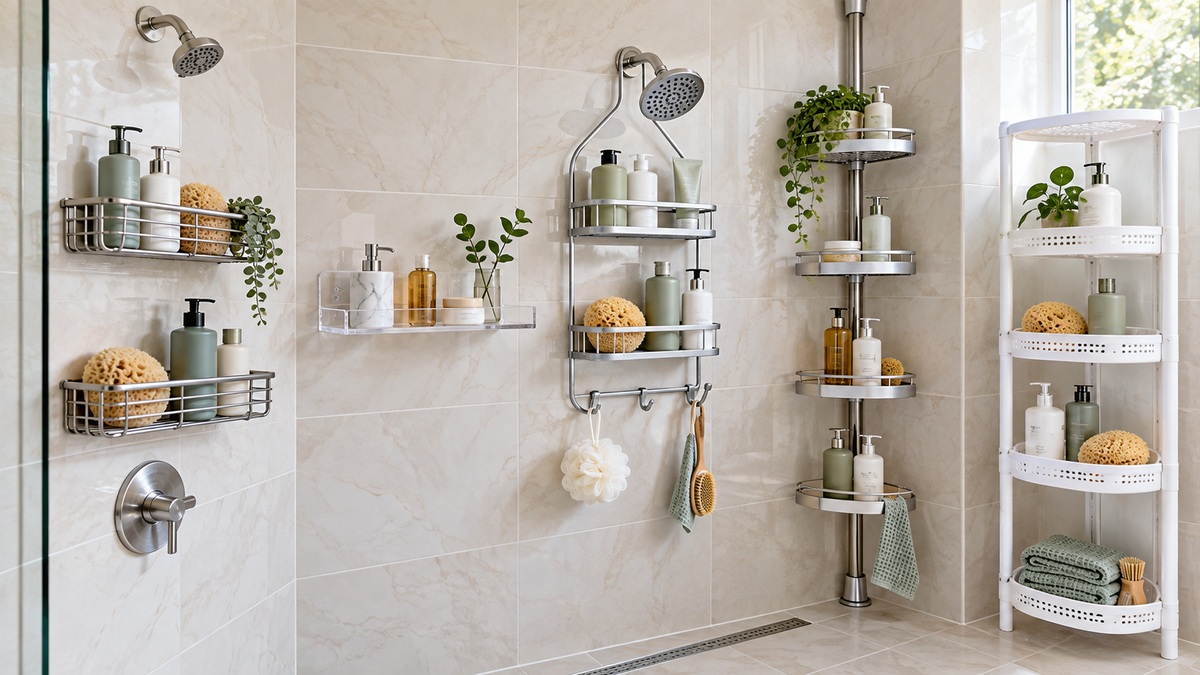
Choose the floor-standing pick when you want four compartments without attaching baskets to the wall. Select the suction-mounted corner set for smooth, non-porous tile, glass, or marble and easy removal. The adhesive corner pair suits a smooth corner when you want an adhesive or drilled installation path. Use the tension-pole organizer when vertical adjustment and four baskets matter more than a compact profile. The adhesive wall-basket set is the straightforward choice for a flat compatible wall and hanging accessories. If the surface is rough, painted, porous, interrupted by grout, or otherwise excluded by a listing, change the mounting method instead of assuming stronger adhesive will solve the mismatch.
What matters for non rust shower shelves
Require an explicit rust-related statement
Material alone does not settle this question. Stainless steel and aluminum appear across the selected products, but the useful evidence is the listing’s own rust-related wording. Look for “rustproof,” “rust resistant,” or a direct statement that the shelf will not rust. A finish name by itself does not explain how the maker describes use in a humid shower.
Treat the claim as a selection filter, not a promise that removes maintenance. Soap residue, standing water, and crowded bottles can interfere with drainage. Open or hollow shelf construction is therefore relevant because it gives water a route away from containers. When comparing two shelves with similar mounting methods, favor the one whose listing clearly addresses both material and drainage.
Match the mount to the actual surface
Mounting style can eliminate a shelf before capacity matters. Suction cups need the surface described by the maker. Adhesive systems also depend on surface texture, grout position, and preparation. A tension pole relies on the available vertical span and a suitable corner. A floor stand needs an open, stable floor area.
Renters may prefer a no-drill path, but “no drilling” is not the same as universal compatibility. A removable shelf can still be wrong for a porous or textured wall. Owners who accept drilling may have another installation route with some products, yet they should use only the hardware and method specified in the manual. Readers comparing adhesive options can also review these self-adhesive shower shelves before deciding.
Compare shelf geometry, not just shelf count
A four-tier corner unit and a two-basket wall set organize space differently. Corner shelves preserve the middle of the shower wall, while rectangular baskets can provide a longer front edge. A tension organizer uses height. A floor-standing organizer occupies the lower corner. Consider where bottles will be reached, whether hooks are useful, and whether a towel bar will compete with nearby fixtures.
Dimensions describe the outside product, not guaranteed usable bottle space. Rails, hooks, and curved corners can change how items sit. If a tall pump bottle is essential, check its height against the current product images and specifications. Do not infer clearance from the number of compartments alone.
Read capacity claims in context
Capacity figures can describe a total, a basket, or a maker’s recommendation. Do not treat differently labeled figures as identical. A shelf rated in pounds also needs a correctly prepared and compatible mounting surface. The capacity number does not override installation instructions.
Plan storage by grouping the bottles you genuinely keep in the shower. If the group is close to a listed maximum, select another layout or reduce the load rather than planning to operate at the edge. A sturdy shower shelf guide may help if carrying ability is the main concern.
Favor drainage that stays accessible
Open shelf bottoms and hollow designs are useful only when bottles do not block every opening. Arrange containers so water can leave the basket, and keep soap buildup from filling the gaps. This is especially important in a wet area: EPA reports that showering represents nearly 17 percent of residential indoor water use and nearly 40 gallons per day for an average family. That figure concerns water use, not shelf performance, but it explains why shower storage sees repeated moisture.
Five non rust shower shelf options
At a glance: the 5 picks, by their own spec fields
| Pick | Material | Mounting | Weight limit |
|---|---|---|---|
| HuggieGems 4-Tier Floor Standing | Stainless steel | Corner stand (floor) | 750 lb field — unusually large, verify on current listing before relying on it |
| VOLPONE Suction Corner 2-Pack | Aluminum, rust resistant | Suction cup (smooth, non-porous surfaces only) | 40 lb |
| Adhesive Corner Shelf 2-Tier | Aluminum | Wall mount (adhesive or drilled) | 22 lb |
| HAMITOR Tension Pole 4-Tier | Stainless steel | Tension mount, 11.5″D x 8.4″W x 124.02″H | 20 lb |
| Orimade Adhesive Wall Basket | Stainless steel | Wall mount, adhesive (non-reusable) | 10 lb |
1. HuggieGems 4 Tier Floor Standing Corner Shower Caddy Organizer Shelf with Hooks, Bathroom Shelves (Best floor-standing option)
Specs from the listing (checked 2026-10-11):
- Material: Stainless Steel
- Mounting Type: Corner Stand
- Number of Compartments: 4
- Item Weight: 1.87 kg
Pros
- Four compartments provide separate floor-level storage, and the listing says the shelves drain easily.
Cons
- The 750-pound capacity field is unusually large and should be verified on the current product page before it guides loading.
Best for: A shower with an open floor corner where wall attachment is undesirable.
Skip if: Floor space is limited or the corner cannot support a stable standing organizer.
View on Amazon (affiliate link)
2. VOLPONE Corner Shower Caddy Suction Cup, 2 Pack Shower Shelves No Drilling, Showers Organizer (Best suction corner set)
Specs from the listing (checked 2026-10-11):
- Special Feature: Rust Resistant
- Mounting Type: Suction Cup Mount
- Product Dimensions: 8.82"D x 11.97"W x 1.73"H
- Capacity: 40 pounds
- Unit Count: 2 Count
Pros
- The two-pack combines hollow aluminum shelves with a towel bar and six removable hooks.
Cons
- The suction base is intended for smooth, non-porous surfaces, excluding rough or porous walls.
Best for: Smooth tile, glass, or marble where removable corner storage is wanted.
Skip if: The available corner contains a textured surface or prevents full suction-cup contact.
View on Amazon (affiliate link)
3. Adhesive Corner Shelf Bathroom Shower Caddy Organizer for Kitchen Toilet No Drilling 2-Tier (Best dual-installation corner pair)
Specs from the listing (checked 2026-10-11):
- Material: Aluminum
- Special Feature: Durable, Easy to Install, Large Storage, Rust Resistant, Scratchproof, Waterproof
- Mounting Type: Wall Mount
- Product Dimensions: 8.86"D x 12.1"W x 1.77"H
- Maximum Weight Recommendation: 22 pounds
Pros
- The package supports either self-adhesive or drilled mounting and includes four hooks.
Cons
- Adhesive placement cannot cross a tile joint or grout line, and loading requires a 24-hour wait.
Best for: A smooth shower corner where the buyer wants a choice of adhesive or screw mounting.
Skip if: Neither supplied mounting method suits the wall or the pad area overlaps grout.
View on Amazon (affiliate link)
4. HAMITOR Corner Shower Caddy Tension Pole: Rustproof Stable 4-Tier Bathroom Organizer Shelves (Best adjustable tension organizer)
Specs from the listing (checked 2026-10-11):
- Material: Stainless Steel
- Mounting Type: Tension Mount
- Number of Shelves: 4
- Weight Capacity Maximum: 20 pounds
- Item Dimensions D x W x H: 11.5"D x 8.4"W x 124.02"H
Pros
- Four adjustable baskets, eight hooks, and a soap holder organize items vertically without a drilled wall basket.
Cons
- The pole only fits when the measured vertical span and contact points meet the maker's tension-installation requirements.
Best for: A compatible shower corner needing adjustable multi-tier vertical storage.
Skip if: The floor-to-ceiling measurement is outside the stated adjustment range.
View on Amazon (affiliate link)
5. Orimade Shower Caddy Basket Shelf with 5 Hooks Adhesive Organizer Storage Rack Rust Resistant Wall (Best adhesive wall baskets)
Specs from the listing (checked 2026-10-11):
- Material: Stainless Steel
- Special Feature: Rust Resistant, Self Sticking, Sturdy
- Mounting Type: Wall Mount
- Product Dimensions: 4.72"D x 12.6"W x 3.54"H
- Maximum Weight Recommendation: 10 pounds
Pros
- Two polished stainless steel baskets supply long rectangular storage and dedicated hanging hooks.
Cons
- The adhesive is non-reusable and is not suitable for painted, wallpapered, limed, concrete, or rough surfaces.
Best for: A compatible smooth flat wall where two adhesive baskets and hanging points are useful.
Skip if: The wall has a finish the listing excludes or future repositioning is likely.
View on Amazon (affiliate link)
First pick: four-tier floor-standing corner storage
The first pick is a stainless steel corner stand with four compartments. Its listing calls the material rustproof and describes the unit as sturdy, stable, and secure. It also says the shelves drain easily. Because the organizer stands on the floor, it avoids asking an adhesive patch or suction cup to carry the load on a wall.
The listed item weight is 1.87 kg. The capacity field says 750 pounds, but that unusually large figure should be checked on the current listing before it guides a load decision. The organizer includes hooks for brushes or related shower items and is described as easy to assemble. This format fits a shower with an open floor corner and a user who wants several storage levels.
Skip it if floor space is tight, the corner is uneven, or you specifically need wall-mounted storage above fixtures. Also skip it if you cannot confirm how the maker intends the stated capacity to be interpreted. A standing rack changes the cleaning path around the shower floor, which is a meaningful tradeoff even without wall preparation.
Second pick: suction-mounted aluminum corner pair
The second pick uses suction cups and comes as a two-count set. Each triangular shelf measures 8.82 inches deep by 11.97 inches wide by 1.73 inches high. The listing describes a 40-pound capacity and says the thickened aluminum is rust-proof, scratch-proof, and corrosion-resistant. Its hollow construction is intended for drainage.
This set adds one towel bar and six removable hooks. The maker identifies smooth, non-porous tile, glass, and marble as suitable surfaces. Installation requires pressing the base against a flat, smooth surface, while removal involves gently lifting the suction-cup edge. That makes the pair useful when repositioning matters and the shower wall meets the stated surface conditions.
Do not choose it for rough, porous, or uneven walls. Suction performance depends on surface contact, so the capacity statement does not make an incompatible wall acceptable. Skip it as well when the triangular footprint conflicts with corner trim or a nearby shower control. Measure the available corner rather than judging fit from a product photo.
Third pick: adhesive or drilled aluminum corner shelves
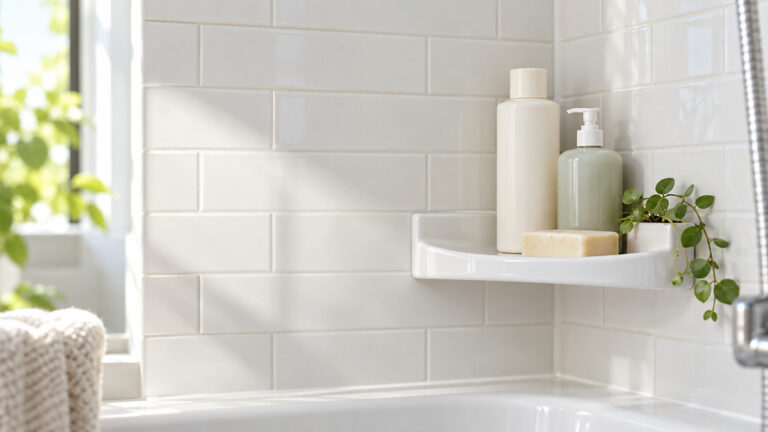
The third pick is an aluminum two-pack with two triangular compartments and four hooks. Each shelf is listed at 8.86 inches deep by 12.1 inches wide by 1.77 inches high. The special-feature field includes rust resistance, scratch resistance, and waterproof construction. A hollow, ventilated form is intended to let water drain from stored items.
Its main advantage is the choice between adhesive installation and drilling. The included-components field names four strong self-adhesive pieces and a screw-mounting kit. The listing gives a 22-pound maximum recommendation and tells adhesive users to wait 24 hours before loading the shelf. It also warns against placing an adhesive sticker over a tile joint or grout line.
This option fits someone who wants corner storage but has not yet committed to one mounting route. Skip the adhesive route if the surface is not smooth or if the available position crosses grout. Skip the product entirely if neither the adhesive instructions nor the supplied screw method suits the wall. The two routes still require careful placement; they are not interchangeable shortcuts.
Fourth pick: adjustable four-shelf tension pole
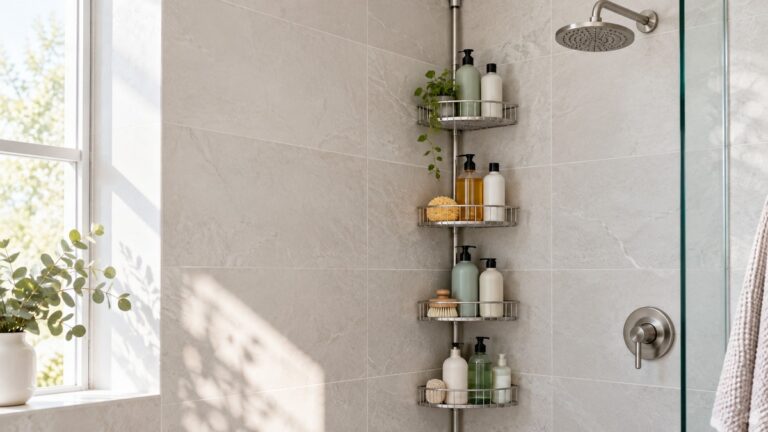
The fourth pick uses a tension mount rather than a wall basket or floor-only frame. Its stainless steel organizer has four rustproof shelves and an advertised adjustment range of 47–121 inches. The listing describes rust resistance, moisture resistance, waterproof construction, scratch resistance, and hollow shelf drainage. It includes eight stainless steel pole sections, four patented clips, a soap holder, and a fixed buckle.
The stated overall dimensions are 11.5 inches deep by 8.4 inches wide by 124.02 inches high, while the item weighs 6.8 pounds. The listing says each basket carries 20 LBS and describes the clip-on layout as a way to adjust shelf height. This design suits a user who wants vertical separation between bottles and can verify that the tension range matches the intended location.
Skip it when the measured floor-to-ceiling span falls outside the maker’s range or when the top and bottom contact points cannot support the specified setup. It also demands more vertical assembly than a single adhesive basket. Check the current manual for placement and tightening rather than inferring installation steps from the pole count.
Fifth pick: polished stainless steel wall baskets
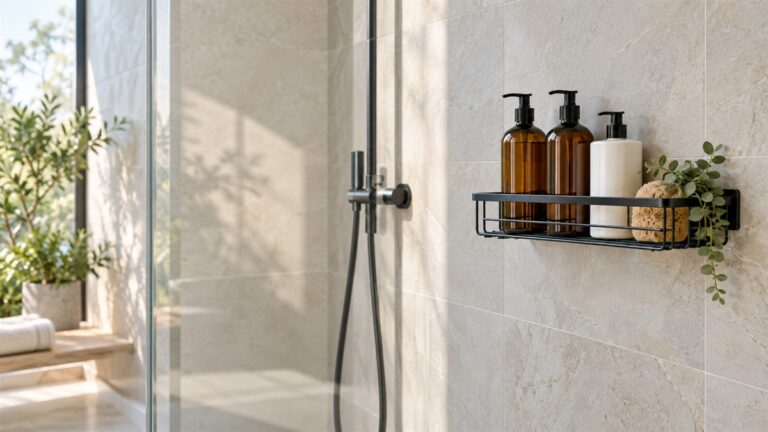
The fifth pick provides two rectangular stainless steel baskets, three adhesives, and five hooks per the title and bullet details. Each basket is listed at 4.72 inches deep by 12.6 inches wide by 3.54 inches high. The maximum weight recommendation is 10 pounds. Its polished finish and explicit rust-resistant feature make it a direct option for flat-wall shower storage.
The listing says installation does not require drilling. It also states that the adhesive is not reusable, although the rack can be removed from its adhesive hooks. Two side hooks accommodate a razor or washcloth, while three front hooks are described for a sponge or towels. This set suits users who want long baskets rather than triangular corner trays.
Skip it for painted walls, wallpaper, limed walls, concrete, or other rough surfaces identified as unsuitable by the maker. Because replacement positioning requires attention to the non-reusable adhesive, decide the height and spacing before pressing it into place. Users who want more alternative layouts can compare mounted shower shelves and rust-proof shower racks.
How to choose among the five mounting styles
Start with exclusion rather than preference. Remove any option whose mounting requirements conflict with the shower. A suction shelf needs the maker’s approved smooth, non-porous surface. An adhesive shelf needs a compatible smooth area without an interfering grout line. A pole needs a verified vertical span. A floor stand needs free space at its base.
Next, map the storage layout. Count groups, not individual containers: daily bottles, soap, razors, brushes, and hanging items. Four separated tiers can keep groups apart, while two long baskets may make frequently used items easier to scan. Hooks matter only if their position is reachable and does not put a towel directly in the water path.
Then compare dimensions with the available area. Measure depth, width, and any obstruction created by trim, plumbing controls, or a shower door. Product dimensions are exterior measurements, so confirm usable interior space on the product page. For corner options, check both walls rather than measuring just the front opening.
Finally, read the current listing and manual immediately before installation. Confirm what comes in the box, the preparation sequence, waiting time, and surface restrictions. If the product page and packaging disagree, follow the maker’s current instructions or ask the manufacturer. Rust-related language cannot compensate for an installation that ignores the stated surface.
Worked example: selecting a corner shelf by measured fit
Suppose an available corner has 13 inches along each wall, and a nearby control begins 2 inches beyond the proposed shelf edge. We compare the two measured corner baskets whose listed widths are 11.97 inches and 12.1 inches.
For the first candidate, subtract its width from the available wall run: 13 inches − 11.97 inches = 1.03 inches of remaining wall length. Check the arithmetic in reverse: 11.97 inches + 1.03 inches = 13 inches. With the separate 2-inch control gap, the planned remaining distance is 1.03 inches + 2 inches = 3.03 inches. Reverse-check that sum: 3.03 inches − 2 inches = 1.03 inches.
For the second candidate, calculate 13 inches − 12.1 inches = 0.9 inches. Verify it: 12.1 inches + 0.9 inches = 13 inches. Add the same control gap: 0.9 inches + 2 inches = 2.9 inches. Recheck by subtraction: 2.9 inches − 2 inches = 0.9 inches.
Both widths fit the hypothetical wall run, but this calculation does not prove usable bottle space or mounting compatibility. The suction model still requires an approved non-porous surface, while the other corner model requires a suitable adhesive or drilled installation. Confirm the depth, control clearance, and actual corner angle before choosing.
Common mistakes that shorten the decision process for the wrong reason
Treating every “rust” phrase as the same promise
Listings use rustproof, rust resistant, and will-not-rust language. Record the exact claim for each candidate rather than silently upgrading one phrase into another. The product page should remain the authority for the chosen model.
Starting with the capacity number
A large capacity statement is irrelevant if the mount does not suit the wall. Surface, installation method, and shelf geometry come first. After those checks, use the capacity field only in the context supplied by that listing.
Crossing grout with an adhesive pad
One selected corner shelf explicitly warns that no tile joint or grout line should sit beneath its adhesive sticker. Inspect the complete pad area, not merely the center point. If the required clear area is unavailable, use another approved method.
Assuming all no-drill systems are movable
Suction, adhesive, tension, and floor-standing products all avoid a conventional drilled basket, but they behave differently after installation. One adhesive in this group is specifically described as non-reusable. Decide whether relocation matters before selecting the mount.
Measuring only the empty wall
Include controls, door travel, trim, and the reach path to bottles. A shelf that technically fits can still block a handle or crowd a door. Use the listed exterior dimensions for the first screen, then confirm the full geometry on the current product page.
Keeping drainage and mounting areas inspectable
Follow the maker’s cleaning and care directions for the selected finish. Keep drainage openings visible and remove residue before it blocks them. Do not use a cleaner merely because it is suitable for another metal or coating; verify compatibility in the manual.
Inspect attachment points when you clean the surrounding wall. If an adhesive edge lifts, a suction cup loses contact, a pole shifts, or a floor stand becomes unstable, unload the shelf and follow the maker’s reset instructions. Do not use the listed weight figure as a reason to keep loading a mount that has visibly changed.
For a broader comparison of materials and layouts, see stainless steel shower caddies and metal corner shower shelves. Those formats may suit a different surface or storage plan better than the five configurations here.
FAQ
Are stainless steel shelves automatically rustproof?
No. Use the product’s explicit claim rather than inferring performance from “stainless steel.” The selected shelves use phrases such as rustproof, rust resistant, or rust-resistant material. Those descriptions help screen candidates, but they do not replace the maker’s care instructions. Confirm the current finish and rust wording on the product page because similarly shaped shelves can use different materials or coatings.
Can a suction shower shelf attach over grout?
The suction option here is described for smooth, non-porous surfaces such as tile, glass, and marble. A grout line interrupts that smooth contact area, so do not assume it will hold there. Find a position where the entire suction base meets an approved surface. If the shower lacks that area, choose a compatible tension, floor-standing, drilled, or adhesive arrangement instead.
How long should an adhesive corner shelf sit before loading?
One selected aluminum corner set instructs users to wait 24 hours before use. That waiting period belongs to that product and should not be transferred to every adhesive shelf. Follow the instructions supplied with the exact set you buy. Prepare the surface as directed, keep its pads away from grout where required, and avoid loading the basket until the stated sequence is complete.
Is a tension pole suitable for every shower height?
No. The selected tension unit lists a 47–121 inch adjustment range. Measure the intended vertical span before ordering and verify the maker’s current fit directions. A number inside that range is only the first check; the top and bottom contact locations must also suit the installation method. If either endpoint is unsuitable, use another shelf format rather than forcing the pole.
Which layout works when drilling is not allowed?
The group includes suction, adhesive, tension, and floor-standing approaches that do not require a conventional drilled wall basket. Choose among them by surface and available space. Smooth, non-porous walls may suit suction; compatible smooth walls may suit adhesive; a measurable corner may accept a tension pole; and an open floor corner may accept a stand. Follow each maker’s restrictions.
Should I choose the shelf with the highest listed capacity?
Not by that figure alone. Capacity fields may refer to different parts or use different wording, so first confirm mounting compatibility and physical fit. One floor unit even carries a 750-pound field that deserves verification on the current product page before use. Treat unclear or unusually large figures cautiously and never let them override the installation instructions.
How do I keep water from collecting around bottles?
Choose a shelf whose listing describes an open, hollow, or draining design, then leave those openings unobstructed. Bottle placement can cover drainage paths even when the shelf itself has slots. Clean residue according to the maker’s directions and inspect the basket during routine cleaning. If water continues to pool, rearrange the containers or select a geometry with more accessible drainage.
Bottom line
Choose the floor stand for four low corner levels, the suction pair for a verified smooth non-porous surface, or the adhesive corner set when its mounting area clears grout. Pick the tension pole when the measured height matches its stated range and vertical organization is the priority. Use the adhesive wall baskets for a compatible flat surface and straightforward hook storage. Surface fit comes first; a rust-related claim and capacity number matter only after the mounting method works in your shower.
Sources
- EPA WaterSense showerheads: supports the residential shower-water-use figures used to explain repeated moisture exposure.