What the WaterSense Label Means on a Shower Head
As an Amazon Associate we earn from qualifying purchases.
What does the WaterSense label mean on a shower head? It means EPA has certified the head against its WaterSense specification. That specification caps rated flow at 2.0 gallons per minute and sets minimum tests for flow at set pressures, spray force and spray coverage. This guide explains each requirement, how a head earns the label, and which version of the specification the criteria come from. The criteria here come from Version 1.0, and that is stated throughout.
Quick answer
- The label means the head meets EPA’s WaterSense specification: rated flow of 2.0 gallons per minute or less, minimum performance tests, and independent certification. Standard heads are described at 2.5 gallons per minute.
- EPA says the label is meant to ensure a satisfactory shower equal to or better than conventional showerheads. The criteria it names are spray force, spray coverage and pressure compensation.
- The criteria in this guide come from the Version 1.0 PDF dated March 4, 2010. EPA’s page says Version 1.1 followed in 2018 with minor changes, and that version was not opened for this guide.
What the label promises: 2.0 gallons per minute
EPA’s consumer page says standard showerheads use 2.5 gallons per minute. A head that carries the WaterSense label must demonstrate that it uses no more than 2.0 gallons per minute. The specification requires the manufacturer to state a rated maximum flow at or below 2.0 gallons per minute. Its metric equivalent is 7.6 liters per minute.
The WaterSense technical sheet says a labelled head’s maximum flow of 2.0 gallons per minute is 20 percent less than the current federal standard. The U.S. Department of Energy job aid for installers gives the federal figure directly: rated flows of new showerheads should be no more than 2.5 gallons per minute. The two figures agree, because 2.0 gallons per minute is 20 percent below 2.5.
| Benchmark | Flow figure | Source |
|---|---|---|
| Standard showerhead, as EPA describes it | 2.5 gallons per minute | EPA consumer page |
| Federal figure for new showerheads, as the installer job aid states it | 2.5 gallons per minute or less | DOE job aid 24-1 |
| WaterSense labelled head, rated maximum | 2.0 gallons per minute or less | EPA specification, section 3.1.1 |
The specification’s scope covers fixed showerheads and hand-held showers, and it excludes body sprays. It also bars packaging or instructions that point to a setting that would override the rated maximum flow. Any maintenance instruction must show how to return the product to its intended maximum flow. The rule implies that cleaning or servicing can change a head’s flow, so the instructions must show how to return it to the rated figure.
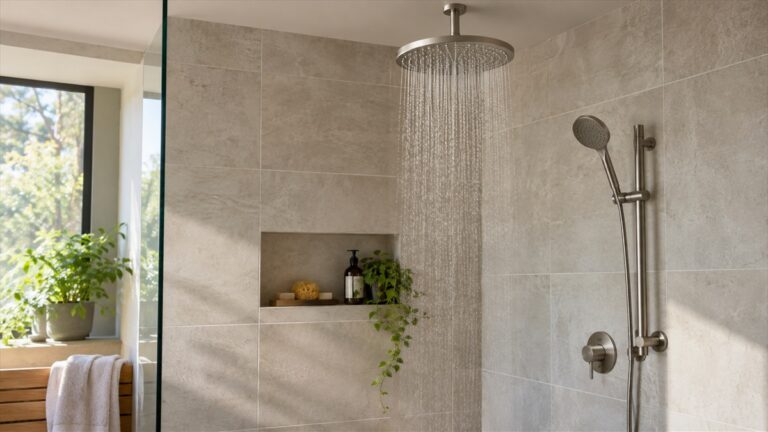
The federal rule covers more than fixed heads. The DOE page says the Energy Policy and Conservation Act defines a showerhead as any showerhead, including a handheld showerhead, except a safety shower. The WaterSense label applies to fixed heads, hand-held showers and rain showers, according to the technical sheet. For hand-held models, see the water-efficient hand-held shower heads roundup.
How a head earns the label
A manufacturer needs a signed WaterSense partnership agreement with EPA before it submits products for testing. The specification’s appendix says the product’s conformance must be certified by an EPA licensed certifying body, accredited under the WaterSense product certification system. The consumer page adds that labelled products must be independently certified to meet EPA’s water efficiency and performance criteria.
The technical sheet adds a rule for showers with more than one showering device. The maximum flow must be determined with all devices running, and the sheet advises limiting how many can run at the same time. The home certification organization gives the protocol for that check, so consult it before relying on a count.
The technical sheet lists what that certification covers: minimum flow rate, spray force and spray coverage. It also lists the household steps. Obtain the make and model of each showerhead, check it in the WaterSense product search tool, and verify the marked gallons-per-minute figure. The product search tool is EPA’s own lookup, and this guide did not open it, so it is named here only as the tool EPA recommends.
The performance tests behind the label
The specification is written to ensure sustainable, efficient water use and a high level of user satisfaction. The table lists each requirement with the consumer-facing reason EPA gives for it, where a source gives one.
| Requirement | Test condition | What EPA says it does |
|---|---|---|
| Rated maximum flow of 2.0 gallons per minute or less | Highest value at 20, 45 and 80 psi | Keeps water use efficient |
| Minimum flow at least 60 percent of rated maximum | 20 psi at the inlet | Pressure compensation across household pressures |
| Minimum flow at least 75 percent of rated maximum | 45 and 80 psi | Pressure compensation across household pressures |
| Spray force at least 2.0 ounces | 20 psi at the inlet, flowing | Sufficient force for user satisfaction |
| Spray coverage within set ring limits | 45 psi, one minute | Adequate coverage, not too narrow or too wide |
| Marking of rated flow in gallons per minute and liters per minute | Product and packaging | Not stated |
Spray force and spray coverage are the criteria that the EPA user study found most influenced satisfaction. The specification describes the spray force test in an appendix: the head is mounted about 18 inches from a force target, water flows at 20 psi, and the spray centre must line up with the target centre. The coverage test measures how the water spreads across the rings, and it sets limits on the share landing in the inner rings. For heads marketed as high-pressure, the water-saving heads with a high-pressure spray roundup is the next place to look.
The specification also sets marking rules. The product must be marked with its maximum flow in gallons per minute and liters per minute, and the packaging must carry the same figure. The packaging must also show a minimum flow at 45 psi, which the specification sets at 75 percent of the maximum. For a head rated at 2.0 gallons per minute, that calculation gives 1.5 gallons per minute at 45 psi. The specification’s example format is 2.0 gpm with 7.6 L/min in brackets.
A labelled head also has to meet the rules for each mode.
The specification says that if a head has more than one mode, every mode must meet the maximum flow requirement, and at least one mode must meet all the requirements. For a combination device, each showerhead must meet the specification, and the whole device must meet the flow limit in every operating mode. A dual unit of this kind is covered in the dual shower head with a slide bar roundup.
What EPA says the label saves
EPA says showering accounts for nearly 17 percent of residential indoor water use. It says the average family could save 2,700 gallons per year by installing WaterSense labelled showerheads, and more than 330 kilowatt hours of electricity annually, because less hot water is heated. These are EPA estimates. The sources do not show how the figures were calculated, so treat them as EPA’s numbers, not as a measured result for your home.
Version 1.0 and Version 1.1
The specification PDF this guide read is labelled Version 1.0, dated March 4, 2010, and effective February 9, 2010. Every requirement in the sections above comes from that version.
EPA’s consumer page says it released Version 1.1 in July 2018. EPA describes the changes as minor and as clarifications of existing requirements, and says the revision also changes the spray force test to accommodate water-efficient rain showers. The page says Version 1.1 replaces Version 1.0, and that the updates ensure labelled showerheads are tested, marked and labelled consistently. This guide did not open Version 1.1, so it does not state its wording. If the label on a head is based on Version 1.1, check that version before relying on the figures here.
What the label does not cover
The specification covers flow, spray force, spray coverage, marking and certification. It does not describe water quality, filtering, or any treatment of hard water. A WaterSense label is therefore a statement about flow and spray performance, not about what is in the water. Virginia Tech notes that hard-water devices do not change the hardness of the water, which is a separate question from this label.
The technical sheet also describes thermostatic shutoff valves, which slow water to a trickle after hot water arrives so that less water is wasted while the shower warms. The specification does not mention them, so they are a separate choice from the head label.
The label is also not a federal flow rule. It is an EPA program with its own test points. The federal figure for showerheads comes from a separate standard, which the DOE page describes.
How we chose
This guide uses five sources, all opened on 2026-10-21. The EPA specification and the EPA consumer page describe the label’s criteria. The EPA technical sheet describes certification and the home check. The DOE pages give the federal figure and the scope of the federal rule. The Oklahoma State sheet and the Alabama test are used only to explain pressure drop, and the Virginia Tech publication is used only to mark what the label does not cover. The guide does not rank heads or name any product.
What we could not verify: what the sources do not say
- The wording of Version 1.1 of the specification. EPA says the changes are minor, but that version was not opened.
- The spray force criteria for rain showers. EPA says Version 1.1 changes the test for rain showers, and the criteria are not stated in the opened pages.
- The current list of labelled models. The product search tool was not opened.
- The ASME and CSA plumbing test standard that the specification refers to. It was not opened.
- How EPA’s savings estimates were calculated. The sources do not show the method.
- How the marking must appear on packaging. The specification requires the marking, but the sources do not state its placement or format beyond the examples.
Frequently asked questions
Does the WaterSense label mean a shower head is low-flow?
Yes, in the sense that the rated maximum must be 2.0 gallons per minute or less. Standard heads are described at 2.5 gallons per minute, so a labelled head is at least 20 percent lower on its rating.
Does the label guarantee a good shower?
No label guarantees a particular experience. EPA says the label is meant to ensure a satisfactory shower equal to or better than conventional showerheads, and it names spray force and coverage as the criteria that most influenced user satisfaction. The sources do not give user survey results for individual models. Each model’s own tested figures are the better guide, and one high-pressure hand-held model is covered on its own page.
Who certifies a labelled shower head?
An EPA licensed certifying body, accredited under the WaterSense certification system, certifies conformance. The manufacturer must have a signed partnership agreement with EPA first. EPA’s page adds that labelled products must be independently certified.
Is the WaterSense label the same as the federal limit?
No. The federal figure for new showerheads is 2.5 gallons per minute, according to the DOE job aid. The WaterSense ceiling is 2.0 gallons per minute. The label is an EPA program with its own tests, and the federal figure comes from a separate standard.
How do I find a labelled model?
EPA recommends its WaterSense product search tool, which lists models that have earned the label. This guide did not open that tool, so the sources do not confirm any model’s current status.
What do the savings figures mean for a home?
EPA says the average family could save 2,700 gallons per year and more than 330 kilowatt hours of electricity annually with labelled showerheads, because less water is heated. These are EPA estimates for an average family. The sources do not give a figure for a specific home or show the calculation.
Bottom line
Look for the WaterSense label, then confirm the rated maximum of 2.0 gallons per minute or less on the product or packaging. If the head is labelled under Version 1.1, check that version too, because this guide read only Version 1.0.
Sources
- U.S. EPA, WaterSense: Showerheads (consumer page). https://www.epa.gov/watersense/showerheads (opened 2026-10-21)
- U.S. EPA, WaterSense Specification for Showerheads, Version 1.0 (PDF, March 4, 2010). https://www.epa.gov/sites/default/files/2017-01/documents/ws-products-spec-showerheads.pdf (opened 2026-10-21)
- U.S. EPA, WaterSense Homes TRM 4: Showerheads Tech Sheet (July 2023, PDF). https://www.epa.gov/system/files/documents/2023-08/ws-homes-TRM-4-ShowerheadsTechSheet.pdf (opened 2026-10-21)
- U.S. Department of Energy, Showerheads (program page). https://www.energy.gov/eere/buildings/showerheads (opened 2026-10-21)
- U.S. Department of Energy, Install a Low-Flow Showerhead, Weatherization Installer Job Aid 24-1 (PDF). https://www.energy.gov/sites/default/files/2024-07/24-1_install-low-flow-showerhead.pdf (opened 2026-10-21)