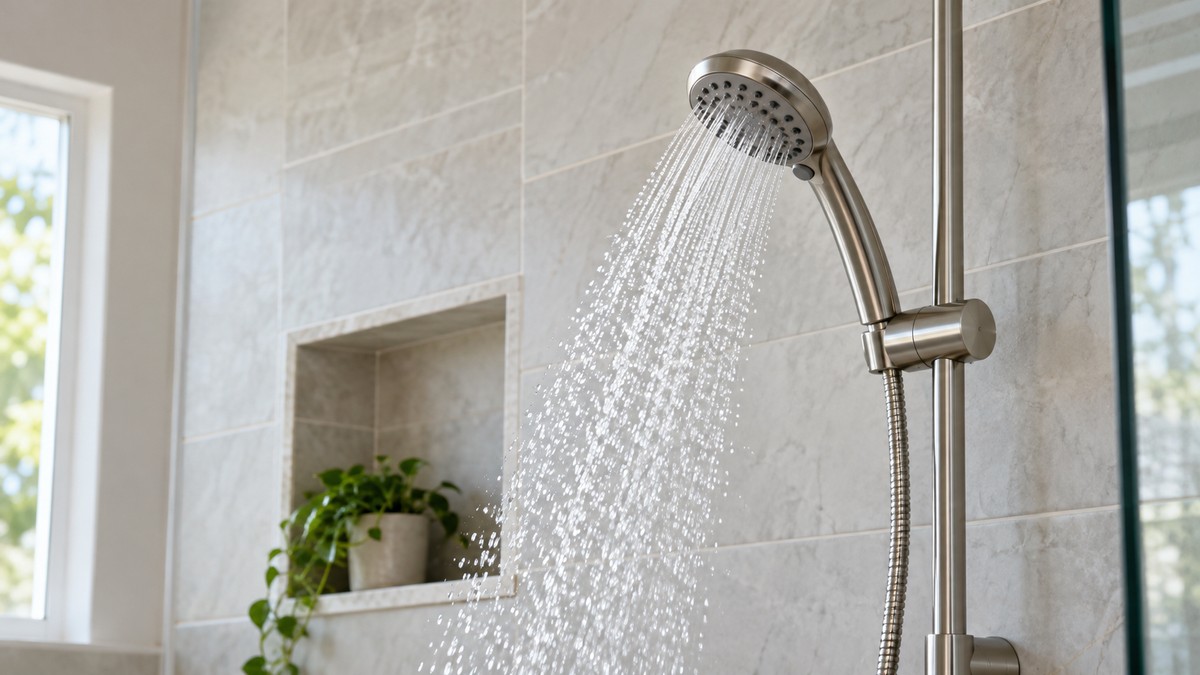
What Is a Handheld Shower Head?
As an Amazon Associate we earn from qualifying purchases.
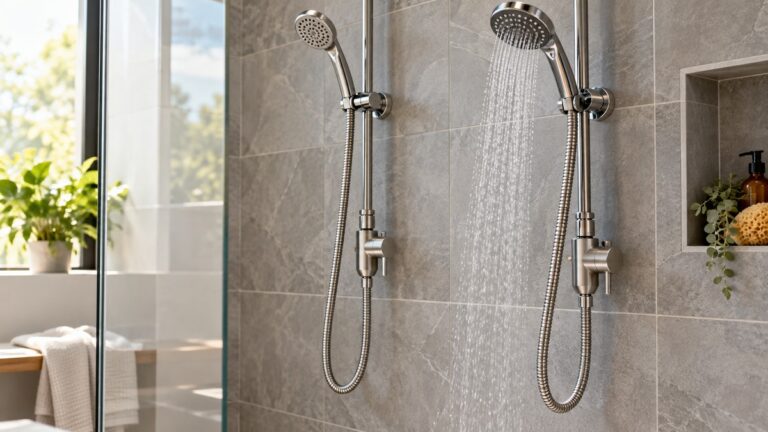
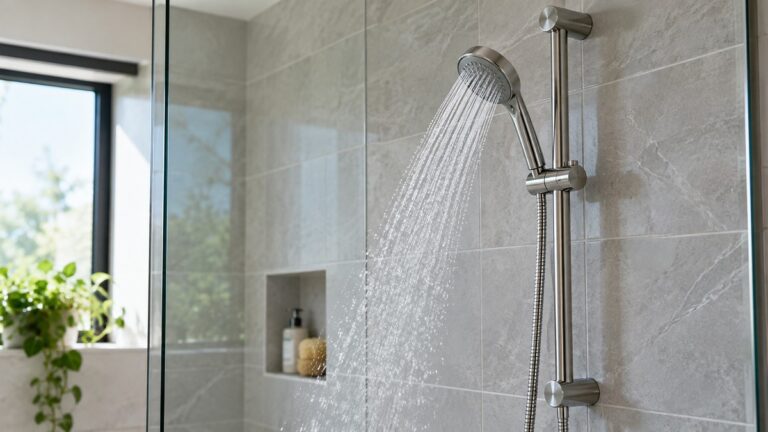
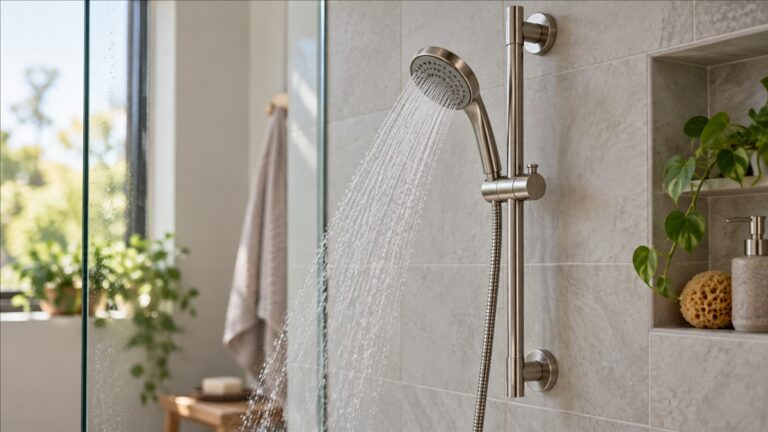
What is a handheld shower head? In the sources, it is a moveable device that directs water onto a user, and it can be installed on a support to work as a fixed head. EPA’s WaterSense specification counts hand-held showers as showerheads for its criteria. DOE’s showerhead page quotes a federal definition that includes handheld showerheads, but the same page reports a repeal of that definition. Moen’s handheld sheets show the usual parts: a bracket on the shower arm, a hose with washers and the handheld shower itself.
Quick answer
- A handheld shower head is a moveable device that directs water onto a user. EPA says it can be installed on a support to work as a fixed head.
- DOE’s page quotes a federal definition that includes handheld showerheads. The same page reports a repeal of the showerhead definition, effective May 15, 2025.
- Under EPA’s specification, WaterSense labeled showerheads, which include hand-held showers, must be equal to or less than 2.0 gpm. Standard showerheads use 2.5 gpm, according to EPA.
- Check the gpm marking on the product. EPA’s homes guidance tells verifiers to check it.
How the sources define it
EPA’s WaterSense specification describes “Hand-held showers, a subset of showerheads that are moveable devices for directing water onto a user.” It adds that “When used in this document the term “showerhead” shall also include hand-held showers.” The same copy says hand-held showers “can be installed on a support to function as a fixed showerhead.” EPA spells the term hand-held. DOE and Moen write handheld.
DOE’s showerhead page quotes the federal definition: “EPCA defines a showerhead as any showerhead (including a handheld showerhead), except a safety shower showerhead.” The same page says “DOE has published a Federal Register final rule repealing the definition of showerheads.” It also says “The effective date of this rule is May 15, 2025.” The page lists the repeal rule as 90FR15647 (April 15, 2025). The same page says the water use standards for showerheads have not been amended, and that DOE last amended the test procedures for showerheads on September 30, 2013. The page does not say what the repeal changes for handheld heads, so this guide does not treat the older definition as the current rule.
Parts and installation in the Moen sheets
The Moen handheld installation sheet (INS10819) lists a bracket, a handshower, washers and a hose. Its steps are to remove the existing showerhead, hand tighten the handheld bracket to the shower arm, and hand tighten the hose and washers to the bracket and the handheld shower. The sheet notes that the existing shower arm is not included. If your setup uses a slide bar, see handheld shower heads on a slide bar.
The magnetic docking sheet (INS10567A) has a different install. Its steps are to add thread seal tape to the shower arm threads, attach the bracket to the arm, and tighten with a wrench. The handheld sheet says to hand tighten the bracket instead.
The magnetic docking sheet (INS10567A) describes a handheld that contains neodymium magnets, which the sheet says are up to .3T in strength. It warns that in certain conditions some magnets may interfere with pacemakers or other implantable medical devices. Anyone with one of those devices is told to consult the device maker and a clinician. The sources do not say more than that about magnetic docking.
Flow rates and the gpm mark
EPA’s WaterSense specification says labeled showerheads “must be equal to or less than 2.0 gallons per minute (gpm).” It also says the product “shall be marked with the maximum flow rate value in gpm and L/min.” The spec sets a minimum spray force of 2.0 ounces. EPA’s homes guidance tells verifiers to check the gpm marking on the showerhead.
For comparison, EPA’s consumer page says standard showerheads use 2.5 gallons of water per minute (gpm). DOE’s installer job aid says low-flow showerheads must have flow rates of 2.5 gallons per minute or less, to reduce heating load and water use. For shopping options, see water-efficient hand held shower heads.
None of the sources says a shower head adds supply pressure. The sources do not describe whether a handheld raises the pressure your home supplies. EPA’s consumer page uses “pressure” as a label for spray force, which is a different measure from the supply pressure in your pipes. EPA’s homes guidance says labeled products are tested across a range of permissible service pressures. The consumer page describes pressure compensation as a check that ensures the showerhead will provide for a minimum flow across a range of household water pressures.
What the spec tests beyond flow
The spec measures flow at several pressures. The maximum flow is the highest result at flowing pressures of 20, 45, and 80 psi. At 20 psi the minimum flow must be at least 60 percent of the maximum, and at 45 and 80 psi it must be at least 75 percent. The packaging must show the minimum flow at 45 psi.
Spray force must be at least 2.0 ounces at 20 psi at the inlet while water is flowing. Spray coverage is checked in rings: no more than 75 percent of the water may fall in the 2- and 4-inch rings, and at least 25 percent must fall across the 2-, 4- and 6-inch rings. The spec also adds a rule for showerheads with more than one spray mode: “If the showerhead has more than one mode, all modes must meet the maximum flow rate requirement”, and at least one mode, as the maker specifies, must meet every requirement in the spec.
The spec also covers instructions. A product may not be packaged, marked, or supplied with instructions that point to a setting that overrides the maximum flow rate. Cleaning or maintenance instructions must show how to return the product to its intended maximum flow rate.
Where the sources mention handheld use
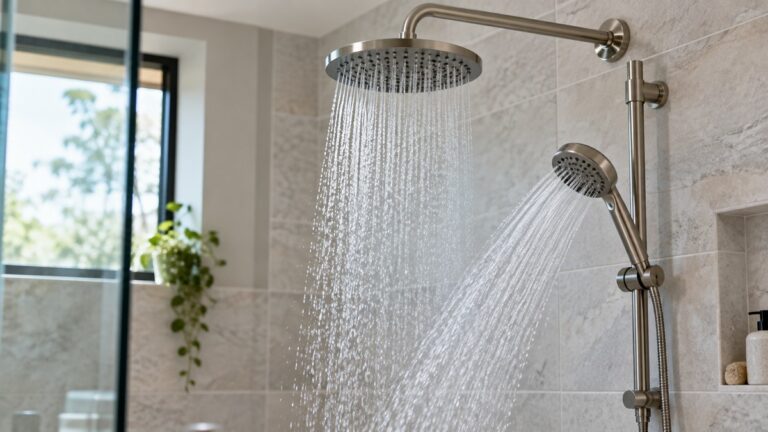
DOE’s installer job aid lists handheld among the occupant needs for a new showerhead, alongside shut-off and swivel options. EPA’s homes guidance says showerheads, rain showers and hand-held showers are all eligible to earn the WaterSense label. The same guidance says to limit the number of showering devices that can be turned on at the same time in one shower compartment, and to determine the maximum flow rate when all devices are operating in a compartment that has more than one. It says to check with the Home Certification Organization if more than one showerhead is planned.
EPA’s consumer page says spray force and spray coverage were the criteria that most influenced user satisfaction. The sources make no skin, hair or health claims for handheld heads. If you are choosing one for an older adult, see handheld shower heads for seniors.
What the sources say at a glance
| Source | What it says about handheld showers | Flow or marking figure |
|---|---|---|
| EPA WaterSense Specification for Showerheads (copy labelled Version 1.0) | Scope includes hand-held showers, which can be installed on a support to function as a fixed showerhead | Equal to or less than 2.0 gpm; product marked in gpm and L/min |
| EPA WaterSense Homes TRM 4 (July 2023) | Showerheads, rain showers and hand-held showers are all eligible to earn the label | Labeled showerheads at 2.0 gpm maximum; verify the gpm marking |
| DOE showerheads page | Quoted federal definition includes handheld showerheads; page reports a repeal effective May 15, 2025 | Not stated |
| DOE installer job aid 24-1 (July 2024) | Handheld listed among occupant needs with shut-off and swivel | Low-flow showerheads 2.5 gpm or less |
| Moen handheld installation sheet (INS10819) | Bracket, handshower, washers and hose; existing shower arm not included | Not stated |
| Moen magnetic docking sheet (INS10567A) | Neodymium magnets up to .3T; pacemaker and implant warning | Not stated |
| EPA WaterSense consumer page | Uses “pressure” as a label for spray force | Standard showerheads 2.5 gpm; labeled showerheads no more than 2.0 gpm |
For related head types, see sliding shower heads.
Mistakes to avoid
- Assuming supply pressure rises. The sources give no support for that idea.
- Reading the DOE definition as current. The same page reports a repeal effective May 15, 2025.
- Skipping the marking. EPA’s homes guidance tells verifiers to check the gpm marking.
- Treating magnetic docking as a plain swap. The Moen sheet warns about pacemakers and other implantable medical devices.
- Assuming minerals do not apply. The New Jersey guide says minerals can build up and block the nozzles on a shower head. A handheld is a showerhead under EPA’s specification, and the sources do not say it avoids this.
How we chose
This guide is built from seven sources, all opened on 2026-10-21. Each one was used for a claim it could support. The DOE showerheads page and the EPA specification were used for the definitions, because they state them directly. The EPA homes guidance and consumer page were used for the label, the marking and the flow figures. The DOE installer job aid was used for occupant needs and the 2.5 gpm figure. The two Moen sheets were used only for the parts and warnings of the named models. Pages that did not open were left out, and no products were ranked.
What we could not verify: what the sources do not say
- Whether a handheld raises the pressure your home supplies. No source says so, and none describes it.
- What the 2025 DOE repeal changes for handheld heads. The page does not say.
- Which EPA specification version applies. The copy opened is labelled Version 1.0, dated March 4, 2010. EPA’s showerhead page says Version 1.1 replaced Version 1.0 in July 2018, with minor changes. This guide reads Version 1.0.
- Rain shower flow criteria. EPA’s consumer page says Version 1.1 revised the spray force test protocol to accommodate water-efficient rain showers, but no source opened here gives the criteria.
- Handheld height above the floor or mounting height. No opened source gives a standard height.
- Slide bars, diverters and hose lengths. The Moen sheets describe a bracket on the arm only.
- Handheld test results. The sources list criteria, not results for any model.
Frequently asked questions
Is a handheld shower head a showerhead?
Under EPA’s WaterSense criteria, yes. The specification says the term showerhead includes hand-held showers. DOE’s page quotes a definition that includes handheld showerheads, but it also reports a repeal, so the sources do not give a settled answer for federal rules.
Can a handheld work as a fixed head?
EPA’s specification says hand-held showers can be installed on a support to function as a fixed showerhead. The sources do not describe that support.
What is the flow limit for a handheld?
The sources give maximums for showerheads. The WaterSense specification sets 2.0 gpm or less for labeled showerheads, and EPA says standard showerheads use 2.5 gpm. Read the gpm mark on the product itself.
Will a handheld raise my water pressure?
The sources do not say so. None says a shower head adds supply pressure, and EPA’s consumer page uses “pressure” to mean spray force.
What pressure does the EPA spec test at?
The spec tests flow at flowing pressures of 20, 45 and 80 psi, and the copy opened is Version 1.0. The sources do not say what household pressure a handheld should have.
Are magnetic docking handhelds safe with a pacemaker?
The sheet does not call them safe for everyone. It warns that in certain conditions some magnets may interfere with pacemakers or other implantable medical devices, and it tells people with those devices to consult their device maker and clinician.
Bottom line
Before you buy, check the marked gpm and the parts list for your model, because the sources cover only the basic parts.
Sources
- U.S. Department of Energy, Showerheads: https://www.energy.gov/eere/buildings/showerheads (opened 2026-10-21)
- U.S. EPA, WaterSense Specification for Showerheads (copy labelled Version 1.0): https://www.epa.gov/sites/default/files/2017-01/documents/ws-products-spec-showerheads.pdf (opened 2026-10-21)
- U.S. EPA, WaterSense Homes TRM 4: Showerheads Tech Sheet (July 2023): https://www.epa.gov/system/files/documents/2023-08/ws-homes-TRM-4-ShowerheadsTechSheet.pdf (opened 2026-10-21)
- U.S. EPA, WaterSense: Showerheads (consumer page): https://www.epa.gov/watersense/showerheads (opened 2026-10-21)
- U.S. Department of Energy, Install a Low-Flow Showerhead, Weatherization Installer Job Aid 24-1 (July 2024): https://www.energy.gov/sites/default/files/2024-07/24-1_install-low-flow-showerhead.pdf (opened 2026-10-21)
- Moen, Handheld Shower Installation Guide INS10819: https://assets.moen.com/shared/docs/instruction-sheets/ins10819.pdf (opened 2026-10-21)
- Moen, Magnetic Docking Handheld Shower Instruction Sheet INS10567A: https://assets.moen.com/shared/docs/instruction-sheets/ins10567a.pdf (opened 2026-10-21)