How to Clean Bath Toys Safely
As an Amazon Associate we earn from qualifying purchases.
How to clean bath toys: wash hard plastic toys with soap or a mild detergent and water, rinse, and dry them completely. Throw away soft or absorbent toys that have mold. The EPA pages we opened are written for mold cleanup in general, not for toys, so this post applies them to bath toys and says where it does. No opened source covers vinegar or toys with holes, and this post does not invent a method for either.
Quick answer
- Wash hard plastic bath toys with soap or a mild detergent and water, then rinse.
- Dry every toy completely. EPA notes that damp places are hard to keep free of mold and that more frequent cleaning and more ventilation keep mold to a minimum.
- Throw away soft, squeezable, or absorbent toys that show mold. The sources say these items are hard or impossible to clean fully.
- Do not mix bleach with ammonia or other cleaners. Keep children away from heavy mold during cleanup.
How to clean bath toys step by step
These steps are for ordinary household bath toys. Each step below states which opened source it rests on. Where a toy’s material or construction is not covered by any source, the post says so instead of guessing.
Step 1: Sort the toys by material
Before you clean anything, sort the toys into two piles. The first pile holds hard, non-porous toys, such as molded plastic cups, boats, and blocks with no soft parts. The second pile holds soft or absorbent toys, such as sponge toys, plush toys, bath books made of cloth or foam, and anything that feels squishy when wet. The EPA children’s guidance says to throw away all soft or absorbent toys because they cannot be cleaned properly, so the second pile is a disposal pile unless a toy is clearly hard all the way through. The EPA mold cleanup page makes the same point for building materials: absorbent or porous materials may have to be thrown away when they become moldy, because mold can grow into spaces that are hard to clean.
Step 2: Inspect each hard toy
Look at the toy in good light. Check seams, joints, openings, and any spot where water can sit. The EPA homeowner guide notes that mold may be hidden, so the visible surface is not the whole test. Look for dark spots, fuzzy patches, slimy film, and a musty smell. The EPA mold cleanup page also warns that mold may cause staining and cosmetic damage, and that it may not be possible to clean an item so that its original appearance is restored.
Step 3: Wash with soap or detergent and water
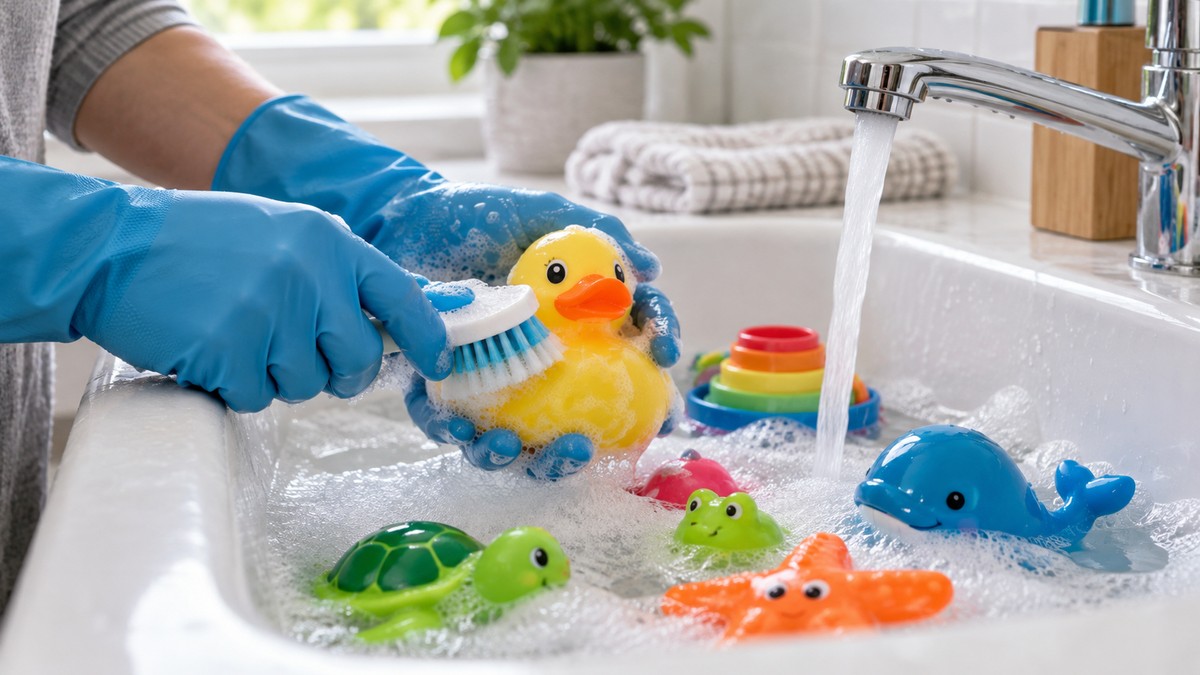
The EPA homeowner guide tells readers to clean with water and a detergent, remove all mold they can see, and dry right away. The EPA mold cleanup page gives the same approach for hard surfaces: scrub mold off with detergent and water, then dry completely. For a hard plastic bath toy, that means washing the toy in soapy water, scrubbing any visible mold, rinsing it under clean water, and moving on to drying. The sources do not name a brush type, a water temperature, or a soak time, so this post does not give one.
Step 4: Dry the toy completely
The EPA mold cleanup page says to dry all items completely. Molds are usually not a problem indoors unless mold spores land on a wet or damp spot and begin growing, according to the EPA mold and health page. Air the toys out where air can move around them.
The sources do not address toy baskets or closed storage. The general rule from the EPA pages is that damp conditions let mold grow, so a closed container that stays wet is a poor place for toys to dry. Our bathroom bath caddy guide and bamboo bathroom caddy guide cover storage options, but they do not test drying.
Step 5: Ventilate the bathroom
EPA’s bathroom tip says places that are often or always damp can be hard to keep completely free of mold. If mold seems to come back in the bathroom, increasing ventilation, such as running a fan or opening a window, and cleaning more often will usually prevent mold from recurring or at least keep it to a minimum. This tip applies to the room, not to toys specifically, but it is the reason the drying step matters: a toy that dries in a room with air movement has a better chance of staying clean than one that sits in standing water.
Step 6: Decide when to throw a toy away
The EPA children’s guidance for flood cleanup says to throw away soft or absorbent toys. It was written for flood-contaminated items, so it does not directly cover ordinary mold. The mold cleanup page is the closer match: porous materials may have to be thrown away once they become moldy. A hard toy with light surface mold can usually be washed and dried. A toy whose mold keeps returning, or that you cannot dry or reach, should be discarded.
How to clean bath toys with mold
For light mold on a hard plastic bath toy, the sources support the steps above: wash with detergent and water, scrub off what you can see, rinse, and dry completely. That is the method that EPA’s mold cleanup page describes for hard surfaces. It is not a sterilizing method. The EPA bleach page says that the use of a biocide such as chlorine bleach is not recommended as a routine practice during mold cleanup. It notes that professional judgment may point to such use in some cases, for example when immune-compromised people are present, and that in most cases it is not possible or desirable to sterilize an area, because a background level of mold spores will remain.
For that reason, this post does not recommend a bleach soak for bath toys and does not give a bleach ratio. The sources opened for this post do not give a bleach ratio for bath toys, and a routine bleach treatment is outside what the EPA mold guidance recommends. If a toy has mold that does not come off with soap and water, the safer choice under the sources is usually to replace the toy rather than to try a stronger chemical treatment at home.
Why mold on toys matters for children
Mold is a health issue, and the EPA mold and health page says so directly. Molds produce allergens and irritants. Inhaling or touching mold or mold spores may cause allergic reactions in sensitive people. The allergic responses listed are hay fever-type symptoms, such as sneezing, runny nose, red eyes, and skin rash. Mold exposure can also irritate the eyes, skin, nose, throat, and lungs of both mold-allergic and non-allergic people. The same page says molds can trigger asthma episodes in sensitive individuals with asthma.
The EPA children’s health page adds that children breathe faster relative to body size, so they take in more air and more exposure. It also lists coughing, wheezing, and asthma attacks among the possible effects of inhaling mold. These are reasons to dry toys well and replace toys whose mold cannot be cleaned.
Keep children away from the cleanup
EPA guidance on flood cleanup and mold says that children, pregnant people, and people with asthma or weakened immune systems should not take part in cleanup and should keep away from moldy sites. Our reading is that an adult should wash and dry moldy toys while children are in another room. That is a practical step taken from the guidance, not a statement the sources make about bath toys.
Do not mix cleaning products. The EPA children’s page says that mixing bleach with ammonia or other cleaners can create poisonous gases. If you use a commercial cleaner, follow its label, keep the room ventilated, and store the product out of children’s reach.
When to contact a health professional
The EPA children’s page says to contact a healthcare provider if you or a family member has breathing or other health problems after exposure to mold. The mold and health page says that the effects it lists do not cover every possible health effect, and that a health professional or the state or local health department can give more detail. EPA also says research on mold and health effects is ongoing.
How to clean bath toys with holes
None of the opened sources covers bath toys with holes. That includes squeeze toys with openings, toys with a valve or small hole where water enters, and toys that can trap water inside. The sources do not describe how to clean the inside of a hollow toy, how to reach a hole, or whether a toy with a hole can be sanitized.
The closest guidance is the EPA rule for porous or absorbent materials. Those materials can hold mold in spaces that are difficult or impossible to clean, and they may have to be thrown away when they become moldy. Water that stays inside a hollow toy keeps the inside damp, and the sources say that damp conditions are what allow mold to grow. A practical reading of the sources is that a toy with holes should be turned over, shaken to drain, and dried as completely as possible after each bath. If you cannot see or reach the inside, or if mold appears there, the sources point toward discarding the toy.
This is an inference from the porous-materials and drying guidance. It is not a method that any opened source gives for toys with holes, and the toy maker’s care label or instructions are the better source if the toy came with one.
How to clean bath toys with vinegar
None of the opened sources recommends vinegar for cleaning bath toys, and this post does not give a vinegar method. The EPA mold pages we opened name detergent and water as the cleaning agent for hard surfaces. The EPA children’s page names soap, a non-ammonia detergent, or a commercial cleaner for clean surfaces during flood cleanup, and says to choose a product that is phenolic or pine-oil based if you use a commercial cleaner. The sources do not mention vinegar at all.
How we chose
Each step had to rest on a page we opened in this session, checked with curl, not on a search result or a retail listing. We checked each quoted sentence against the opened text and dropped any we could not find. We did not use retail listings or blog posts for health claims.
We opened seven pages in total: four EPA web pages on mold cleanup, mold and health, bleach, and children; the EPA brief guide to mold, moisture and your home; and two EPA PDFs, a flood cleanup guide for children and a homeowner guide to mold cleanup after disasters. Requests to several CDC pages returned HTTP 403, so no CDC page is cited. We did not treat a search summary as evidence.
The post covers four keywords. The first two are answered from the sources. The last two are answered with what the sources do not say, and no method is invented to fill them.
What we could not verify: what the sources do not say
- No opened source gives cleaning steps written for bath toys, toy materials, or toy brands.
- No opened source gives a vinegar method for toys.
- No opened source covers toys with holes, squeeze toys with openings, or toys that trap water inside.
- No opened source gives a bleach ratio for bath toys. The EPA bleach page says a routine bleach treatment is not recommended in mold cleanup.
- No opened source gives a dishwasher, boiling, or other sanitizing temperature for toys.
- No opened source gives a soak time, a brush type, or a drying time for toys.
- No opened source gives an age or time limit for keeping a child away from a moldy toy.
- No CDC page was opened: requests to CDC pages returned HTTP 403.
- EPA says research on mold and health effects is ongoing. The sources do not measure how much mold on a toy creates a health risk.
FAQ
Can I put bath toys in the dishwasher?
The opened sources do not address dishwashers for toys. Check the toy maker’s instructions. If the toy is soft or absorbent, the sources say to discard it rather than clean it.
Is vinegar safe for cleaning bath toys?
The opened sources do not state whether vinegar is safe or effective on bath toys, so this post does not say it is. Check the toy maker’s instructions first. Do not mix any cleaner with bleach.
Do I need bleach to kill mold on bath toys?
No. The EPA bleach page says that a chemical biocide such as chlorine bleach is not recommended as a routine practice during mold cleanup. It notes that professional judgment may point to its use in some cases, and that it is usually not possible to sterilize an area. For a hard toy with light mold, the sources support washing with detergent and water and drying completely.
How often should bath toys be cleaned?
The opened sources do not give a cleaning schedule for toys. EPA’s bathroom tip says that cleaning more often and increasing ventilation usually keep mold to a minimum in places that stay damp. A toy that stays wet between baths is the one most likely to need more frequent drying.
When should I call a doctor about mold exposure?
The EPA children’s page says to contact a healthcare provider if you or a family member has breathing or other health problems after exposure to mold. Mold can trigger asthma episodes in sensitive people with asthma, according to the EPA mold and health page. If a child has trouble breathing, get medical care rather than waiting on home cleaning.
Bottom line
If a bath toy is hard plastic and shows light surface mold, wash it with soap or a mild detergent and water, scrub what you can see, rinse, and dry it completely. If it is soft, absorbent, or keeps growing mold, throw it away. Keep children away from heavy mold cleanup, do not mix cleaners, and follow the toy maker’s instructions where they exist, since none of the opened sources covers bath toys directly. For storage that helps toys dry, see our bath caddy organizers guide.
Sources
- Mold Cleanup in Your Home, US EPA (opened 2026-10-23, HTTP 200): cleaning hard surfaces with detergent and water, drying completely, porous materials, bathroom ventilation.
- Should I use bleach to clean up mold?, US EPA (opened 2026-10-23, HTTP 200): biocides not recommended as routine practice in mold cleanup.
- Mold and Health, US EPA (opened 2026-10-23, HTTP 200): allergic and irritant effects, asthma, research ongoing.
- Brief Guide to Mold, Moisture and Your Home, US EPA (opened 2026-10-23, HTTP 200): mold cleanup guidelines, PPE, drying within 24 to 48 hours.
- Mold Exposure and Respiratory Conditions in Young Children, US EPA (opened 2026-10-23, HTTP 200): children more exposed; keep children out of cleanup; contact a healthcare provider.
- Cleaning Up After a Flood: Children’s Health, US EPA Region 2 (PDF, Nov 2012) (opened 2026-10-23, HTTP 200): throw away soft or absorbent toys; do not mix bleach with ammonia.
- Homeowner’s and Renter’s Guide to Mold Cleanup After Disasters, US EPA (PDF) (opened 2026-10-23, HTTP 200): clean with water and detergent, remove visible mold, dry right away.