Adhesive Shower Caddy for Tile: Fit Guide
As an Amazon Associate we earn from qualifying purchases. Details
Renters and homeowners often want shower storage without drilling into tile. An adhesive caddy can be a practical answer to that need, but tile is not one surface. Glossy glazed tile, textured tile, grout lines, and cracked or porous tile can all behave differently with an adhesive pad. This guide looks at one specific product, the OMAIRA 3-pack adhesive shower caddy, and explains what its listing says about tile compatibility, preparation, curing, removal, and load.
This guide is based on the published product specifications and listing copy.
Quick verdict
The OMAIRA set is a three-piece adhesive caddy kit for a smooth shower wall. It includes two shelves, one soap holder, and built-in hooks, and it is listed as suitable for smooth wall, glass, and tile surfaces. It is a reasonable option to evaluate for a no-drill shower organizer on a smooth, well-prepared tile wall. It is not a universal answer for every tile surface. The product information does not establish compatibility with textured, porous, cracked, or heavily grouted tile, so the wall should be checked before buying.
The three questions that matter most are the tile surface, the curing and preparation steps, and the load the caddy can carry. The product information gives a figure for each, and the figures are not fully consistent. The sections below work through each question in turn.
What the product is
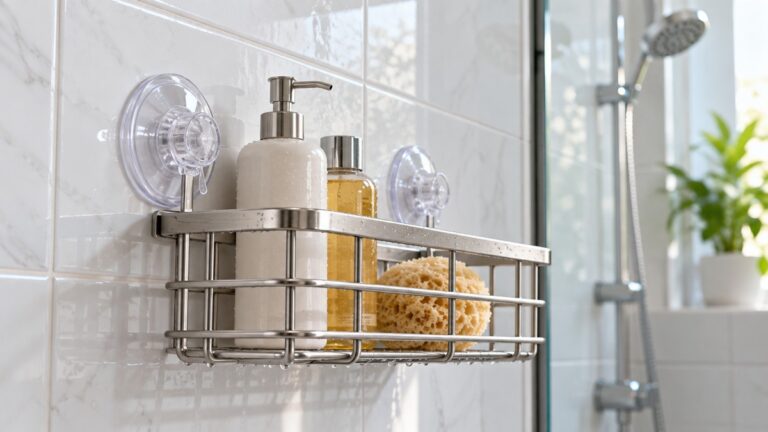
The OMAIRA listing describes a three-piece set. The specifications list three items, two of which are shelves and one a soap holder. One bullet point describes eight built-in utility hooks, so the set combines shelf storage, a soap holder, and hooks in one kit. The set is made of stainless steel with a polished finish and a black color. The product information says a rust-resistant coating on the metal shelves, and the specification fields list the item as rust resistant.
The set mounts to the wall. The product information says it is installed with adhesive pads rather than screws, and it describes three pads included with the set. The listed dimensions are 10.77 inches deep, 2.26 inches wide, and 4.35 inches high, and the item weighs 13.28 ounces. The specification fields list a capacity of 105 cubic inches.
The product information names several uses, including showers and home decor. It describes the set for master bathrooms, guest baths, kitchens, and RVs. For this guide, the relevant question is narrower: does the set work on your shower tile, and can you install and remove it without damaging the surface?
Who this guide is for
The intended reader is a renter or homeowner who wants to know whether a no-drill caddy suits a smooth tiled shower wall. That reader may not be able to drill into the wall, or may prefer not to. A caddy that holds shampoo, conditioner, body wash, and a soap holder can free up the shower ledge, and that is the practical benefit The product information says.
Use this set if the following describe your situation:
- Your shower wall is smooth, glazed, and in good condition
- You cannot or do not want to drill into the tile
- You have room for a shelf about 10.77 inches deep on the wall
Choose a different approach if any of these describe your situation:
- Your tile is heavily textured, very porous, or cracked
- Your grout lines are wide or irregular, so the pads may not sit flat
- Your shower wall is curved or does not give a flat area for the pads
- You plan to hang heavy bottles that approach the listed weight limit
Those are the situations in which an adhesive caddy is most likely to disappoint, and the product information does not establish performance in any of them.
Decision criteria for an adhesive tile caddy
Check these five points before buying.
Tile surface. The product information says the caddy is for smooth wall, glass, and tile. It does not describe textured, porous, or cracked tile. Confirm that the exact spot you plan to use is smooth and intact. Compatibility depends on the surface where the pads will sit, not on the general type of your shower.
Adhesive preparation. the product information gives a simple sequence: clean the surface, apply the adhesive, wait 24 hours, and hang the caddy. Cleaning and drying matter, because an adhesive bond can only be as good as the surface beneath it. The product information does not name a cleaning product, so choose one that is suitable for your tile and leaves no film.
Curing time. The product information says to wait 24 hours before hanging the caddy. Plan that wait into your setup routine. Hanging the caddy early, or loading it before the wait is over, goes against the product information’s own instructions.
Load. The product information says the caddy holds up to 40 pounds. The specification fields list a maximum weight recommendation of 13.61 kilograms, which is about 30 pounds. The two figures conflict, and the product information does not say which applies. Plan around the lower figure until the seller confirms which one is correct.
Removal. The product information says that to remove an adhesive pad, you can heat it with a hair dryer or hair blower to soften it. It does not say what residue removal may leave on tile or grout, or how the tile finish responds to heat. Test a small, hidden area first if you can, and decide before installation whether the removal method is acceptable for your space.
A buyer who works through these five points knows whether the tile, the preparation, the curing time, the load, and the removal plan fit the situation. The rest of the decision depends on that fit.
Product coverage: the OMAIRA set in detail
The table below summarizes the most useful fields from the published specifications and listing bullets.
| Feature | What The product information says |
|---|---|
| Pieces | 3 (2 shelves, 1 soap holder) |
| Built-in hooks | 8 (bullet point) |
| Special feature | Rust resistant |
| Mounting | Wall mount, adhesive pads |
| Surface compatibility | Smooth wall, glass, tile, marble (listing) |
| Dimensions | 10.77 inches deep, 2.26 inches wide, 4.35 inches high |
| Weight of the item | 13.28 ounces |
| Weight recommendation | 13.61 kilograms (specification field); 40 pounds (bullet point) |
| Finish | Polished stainless steel, black |
| Model | O2-BK-L |
Several details in this table need a closer look.
The weight figures conflict. One bullet point says the caddy holds up to 40 pounds. The specification field gives 13.61 kilograms, which is about 30 pounds. Plan around the lower figure, and ask the seller which figure applies. A caddy that is loaded close to its limit is the one most likely to show movement at the pads, so the lower figure is the safer planning number.
The material description is consistent. The specification fields list stainless steel, and a bullet point describes metal shelves with a rust-resistant coating. Both describe a corrosion-resistant metal design. The product information does not provide corrosion test results, so the rust-resistance claim is a manufacturer statement.
The pieces are described as a set. The product information says three pieces with two shelves, one soap holder, and eight hooks. Check the photos and the seller’s listing to confirm the arrangement before buying, because the bullets and the specification fields do not describe the exact layout of the hooks.
The finish is listed as polished. The product information does not describe the finish in more detail, so check the finish in person or in the product information photos if its appearance matters to your bathroom.
Preparing a tile surface
The product information’s preparation sequence is short, and it is easy to follow. Choose a flat, smooth section of tile with no cracks or loose grout nearby. Clean the surface and let it dry fully. Position the caddy and mark the spot, so you can match the placement after applying the pads. Apply the adhesive pads according to the instructions included with the set, and wait 24 hours before placing any load in the caddy.
If the surface feels slick, dusty, or greasy after cleaning, clean it again before applying the pads. Residue on the tile can stop the pads from bonding properly, and the product information does not describe what happens when a surface is not fully clean. A second cleaning costs little compared with reinstalling the caddy.
Because the product information does not describe a specific cleaning product, choose one that is suitable for your tile and leaves no film. A film can be the difference between a bond that holds and one that slowly lets go. Choose the cleaner before you start, so you do not have to decide mid-process.
The 24-hour wait is the most important timing step. The product information says the adhesive needs that time before the caddy is hung, and does not describe what happens if the caddy is loaded early. Keep the caddy empty during that period, and do not test the bond by pulling on it.
Load checks
With a listed load figure of up to 40 pounds in the bullet point and about 30 pounds in the specification field, the practical planning figure is the lower one. Keep the load well below it.
Distribute weight across both shelves rather than loading one end. Keep heavier bottles low and lighter items higher. A heavy bottle on a high shelf raises the center of gravity and puts more stress on the pads, so the weight should stay near the lower part of the caddy.
Check the caddy after the first day of use for any sign of movement or lift at the pads. Remove items and reassess if the caddy shifts, even slightly. Movement at the pads is the earliest sign that the bond is not holding, and it is much easier to fix before the caddy takes a full load.
The product information says the caddy’s holding strength as reliable, but that is a claim. This guide has not tested the caddy, and does not include independent holding-strength results. The load guidance should be treated as the manufacturer’s planning figure, not a verified limit.
Removal and renter considerations
The product information says the caddy is renter-friendly and installs without tools. That describes the installation method, not the outcome of removal. Before you install, think about how you will remove the caddy later. The product information says the adhesive can be softened with a hair dryer or hair blower and then removed. Heat and scraping can affect tile, grout, and sealant, and does not describe those effects.
If you rent, read your lease or building rules before installing any adhesive product. Test removal on a small hidden spot before committing to the full installation, so you know how the tile responds to the heat and how the pads come away.
The product information’s phrases “100% tool-free” and “renter-friendly” are manufacturer claims. They describe the installation method. They do not promise that removal will leave no mark on every surface, and does not describe the result on any particular tile finish.
Purchase decision: where this product fits
OMAIRA 3-Pack Shower Caddy with Soap Holder is easiest to evaluate as a fit decision, not as a universal recommendation. Its stated design can be useful when the dimensions, included parts, and intended use described above match your exact setup. It is a weaker choice when you need a capability the product information does not explicitly provide.
Buy it when
- The stated size and configuration fit the space or equipment you already have.
- The included components replace separate purchases you would otherwise need.
- The limitations described in this review do not interfere with your main use case.
Avoid it when
- A missing compatibility measurement would determine whether it works at all.
- You need proof of performance beyond the manufacturer’s stated specifications.
- A simpler product would solve the same problem without unused features.
Before ordering, verify the two or three measurements that control fit. This single check is more useful than relying on a broad “works for most” description.
Limitations and caveats
The product information says one exact adhesive caddy for smooth wall, glass, and tile. It does not establish compatibility with other tile finishes. Compatibility with textured, porous, cracked, or heavily grouted tile is not established. If your tile is any of those, check with the seller before buying, or choose a different installation method.
Holding strength is not independently tested. The 40-pound figure is a manufacturer claim, and the specification field gives a different figure. Neither figure has been confirmed by a test.
The product information does not give a warranty description. Confirm return and support terms with the seller before buying, especially if the caddy fails to hold after installation.
The bullet points describe the caddy with phrases such as “rock-solid” and “reliable.” Those are marketing descriptions. They do not replace the planning figures or the inspection steps in this guide.
Buyer guidance
Before buying, make a short checklist:
- Confirm your tile is smooth, glazed, and in good condition at the planned spot.
- Measure the wall space for a caddy that is 10.77 inches deep and 4.35 inches high.
- Decide how much weight you expect to store, and plan around the lower listed figure of about 30 pounds.
- Plan the 24-hour wait into your setup routine.
- Test removal on a small hidden area of tile before you commit to the full installation.
- Confirm return and support terms with the seller.
If your tile does not meet these checks, consider a different storage method rather than forcing an adhesive install. An adhesive caddy is the right choice only when the surface, the load, and the removal plan all fit the situation.
View the OMAIRA shower caddy set on Amazon
Conclusion
The OMAIRA 3-pack adhesive shower caddy is listed for smooth wall, glass, and tile surfaces. It offers two shelves, a soap holder, and eight hooks, with a stainless steel build, a rust-resistant coating, and a 24-hour adhesive curing step. For a renter or homeowner with smooth, well-prepared tile, it is a reasonable option to evaluate.
The main limits are the unverified holding strength, the conflicting weight figures, and the lack of compatibility data for textured, porous, cracked, or heavily grouted tile. Check those points before buying, test removal on a small hidden area first, and plan the load around the lower figure. If the wall does not meet those conditions, a different storage method is the better choice.
FAQ
Can this caddy go on any tile?
Not necessarily. The listing does not confirm compatibility with textured, porous, cracked or heavily grouted tile, so inspect the wall before you buy.
How long should I wait before loading the caddy?
Wait 24 hours after applying the pads before placing any load in the caddy, and keep it empty during that period.
How much weight can the caddy hold?
Plan around the lower figure. The listing gives up to 40 pounds in a bullet point and about 30 pounds in the specification field, and both are manufacturer claims.
What does the OMAIRA set include?
The set has three pieces: two shelves and one soap holder. One bullet point also describes eight built-in utility hooks.
What should I check after installation?
Check the caddy after the first day of use for any movement or lift at the pads. Remove items and reassess if it shifts, even slightly.
Sources
- – https://www.amazon.com/dp/B0CRL16CR6/?tag=bestshowerhead003-20