Best Shower Filter for Well Water: What the Listings and Extension Pages Support
As an Amazon Associate we earn from qualifying purchases. Details
The best shower filter for well water is the one that matches the water report you already have, and that fits the shower you already own. Only one of the ten listings we read names well water as its design target. The EPA and Nebraska pages we opened make a more basic point first: test the well, then choose treatment that fits the results. Those pages do not describe shower filters at all, so this guide sorts the listings by what they state and says where the pages stop.
Quick answer
- Report shows staining, odor or iron: The AquaHomeGroup Well Water 5-stage is the only listing built for well water. Its bullets name discoloration and debris, and give no removal figure.
- Report shows nitrate or bacteria: None of the ten listings names nitrate. Nebraska says the treatment must match the results, and EPA says to contact the health department when a contaminant exceeds health standards, so start with a certified test.
- You want to keep your current shower arm: The Aquabliss SF100 and the Dwavele are cartridge filters that their listings say fit a standard 1/2 inch thread. The Aquabliss cartridge lasts 3 to 6 months, depending on water quality.
- You are replacing the head anyway: The myhalos and the AquaHomeGroup 20+3 handheld set replace the head, and each includes its own filter.
What the EPA and extension pages ask you to check first
The EPA page on protecting your home’s water gives the routine list. It says to “Test your private well annually for total coliform bacteria, nitrates, total dissolved solids, and pH levels.” It also says to “Only use laboratories that are certified to do drinking water testing.” The K-State Research and Extension publication on private water systems agrees on the core pair. It says that “KDHE and K-State Research and Extension recommend annual water tests for coliform bacteria and nitrate.”
The Nebraska Extension reminder adds a second group. It separates the health tests from the cosmetic ones, and recommends that owners “Optionally test for cosmetic concerns like staining or odor, such as hardness, iron, sulfur, and copper.” That is the group a shopper with stained fixtures or a sulfur smell is most likely to be looking at. It is also the group where a shower filter is most often marketed, which is why the list matters before you read any product claim.
The K-State page adds a note on the lab. It says that “Using a certified laboratory is critical if results might be used as evidence of pollution or in litigation.” Even if you only want to decide on a filter, a certified lab result is the reference point the listings cannot provide.
Treatment has to match the result
The Nebraska page makes the central rule explicit: “The type of treatment equipment must be matched to the contaminants and the levels the test results show.” It gives an example of a larger system, not a shower unit: “Reverse osmosis (RO) filtration plus a carbon filter is an option that removes a wide variety of contaminants like nitrate, arsenic, uranium, etc.” The same page says that a reverse osmosis unit’s output should be checked, and that the unit does not remove all of the nitrate.
The EPA page takes a similar line. It says that “On-site treatment processes like disinfection, distillation, and filtration may remove the contaminants found in your well water.” For high bacteria, it gives disinfection as the approach, with chlorine, ozone, ultraviolet light and electronic radiation named as examples. Neither page describes a cartridge that sits on a shower arm, and that is the main limit of this guide. A shower filter is a different product from the systems those pages describe.
What that means in practice is a simple order. Get the annual test, read what it found, and only then ask whether a shower filter addresses any of those results. The listings below are sorted by what they state. None of them says it addresses a result from a well test, except where the wording is noted.
What the ten listings say about wells
The table gives each pick’s stated media, stage count, well-water wording, cartridge life and fit. Blank cells mean the listing says nothing about that point.
| Pick | Media or stages (listing) | Well-water wording (listing) | Cartridge life (listing) | Fit (listing) |
|---|---|---|---|---|
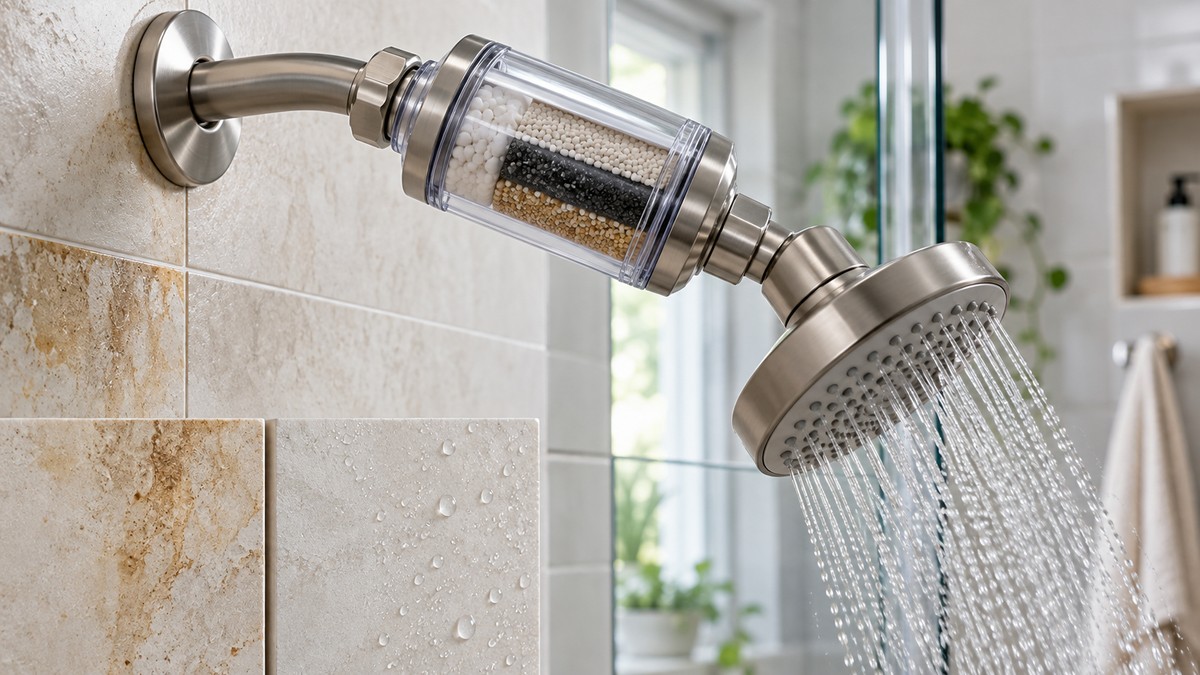
| AquaHomeGroup Well Water 5-stage | KDF 55, zeolite, ceramic media, activated carbon; 5 stages | “Specially designed for well water” | Not stated | Handheld, rainfall and wall-mounted heads |
| AquaHomeGroup 20-stage with 5 cartridges | Vitamin C, E and A; 20 stages | “Helps reduce rust and iron in the water” | Not stated | Wall-mounted, handheld, rainfall and combo heads |
| Dwavele 20-stage | KDF-55, activated carbon, alkaline ceramic balls; 20 stages | None | Two cartridges, one installed | Standard G1/2 thread |
| WEAQUA 2-pack | Sediment, carbon, KDF and calcium sulfite | “Works great with municipal water or well water” | Six months | Universal fit; about 5 minutes to install |
| WEAQUA single | Sediment, carbon, KDF and calcium sulfite | “Works great with municipal water or well water” | Six months | Universal fit; about 5 minutes to install |
| Aquabliss SF100, brushed nickel | SFC100 cartridge with Vitamin C media | None | 3 to 6 months, depending on water quality | Standard 1/2 inch arm; adapter for ball-joint arms |
| myhalos filtered head | Calcium sulfite, KDF-55, activated charcoal; three stages | None | Up to 90 days for a family of three | Replaces the head |
| AquaHomeGroup 20+3 handheld | KDF media, Vitamin C, E and A; 20+3 stages | None | Not stated | Handheld head with a 59 inch hose |
Only the AquaHomeGroup Well Water 5-stage names well water as its design target. Its title and first bullet both say so. The two WEAQUA listings say their filter “Works great with municipal water or well water,” which describes use, not a design for wells. The AquaHomeGroup 20-stage says it “Helps reduce rust and iron in the water,” which overlaps with iron, one of the cosmetic concerns on the Nebraska list. The other listings do not mention well water.
Two figures in the table need arithmetic. The AquaHomeGroup 20-stage lists 20 stages and the well-water 5-stage lists 5. Dividing 20 by 5 gives 4, so the first has four times the stage count of the second. The listings do not define a stage, and they do not give a removal figure for either model, so a higher count is not a higher result. The myhalos listing gives up to 90 days, and 90 ÷ 30 = 3, which puts its life at about three months. That is the low end of the Aquabliss range of 3 to 6 months.
The AquaHomeGroup handheld set includes a 59 inch hose. Converting 59 inches at 2.54 cm per inch gives 59 × 2.54 = 149.9 cm, which matches the 1.5 meters its listing gives.
The iron and rust claim
The AquaHomeGroup 20-stage listing says it “Helps reduce rust and iron in the water.” The Nebraska page lists iron among the cosmetic concerns to check, so the claim is about a real concern. The pages we opened do not link shower cartridges to iron removal, though. The claim is the seller’s claim until your own report shows iron, and until the seller gives a figure you can compare against that report.
The same applies to sulfur. Nebraska lists sulfur as a cosmetic concern to test, and none of the ten listings names sulfur. If a sulfur smell is your reason to buy, a shower filter’s stated media is the first thing to check, and its listing is the only place the claim appears.
Filter, head or set: how the fit changes the choice
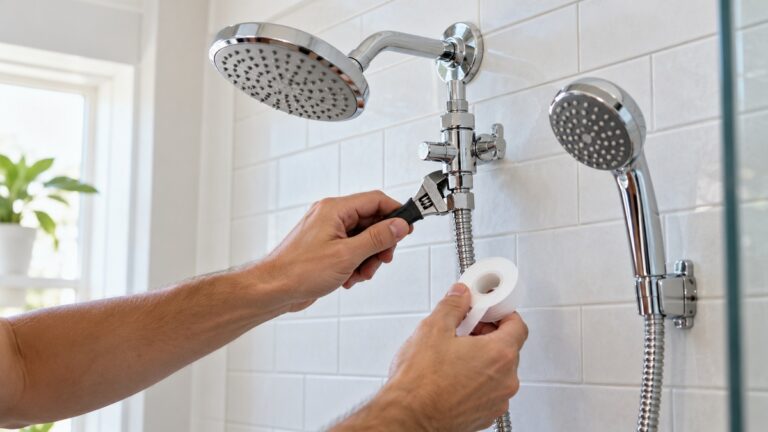
The two cartridge units, the Aquabliss SF100 and the Dwavele, are listed for a standard 1/2 inch thread. The Aquabliss listing says it fits “STANDARD 1/2-INCH SHOWER ARMS” with thread seal tape included, and that it adds “about 3-4 inches” to the arm. It also says that “ball-joint or short-elbow arms need a threaded adapter.” If your arm is a ball joint, you will need that adapter before the filter can go on. The Dwavele listing says it uses a standard G1/2 thread and comes with two cartridges, one installed. Both are the choice if you want to keep the head you already have.
The myhalos and the AquaHomeGroup 20+3 replace the head. The myhalos listing says it is a “Filtered Shower Head,” with a lifetime head guarantee and a filter in the box. The AquaHomeGroup 20+3 is a handheld head, and its bullets describe “integrated multi-stage filtration” with a “stainless steel hose (59in / 1.5m)” in the set. If you are replacing the head anyway, these two fit that plan. If you are not, they are not the right type of product, and the cartridge units are the better fit.
The AquaHomeGroup 5-stage listing says it fits handheld, rainfall and wall-mounted heads and needs no tools to install. Check that list against the head you own before you order.
Cartridge life and what the listings state
Cartridge life is the figure that changes the running cost, and only four listings state a life: the Aquabliss, both WEAQUA listings and the myhalos. The Aquabliss gives 3 to 6 months, with the note that the range “depends on your water quality.” The WEAQUA listings give six months. The myhalos gives up to 90 days for a family of three. The other listings give a cartridge count but no life. The AquaHomeGroup 20-stage names five replacement cartridges in its title, and the Dwavele names two cartridges with one installed. A count tells you how many spares are in the box, not how long each one lasts.
The Aquabliss range depends on a condition the listing does not define, so its 3 to 6 month figure is a range the buyer has to judge against their own water. The WEAQUA six-month figure is a single number, and its listing does not say which water quality it assumes. Neither is a test result.
How we chose
We read the first results page for the keyword. We kept listings whose title names a filter or a filtered shower head. We counted a filtered head as a filter product because the filter is its main feature. We left out the sponsored results on the page.
We kept the first ten in page order and read each of them in full. We used eight of the ten. We left out the Aquabliss matte black because its bullets are the same as the brushed nickel version, so a second card would repeat the first. We left out the UltrTxenova fixed head because its bullets describe a button-release cartridge but give no stage count and no cartridge life, which left the card with little to compare.
Each card gives a reason from its own listing, at least one limitation and a skip case. We did not use prices, ratings, sales figures or rankings. The order of the picks does not rank them.
What we could not verify
- Removal percentages for any listed filter. The WEAQUA listing claims 99 percent removal of a long list of contaminants, and that is a seller claim. The pages we opened do not confirm it for a shower cartridge.
- Whether any listed filter reduces bacteria, nitrate or coliform. None of the listings names nitrate, and none names coliform or bacteria as a contaminant it removes.
- The iron and rust claim for the AquaHomeGroup 20-stage, and whether the Aquabliss or the Dwavele address iron or sulfur.
- Cartridge life for the AquaHomeGroup 5-stage, the Dwavele, the AquaHomeGroup 20-stage and the handheld set. Those listings give no life figure.
- What a stage is. The listings use stage counts without defining them.
- Certification. The bullets we read name no certification.
- Water pressure and flow after installation, beyond the bullet claims. The Aquabliss bullet says its design keeps your existing flow, and that is the listing’s claim.
- The result for your water. Only your own test results can say which contaminants a filter needs to address.
FAQ
Does a shower filter make well water safe to drink?
The pages we opened do not say that a shower filter does. The EPA page says on-site treatment such as disinfection, distillation and filtration may remove contaminants found in well water. That is a statement about treatment in general, and it does not describe a shower cartridge. None of the ten shower listings says it treats drinking water, and the right step is to match any drinking-water treatment to a certified test.
What should I test before I buy a shower filter for well water?
Start with the EPA list, which is total coliform bacteria, nitrates, total dissolved solids and pH, tested every year. The K-State publication recommends annual coliform and nitrate tests. Use a certified laboratory, because the EPA page says to, and the K-State page says a certified lab is critical when results might be used as evidence.
Which listing is built for well water?
Only the AquaHomeGroup Well Water 5-stage names well water in its title. Its bullets say the filter is “Specially designed for well water.” The two WEAQUA listings say they “Work great with municipal water or well water,” which describes use across supplies rather than a design for wells. The AquaHomeGroup 20-stage says it helps reduce rust and iron, but it does not name well water.
Does a filter remove iron or sulfur?
The Nebraska page lists iron and sulfur among the cosmetic concerns to test for. The AquaHomeGroup 20-stage listing says it helps reduce rust and iron. The pages we opened do not tie shower cartridges to iron or sulfur removal, and no listing names sulfur. Compare the iron figure in your report with the claim before you buy, and treat the claim as the seller’s until you can check it.
Does the 20-stage model beat the 5-stage model?
The listings do not show that. The 20-stage count is four times the 5-stage count, since 20 ÷ 5 = 4, but neither listing defines a stage or gives a removal figure. The 5-stage model is the one the listing builds for well water, and that is the more specific match, even though it has fewer stages.
Bottom line
Start with the report, not the listing. If it shows staining, odor or iron, the AquaHomeGroup Well Water 5-stage is the one listing built for well water, and its listing still gives no removal figure to check. If it shows bacteria or nitrate, the pages we opened point to disinfection or matched treatment, and not to a shower cartridge. Then choose by fit: a cartridge for a standard 1/2 inch arm, or a filtered head or handheld set if you are replacing the head anyway.
If you are also choosing a handheld hose to go with the head, see Best Hand Held Shower Head Extension Hose Options and Best Replacement Hose for Waterpik Shower Head.
Picks at a glance
Each card gives a reason drawn from its listing, at least one limitation and a skip case.
1. AquaHomeGroup Well Water Shower Filter, 5-Stage, KDF filtration (Well-water design with five stages)
Pros
- The title and bullets name well water as the design target
- The listing names KDF 55, zeolite, ceramic media and activated carbon
- It fits handheld, rainfall and wall-mounted heads, and the listing says it needs no tools
Cons
- The listing gives no removal percentage for any contaminant
- The listing gives no cartridge life
Best for: Well-water owners who want a filter named for well water
Skip if: You need a removal figure for iron or nitrate before you buy
View on Amazon (affiliate link)
2. AquaHomeGroup Shower Head Filter — 20-Stage + 5 Replacement Cartridges — Reduces Chlorine and Other (20-stage filter with five spare cartridges)
Pros
- The title names five replacement cartridges
- The bullets say it helps reduce rust and iron in the water
- It fits wall-mounted, handheld, rainfall and combo heads, according to the bullets
Cons
- The rust and iron claim is a listing claim that the pages we opened do not confirm for shower filters
- The listing gives no life figure for its cartridges
Best for: Owners who want spare cartridges and an iron claim to check against their report
Skip if: You need a removal figure you can compare with a published standard
View on Amazon (affiliate link)
3. Shower Filter – 20 Stage, 2 Replacement Cartridges Total – 1 Installed (Standard-thread filter with a spare cartridge)
Pros
- The bullets list 20-stage filtration with KDF-55, activated carbon and alkaline ceramic balls
- The title and bullets say two cartridges, one installed
- The bullets give a standard G1/2 thread that fits most heads
Cons
- The bullets say to run water for 5 to 10 minutes on first use to remove carbon dust
- The listing gives no cartridge life and no well-water statement
Best for: A filter for a standard thread, with a spare on hand
Skip if: You want a filter the listing names for well water
View on Amazon (affiliate link)
4. Heavy Duty 2-Pack Shower Filter for Hard Water Chlorine Heavy Metals (Two-pack for sediment, chlorine and hard water)
Pros
- Two filters in the pack, with sediment, carbon, KDF and calcium sulfite media
- The bullets say it works great with municipal water or well water
- The listing states a six-month filter life
Cons
- The 99 percent removal list is a seller claim that the pages we opened do not confirm
- The listing names hard water as its target, not well water
Best for: Sediment and chlorine on a well supply, with a spare cartridge
Skip if: You need a filter for nitrate, which the listing does not name
View on Amazon (affiliate link)
5. Heavy Duty Shower Filter for Hard Water, Chlorine, Heavy Metals (Single filter with the same media and a five-minute install)
Pros
- One filter with the same stated media as the two-pack
- The listing says installation takes just 5 minutes with no tools
- The listing gives a six-month filter life
Cons
- The listing gives no per-contaminant figures
- It covers one shower, so a home with two showers needs a second unit
Best for: One shower, with the same stated media as the two-pack
Skip if: You need a figure for nitrate or bacteria, which the listing does not give
View on Amazon (affiliate link)
6. Aquabliss SF100 Daily Revitalize Shower Filter – Brushed Nickel (Low-profile cartridge for a standard arm)
Pros
- The listing says it fits standard 1/2 inch shower arms, with thread seal tape included
- Filtration is designed to work with your existing flow rather than restrict it, per the bullets
- The cartridge lasts 3 to 6 months, depending on your water quality, according to the listing
Cons
- The listing does not mention well water, iron or hardness
- Ball-joint or short-elbow arms need a threaded adapter, which the listing names
Best for: A low-profile filter for a standard 1/2 inch arm
Skip if: Your arm is a ball joint or short elbow, and you do not want an adapter
View on Amazon (affiliate link)
7. MyHalos® Filtered Shower Head, Shower Head Filter for Hard Water (Chrome) (Filtered head with three stages and a stated life)
Pros
- The bullets list three-stage media: calcium sulfite, KDF-55 and activated charcoal
- The listing says the filters last up to 90 days for a family of three
- The purchase includes plumber's tape and a filter, according to the listing
Cons
- It is a shower head, so you replace the head you have
- The listing has no well-water statement and no removal percentage
Best for: A new filtered head for a family, if you are replacing the head
Skip if: You want to keep your current shower head
View on Amazon (affiliate link)
8. AquaHomeGroup Filtered Shower Head, 20+3 Stage, Reduces Chlorine, Chrome (Handheld filtered head with a 59 inch hose)
Pros
- The title and bullets name 20+3 stage filtration with KDF media for chlorine
- The set includes a stainless steel hose of 59 inches, which the listing gives as 1.5 meters
- The bullets name a reinforced brass holder and Vitamins C, E and A
Cons
- It is a handheld head, so it replaces your head rather than filtering the one you have
- The listing does not name well water as a design target
Best for: A handheld set with a hose, if you are replacing the head
Skip if: You want a filter that sits on your current head
View on Amazon (affiliate link)
Sources
- US EPA, “Protect Your Home’s Water” (private wells), opened 2026-10-20: https://www.epa.gov/privatewells/protect-your-homes-water
- University of Nebraska-Lincoln Extension, “Nebraska Extension Issues an Important Reminder for Statewide Private Well Drinking Water Testing”, opened 2026-10-20: https://water.unl.edu/nebraska-extension-issues-important-reminder-statewide-private-well-drinking-water-testing/
- K-State Research and Extension, MF3655 “Testing Private Water Systems”, opened 2026-10-20: https://bookstore.ksre.ksu.edu/pubs/MF3655.pdf