Best Shower Flow Restrictor
As an Amazon Associate we earn from qualifying purchases. Details
The best shower flow restrictor is a small insert or valve that lowers how many gallons per minute a showerhead or handheld hose delivers. Three choices decide most purchases: the rating you want, whether you need a fixed insert or an adjustable valve, and whether the thread or opening matches your fixture. This guide compares six Amazon listings for flow restrictors, using only the titles, bullets and spec tables we read, and explains what the federal and WaterSense flow limits mean for the number you pick.
Quick answer
- Start with the rating. The EPA says standard showerheads use 2.5 gallons per minute, and WaterSense labeled showerheads must use no more than 2.0 gpm, so 2.0 gpm is the stricter target.
- Choose an insert when you want one fixed rating. Choose a valve when you want to pause or adjust the flow by hand. The six listings mix both types under the name flow restrictor.
- Check the thread or opening before you order. The listings name a 1/2 inch thread, G1/2, 1/2 inch IPS, NPT and a 14.3 mm opening, and one size does not cover them all.
- Do not trust the title for the rating. Three of the six listings give no GPM rating in the bullets we read.
What a flow restrictor does
A flow restrictor works by narrowing the opening that water passes through. Penn State Extension describes this for low-flow showerheads: “low flow shower heads accomplished conservation by restricting the diameter of the hole that the water passes through.” The same extension page says older heads “typically deliver three to eight gallons of water per minute,” so the gap between an old head and a restricted one can be large.
The federal number is a ceiling, not a target. The U.S. Department of Energy says showerheads manufactured and sold in the United States after January 1, 1994, “must use no more than 2.5 gpm,” and it adds that “These fixture ratings are the maximum flow rate allowed!” A restrictor rated at 2.5 gpm therefore sits at the federal ceiling, and any lower rating goes beyond it.
WaterSense is the stricter standard. The EPA’s showerhead page says that standard showerheads “use 2.5 gallons of water per minute (gpm),” and that WaterSense labeled showerheads “must demonstrate that they use no more than 2.0 gpm.” Those figures describe showerheads that carry the label. An insert you add to a head you already own does not earn the label, so treat 2.0 gpm as a benchmark for your choice rather than a certification.
A restrictor is a practical tool when the head is already installed and you only want to lower the rate. It does not change the head’s spray pattern, its build quality or the supply pressure coming into your home. If the problem is weak pressure from the supply, a restrictor will lower the flow further rather than add pressure, so check the cause before you buy. For shower heads designed for higher pressure, our high-pressure water-saving guide covers the head itself, which is a different decision from adding a restrictor to a head you already own.
The flow numbers in the six listings
Table 1 lists every GPM rating that appears in each listing’s title or bullets. We counted how many ratings fall at or below 2.0 gpm, because that is the WaterSense benchmark used above.
| Listing | Ratings in the title or bullets | At or below 2.0 gpm | Above 2.0 gpm |
|---|---|---|---|
| Patelai, 10-piece set | 1.5, 1.8, 2.0, 2.5, 3.0 gpm | 3 | 2 |
| HammerHead, single part | 2.5 gpm | 0 | 1 |
| Honoson, 14-piece set | 1.2, 1.5, 1.8, 2.0, 2.2, 2.5 gpm | 4 | 2 |
| GARGIER, brushed gold valve | none given | none | none |
| IBGBYAS, lever valve | none given | none | none |
| OIKOZEL, ceramic valve | none given | none | none |
Patelai gives five ratings, and three of them (1.5, 1.8 and 2.0 gpm) fall at or below the WaterSense benchmark. Its spec table, however, lists one flow rate of 3 gpm. That does not match the five rates in the bullets, and the listing does not explain the difference, so this post reports both numbers and does not choose between them.
Honoson gives six ratings from 1.2 to 2.5 gpm, and four of them sit at or below 2.0 gpm. The HammerHead listing is one 2.5 gpm part. That matches the federal ceiling, and it sits above the WaterSense benchmark.
The three shut-off valves do not give a GPM rating in the bullets we read. For those listings the only flow claim is a general one, such as the savings percentage in the OIKOZEL bullets, which we cover further down.
What the arithmetic shows
A rating is only useful once you turn it into gallons. Take a 10-minute shower. At 2.5 gpm it uses 10 x 2.5 = 25 gallons. At 2.0 gpm it uses 10 x 2.0 = 20 gallons. The difference is 5 gallons for each 10-minute shower.
Multiply that by your household habits and the gap grows. A household with four people who each take one 10-minute shower a day would save 5 gallons per person per day at the 2.0 gpm rate, compared with the 2.5 gpm ceiling. This is a planning figure built from the rated numbers, and it assumes the rate holds for the whole shower. Real flow depends on your water pressure, so use the calculation to compare options, not to predict a water bill.
Insert, valve or replacement part
The six listings use the same name for three kinds of product, and the difference matters for how you use the part.
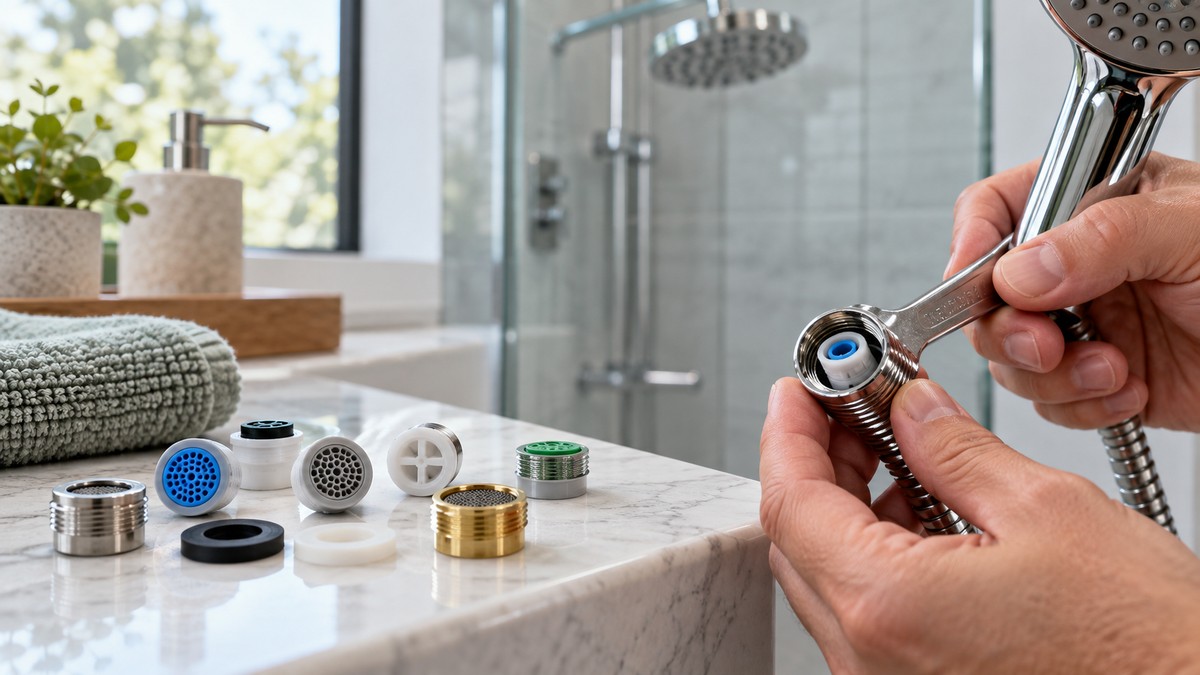
Patelai sells ten pieces. The bullets say each color is a different rate, with two pieces in each color, so you choose the rate by choosing the color. HammerHead sells one replacement part for shower heads. Its bullet does not say whether the part is an insert or a valve. Honoson sells a set that includes two valves and twelve inserts, so the set covers both approaches.
GARGIER, IBGBYAS and OIKOZEL sell shut-off valves. Each one has a handle, lever or turn that lowers or stops the flow. GARGIER says the valve lets you “temporarily pause the flow while soaping up.” IBGBYAS says it keeps water from running while you lather or shave. A valve of this kind is the right tool when you want control during the shower. It is the wrong tool when you want a rating that stays the same no matter how the handle is set, because none of the three valves gives a fixed rating in its bullets.
The rule is simple. If you want one fixed rating, read the bullets for an insert set with a stated GPM, such as Patelai or Honoson. If you want to pause the water by hand, look at the valves. Read the bullets before you buy, because the title does not always say which type you are getting.
Thread, opening and fit
Fit decides whether any restrictor works, and the listings describe fit in four different ways.
- Honoson: a 1/2 inch thread with an NPT outlet connection, and a restrictor valve that the bullets size at about 24 mm across and 22 mm long.
- Patelai: an opening of 0.566 inch, or 14.3 mm, for fixed or handheld heads, according to the bullets.
- GARGIER and OIKOZEL: 1/2 inch IPS in the GARGIER title and G1/2 in the OIKOZEL title, with a G1/2 outlet in the OIKOZEL spec table.
- IBGBYAS: G1/2 male and female threads, with two included sealing washers.
- HammerHead: no thread or opening in the bullet or the spec table we read.
The listings use three different thread names, and none of them explains how to convert from one to another. Before you order, look at the name stamped on your current fitting or in the manual for your head or hose. Then match that name to the listing. If the listing does not name a thread, do not assume one. Ask the seller or choose a listing that does.
Measure the opening as well. The Patelai bullets say their inserts suit a 14.3 mm opening, and that figure is the only size the bullets give. Where a listing gives a diameter for a valve, as Honoson does, compare it with the space where the part will sit.
Handheld, fixed head or hose
Several listings name handheld showers. Patelai says its inserts fit fixed or handheld heads. Honoson says its shower flow reducer fits handheld and head showers. IBGBYAS describes its valve as installed at a compatible handheld shower connection, and OIKOZEL says its valve matches handheld showers, shower hoses and bidet sprayers.
For a fixed overhead head, check the listing before you buy. The bullets for the three valves name handheld hoses and connections, not a fixed head. A fixed head usually needs a part that sits inside the head or at the arm, so confirm that the listing describes that location.
Hose choice matters too. A valve on the hose lets you change flow without reaching the head, which is the point of the IBGBYAS lever. An insert inside the head changes the rate without adding anything to the hose. Think about where your hand will be when you want to change the flow, and choose the location that matches.
What the bullets claim about water use
Several bullets make claims about savings, pressure or hot water. We report them as the listing’s words, not as results.
- HammerHead says its restrictor is for regulating flow “and maintain pressure.”
- OIKOZEL says its valve “saves 30% to 50% water to lower household water bills.”
- GARGIER says its valve “helps lower water usage and prevents wasting hot water during your shower routine.”
None of these bullets gives a method, a baseline or a test. The DOE page describes the federal figures as maximum flow rates, not as measured savings for a given fixture, so a savings percentage on a listing needs its own source before anyone relies on it. The listings do not supply that source.
How to read a listing before you buy
- Find the rating in the bullets. If none is given, as with three listings here, ask the seller for it or choose a listing that states one.
- Decide between insert and valve by reading the bullets, not the title.
- Write down the thread or opening your fixture uses, then match it against the listing.
- Confirm whether the part is for a handheld hose, a fixed head or both.
- If WaterSense is your target, keep the rating at or below 2.0 gpm, then see whether the flow still feels right once the part is in place.
Common mistakes
- Reading 2.5 gpm as a savings figure. It is the federal ceiling for showerheads sold after 1994, so it is the highest rate the standard allows, not the lowest.
- Assuming that two thread names are the same. The listings do not explain how NPT, IPS and G1/2 relate, so check them one at a time.
- Buying a valve when you wanted a fixed rating, or an insert when you wanted to pause the water by hand.
- Trusting the spec table without reading the bullets. The HammerHead table includes a hose length of 2017 inches and an installation type of wall mounted, and neither describes a restrictor. The Patelai table lists 3 gpm where its bullets list five rates.
1. Patelai 10 Pcs Shower Flow Restrictors Water Limiter, 14.3 x 13.85 x 5.2 mm (Ten-piece insert set with five GPM rates)
Pros
- The bullets list five insert rates from 1.5 to 3.0 GPM, two pieces of each color
- The bullets give an insert size of 14.3 x 13.85 x 5.2 mm and fit to a 14.3 mm opening
- The bullets say the POM material is rated for water from 0 to 90 degrees Celsius
Cons
- The spec table lists a flow rate of 3 gpm, which does not match the five rates in the bullets
- The bullets do not say which rate suits which head, so the choice is left to the buyer
Best for: A household that wants to try several flow rates before settling on one
Skip if: You need one rate you can confirm from the listing alone, because the table and bullets disagree
View on Amazon (affiliate link)
2. HammerHead® Flow Restrictor 2.5 GPM (Single 2.5 GPM replacement restrictor)
Pros
- The listing is for one restrictor rated 2.5 GPM, the same ceiling the DOE gives for showerheads sold after 1994
- The bullet describes a replacement part that regulates flow and maintains pressure
- The spec table gives a weight of 0.176 ounces and a part number that matches the title
Cons
- The listing has only one bullet, so other details come from the title and the spec table
- The spec table also lists a hose length of 2017 inches, which does not describe a restrictor, and we did not use it
Best for: A buyer who needs one 2.5 GPM replacement part and nothing else
Skip if: You want a choice of ratings in one order, since this listing offers only 2.5 GPM
View on Amazon (affiliate link)
3. Honoson 2 Set Shower Head Flow Restrictor, 1.2/1.5/1.8/2/ 2.2/2.5 GPM (Fourteen-piece set with two valves and twelve inserts)
Pros
- The bullets list six ratings from 1.2 to 2.5 GPM across the valves and inserts
- The bullets give a valve about 24 mm across and 22 mm long, with a 1/2 inch thread
- The spec table lists brass as the exterior finish and an NPT outlet connection
Cons
- The bullets give an insert size of 14 x 16 x 6 mm but do not say which head it suits best
- The bullets also mention kitchen faucets, but give no rating or fit detail for that use
Best for: A household that wants several ratings to try across different heads
Skip if: You want one fixed rating in a single package
View on Amazon (affiliate link)
4. Brushed Gold Shower Head Flow Restrictor, 1/2″ IPS Copper (Brushed gold shut-off valve with a ceramic cartridge)
Pros
- The bullets describe an adjustable valve that controls water volume without touching the main knob
- The bullets say the body is solid brass with a ceramic cartridge and a brushed gold plated finish
- The spec table lists threaded inlet and outlet connections and includes PTFE tape
Cons
- The listing gives no GPM rating, so its flow cannot be compared with the insert sets
- The title says flow restrictor, but the bullets describe a shut-off valve you adjust by hand
Best for: An owner who wants a hand-operated shut-off valve in a brushed gold finish
Skip if: You need a fixed rating such as 2.0 GPM
View on Amazon (affiliate link)
5. Shower Head Shut Off Valve, G1/2 Brass Flow Restrictor for Handheld Shower (Lever valve for pausing water at a handheld shower)
Pros
- The bullets describe a lever that changes flow between users and pauses water while you lather
- The bullets give G1/2 male and female threads and include two sealing washers
- The bullets say the body is solid brass with a polished chrome finish
Cons
- The listing gives no GPM rating, so the change in flow cannot be read from the page
- The bullets tell the buyer to check thread type and lever clearance before fitting
Best for: A handheld shower user who wants one-handed control of the flow
Skip if: You need a fixed insert that stays in the head
View on Amazon (affiliate link)
6. Shower Head Shut Off Control Valve, Pressure Reducer, Flow Restrictor (Ceramic shut-off valve with a 90-degree turn)
Pros
- The bullets describe a ceramic valve core and a 90-degree turn to adjust or shut off the water
- The bullets give G1/2 IPS threads and say the valve matches handheld showers, hoses and bidet sprayers
- The spec table lists a mesh filter washer and an O-ring among the included parts
Cons
- The bullets claim a 30% to 50% water saving, and the page gives no test or rating behind that figure
- The listing gives no GPM rating, so it cannot be compared with the insert sets
Best for: A buyer who wants a chrome shut-off valve on a handheld hose
Skip if: You want a water-saving rating you can confirm before buying
View on Amazon (affiliate link)
How we chose
We searched Amazon.com for “best shower flow restrictor” in Chrome on 20 October 2026 and read the first results page. We then ran one more search, “shower head flow restrictor insert”, because the first page mixed in fittings that are not restrictors and gave too few flow restrictor products from different brands.
We kept a listing when its title named a flow restrictor, a flow limiter, or a shut-off valve that the title calls a flow restrictor. We dropped shut-off valves whose titles do not use the word restrictor, and a flow restrictor listed with push connectors and a milliliter-per-minute rating, which is not a shower part. Where one brand had several listings, we kept one and dropped the rest. That removed a second listing from GARGIER and the other Honoson sets. Six products remained, from six different brands, and no ASIN appears twice.
For each kept listing we read the title, the first five bullets and the spec table. Where the spec table and the bullets disagreed, we report both. We did not use any price, rating, rank or availability figure, because those were not part of the data we used.
What we could not verify
- Whether any insert or valve delivers its rated flow in your plumbing. The DOE page describes federal figures as maximum flow rates, not as readings for a given fixture, and the listings give ratings without a test method.
- Which Patelai figure is right, 3 gpm in the spec table or the five rates in the bullets.
- Whether the Honoson or Patelai inserts fit a particular head. The bullets give a size but do not say where the insert sits.
- The “maintain pressure” claim on HammerHead, the 30% to 50% savings claim on OIKOZEL and the “helps lower water usage” claim on GARGIER. The listings give no method for any of them.
- The Patelai bullet that calls its POM material “safe and stable,” and the 0 to 90 degree working range it gives. We did not check either against a material or temperature source.
- Any item below the first five bullets, and the spec entries that do not match the product, including the HammerHead hose length.
- Whether the listed brands sell a warranty, a return window or replacement parts, since the bullets we read do not say.
FAQ
Is 2.0 gpm the best rating for a shower?
Not automatically. The EPA says WaterSense labeled showerheads must use no more than 2.0 gpm, and the DOE says the federal ceiling is 2.5 gpm. A 2.0 gpm part meets the stricter figure on paper. The listings do not say how the flow will feel at your pressure, so choose the rating that fits your fixture and your comfort, then check how the shower performs.
Does a flow restrictor save water?
It lowers the maximum rate, so the water used per minute falls. Using the rated numbers, a 10-minute shower at 2.0 gpm uses 20 gallons, compared with 25 gallons at 2.5 gpm. Penn State Extension says low-flow shower heads conserve water by restricting the opening, which is the same mechanism a restrictor uses.
Can I put a flow restrictor on a handheld shower?
Some listings say so. Patelai says its inserts fit fixed or handheld heads with a 14.3 mm opening. Honoson says its flow reducer fits handheld and head showers. IBGBYAS and OIKOZEL describe their valves for handheld connections. Check the thread or opening against your hose before you order, because the bullets do not give your fitting’s size.
What is the difference between an insert and a shut-off valve?
An insert is a fixed part that holds one rating. A shut-off valve has a lever, handle or turn that you use to reduce or stop the flow. Several listings use flow restrictor for the valve, so read the bullets before you buy.
Should I remove a water saver to get more flow back?
That is a separate decision from buying a restrictor. Our guide on removing a water saver from a shower head covers what changes when the saver comes out, and it is the better read if your current head already has one.
Bottom line
Pick the rating first, then the type, then the thread. If you want one rating that does not change, choose an insert set with a stated GPM in its bullets. If you want to pause the water by hand, choose a valve whose thread matches your hose. Treat any savings percentage as the listing’s claim until you can see how it was measured.
Sources
- EPA WaterSense, Showerheads (opened 20 October 2026): https://www.epa.gov/watersense/showerheads
- U.S. Department of Energy, FEMP, Best Management Practice #7: Faucets and Showerheads (opened 20 October 2026): https://www.energy.gov/eere/femp/best-management-practice-7-faucets-and-showerheads
- Penn State Extension, Saving Water in the Home (opened 20 October 2026): https://extension.psu.edu/saving-water-in-the-home