How to Hang a Bathroom Towel Rack, Towel Hooks and Mirror
As an Amazon Associate we earn from qualifying purchases.
This guide answers how to hang bathroom towel rack hardware, step by step, from manufacturer install sheets. The right method depends on the wall. A stud takes wood screws, drywall takes the anchors in the kit, and none of the sources opened for this post gives steps for tile. Mark a level line first, drill only where the sheet says to, and tighten until the fixture is firm rather than tight.
Quick answer
- Level the mounting line before you drill. Moen and Kohler both call for a level.
- In drywall, use the anchors in the kit. In a stud, the Moen sheet says to use the wood screws only.
- Mirror clips and Z-clips go where the manufacturer’s bracket layout puts them. FHC and Robern each give their own hole sizes.
- Do not overtighten. Kohler says overtightening can damage the towel bar, and Robern’s anchor step says DO NOT OVER TIGHTEN.
- A towel bar is not a grab bar. Kohler says its accessories are not designed for use as one.
- The sources do not cover tile anchors, towel hook height, or load ratings for towels or mirrors.
Tools and hardware to have before you start
The Moen towel bar sheet lists a Phillips screwdriver, a drill, a 1/4-inch drill bit, a hammer, a level and tape. For a 24-inch double towel bar with a robe hook and paper holder, the kit lists 4 anchors (2 for the robe hook), 4 wood screws (2 for the robe hook) and 1 hex wrench. Kohler’s accessory sheet also calls for a hex wrench to tighten the setscrews, and it tells the installer to select a drill and bit for the wall material being drilled.
Mirror hardware differs. The FHC slip-fit clip sheet uses 3/32-inch holes for its brackets, and the Robern framed mirror sheet uses a 5/16-inch hole for its anchors. Use the bit size from the sheet that came with your own hardware, not a size taken from another brand.
How to hang bathroom towel rack: the Moen steps
The Moen install sheet INS10621 covers its 18-inch and 24-inch towel bars. The sheet’s note reads “Directions below are for installation into drywall.” The steps below follow that sheet as written. If you install into a stud, the sheet’s stud route is covered in the next section.
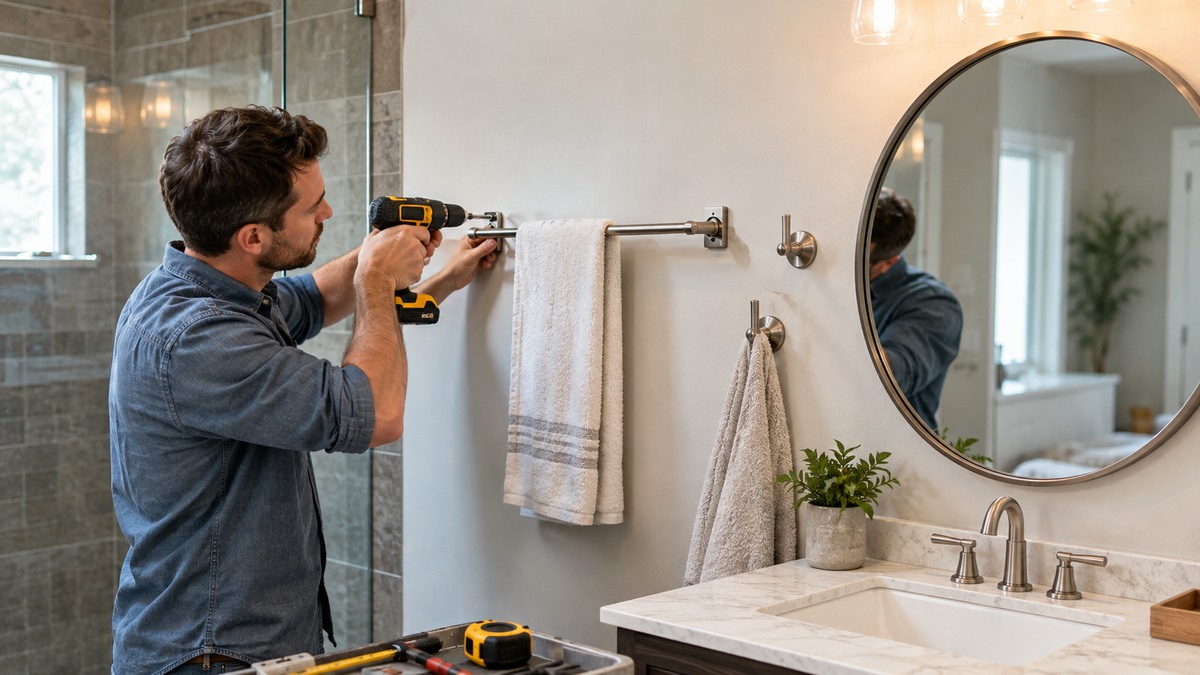
Step 1: Position the mounting template on the wall where you want the bar, align it with a level, and tape it in place.
Step 2: Mark the hole locations at each mounting post. Use the horizontal holes on the template for drywall, or the vertical holes for a stud. The sheet gives one other option: drill pilot holes at the corresponding location.
Step 3: Remove the template. Using a Phillips screwdriver, screw the provided anchors into the wall until they are flush.
Step 4: Loosen each setscrew with the provided hex wrench and remove the mounting posts from the product assemblies.
Step 5: Place each mounting post over its anchors with the arrow facing up, and insert the provided screws through the post into the anchors. Tighten the screws.
Step 6: Assemble the towel bar and posts. Position each end post with its setscrews facing down, place the assembly over both mounting posts, and tighten the setscrew at the bottom of each post.
The Kohler accessory steps
Kohler’s accessories guide 1020816-2 covers models K-8138, K-8139, K-8140 and K-8143. It asks the installer to decide the spot, then mark vertical and horizontal center lines and check the roughing-in diagrams for dimensions. Use a level so that all center points are level. Its pilot-hole step says to mark holes 9/16 inch above and below each center point, and to drill a 5/16-inch hole at every mark.
Next, press the legs of a wall anchor together, insert it into the hole, and tap it with a hammer until it is flush with the finished surface. Orient each wall plate with the large slotted mounting hole down and the smaller hole over the higher anchor, then secure it with the supplied panhead screws. Start a setscrew into each post without threading it fully, slide the towel bar onto the wall plates, and tighten the setscrews with a hex wrench.
How to install bathroom towel rack on a stud, drywall or tile
Most of the install question is about the wall. Moen’s sheet is written for drywall and says a stud install needs the wood screws only. Kohler says its accessories should be “located and mounted to a wall stud,” and that a stud-mounted product “will yield the best results.”
Stud installs
For a stud, use the vertical holes on the Moen template and drive the wood screws supplied with the kit. The sources do not describe how to find a stud, so the method for locating one is outside this post.
Drywall installs
For drywall, use the anchors in the kit, screwed flush with the wall as in the Moen steps. The Kohler sheet covers an anchor that lands between two studs. In that case, it says the anchor legs must be spread by inserting a thin long object, such as a finishing nail, into the anchor hole. Repeat for each anchor between studs.
Tile
None of the opened sources covers tile. Moen’s sheet is written for drywall and stud. Kohler tells the installer to pick a bit for the wall material, but does not name tile. Robern’s anchor step lists drywall or wallboard, plaster, brick, or concrete, and tile is not on that list. Pick tile hardware and a bit from the hardware maker’s own tile instructions, which were not among the sources opened for this post. If you are looking at a tiled wall and need storage rather than a bar, tile-mounted shower shelf options cover a different mounting question.
Kohler’s sheet also says to observe all local plumbing and building codes. The sources do not describe how to locate pipes or wiring behind a wall before drilling. That check is outside what this post can source, so do it before any hole is drilled.
How to hang a bathroom mirror: level and position
The Robern install sheet for its decorative framed wall mirror (part 209-1158-B) uses two Z clips. Carefully choose the location, then mark the bottom and side edges of the mirror on the wall with a pencil. The sheet has a figure that shows where each Z clip sits relative to the mirror outline, and it says to install the two clips with the supplied washers and SS674 #10 x 2-inch screws.
Peel the backing from one side of the 2-inch square double-sided adhesive pads and stick them to the back inside corners of the glass. Hang the mirror on the Z clips. If the mirror needs to move, adjust the Z clips up or down until the mirror is level. Tilt the bottom of the mirror out slightly, peel the backing from the other side of the pads, and push the mirror firmly against the wall until the pads stick. Check that your mirror matches the sheet’s model before you follow it.
How to install bathroom mirror: clips, anchors and brackets
Mirror installs depend on the clip system and on whether a stud is behind the mounting point. The two sheets opened for this post take different routes, so the steps are given separately.
Robern wall anchors
Robern’s sheet says: “You must use the supplied plastic anchors when there is no wall stud at the Z clip location.” For the anchor type the sheet calls BLUE 203-1309, drill a 5/16-inch hole into drywall or wallboard, plaster, brick, or concrete. Insert the anchor until its flange is flush with the wall, insert the #10 screw, and tighten until it contacts the Z bar or Z clip. Keep tightening until there is strong resistance, and do not over tighten.
The same sheet names a second anchor type, RED SS680. For that one, if no furring strip or stud is available, drill a 9/32-inch (7 mm) hole for the supplied plastic anchor, insert the anchor until its flange is flush, and tighten the screw until it is tight against the fixture. The sheet says to identify which anchor type came with your mirror before you drill.
FHC slip-fit clips
The FHC sheet’s warning says the clips “should be installed into wall studs for maximum support.” It also says the installer is responsible for choosing screws and anchors when the clips are not mounted to a stud, and for “determining the safe weight load based on the substrate.” Set each bracket 1/2 inch in from the edge of the mirror, mark the bracket holes, drill 3/32-inch holes, and screw the brackets to the wall with the supplied screws.
For a mirror without bottom support, the sheet says to fasten the upper screw in the bracket only, insert the Slip Clip, and then fasten the lower screw through both the clip and the bracket. Insert pads in the tips of the clips to help protect the mirror from metal contact. Place the mirror, then push the top clips down to secure it. The sheet says “Do not force or hammer clips into place,” and it notes a small slot in the clip allows for added adjustment.
How to hang towels on a towel bar
The opened sources do not describe how to fold, stack or arrange towels on a bar, and they give no load figure for towels. What they do say is about use. Kohler states that its accessories are not designed or intended for use as a grab bar or support bar, and warns against installing them where they are likely to be used that way. A towel bar is for holding towels. Do not lean or pull on it.
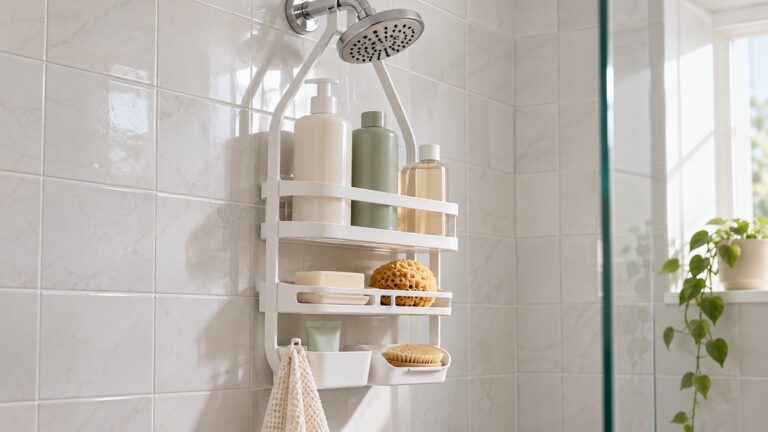
If you need a place for items beside the towels, a caddy that sits over a towel bar is a separate product type with its own mounting method. This post does not cover that method.
How high should shower towel hooks be
None of the opened sources gives a height for shower towel hooks, so this post does not name one. The closest figure is the reach range in the 2010 ADA Standards, as shown on the Access Board’s operable-parts guide. It says “The range for unobstructed reaches (15″ to 48″) applies only to those portions of elements that are operable.” Non-operable portions can sit outside that range.
The same guide says the maximum high reach over an obstruction drops to 44 inches when the depth of reach over that obstruction exceeds 20 inches. That is an accessibility rule for reach, not a height rule for towel hooks, and the sources do not say what height suits a household. Set the hook at a height the person using it can reach. If a seated user needs to reach it, the sources do not address that case.
Mistakes to avoid
- Putting drywall anchors into a stud. Moen’s sheet says to use the wood screws only in a stud.
- Skipping the level. Kohler says that without level center points, multi-post accessories have no provision for later adjustment.
- Overtightening. Kohler warns that overtightening can damage the towel bar, and Robern’s sheet says DO NOT OVER TIGHTEN.
- Using the bar as support. Kohler says its accessories are not designed or intended as a grab bar or support bar.
- Forcing mirror clips into place. The FHC sheet says not to force or hammer them.
How we chose
This post used five pages, each opened with curl on 2026-10-23. The criteria were narrow. Each source had to be a manufacturer install sheet for a towel bar or mirror, or an accessibility reference for reach ranges. Each quote had to appear in the downloaded text. Retailer blogs and search results were not used as sources. Other manufacturer sheets were opened, and left out where they covered a different fixture. The post names no products and has no product list, because the scope is how-to only.
What we could not verify: what the sources do not say
- Tile anchors. No opened source names tile as a base for its anchors.
- Load ratings. None gives a weight rating for a towel bar, a towel or a mirror on a drywall or stud install. FHC leaves the safe weight load to the installer.
- Towel hook height. No height for a shower towel hook or bar appears in the sources.
- Locating studs and checking for pipes or wiring behind the wall before drilling.
- Adhesive-only mounting. This post does not say whether adhesive holds a towel bar or mirror. For a no-drill rack, see the adhesive shower rack guide.
- Fold, stack or arrangement of towels on a bar.
FAQ
Can I hang a towel bar without finding a stud?
Yes, both the Moen and Kohler sheets cover installs into drywall with the anchors supplied. Moen’s note says its directions are for drywall. Kohler says a stud-mounted product “will yield the best results,” so a stud is the stronger choice where one is available. The sources do not give a load rating for the drywall option.
Do I need a level?
Both Moen and Kohler say to use one. Moen aligns its template with a level and tapes it to the wall. Kohler says to use a level to ensure the center points are level, and warns that multi-post accessories cannot be adjusted later if the center points are off.
How tight should the screws be?
Firm, not tight. Kohler says “Do not overtighten the setscrews” and that “Overtightening can damage the towel bar.” Robern’s anchor step says “DO NOT OVER TIGHTEN” and asks the installer to stop at strong resistance.
Can a towel bar hold my weight?
No. Kohler says its accessories are not designed or intended for use as a grab bar or support bar. The sources give no load figure for a towel bar, so do not treat it as support.
How high should shower towel hooks be?
The sources do not give one. The ADA reach range of 15 to 48 inches from the Access Board is a reach guideline for operable parts, not a towel hook height. Choose the height by who will reach it, and follow the mounting method in the instructions for your hardware.
Bottom line
Level the mounting line, use the anchors in the kit for drywall or the wood screws for a stud, and stop tightening once the fixture is firm. Moen and Kohler follow the same basic order for towel bars: mark the position, drill, set the anchors or screws, fit the posts, then fit and tighten the bar. Robern and FHC mount mirrors on clips or Z clips, and both warn against forcing or overtightening. Tile anchors, towel hook height and load ratings are not in the sources opened for this post.
Sources
- Moen INS10621, Belfield 18 and 24 inch towel bar installation sheet (opened 2026-10-23). Drywall note, template steps, stud note, hardware kit contents, tools list, setscrew steps.
- Kohler accessories installation guide 1020816-2 (opened 2026-10-23). Grab bar limit, wall stud advice, center points and level, 9/16 inch pilot marks, 5/16 inch hole, anchor steps, wall plate steps, setscrews.
- FHC Slip Fit Mirror Clips installation instructions, item SF114 (opened 2026-10-23). Stud warning, installer responsibility for anchors and weight, bracket spacing, 3/32 inch holes, slip clip steps, no forcing.
- Robern decorative framed wall mirror installation instructions, part 209-1158-B, and anchor notice (opened 2026-10-23). Z clip steps, adhesive pads, level adjustment, anchor types, 5/16 inch and 9/32 inch holes, do not over tighten.
- U.S. Access Board, Chapter 3: Operable Parts (opened 2026-10-23). Unobstructed reach range 15 to 48 inches for operable parts; obstructed high reach limit of 44 inches over an obstruction deeper than 20 inches.