How to Install or Fix a Toilet Paper Holder or Curtain Rod
As an Amazon Associate we earn from qualifying purchases.
Here is how to install toilet paper holder hardware: mark the mounting spots, drill pilot holes at the size your manual gives, press wall anchors in, then fasten the plate or bracket. A shower curtain rod can be hung with no drill at all using a tension rod that wedges between the walls. This guide covers installing, fixing and removing a toilet paper holder, and installing and fixing a shower curtain rod. It uses only the steps in the manufacturer manuals we opened, and it says so where they stay silent.
Quick answer
- Install a toilet paper holder: mark the holes, drill pilot holes (the manuals state a 5/16-inch or 1/4-inch bit), set the anchors, then fasten the plate or bracket.
- Fix a loose holder: tighten the set screw at the base. The sources do not cover repairing a spinning anchor.
- Remove a toilet paper holder: loosen the set screw, lift off the holder, then remove the plate or bracket and its screws.
- Install a curtain rod without drilling: use a tension rod, set its length, and turn the sleeve until it presses both walls. Do not overtighten, and keep the load within the manual’s limit.
Before you start: check the wall
Before any drilling, look at the wall where the drill will go. The Kohler REVIVAL manual says that while “it is possible to mount these products on any surface,” it is best to find a wall stud to secure them to. If a drill bit could reach a pipe, a supply line or a wire, stop and pick another spot, or call a licensed professional. None of the steps below involve the water supply, and this guide does not cover plumbing or electrical work.
The same Kohler manual says its products are “not designed or intended for use as a grab bar or support bar.” A holder or curtain rod is a common thing to grab for balance, so do not treat either one as a support bar.
How to install toilet paper holder hardware
Step 1: Mark the location and check it is level
Hold the plate or bracket where you want it and mark the mounting holes. The Kohler service-kit manual says to mark the holes and verify that the marked positions are level before you adjust. The Lowes Project Source manual has you outline the holder base with a pencil and center the bracket in the outline. Level is on the tools list in both the Lowes manual and the Kohler REVIVAL manual, so use one.
Step 2: Drill the pilot holes and set the anchors
The drill size changes between products. The three manuals we opened state the following:
| Source | Product named in the manual | Drill step stated | Anchor step stated |
|---|---|---|---|
| Kohler service kit, document 1064697-9 | Toilet tissue holder wall plate (part 1064696) | Drill pilot holes with a 5/16-inch bit at the marked locations | Press the anchor legs together, insert, then tap in with a hammer |
| Lowes Project Source manual, item 5287614 | Toilet paper holder, models 161-DOVTP-PSCH and 161-DOVTP-PSMB | For drywall, drill 1/4-inch holes through the bracket’s screw holes | Gently hammer the drywall anchors in until flush with the wall surface |
| Kohler REVIVAL accessories, document 114528-2 | Double toilet tissue holder (K-16152) and shower curtain rod (K-16154) | Drill 5/16-inch mounting holes, using a bit suited to the wall material | Press the legs together, insert, tap until flush; spread the legs with a narrow rod if the anchor sits between studs |
The two bit sizes are both in use, so the number in your own manual wins. Anchors are what hold the screws in drywall, so do not skip them. If an anchor will not sit flush, pull it out and check the hole before you force it.
Step 3: Fasten the plate and tighten the set screw
Line up the plate or bracket over the flush anchors in the same orientation and fasten it with the supplied screws. The Kohler manual says to secure the plate, reinstall the accessory, and then secure it with its set screw. The Lowes manual has you place the holder over the bracket and tighten the set screw at the base with the included Allen wrench.
Wood walls and studs
The Lowes manual says that on a wood wall you fasten the bracket directly with the mounting screws, and it says not to pre-drill the holes in that case. The Kohler REVIVAL manual says an anchor set in a stud keeps its legs together and gives proper support. The sources do not give a screw length or stud spacing, so find the stud with a finder and use screws long enough to reach it.
Horizontal mounting
The Kohler service-kit manual notes that if a toilet tissue holder is mounted horizontally, the existing anchors may need to be removed and new holes drilled horizontally. Decide the orientation before you mark the wall.
How to fix a toilet paper holder
When the holder wobbles or spins
Most loose holders have a set screw that has backed out. In the Lowes manual it sits at the base of the holder and takes the included Allen wrench. Loosen it, check that the holder sits square on its bracket, then tighten it again until the holder stops moving. The manuals do not give a torque figure, and a small set screw can strip if you overdo it.
When the plate pulls away from the wall
If the plate moves while the anchors stay put, the screws may not be fully seated. Take the holder off, tighten the screws into the anchors, and check the plate is flush. The Kohler manual says to ensure the wall anchors are flush with the finished surface, so check that first.
When the anchor spins or the hole is too big
This is the repair the sources do not cover. None of the manuals we opened describes how to fix an anchor that spins, a crumbled hole, or a hole too large for its anchor. Do not fill the hole with a product the manual does not name, and do not drill a bigger hole to make a loose anchor fit. Ask a professional or the product maker’s support line.
How to remove a toilet paper holder
Take off the holder and the plate
The Lowes manual says to unscrew the set screw at the base with the Allen wrench, which frees the holder. The Kohler manual says to remove the accessory from the wall plate, note the orientation of the slot and set screw dimples, and then remove the plate. Keep the screws together in case you reinstall.
Take off the bracket and the anchors
With the holder off, remove the mounting screws and the bracket. The sources say existing anchors may need to come out when a holder moves to a horizontal position, but they do not give a method for pulling an anchor. If an anchor will not come out, stop and look at the wall before you pry.
Patch the holes
The sources we opened do not cover patching the holes left behind. Look for a patch method from the wall or paint maker, and do not use any filler named in this guide, because none of the opened manuals names one.
How to install a shower curtain rod without drilling
Choose tension or permanent mount first
The Lowes tension-rod manual cautions that, before installation, you must choose a tension mount or a permanent mount, and that drilling is required for a permanent installation. A no-drill rod means the tension mount. The sources do not give a no-drill method for a permanent mount.
Set the length and tension the rod
The Lowes manual gives six steps. Measure the distance between the walls and write it down. Unscrew the tightening sleeve until the threaded collar is fully disengaged. Extend the rod to the recorded length, loosen the set screws with the small hex wrench so the collar slides, and place the collar near the junction of the two tubes. Tighten the set screws until the collar cannot move, noting “Do not overtighten.” Thread the sleeve over the collar, place the rod in position, and keep turning the sleeve to apply tension, again without overtightening.
Measure first, because the length has to be set before tension is applied. The steps we read do not describe trimming a rod that is too long. Kohler’s rod manual also says to ensure the tube is level before you secure it, which is a sensible check even for a tension rod.
Know the weight limit
The Lowes manual says “Do not overload” and that “The maximum weight capacity is 15 lbs. evenly distributed.” A heavy liner, a double curtain or a rod that keeps sagging is a sign the load is too high for a tension rod. The sources give no load figure for other rods, so check the box or manual for the rod you buy.
How to fix a shower curtain rod
When the rod slips
A slipping tension rod usually needs more tension. The Lowes manual’s adjustment is to loosen the set screws, slide the collar, retighten until the collar cannot move, then turn the sleeve again until the rod presses the walls. Do not overtighten at any step.
When the rod sags in the middle
The sources do not describe a fix for sag. The Lowes manual covers tension and the weight limit, but not how to stiffen a bent rod. If it still sags with a light curtain, the sources do not say whether the rod is faulty, too long or the wrong type. Reduce the load or replace the rod, and check the maker’s support line.
When a permanent rod is loose at the wall
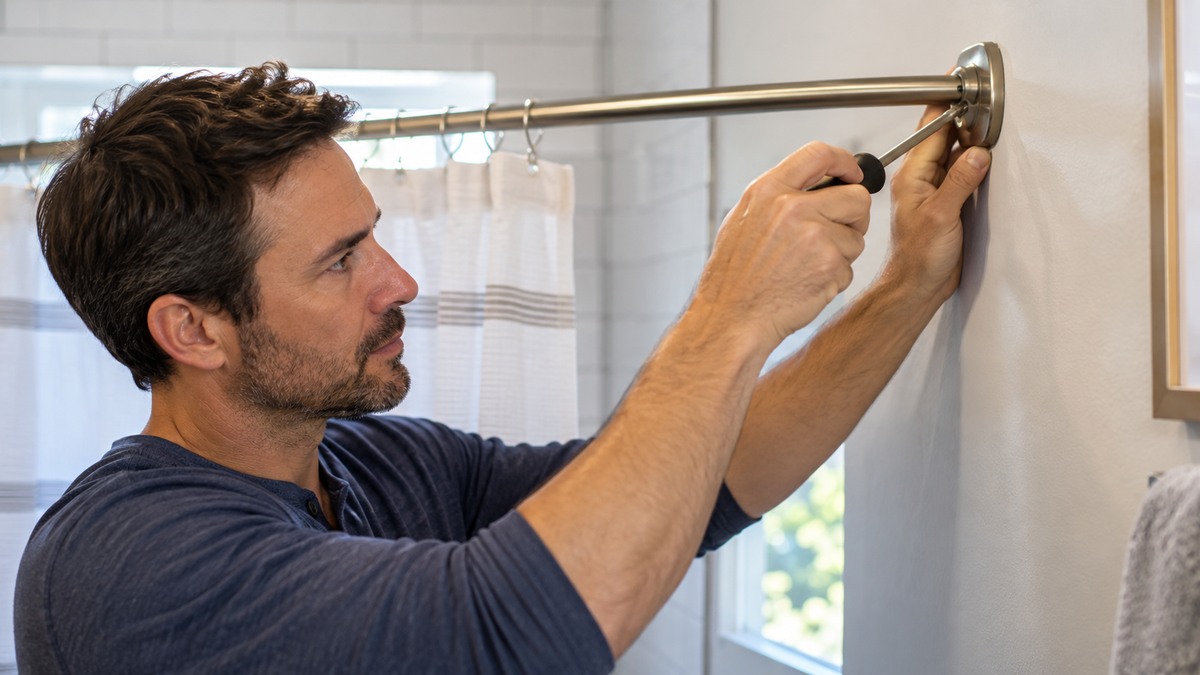
The Kohler rod manual says to secure the tube to each anchor with the setscrews and “Do not overtighten,” then hand tighten each escutcheon to its anchor. The Lowes curved-rod manual says to drill pilot holes with a 3/16-inch bit and insert wall anchors in drywall. If an anchor spins, the sources do not give a repair method.
How we chose
We limited this guide to steps a manufacturer or a manufacturer-supplied manual states. On 2026-10-23 we opened the documents listed at the end of this post, opened with curl, and we checked that each quoted sentence appears in the text of the document we downloaded. We chose manuals that name a product type matching the job: toilet tissue holders, a toilet paper holder with named models, and tension and curved shower curtain rods. Two candidate pages returned HTTP 403 and were not used. We also opened a retail toilet paper holder instruction sheet and a home-improvement article about tension rods, but we did not use them as sources because one is a retail page and the other is a blog.
The manuals are for specific models. A Lowes item number or a Kohler part number applies to that product, so read your own manual before you follow any step here.
What we could not verify: what the sources do not say
- How to repair a spinning, crumbling or oversized anchor hole. None of the opened manuals gives a method.
- How to patch or paint over old holes after removal.
- A no-drill method for a toilet paper holder. Every holder manual we opened calls for drilling or screws.
- A weight limit for toilet paper holders. The one load figure we found is for a tension rod: 15 lbs. evenly distributed.
- A fix for a tension rod that sags. The Lowes manual covers tension and weight, not sag.
- Anchor and screw sizes for every wall type. Each manual names its own bit and anchor.
- Any plumbing or electrical step. These jobs do not involve pipes or wiring in the steps we read.
Related reading on this site
If the shower needs a bar you can adjust to your height, our guide to drill-less shower slide bars covers a different mounting approach. For a hand-held head on a bar, see our guide to hand-held shower heads on a slide bar. Our slide bar roundup covers the options by use.
Frequently asked questions
Can I install a toilet paper holder without drilling?
The holder manuals we opened all call for drilling and anchors, or for screws into a wood wall. The sources do not describe a no-drill toilet paper holder, so this guide does not give one. Check the product listing or the maker’s support line before buying a model that claims no drilling.
What size drill bit do I need for a toilet paper holder?
It depends on the product. The Kohler service-kit manual says a 5/16-inch bit for pilot holes. The Lowes Project Source manual says 1/4-inch holes for drywall. Use the size in your own manual. The sources do not give a universal size.
Do I need to turn off the water to install a toilet paper holder or curtain rod?
No. None of the steps in the manuals we opened involves the water supply, and this guide does not cover plumbing. The one safety step is to check the wall first so a drill bit does not reach a pipe or wire. If you are unsure, stop and call a licensed professional.
How much weight can a tension shower curtain rod hold?
The Lowes tension-rod manual we opened states a maximum weight capacity of 15 lbs. evenly distributed, and says “Do not overload.” That figure comes from that manual, not from every tension rod sold, so check the manual for your model.
Why does my tension rod keep falling?
Based on the Lowes steps, the likely causes are that the rod was not tensioned fully or the load is too heavy. Re-tension it by loosening the set screws, repositioning the collar, retightening until it cannot move, and turning the sleeve. Do not overtighten. If the rod still falls, the sources do not say what to try next, so contact the maker.
Bottom line
To install a toilet paper holder, mark the spot, drill pilot holes at the size in your manual, set the anchors flush, and fasten the plate. To fix a loose holder, tighten the set screw; the sources do not cover a spinning anchor. For a shower curtain rod without drilling, use a tension rod, tension it until it presses both walls, do not overtighten, and keep the load under the manual’s limit. Where a source is silent, this guide says so.
Sources
- Kohler Co., service kit instructions for wall plate, document 1064697-9-A: https://techcomm.kohler.com/techcomm/pdf/1064697-9.pdf (opened 2026-10-23). Wall plate steps, 5/16-inch pilot bit, anchors, horizontal mounting note.
- Kohler Co., REVIVAL accessories instructions, document 114528-2-AA(A): https://resources.kohler.com/onlinecatalog/pdf/114528_2.pdf (opened 2026-10-23). Grab bar warning, wall stud note, anchor steps, rod installation and “Do not overtighten.”
- Lowe’s (Project Source), toilet paper holder instructions, item 5287614, document SS23331: https://pdf.lowes.com/productdocuments/055a740b-3560-4046-9344-a45908a51e95/63967796.pdf (opened 2026-10-23). Drywall 1/4-inch drill step, anchor step, wood-wall step, set screw.
- Lowe’s (Allen + Roth), curved shower rod instructions, models SHLSNC01SN and related, document 73168623: https://pdf.lowes.com/productdocuments/91bb3d05-5128-4651-95ba-ab9ef8f8a275/73168623.pdf (opened 2026-10-23). Tension steps, 15 lb. capacity caution, tension or permanent mount choice.
- Lowe’s, curved shower rod instructions, document 05390151: https://pdf.lowes.com/productdocuments/a807f245-5f88-495a-90a0-73ae96fcdb0e/05390151.pdf (opened 2026-10-23). 3/16-inch pilot drill step and anchors for a permanent drywall rod.