Shower Head Pause Button and Spray Settings Guide
As an Amazon Associate we earn from qualifying purchases.
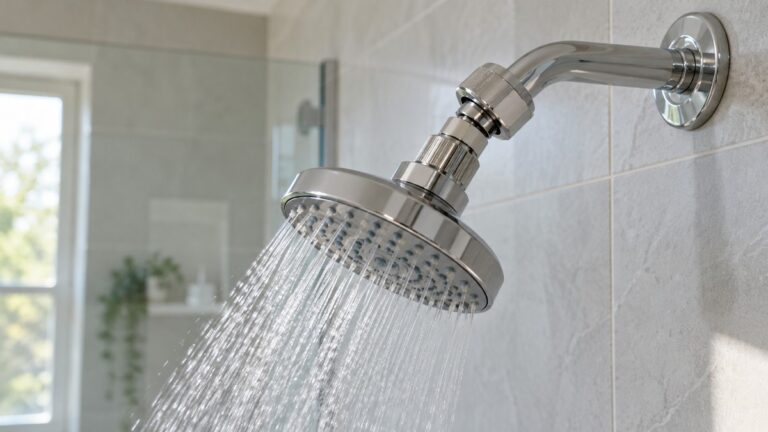
A shower head pause button lowers the spray to a trickle so you can lather, shave or rinse a child without turning the whole shower off. It does not shut the water off. The Waterpik and Delta manuals we opened describe the control as a way to reduce flow, and Waterpik says its pause cannot stop water completely. If the spray is weak, uneven or missing a pattern after you pause or change modes, check the control position first, then clean the face, nozzles and filter screen. If the button is physically stuck, or the valve needs work, contact the maker or a licensed plumber.
Quick answer
- A pause control reduces water to a trickle. It is not a shut-off. Waterpik’s pause-in-handle manual says the pause “will not shut off water flow completely.”
- In the manuals we opened, the control is a sliding switch, a push button or a button on the hand shower. Check your own manual for its exact location.
- If the spray is weak or a pattern is missing, first confirm the control is not left in the trickle position. Then clean the spray face, the nozzles and the filter screen.
- If a button is stuck, or the problem sits inside the valve or the pivot connection, contact the manufacturer or a licensed plumber. The sources we opened give no disassembly steps for that.
What a shower head pause button does
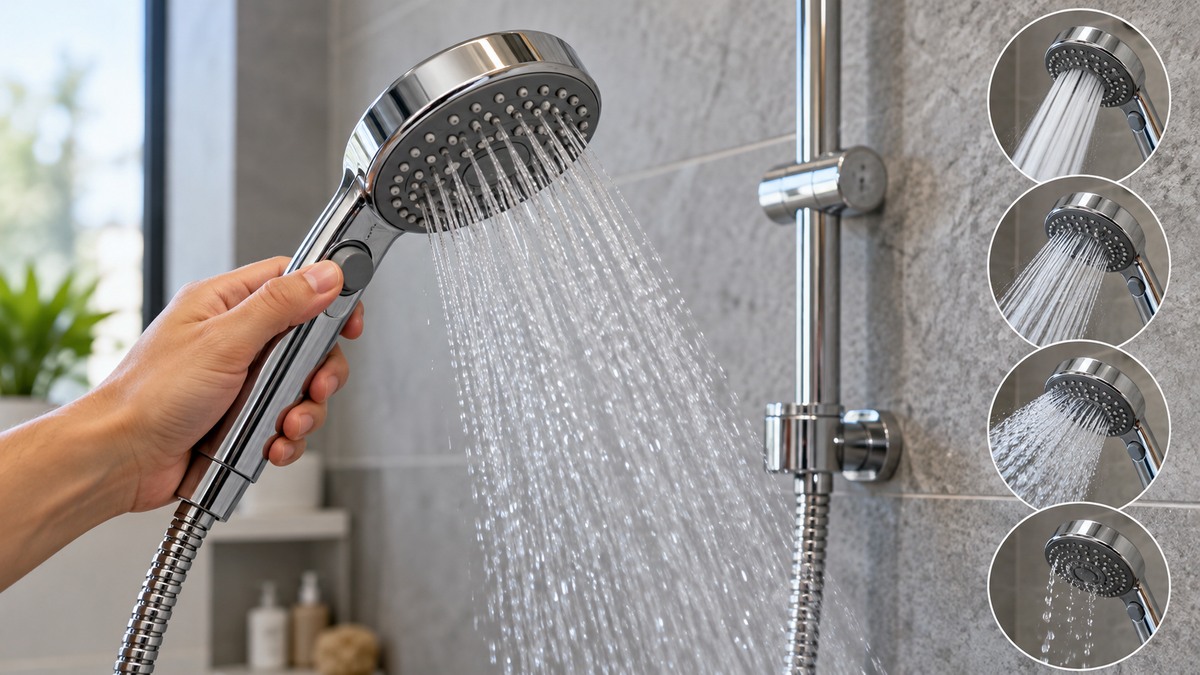
On Waterpik’s pause-in-handle hand shower, the feature lets you “control water flow from full power to a water saving trickle.” The manual notes it is useful for bathing children or pets. Waterpik’s Dual Power Pulse uses a sliding switch instead. The manual says to move the switch fully right for a pause, shown as a trickle, and fully left for full flow. Positions in the middle adjust spray strength. Delta’s hand shower manual, which we opened as a Lowe’s-hosted PDF, uses a button on the handle: pressing from the front brings the output down to a trickle, and pressing in from the back returns normal flow.
Why a pause never fully shuts the water off
Waterpik’s manual explains the limit. The note under the pause feature says the control “will not shut off water flow completely.” The manual cites the ASME A112.18.1 standard, which it says the U.S. Department of Energy and plumbing code use. That standard states that a flow control device “shall not completely shut off the flow of water” downstream of the primary shut-off valve when it is fitted to, or built into, a shower head or hand shower. If you need the water fully off, for example to work on the head, close the shower valve or the supply valve.
How to use the pause control
The steps below follow the manuals we opened. The layout and direction differ by brand and by model, so check your own guide.
- Find the control. On Waterpik’s pause-in-handle model it sits on the handle. On the Dual Power Pulse it is the sliding switch on the handle. On Delta’s hand shower it is a button on the handle that you press from either side.
- Pause. On the Dual Power Pulse, move the switch fully right. On the Delta hand shower, press the button from the front of the handle.
- Resume full flow. On the Dual Power Pulse, move the switch fully left. On the Delta hand shower, press the button in from the back.
- Set a middle strength. The Dual Power Pulse manual says the spray strength of any setting can be changed by moving the switch somewhere in the middle. This gives less force without a full trickle.
- Check the result. Run the water for a few seconds after each change. If nothing changes, go to the troubleshooting sections below.
Spray settings: how the modes change
A pause lowers the flow. A spray setting changes the pattern or the spray type. The manuals we opened describe three ways a head changes its setting, and one head may use more than one.
The trim ring and the small lever
On Waterpik’s pause-in-handle hand shower, the manual says: “Spray pattern is controlled by the small lever that rotates left and right.” It adds that you rotate the trim ring around the face of the head to change settings. Turn each one slowly and watch the spray before you turn it further.
Buttons on the back of the hand shower
Delta’s hand shower manual uses buttons instead. You press the appropriate button, or a combination of buttons, on the back of the hand shower. In the manual’s chart, the first button gives a wide spray, the second a massage spray, and the third a narrow spray. Because the combinations differ by model, use the chart in your own manual.
Cleaning mode on the Clean Pro
Waterpik’s Clean Pro manual includes a cleaning spray. The manual says it will “only activate when the top of the shower head is below the horizontal position.” It also warns that cleaning spray is extremely powerful, so you should avoid pointing it at your face or other sensitive areas. Move out of cleaning mode before you return the head to the bracket and turn the water off. The manual warns that otherwise the head may spray your ceiling when the water is turned back on.
If the spray goes off-angle rather than weak, the cause is often the arm or the face, not the pause. Our guide to why a shower head sprays in different directions covers those causes.
Why the spray looks wrong
The troubleshooting tables in the manuals group most spray complaints under one heading: low water pressure or missing spray patterns. The solutions run in a set order, starting with the control and ending with cleaning and fitting checks.
The control is in trickle or pause position
Waterpik’s Dual Power Pulse troubleshooting table lists making sure the Hybrid Power control is not in the trickle position as the first fix for low pressure or missing patterns. On any model with a pause, move the control through its full travel and back to full flow, then run the water again.
Mineral deposits on the spray holes
Waterpik’s manual says cleaning is required when mineral deposits appear on the spray orifices, and that you should “gently rub the rubber nozzles” on the face to dislodge them. Kohler’s care sheet says mineral buildup can be removed from rubber nozzles by firmly rubbing a finger over them while the water runs. Deposits on a mesh spray face need a soak, covered in the cleaning steps below.
The filter screen and the washers
A clogged filter screen can cut flow even when the head is clean. On Waterpik’s pause-in-handle model, the manual says to unscrew the filter screen from the pivot ball and rinse it by back flushing. On the Dual Power Pulse, the screen is located in the handle and gets its own step. The Waterpik troubleshooting table also says to confirm there is only one washer in the pivot ball and that one washer sits on top of the screen.
Nozzles that stay blocked
When rubbing and soaking do not clear a nozzle, a toothpick can be used with care. American Standard’s cleaning guide says you can “use a toothpick to make sure all of the shower nozzles are unclogged.” Treat this as a light check. Work one hole at a time and do not force a pin into a face that does not give easily. For a fuller method, see our guide on how to clear clogged shower head nozzles.
Cleaning the face and nozzles, step by step
Cleaning fixes most spray complaints in the sources. Work in this order, and stop as soon as the spray is even.
- Shut the water off first. Close the shower valve before you remove or unscrew anything.
- Rub the nozzles. With the water running, rub the rubber nozzles with a finger. American Standard’s guide also says to scrub the face with a toothbrush after a soak.
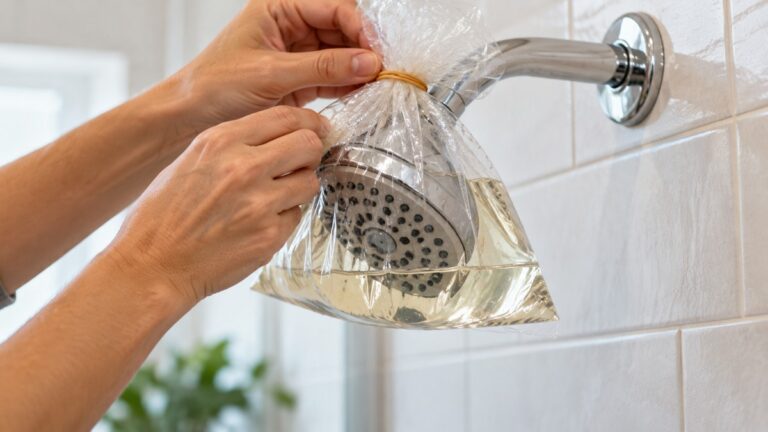
- Soak. Remove the head if you can, and soak it in distilled white vinegar for the time your manual gives. The table below compares the three soak methods in the sources.
- Flush. Rinse the head thoroughly. American Standard suggests running the water for five to ten minutes. Waterpik says to run the head in each mode to flush out the vinegar.
- Check the screen and washers. If the spray is still weak, clean the filter screen and confirm the washer is seated, as described above.
- Use a toothpick last. Only if a single hole stays blocked after soaking and brushing.
| Source | Soak method | Time stated | Flush or follow-up |
|---|---|---|---|
| Waterpik Pause-in-Handle manual | Remove the head and soak face down in 1 to 2 cups of white vinegar | About 2 to 3 hours; repeat as needed | Replace and run in each mode |
| American Standard guide | Bag with about 12 oz of distilled white vinegar, wrapped around the arm | Overnight, or at least one hour if needed right away | Run hot water for 5 to 10 minutes, then scrub |
| Kohler care sheet | Vinegar applied to the mesh spray face | Left to sit overnight | Rub with a cotton swab to remove residue |
Avoid harsh cleaners. Waterpik’s Dual Power Pulse manual warns against “harsh chemicals, heavy duty cleaners, or abrasives,” which it says may damage parts or the finish. Moen’s care text suggests rinsing the face with warm water and a mild soap first.
When the pause button sticks or the spray will not come back
A button that will not move is a different problem from a clogged head. None of the manuals we opened gives a repair procedure for a stuck pause control. Waterpik’s troubleshooting guide, for a pivot connection problem, tells the owner to loosen the pivot ball and contact the company “for further instructions.” That is the step to take when the cleaning and screen checks do not help.
Check the warranty before you pay for a repair. Waterpik’s manual says to save your receipt, because proof of purchase is required for warranty action. Its warranty also says the company is not responsible for labor charges, installation, or other consequential cost. If the trouble is in the valve body, the connection inside the wall, or the water pressure itself, do not take the valve apart from a guess. Call a licensed plumber. The Waterpik pause manual recommends a pressure-balance tub and shower valve with rotational limit stops set by a plumber, so ask a plumber to check that setting if you are unsure.
Safety before you start
- Close the water first. Shut the shower valve before you unscrew or remove a head. American Standard’s guide wraps the nut and arm in a small cloth before using a wrench, to protect the finish.
- Check the water heater. Waterpik’s manuals recommend keeping the water heater at 120°F (48.9°C) or below, and checking the water with your hand before you step in.
- Hand tighten the pivot connection. Waterpik’s installation text says to hand tighten the pivot ball. Stop when it is snug.
- Seat the head in its bracket. Make sure the handheld head sits properly in the bracket before you turn the water on again.
How we chose
We set three rules for this guide. First, the only pages we read were ones we opened in this session with a 200 response. Second, the sources had to be a manufacturer’s own manual or care sheet, or a government page. Third, a claim had to appear in the downloaded text before it was written here, and each quote was checked against that text.
We opened ten pages with a 200 response. One candidate, Oxygenics’ SmartPause instructions, returned a 403 response, so it was excluded and this guide says nothing about that product’s pause mechanism. We did not rank or review any product, and this post contains no product links.
What the sources do not say
What we could not verify
- The sources do not give a repair procedure for a stuck pause button on any named model. For that, contact the manufacturer.
- The sources do not give a spray-force or pressure figure for the pause or for each spray mode, so we cannot say how much pressure a pause or mode change removes.
- The sources do not say how long a pause control or its switch will last, or how much water a typical pause saves.
- The manuals are brand-specific. Waterpik and Delta are covered here. Other brands may use different controls.
On flow, the EPA’s WaterSense page says standard showerheads use 2.5 gallons of water per minute, and that WaterSense labeled showerheads “must demonstrate that they use no more than 2.0 gpm.” The same page says WaterSense performance also covers spray coverage and pressure compensation. It does not say how any particular pause or spray mode changes flow. This guide does not treat any spray mode as a way to add pressure.
FAQ
Does the pause button save water?
It lowers the flow while the button or switch is in the pause position. Waterpik describes the pause as a “water saving trickle.” The sources we opened give no gallon figure for a pause, so the amount saved in your home is unknown.
Can the pause button turn the water off completely?
No. Waterpik’s manual states that the pause “will not shut off water flow completely.” To stop the water, close the shower valve or the supply valve.
Why is my shower head weak after I use the pause?
The control may still be in a partial or trickle position. Move the switch or button fully through its travel and back to full flow, then run the water for a few seconds. If the spray is still weak, clean the nozzles and the filter screen, as covered above.
Can I fix a stuck pause button myself?
You can check the simple things: the control position, mineral deposits on the face and nozzles, and the filter screen. A button that is physically stuck, or a valve that needs work, is a job for the manufacturer or a licensed plumber. Check the warranty first, because the Waterpik warranty text says the company is not responsible for labor charges or installation.
Does changing the spray mode change the water pressure?
A spray mode changes the pattern, such as wide, massage or narrow. The manuals we opened state no pressure figure for any mode.
Bottom line
A shower head pause button drops the water to a trickle, and it does not turn the water off. When the spray is weak or a pattern is missing, check the control position first, then clean the nozzles, the face and the filter screen. If a button is stuck, or the valve or pivot connection needs work, contact the manufacturer or a licensed plumber rather than taking the valve apart from a guess.
Sources
- Waterpik Pause-in-Handle instruction manual (opened 2026-10-23). Pause feature, trickle wording, ASME A112.18.1 note, cleaning, troubleshooting, warranty, water heater setting.
- Waterpik Dual Power Pulse instruction manual (opened 2026-10-23). Sliding switch pause, middle positions, cleaning and troubleshooting, filter screen.
- Delta hand shower manual (Lowe’s-hosted PDF) (opened 2026-10-23). Front and back button pause control, spray function buttons.
- Waterpik Clean Pro instruction manual (opened 2026-10-23). Cleaning spray activation below horizontal, safety note before returning the head to its bracket.
- EPA WaterSense: Showerheads (opened 2026-10-23). 2.5 gpm standard, 2.0 gpm WaterSense limit, spray coverage and pressure compensation.
- Kohler care and cleaning sheet (opened 2026-10-23). Rubbing rubber nozzles, vinegar on mesh overnight.
- American Standard: how to clean a shower head (opened 2026-10-23). Vinegar bag soak, toothbrush scrub, toothpick check, five to ten minute flush, cloth on the nut.
- Moen DIY care guidance (opened 2026-10-23). Rinse face with warm water and mild soap; removing the head for cleaning.