How to Test Your Home Water Pressure With a Gauge
As an Amazon Associate we earn from qualifying purchases.
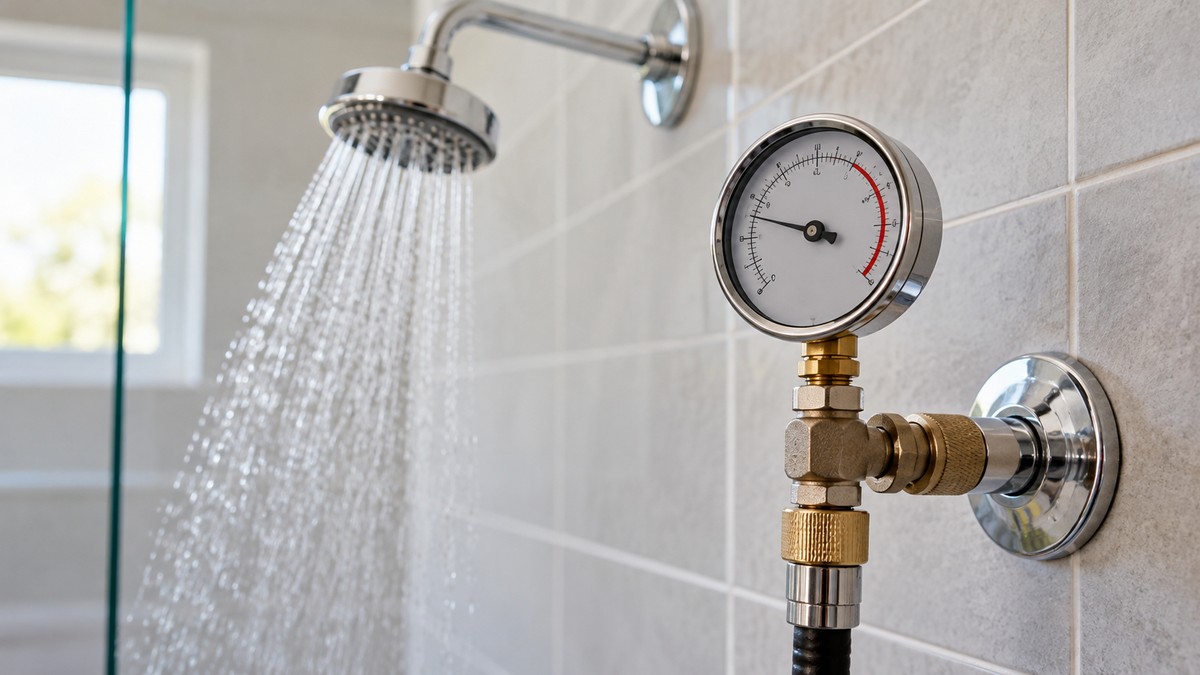
How to test home water pressure with a gauge starts at an outdoor hose bib on the house. The Oklahoma State University fact sheet says to measure the pressure at one of the hose bibs, at the same time of day the system runs, because pressure can vary through the day. A gauge reading gives the pressure at that point. It does not measure how much water a shower head delivers, and the sources treat those as two separate measurements.
Quick answer
- Measure at one of the hose bibs on the house. The Oklahoma State sheet says some gauges thread straight onto a hose bib and others need an adapter.
- Take the reading at the time of day the irrigation system runs, because pressure can vary through the day.
- The sources give different ranges. The Oklahoma State sheet says about 40 to 60 psi is ideal, and the Colorado State guide gives 50 to 70 psi as static household pressure.
- A reading below 25 psi or above 125 psi calls for contacting the utility. At a reading above 80 psi at the house, the Oklahoma State sheet says to consider a whole-house pressure regulator and to contact a licensed plumber.
What the gauge measures, and what it does not
The Oklahoma State sheet is an irrigation fact sheet. Its advice is to measure at a hose bib, because that gives a rough idea of how much pressure is delivered to the system. The sheet says the reading “does not account for pressure losses within the irrigation system itself.” The same logic applies to a house: the reading at a hose bib is the pressure at that outlet at the moment you take it. The sources do not describe how a hose bib reading compares with pressure at a shower.
Valves and hose bibs also matter. The Alabama Cooperative Extension article explains that “a pressure drop occurs when frictional forces act against a fluid” moving through a pipe or valve. In its flow test, the regulator was set to 40 pounds per square inch, and adding hose bibb 2 to the line “increased the pressure drop to 24 psi” and reduced the flow rate by 3.6 gallons per minute, or 35.3 percent. ACES ran that comparison on a test fixture, not on a house line. It shows that a valve can restrict flow, but it does not give a home reading.
Flow is a different measurement. The EPA WaterSense page says standard showerheads use 2.5 gallons of water per minute (gpm), and that WaterSense labeled heads must demonstrate that they use no more than 2.0 gpm. The same page says the WaterSense specification ensures the showerhead will provide a minimum flow across a range of household water pressures. A gauge reading does not measure a head’s gpm, so a good pressure reading does not prove a good shower flow.
If you are comparing heads once you know the pressure, the high-pressure and water-saving roundup and the water-efficient handheld roundup cover head designs. This guide does not cover any head’s performance against a pressure reading.
Valve figures from the ACES test
ACES reports flow results for five common 3/4-inch valves and hose bibbs. Three copies of each were fastened to a fixture with a pressure regulator set to 40 psi, and the open-pipe flow was raised from 0 to 15.5 gallons per minute for each valve. The table uses the ACES Table 2 figures.
| Valve | Smallest opening (in.) | Highest flow tested (gpm) | Flow lost against open pipe |
|---|---|---|---|
| PVC ball valve | 0.77 | 15.0 | 3.1 percent |
| Brass ball valve | 0.73 | 15.0 | 3.1 percent |
| Quarter-turn hose bibb | 0.39 | 11.0 | 28.9 percent |
| Hose bibb 1 | 0.38 | 10.7 | 31.1 percent |
| Hose bibb 2 | 0.31 | 7.4 | 52.3 percent |
The ball valves lose only 3 percent of the open pipe flow rate. Hose bibb 2 loses roughly half (52.3 percent) of the open pipe flow rate, and ACES says that “no more than 8 GPM can be expected out of hose bibb 2 regardless of how much pressure continues to add.” The article is written for farm water systems, where it advises that “Hose bibbs should not be used in line with further plumbing” because the restriction can affect everything downstream during high demand.
Steps the sources support
- Choose a hose bib on the house. The Oklahoma State sheet says to measure the pressure at one of the hose bibs on the house.
- Use an adapter if the gauge needs one. The same sheet says some gauges thread directly to the hose bib, and others require an adapter.
- Read at the time of day the system runs. The sheet says to measure at the same time of day the irrigation system runs, because pressure varies through the day.
- Compare the reading with a range. Use the table below, and note which source each range comes from.
- Act on the extremes. A reading below 25 psi or above 125 psi calls for contacting the utility department, according to the Oklahoma State sheet.
- Consider a whole-house regulator at high readings. If the pressure is more than 80 psi to the house, the same sheet says to consider a pressure regulation device for the entire house, and to contact a licensed plumber for that project.
What counts as a normal reading
The sources do not agree on one range, and none of them is a shower-specific range. The table lists each figure with its context.
| Source | Range the source gives | Context |
|---|---|---|
| Oklahoma State University fact sheet | About 40 to 60 psi is ideal for residential water pressure, and it can vary by location | Irrigation fact sheet; a general residential figure |
| Colorado State University drip irrigation guide, pressure entry | Common household static (non-flowing) pressure is 50 to 70 psi | Irrigation guide glossary |
| Colorado State University drip irrigation guide, regulator entry | Typical household water pressure is 50 to 60 psi | Same guide; a narrower range than its own static figure |
| WaterSense showerhead specification (Version 1.0) | No home range; flow is tested at flowing pressures of 20, 45 and 80 psi | Showerhead test pressures, not a home reading |
| Alabama Cooperative Extension article | No home range; the regulator was set to 40 psi for a test | Farm water panel flow test |
Where the ranges disagree, a reading of 45 psi falls inside the Oklahoma State range and below the Colorado State static range. The sources do not say which range is right for a given house, so a reading should be compared with the range that fits the question you are asking.
The WaterSense showerhead specification also uses pressure, but as a test condition rather than a home range. The copy opened is Version 1.0, dated March 4, 2010. It tests flow at flowing pressures of 20, 45 and 80 psi, and it sets a minimum flow at 20 psi of at least 60 percent of the maximum, and a minimum at 45 and 80 psi of at least 75 percent. EPA’s showerhead page says Version 1.1 replaced Version 1.0 in July 2018 with minor changes. The sources do not say how a home reading should be compared with these test pressures.
What the sources say about high and low readings
The Oklahoma State sheet says residential water pressure is ideally about 40 to 60 psi, and that this can vary significantly based on location. It also says that high pressure causes a different set of problems in irrigation systems, which is a different context from indoor plumbing. For houses, the sheet’s concrete thresholds are the 25 and 125 psi limits for contacting the utility, and the 80 psi limit for a whole-house regulator. The sheet gives that advice to protect the plumbing and appliances inside the home.
The Oklahoma State sheet calls the pressure of a fluid at rest static pressure, and the pressure of a moving fluid dynamic pressure. The Colorado State glossary describes pressure as the force propelling water through pipes, and it notes that irrigation systems operate under flowing pressure that is reduced by elevation gain and friction loss. That is a reminder that a static reading with no water flowing is not the same as the pressure while water runs. The sources do not give a conversion between the two.
How we chose
This guide answers one question: how to test home water pressure with a gauge. We chose sources by three criteria. First, the publisher had to be a university extension service or a government agency. Second, the page had to describe pressure measurement, valves, or shower flow in plain text. Third, we left out sales pages and retailer guides, including commercial plumbing pages that came up in search and were not used. We opened each page with curl on 2026-10-21 and read the saved text.
The guide draws on five sources: the Oklahoma State University fact sheet on home irrigation pressure (published March 2019), the Alabama Cooperative Extension article on valves and hose bibbs (May 6, 2021), the Colorado State University drip irrigation guide, the EPA WaterSense showerheads page, and the EPA WaterSense showerhead specification (Version 1.0). Three of the five are extension pages from three different institutions, and two are EPA pages. The Oklahoma State and Alabama sources are irrigation and farm focused, and the Colorado State guide is about drip irrigation. None is a shower-specific pressure guide. The guide does not rank products and does not name a best option.
What we could not verify: what the sources do not say
- A shower-specific pressure range. The Oklahoma State sheet is about irrigation, and the Colorado State range is from a drip irrigation guide.
- Whether other fixtures should be closed during the reading. The sources do not say.
- Gauge specifications, such as range, thread size or accuracy. The sources do not give them.
- Whether a hose bib reading matches the pressure at a shower. The sources do not describe that comparison.
- Whether a reading can show if a pressure regulator is working. The sources say to contact a licensed plumber above 80 psi and do not describe checking a regulator.
- How many readings to take, or how much readings vary across a day. The sources say to read at the same time of day but do not give a count.
- Whether the Version 1.1 changes affect the 20, 45 and 80 psi test pressures. The EPA page calls the changes minor but does not list them.
Frequently asked questions
What psi should my house have?
The Oklahoma State sheet gives about 40 to 60 psi as ideal for residential water pressure. The Colorado State guide gives 50 to 70 psi for static household pressure, and 50 to 60 psi as typical household pressure in its glossary. The sources do not give a single number for every house.
Where should I attach the gauge?
Use one of the hose bibs on the house. The Oklahoma State sheet says to measure there. Some gauges thread directly to the hose bib, and others need an adapter.
Does a pressure reading tell me the shower flow?
No. The EPA WaterSense page measures shower flow in gallons per minute. It says standard showerheads use 2.5 gpm and WaterSense heads must use no more than 2.0 gpm. The gauge reads pressure, not gpm.
When should I call the utility?
The Oklahoma State sheet says to contact the utility department if the pressure is less than 25 psi or greater than 125 psi. It says that step is for further investigation.
When does a whole-house regulator come up?
The Oklahoma State sheet says to consider a pressure regulation device for the entire house if the pressure is more than 80 psi to the house, and to contact a licensed plumber for that project. The sources do not describe how to check an existing regulator.
Should I turn off other water first?
The sources do not say. This guide does not give that step, because none of the opened sources describes it.
Bottom line
Measure at a hose bib on the house, read at the time of day the system runs, and compare the number with the range that fits your question. Treat the gauge as a pressure check, not a shower flow test. If the reading is above 80 psi, the Oklahoma State sheet points to a licensed plumber for a whole-house regulator.
Sources
Oklahoma State University Extension, “Managing Pressure in the Home Irrigation System,” HLA-6617, published March 2019. https://extension.okstate.edu/fact-sheets/managing-pressure-in-the-home-irrigation-system (opened 2026-10-21).
Alabama Cooperative Extension System, “Do Your Valves and Hose Bibs Restrict Water Capacity?” May 6, 2021. https://www.aces.edu/blog/topics/farming/do-your-valves-and-hose-bibs-restrict-water-capacity/ (opened 2026-10-21).
Colorado State University Extension, “Drip Irrigation for Home Gardens.” https://extension.colostate.edu/resource/drip-irrigation-for-home-gardens/ (opened 2026-10-21).
U.S. Environmental Protection Agency, WaterSense “Showerheads” page. https://www.epa.gov/watersense/showerheads (opened 2026-10-21).
U.S. Environmental Protection Agency, “WaterSense Specification for Showerheads,” copy labelled Version 1.0, dated March 4, 2010. https://www.epa.gov/sites/default/files/2017-01/documents/ws-products-spec-showerheads.pdf (opened 2026-10-21).