How to Fix Low Water Pressure in a Shower
As an Amazon Associate we earn from qualifying purchases.
How to fix low water pressure in shower head comes down to one question: is the head restricting flow, or is the house supplying less water than it should? Start with the head. EPA says scale buildup can restrict flow in showerheads, and cleaning is the cheapest first step. If the head is clean and the spray is still weak, attach a pressure gauge to a cold-water faucet and read the supply. WaterSense recommends incoming service pressure between 45 and 60 psi. A shower head cannot add pressure the plumbing does not supply, so if the supply reads low, a new head will not fix it. At that point the next call is a licensed plumber or your water utility.
Quick answer
- Clean scale out of the head before you blame the house. EPA names white vinegar as one way to dissolve scale.
- Compare a simple flow test with the head’s rating. WaterSense-labeled heads must use no more than 2.0 gpm.
- Read incoming pressure at a cold-water faucet with a gauge. The recommended range is 45 to 60 psi.
- Regulator, pump and supply-line work is plumbing beyond a head swap. Hire a licensed plumber for it.
How to fix low water pressure in shower head
Work through the checks from cheapest to most expensive. The head comes first because EPA names scale as the cause. The supply comes second, and it shows whether a head change could help at all.
Step 1: Turn off the water and remove the head
Turn off the water supply before you unscrew anything. Moen’s installation guide for a faucet says to Always turn water supply OFF before removing existing faucet or disassembling the valve. That guide covers a faucet, not a shower head, so treat it as a general caution rather than a head-specific instruction. Moen’s guide for a fixed head and handshower starts the same way with the existing head: remove it, and Use wrench if necessary.
Step 2: Clean the nozzles
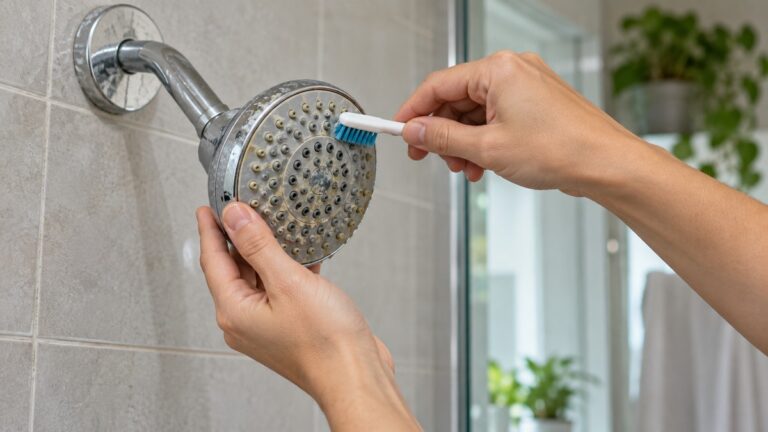
EPA’s commercial guide on showerheads says Certain cleaning products or white vinegar can dissolve scale from showerheads with buildup. Soak the head in white vinegar until the scale softens, then loosen the rest with a soft brush. Rinse the head well before you reinstall it.
The sources do not give a soak time or a dilution ratio, and they do not list which finishes tolerate vinegar. Check the maker’s cleaning instructions for your finish, and do not soak it longer than the maker allows. Never clear a nozzle with metal. EPA says Do not attempt to bore holes in the showerhead or manually remove scale buildup, because that may lead to increased water use or cause performance problems.
Step 3: Reinstall without overtightening
Moen’s guide for a fixed head and handshower says Thread seal tape is not recommended for this project. Do not overtighten. It also says to hand tighten the fixed showerhead to the front of the diverter. Tape rules differ between products, so check the manual that came with your head before you add any tape or washer material.
Step 4: Read the supply with a gauge
If the head is clean and the spray is still weak, the supply is the next suspect. EPA’s service pressure guide says to Attach a pressure gauge to a hose bibb, or to the cold-water faucet for the washing machine, or to a cold-water faucet on the first floor. Then Turn on the water to the fully open position before you read the gauge.
| Gauge reading | What the sources say | What to do |
|---|---|---|
| Between 45 and 60 psi | WaterSense recommends incoming service pressure in this range. | The supply is in range. Look again at the head and the arm. |
| Below 45 psi | This is below the WaterSense recommendation. | Call your water utility about the service, and a licensed plumber for the house side. A new head will not raise supply pressure. |
| Above 80 psi | Most U.S. plumbing codes require pressure-regulating valves above this level. | Check whether a regulator is installed and set. Regulator work is plumbing, so leave it to a plumber. |
A reading above 80 psi is not a reason to adjust a valve yourself. EPA’s guide says High water pressure can damage plumbing piping, fixtures, and appliances, so a higher setting is not a fix for a weak shower.
How to tell if shower head is clogged
Three checks separate a blocked head from a weak supply. None of the sources gives a number that defines a clogged head, so read the results as a judgement, not a rule.
Look at the spray face
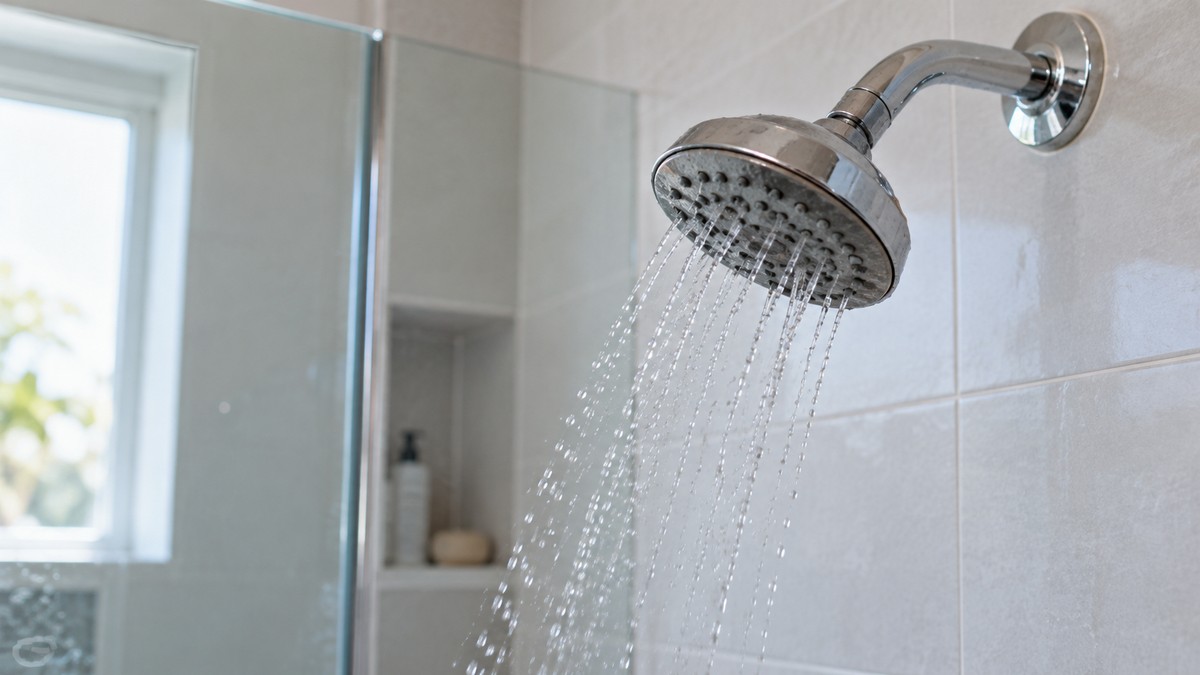
Run the shower at full pressure and watch the spray for about ten seconds. Note whether every hole produces water, whether the fan is even across the face, and whether one side is weaker than the other. Then look closely for white crust around the outer holes. Dead holes, an uneven fan and crust all point to scale. EPA’s guide asks for the same check when it says to Periodically inspect showerheads for scale buildup to ensure flow is not being restricted.
Time the flow
EPA’s commercial guide describes the simplest flow check: collect water in a flow bag or container of known volume, and time how long it takes to fill. Divide the gallons by the seconds, then multiply by 60 to get gallons per minute (gpm). The rows below are arithmetic examples only. They are not readings from any particular head.
| Water collected | Time | Calculated flow |
|---|---|---|
| 2 gallons | 80 seconds | 1.5 gpm |
| 2 gallons | 60 seconds | 2.0 gpm |
| 1 gallon | 40 seconds | 1.5 gpm |
Compare your result with the flow rating on the head or in its manual. WaterSense-labeled showerheads must show that they use no more than 2.0 gpm, and EPA’s commercial guide gives the federal maximum as 2.5 gpm. A reading well under the rating suggests a restriction in the head. The sources do not say how far under counts as clogged. The comparison is also not clean: EPA says WaterSense performance criteria include Pressure compensation, which ensures a head provides a minimum flow across a range of household water pressures. Household pressure can therefore affect the reading too. When you compare labelled ratings, our water-saving head roundup is one place to start.
Press the nozzles
With the water running, rub the rubber nozzles with a finger, one area at a time. If a weak spot clears, the blockage was on the surface. If not, use the soak in the cleaning step above. The sources we opened do not describe this check, so treat it as a practical step, not an EPA procedure.
Rule out the plumbing
Open a second fixture at the same time, such as a sink or another shower. If it is weak too, the cause is probably upstream of the head, and a plumber should check it. The sources do not give a full procedure for diagnosing household pressure.
How to fix no water pressure in a shower
A weak spray and no water are different problems, and the sources we opened do not diagnose a shower that gets no water at all. Start by finding out whether the trouble is limited to the shower.
Check whether the whole house is affected
Run the kitchen tap and a bathroom sink while you run the shower. If they are also weak or stop, the cause is upstream of the shower and the head is not the problem. The sources do not describe this as a formal test, but it shows which repair path applies.
If only the shower is affected
Check the head first, using the cleaning and reinstall steps above. Scale in the nozzles is the cause EPA names. If the head is clean and the shower still gets little or nothing, check the arm and its joint. Moen’s guide says to hand tighten and not to overtighten, so a loose joint should be snugged by hand, not forced. The sources do not cover shower valves, cartridges or diverters in detail, so a valve fault belongs to a plumber.
Read the supply and stop there
Use the gauge steps in the section above. A reading below 45 psi points to the supply, and the utility or a plumber is the right next call. The sources do not say who pays for a fault in the utility line, so ask the utility before you pay for any repair. A reading above 80 psi calls for a check of the regulator. EPA’s guide says to verify the PRV, if installed, is set and working correctly, and that check belongs with a licensed plumber.
How to increase water pressure in shower without a pump
A shower head cannot increase water pressure beyond what the plumbing supplies. The sources we opened do not describe any shower head that adds supply pressure, and a booster pump is plumbing work beyond a head swap. Every fix below is either a cleaning, a head or arm swap, or a question for a plumber.
Why a head cannot add pressure
The house sets supply pressure. EPA’s service pressure guide says Water pressure in supply main lines can reach 100 pounds per square inch (psi) or more, and that high pressure can damage fixtures. A shower head sits at the end of that supply and shapes what arrives. EPA’s WaterSense page describes the head’s performance criterion as spray force, and it puts the word pressure in parentheses after that term. On a head label, read the word pressure as spray, not supply.
What you can change without plumbing work
- Clean the head as described in the first section. This removes a restriction in the head. It does not add supply pressure.
- Replace a worn head with a model whose flow rating you have read. A WaterSense-labeled head must use no more than 2.0 gpm. The sources do not say how that flow will feel on a particular supply.
For models to compare, see our roundup for weak household supply. If you want a water-efficient replacement, our water-efficient handheld heads page is the other place to look.
What needs a licensed plumber
Booster pumps, regulator changes and supply-line work all sit beyond a head, arm, hose or cartridge swap. The sources do not cover booster pumps, their sizing or their installation, so ask a licensed plumber whether one suits your house and your local code.
How to increase water pressure in an upstairs shower
An upstairs shower that is weaker than the rest of the house has one of two causes: the head or arm at that shower, or the supply that reaches the upper floor. The sources we opened cover the head and the supply. They do not cover the effect of height or pipe length, so the answer for your house has to come from a comparison and, if needed, a plumber’s measurement.
Compare the outlets
Run the upstairs shower, then a faucet on the same floor, then a faucet downstairs. If only the upstairs shower is weak, the head or arm is the likely cause, and the steps in the first section apply. If the upstairs shower and the same-floor faucet are weak but the downstairs faucet is fine, the supply to that floor or a valve on it is the likely problem, which is plumbing work. If every outlet is weak, the whole-house supply is the cause, and the gauge steps apply.
Measure at a first-floor faucet
EPA’s guide places the gauge on a cold-water faucet on the first floor. A first-floor reading tells you the supply at the bottom of the house, which is the baseline. The sources do not say how much pressure is lost on the way up, so a reading in the 45 to 60 psi range does not prove that the upstairs shower gets enough.
Clean and reinstall the upstairs head
The sources give no separate method for an upstairs head. Use the cleaning and reinstall steps in the first section, including Moen’s advice not to overtighten.
Leave supply routing to a plumber
Pipe routing, a higher supply line and a booster pump are plumbing work. A licensed plumber can check the supply line that serves the upper floor and the code requirements for your home.
How we chose
We opened five sources on 2026-10-22 and quoted only text found in those downloads. Three are EPA pages: the showerhead page, the commercial showerhead section and the service water pressure technical sheet. Two are Moen installation guides, one for a fixed head with a handshower and one for a faucet. EPA sets the flow and pressure figures used here. The Moen guides are used only for the steps they describe, and the faucet guide only for its general turn-off caution. No product listing was used, and no product is named, priced or rated.
What the sources do not say
- A vinegar soak time, a dilution ratio, or which finishes tolerate vinegar.
- A flow figure below which a head counts as clogged.
- How to separate a clogged head from a weak supply without a gauge.
- Booster pump sizing, installation or cost.
- How much pressure height and pipe length cost an upstairs shower.
- The cause of a shower that gets no water at all.
- Who pays when a utility supply is low.
What we could not verify
We could not verify how a particular head will feel on a particular supply, or any figure for your own outlet. A gauge reading at your own faucet is the only number that answers that question.
FAQ
Why is my shower head suddenly weak?
Scale buildup in the nozzles is the cause EPA names. Check the spray face first, then measure the supply.
Can vinegar damage my shower head?
The sources do not list which finishes tolerate vinegar or how long a soak should last, so follow the maker’s cleaning instructions for your finish.
What water pressure should my home have?
Measure at a cold-water faucet with a gauge, with the water fully open. EPA’s range is 45 to 60 psi, and most U.S. plumbing codes require pressure-regulating valves above 80 psi.
Will a high-pressure shower head fix low pressure?
No. A shower head cannot add pressure the plumbing does not supply. Read the head’s own flow and spray rating before you buy.
Should I use plumber’s tape on the new head?
Not automatically. Moen’s guide for one fixed-head kit says thread seal tape is not recommended for that project. Other heads may differ, so follow the manual that came with the head you buy.
Bottom line
Clean the head, read the supply with a gauge, and treat any low reading as plumbing work. A shower head cannot add pressure the plumbing does not supply, so the head is the fix only when the head is the cause.
Sources
- EPA WaterSense, Showerheads (opened 2026-10-22)
- EPA, WaterSense at Work: Showerheads and Bath and Shower Diverters, Section 3.4 (opened 2026-10-22)
- EPA WaterSense, Service Water Pressure technical sheet (opened 2026-10-22)
- Moen, Installation Guide INS10820, fixed head and handshower (opened 2026-10-22)
- Moen, Installation Guide INS2033A, faucet (opened 2026-10-22)
As an Amazon Associate we earn from qualifying purchases.