How to Cut Water Use in the Shower Without Losing Comfort
As an Amazon Associate we earn from qualifying purchases.
Here is how to reduce water usage in shower time without giving up a usable spray. Four changes do most of the work: choose a showerhead rated at 2.0 gallons per minute (gpm) or less, shorten the time the water runs, fix leaks at the head and the diverter, and keep scale from restricting the outlets. Standard showerheads can use 2.5 gpm, and the WaterSense label is the simplest way to confirm a lower rate. EPA estimates that the average family could save 2,700 gallons per year by installing WaterSense labeled showerheads.
Quick answer
- Check the flow rate. Look for the WaterSense label. A labeled head is certified at 2.0 gpm or less.
- Time your showers. A 10-minute shower at 2.5 gpm uses 25 gallons. At 2.0 gpm it uses 20.
- Find leaks. Check the head connection and the tub-shower diverter. Replace a worn washer when you service the head.
- Keep outlets clear. Inspect for scale periodically and clean it with products or white vinegar, which EPA says can dissolve scale. Never bore holes in the head.
How the showerhead sets your water use
The showerhead sets the maximum flow, so it is the first lever. EPA says the Energy Policy Act of 1992 established 2.5 gallons per minute as the maximum flow for showerheads sold in the United States, and that “Older showerheads may flow as high as 3.0 to 5.0 gpm” (11.4 to 18.9 liters per minute). The Department of Energy’s Federal Energy Management Program states the same federal ceiling of 2.5 gpm for showerheads manufactured and sold after January 1, 1994.
The flow rate is the number that sets the upper limit on water use. Use the table below to see what that number means over a single shower. The table assumes the head runs at its rated flow for the whole shower. Real flow depends on your water pressure, so treat the numbers as the rated maximum rather than a reading from your own bathroom.
| Rated flow (gpm) | Water used in a 10-minute shower (gallons) | Calculation |
|---|---|---|
| 2.5 (federal maximum) | 25 | 2.5 x 10 |
| 2.0 (WaterSense maximum) | 20 | 2.0 x 10 |
| 1.8 (required in some states) | 18 | 1.8 x 10 |
Going from 2.5 gpm to 2.0 gpm saves 5 gallons on each 10-minute shower. If one such shower happens every day, that is 5 gallons x 365 days, or about 1,825 gallons per year. This is our arithmetic from the rated flows, not an EPA figure. EPA’s own estimate, cited above, is 2,700 gallons per year for an average family. For the full savings reasoning, see our guide to how much water a WaterSense shower head can save.
If you use a handheld head on a hose, the same flow math applies. For options built for lower use, see our guide to water-efficient handheld shower heads.
What is a good GPM for a shower head?
For water savings, the target is 2.0 gpm or less. EPA’s showerhead page says: “Water-saving showerheads that earn the WaterSense label must demonstrate that they use no more than 2.0 gpm.” The DOE’s efficiency guidance gives the same WaterSense maximum of 2 gpm for showerheads.
Some states set a lower limit. EPA’s commercial guidance says that a few states, including California, Hawaii, and Washington, require “1.8 gpm (6.8 lpm) or less.” Those rules do not always require the WaterSense label or its performance tests, so a state-compliant head is not automatically a WaterSense head.
A lower number is not a complete measure of a good shower. EPA’s guidance says WaterSense heads must also pass tests for spray force and coverage, and that “All three criteria must be met” to produce a satisfactory shower without using more water. The flow rate is one of three checks, not the whole answer.
How to tell if shower head is WaterSense
Look for the WaterSense label on the head or its packaging. EPA’s showerhead page tells buyers to “look for the WaterSense label on showerheads,” and says the label identifies models that save water and perform well. The label is backed by independent certification. EPA’s commercial guidance says WaterSense labeled showerheads are “independently certified to flow at a rate of 2.0 gpm” or less while also meeting EPA’s spray force and coverage criteria. EPA also runs a product search tool for labeled models.
A head without the label may still be rated at 2.0 gpm or less, but nothing on the package proves it. Check the manufacturer’s stated flow rate in the product documents. For what the label does and does not guarantee, see our explainer on what the WaterSense label means on a shower head.
How to measure shower head flow rate
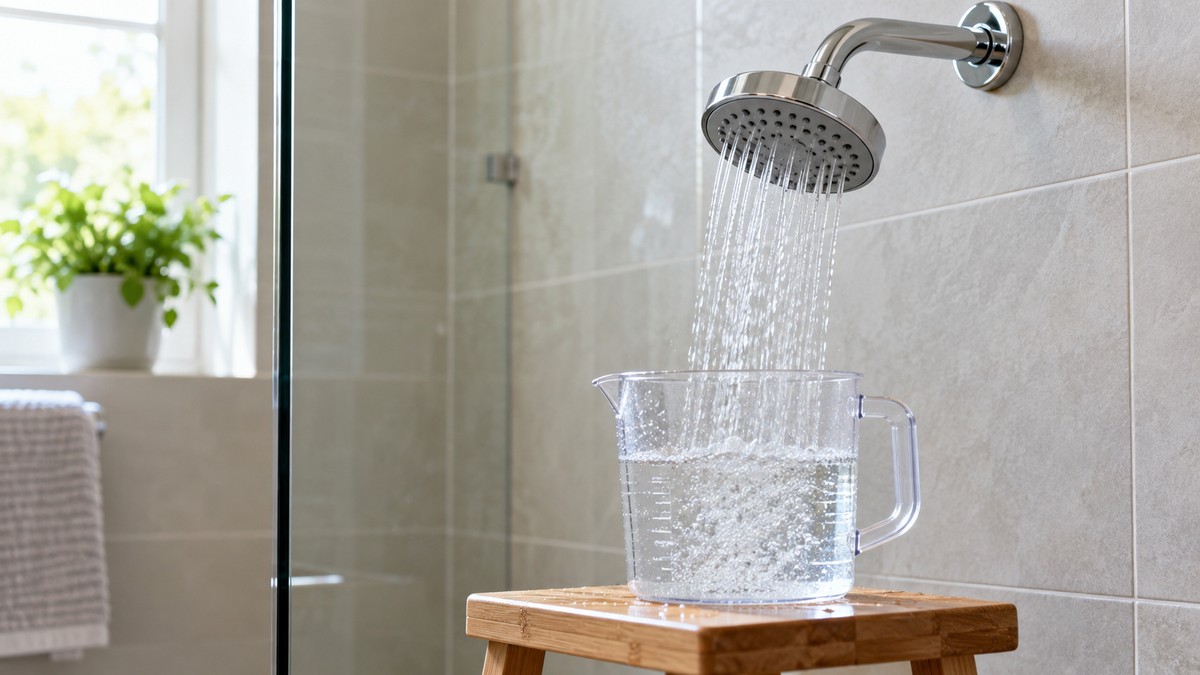
You can check a head’s real flow without special equipment. EPA’s commercial guidance describes the simplest method: “use a timer and collect water in a flow bag or container of known volume.” Time the collection, then convert to gallons per minute with this formula:
gpm = gallons collected / seconds x 60
Two examples. If you collect 0.5 gallon in 15 seconds, the flow is 0.5 / 15 x 60 = 2.0 gpm. If you collect 1.5 gallons in 30 seconds, the flow is 1.5 / 30 x 60 = 3.0 gpm. A result of 3.0 gpm is above the 2.5 gpm federal limit for showerheads sold after 1994, which points to an older head. EPA notes that older heads “may flow as high as 3.0 to 5.0 gpm,” so a reading like this is consistent with an older model rather than a fault.
The container must have a known volume, so use one with a clearly marked capacity. For a longer walk-through of the test, see our guide on how to measure your shower head’s flow rate.
How long do shower heads last?
None of the four sources we opened gives a lifespan for a shower head, so this post cannot give you a number to plan around. What the sources do support is a rule based on condition. EPA’s commercial guidance says showerheads are relatively inexpensive, and that “replacement is often more economical and practical than a retrofit” for inefficient heads. It also says that scale buildup can restrict flow and that heads should be checked periodically.
In practice, that gives you three signs to act on. Replace the head when scale cannot be cleared and flow stays low. Replace it when the spray no longer covers you well, since spray coverage is one of the performance points EPA tests for WaterSense heads. Replace it when the connection keeps leaking after you have checked the washer.
Cut run time and warm-up waste
Run time is the lever most people control directly. EPA’s commercial guidance recommends giving users a way to track showering time, and suggests “placing clocks or timers in or near the showers” to encourage shorter showers. A kitchen timer or a phone timer set to your target length does the same job at home.
Warm-up water is the second source of waste. EPA describes two kinds. Structural waste is the tepid water that must be cleared from the hot-water line before it reaches the head. Behavioral waste is water that has already reached the right temperature but runs down the drain while you are still getting ready. EPA notes that bathers could walk away from the shower while the water heats, which makes the second kind easy to miss. Reducing behavioral waste is simple: step in once the water is warm, not before.
The structural kind needs more than a habit. EPA points to thermostatic shutoff valves, which greatly reduce the flow of water to the showerhead once the water reaches the set temperature, and which can be reopened when you are ready. Installing one changes the plumbing, so it belongs with a licensed plumber, as covered below.
Stop leaks at the head and the diverter
A leak wastes water even when you are not showering. When you replace or service a head, EPA’s showerhead page advises you to “check and, if needed, replace the washer or “o” ring inside the showerhead.” That is a small job, and it is the part of a head swap this post covers.
Tub-shower combinations have a diverter that sends water to the tub spout or to the showerhead. EPA’s commercial guidance says diverters can leak while the shower is running. One study cited there found that “34 percent of bath and shower diverters assessed had leaks exceeding 0.1 gpm,” with an average leak rate of 0.8 gpm among the diverters measured. To check yours, run the shower with the diverter set to the head and look for water coming from the tub spout. EPA’s inspection guidance treats a leak “greater than 0.2 gpm or 0.8 lpm” as significant.
If the diverter leaks, EPA’s guidance suggests cleaning the scale off it, and replacing the diverter if cleaning does not reduce the leak. Replacing a diverter goes beyond a head swap, so call a licensed plumber for that step.
Keep scale from cutting flow
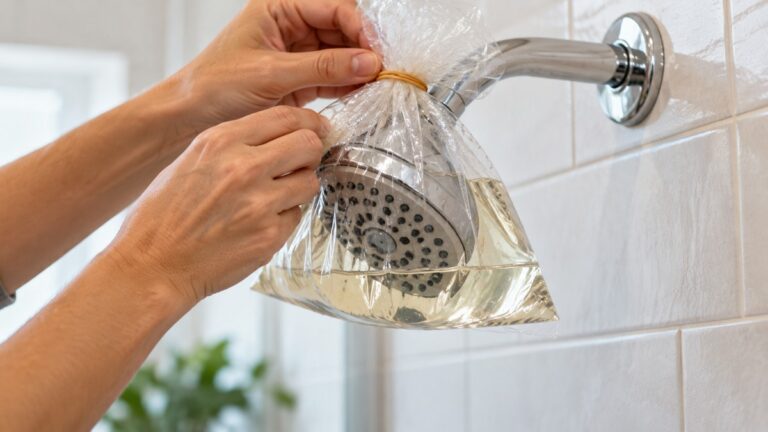
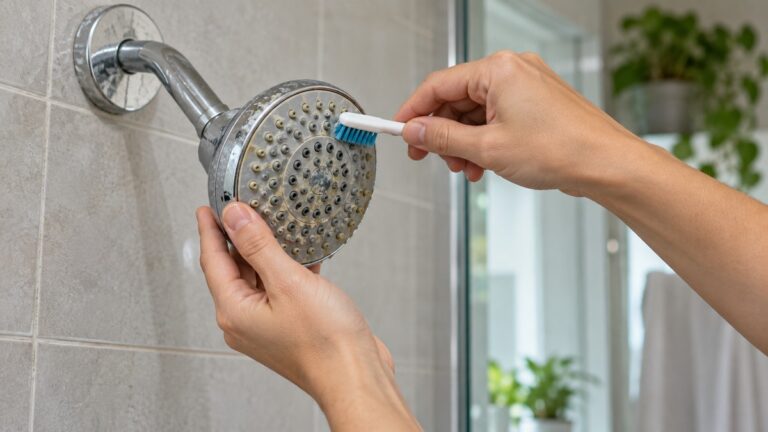
Scale is mineral buildup that narrows the outlets. EPA’s commercial guidance advises you to “Periodically inspect showerheads for scale buildup to ensure flow is not being restricted.” It also says that “Certain cleaning products or white vinegar can dissolve scale from showerheads with buildup.” Follow the directions on the cleaning product you choose, and rinse the head well before reinstalling it.
Do not try to force the outlets clear. EPA warns, “Do not attempt to bore holes in the showerhead,” and notes that drilling or scraping out scale can increase water use or cause performance problems. Cleaning products or white vinegar are the methods the EPA guidance names. If the outlets stay clogged after cleaning, replacing the head is the practical next step.
What a showerhead can and cannot do about pressure
A showerhead does not add water pressure. The plumbing supplies the pressure, and the head limits and shapes the flow that comes out of it.
The supply pressure matters for the whole house. EPA’s technical guidance says that “WaterSense recommends incoming service pressure to be between 45 and 60 psi,” and that “Most U.S. plumbing codes require pressure-regulating valves” where the supply exceeds the threshold. The threshold it gives is 80 psi, where the supplied water exceeds that pressure. EPA’s commercial guidance says that for optimum showerhead efficiency, system pressure should be “between 20 and 80 pounds per square inch (psi).”
WaterSense heads are also tested to keep a minimum flow across a range of household pressures. That is a check on consistency, not a promise of more pressure. If your shower is weak, the supply and any pressure regulator are the places to look, and a plumber can check them.
Plumbing work to leave to a licensed plumber
Some water-saving changes go beyond swapping a head, arm or hose. Leave these to a licensed plumber:
- Installing a thermostatic shutoff valve or a new shower valve.
- Replacing a leaking tub-shower diverter.
- Checking that hot and cold lines feed an auto-compensating mixing valve sized for the head. DOE’s guidance describes this valve as one that prevents significant swings in water pressure and temperature.
- Installing or adjusting a pressure regulator. EPA’s technical guidance says to set it within the 45 to 60 psi range and to consult local plumbing codes.
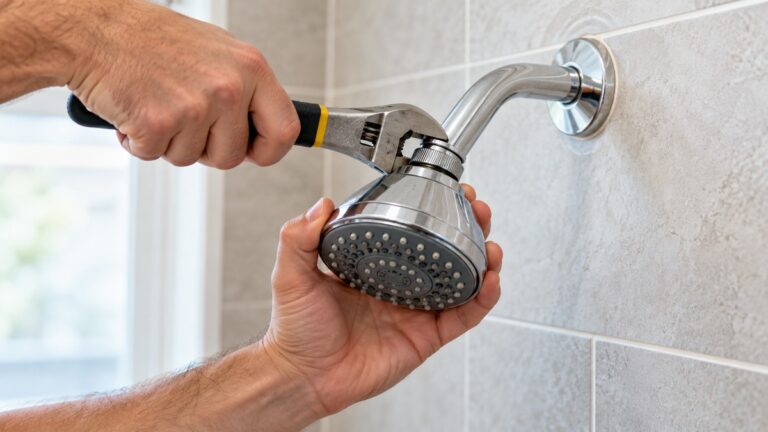
For a head swap, turn the shower off before you start and do not over-tighten the connection.
How we chose
We limited this post to the water-use settings a homeowner controls, and to the sources that set the rules: EPA WaterSense, the DOE’s Federal Energy Management Program, and EPA’s technical guidance. We opened each source directly with curl on 2026-10-23 and checked every quoted sentence against the downloaded text after removing HTML tags. We did not use search snippets, retailer pages, or blog posts as evidence. Some EPA and DOE addresses returned errors, and pages with errors are left out of the sources list.
We did not rank products here. A product list would need listing data for each model, and this post is about the settings and maintenance that apply to any head.
What we could not verify: what the sources do not say
- How long a shower head lasts. None of the four sources gives a lifespan.
- The best flow rate for comfort. The sources set 2.0 gpm as the WaterSense maximum and describe performance tests. They do not name a preferred flow for every shower.
- Your savings. EPA’s 2,700-gallon figure is an estimate for an average family. The table above is arithmetic from rated flow, and it assumes one 10-minute shower a day.
- Your supply pressure. The sources give ranges. Only a gauge test on your own supply gives your reading.
- Your state rule. EPA names California, Hawaii, and Washington at 1.8 gpm. We did not check the rules in other states.
FAQ
Does a WaterSense shower head lower water pressure?
The sources we opened do not say that a WaterSense head lowers pressure. They say the label requires tests for spray force and spray coverage, which are the parts you feel in use. Its maximum flow is 2.0 gpm, against 2.5 gpm for a standard head.
Does a higher GPM mean a better spray?
Not by itself. EPA’s guidance says a satisfactory shower requires spray force, spray coverage, and flow across a range of pressures, and that all three must be met. A flow number alone does not show whether the spray is good.
Will a timer make me use less water?
EPA’s commercial guidance suggests placing timers in or near the shower to encourage shorter showers. The sources do not measure how much a timer changes a typical household’s use, so the effect for your home is something you would need to track.
Which change saves the most water?
The sources do not rank the changes for a given home. The two that you control directly are the flow rate of the head and the length of the shower. A 10-minute shower at 2.0 gpm uses 20 gallons, against 25 at 2.5 gpm, and a shorter shower reduces the total further. Fixing a leak helps only if one exists, so check first.
When should I call a plumber?
Call a licensed plumber for a thermostatic valve, a new shower valve, a diverter, a mixing valve or a pressure regulator. Those jobs change the plumbing, not just the head. The head swap, washer check and cleaning in this post are the steps a homeowner can handle with basic tools.
Bottom line
If your showerhead is rated above 2.0 gpm, or you cannot find its rating, replace it with a WaterSense labeled model or measure it with the timer and container method. Then shorten your showers, fix leaks, and keep outlets clean. Leave valves, diverters and pressure regulators to a licensed plumber.
Sources
- US EPA, WaterSense, “Showerheads,” https://www.epa.gov/watersense/showerheads (opened 2026-10-23, HTTP 200). Supports the 2.5 gpm standard, the 2.0 gpm WaterSense limit, the 2,700-gallon family estimate, the label, and the washer or o-ring check.
- US EPA, WaterSense at Work, Section 3.4 Showerheads and Bath and Shower Diverters, May 2023, https://www.epa.gov/system/files/documents/2023-06/ws-commercial-watersense-at-work_Section_3.4_Showerheads_and_Diverters.pdf (opened 2026-10-23, HTTP 200). Supports older-head flow, the 1.8 gpm states, scale inspection and cleaning, the flow-bag method, diverter leaks, warm-up waste, timers, and the warning against boring holes.
- US DOE, Federal Energy Management Program, Best Management Practice #7: Faucets and Showerheads, https://www.energy.gov/cmei/femp/best-management-practice-7-faucets-and-showerheads (opened 2026-10-23, HTTP 200). Supports the 2.5 gpm federal limit for showerheads sold after January 1, 1994, the 2 gpm WaterSense specification, and the auto-compensating mixing valve.
- US EPA, WaterSense, Service Water Pressure technical sheet (TRM-12), https://www.epa.gov/system/files/documents/2023-08/ws-homes-TRM-12-ServiceWaterPressureTechSheet.pdf (opened 2026-10-23, HTTP 200). Supports the 45 to 60 psi recommendation, the 80 psi threshold for pressure-regulating valves, and the plumber and local-code guidance.