How to Clean Bathroom Grout and Tile Without Damaging Them
As an Amazon Associate we earn from qualifying purchases.
To learn how to clean bathroom grout, start with the gentlest method that works: warm water and a nylon brush for everyday dirt, then a mild pH-neutral cleaner if the grout still looks dirty. Use a baking soda and water paste only on grout that looks dingy and is not sealed. Bleach is named in university guidance for mildew on grout, but only with the manufacturer’s label in hand. The same routine applies to shower walls and floors, with the differences covered below.
Quick answer
- Clean routine grime with warm water and a nylon brush, then rinse and dry.
- Use a mild pH-neutral cleaner when water alone is not enough. Laticrete recommends this type for routine maintenance.
- For dingy grout that is not sealed, UF/IFAS names a paste of baking soda and water.
- Keep bleach away from vinegar and ammonia. UF/IFAS says those mixtures create toxic fumes.
- Test any cleaner on a small hidden area first.
Before you start: safety and a test step
The UF/IFAS factsheet on cleaning without harsh chemicals says never to mix hydrogen peroxide with vinegar, and never to mix bleach with vinegar or ammonia. It warns that the mixture creates toxic fumes. It also says to store cleaners in labeled containers and never in food containers.
Laticrete, a grout and tile maker, says to test any cleaning product on a small inconspicuous area and let it dry before cleaning the whole surface. Its care sheet says the test confirms the cleaner is compatible with the tile and the grout. Repeat the test whenever you change products.
Gather a soft cloth, a nylon-bristle brush or an old toothbrush for the grout lines, a bucket of warm water, and a dry cloth. The UF/IFAS grout paste method and the Laticrete scrubbing steps both use a nylon brush or nylon pad, so a nylon brush is the default tool in this guide.
How to clean bathroom grout: the basic routine
Start with plain water. The UF/IFAS tile guidance says clean water, applied with a soft cloth and then dried, may work well on tile. Wipe the tile surface first, then move to the grout lines.
Laticrete notes that cement-based grout is not self-cleaning or totally stain-resistant, so routine maintenance is required to keep it looking good. Its sheet says to wipe up spills immediately with a paper towel or cloth. If a stain remains, scrub the surface with warm water and a white nylon scrubbing pad for at least 60 seconds. Quick cleanup after spills is the simplest habit the sources agree on.
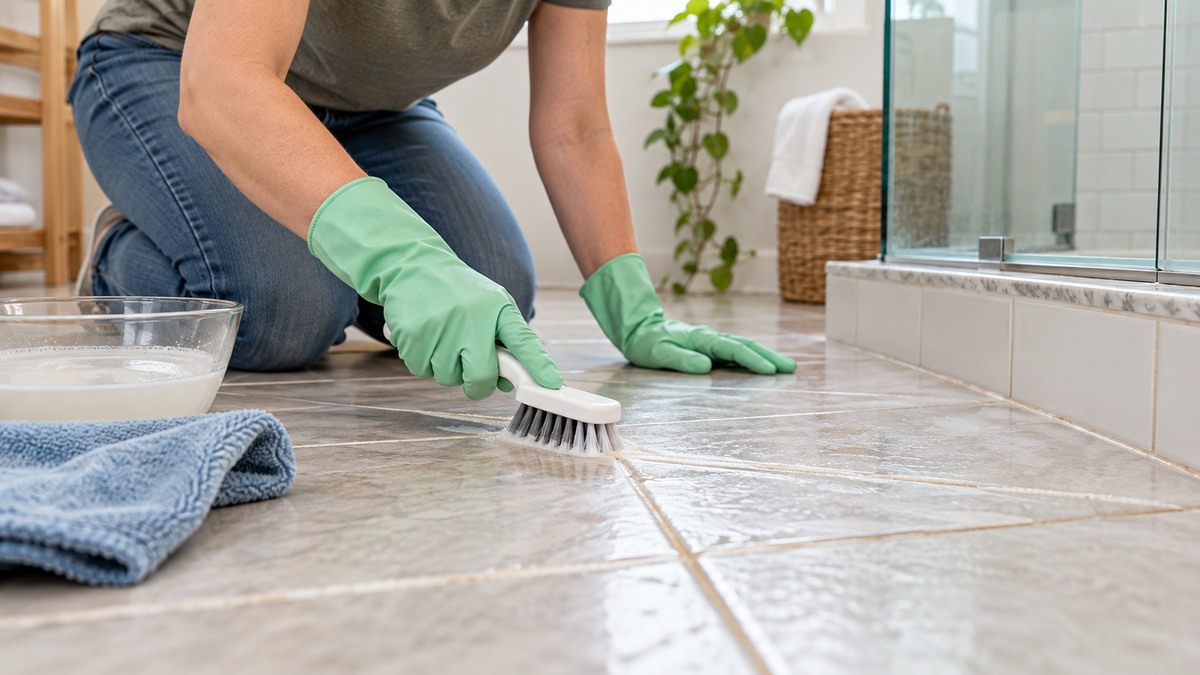
Scrub the grout lines with a nylon brush and warm water. Rinse the area with clean water, then dry it with a cloth. Laticrete’s stain steps call for scrubbing with a nylon pad for at least 60 seconds, which is a useful minimum for a stubborn spot.
If the grout still looks dirty after rinsing, use a mild pH-neutral cleaner. Laticrete recommends a clear pH-neutral cleaner for routine, everyday maintenance cleaning, and an alkaline cleaner for soiling from grease. Its sheet does not give a home ratio, so follow the label on the product you choose.
Finish by rinsing well and letting the surface dry. The Laticrete sheet says to rinse well, vacuum or remove the rinse water, and allow the surface to dry.
How to clean bathroom grout in the shower
The routine above works on shower walls. Work in small sections, rinse each one, and dry it before you move to the next, so the cleaner does not sit on the grout.
If the shower has hard water deposits, Laticrete names a separate class of cleaner for hard water deposits and other inorganic stains. Its sheet does not give a home ratio or a step-by-step method for that class, so this guide does not give one. Read the label, run the test step, and follow the label limits.
For a stubborn stain on grout in a tiled wall, Laticrete says to dampen the grout, apply an alkaline cleaner, let it sit for 3 to 4 minutes, scrub with a white nylon pad for at least 60 seconds, and rinse. If a second round is needed, it says to repeat the soak and scrub on the affected area only.
How to clean bathroom grout naturally
The natural option the sources support is a paste of baking soda and water. UF/IFAS says that if grout is not sealed and becomes dingy, make a paste of baking soda and water, apply it to the grout with a nylon bristle brush or a discarded toothbrush, then rinse with clean water and a cloth and dry.
Two checks come before you use it. First, the UF/IFAS guidance covers grout that is not sealed. The sources we opened do not give a way to tell whether grout is sealed, so check your installer’s records or the product label. Second, the test step still applies. Try the paste on a hidden spot before you clean a full wall or floor.
Some home recipes add vinegar to baking soda. The UF/IFAS factsheet warns against mixing vinegar with bleach, hydrogen peroxide or ammonia. This guide does not recommend adding vinegar to a grout paste, and it gives no vinegar ratio for grout.
How to clean bathroom tiles in the shower
UF/IFAS says that for textured tile, a nylon brush may be needed. For smooth tile, the same source describes clean water applied with a soft cloth, then dried, as a method that may work well. Start with that and move up only if the tile still looks dirty.
Do not use powdered cleansers on tile that is unsealed or unglazed. Laticrete says powdered cleansers are not recommended for cleaning unsealed or unglazed tile, and many types of stone. Liquid cleaners are the safer choice for shower tile, after the test step.
How to clean bathroom tile floor grout
Floor grout needs a slightly different routine because floors get mopped. Laticrete says damp mopping can leave a dirt residue on grout and tile. If the floor looks soiled, mop a solution of a pH-neutral tile cleaner onto the surface, scrub gently with a nylon brush or scrub pad, and remove the mop water with a vacuum before it dries. Rinse well, then let the floor dry.
For dingy floor grout that is not sealed, the same UF/IFAS baking soda and water paste applies. Work in small areas so the paste does not dry before you rinse it.
Mildew and mold on grout
UF/IFAS says mildew and other stains can be removed from grout with a bleach solution. The guidance says to apply it to the grout, let it stand for 5 minutes, rinse with clear water, and air dry. It also says to check the manufacturer’s label, because bleach concentrations vary. This guide does not repeat the bleach ratio. If you use bleach, follow the label, and never mix it with vinegar or ammonia.
The EPA cleanup page says to scrub mold off hard surfaces with detergent and water, and dry completely. It says a moldy area of less than about 10 square feet is usually a job a homeowner can handle, using the EPA cleanup tips. Larger growth needs a different approach under the EPA guidance.
The EPA page also says to fix plumbing leaks and other water problems as soon as possible. Mold grows on moisture, so fixing the water source comes before scrubbing. This guide makes no health claims about mold. For a health question, talk to a health professional.
Keep plumbing work out of this job. If grout stays wet because of a leak behind a wall or a problem with a valve, spout or supply line, stop and call a licensed plumber. This guide covers only the surface cleaning of grout and tile.
Mistakes to avoid
- Mixing bleach with vinegar or ammonia. The UF/IFAS factsheet says the mixture creates toxic fumes.
- Using powdered cleansers on unsealed or unglazed tile. Laticrete says they are not recommended.
- Using acid-based products on polished marble or other stone. Laticrete says they are not recommended.
- Skipping the test step on a hidden area. Laticrete says to test any cleaning product first.
- Leaving a leak in place and cleaning the grout anyway. The EPA page says to fix water problems first.
How we chose
We chose sources by three tests. The source had to be a university extension page, an EPA page or a grout and tile maker’s own care document. We had to open the page or file ourselves on 2026-10-23 and check each quoted sentence against the downloaded text. The source had to cover cleaning grout or tile directly, or give a safety rule that applies to it.
Four sources met those tests: two UF/IFAS documents, one EPA page and one Laticrete care sheet. Search results also pointed to an Iowa State extension blog post, another UF/IFAS EDIS page and a Clemson extension fact sheet. Each returned an HTTP error, so none is cited. Retail and blog pages were not used as sources for any step.
Where a source gave a ratio, this guide does not repeat it. Where a source named a product, this guide describes the type of cleaner instead.
What we could not verify: what the sources do not say
The sources we opened do not say how to tell whether grout is sealed. They do not give a drying time, a cleaning schedule, or a guide to resealing grout. Laticrete says sealers may be used for extra protection of cement grout and follows its sealers with separate instructions. This guide does not cover grout sealing as a repair. Follow the sealer maker’s instructions if you reseal.
The sources do not give a home cleaning ratio for a vinegar method or for a commercial cleaner. They do not name a best grout cleaner. For deep or stubborn stains that do not respond to its steps, Laticrete says to contact its technical support, and this guide does not add other steps.
FAQ
Can I use bleach to clean bathroom grout?
UF/IFAS names a bleach solution for mildew and stains on grout, and says to check the bleach concentration on the manufacturer’s label. Do not combine it with vinegar or ammonia. Rinse the grout well after use.
What is a gentle way to clean grout for routine dirt?
Use warm water and a nylon brush, then rinse and dry. If that is not enough, Laticrete recommends a clear pH-neutral cleaner for routine maintenance cleaning. Run the test step before the first full use.
Does baking soda clean grout?
UF/IFAS says a paste of baking soda and water can be used on grout that is not sealed and looks dingy. Apply it with a nylon brush, rinse fully with clean water and dry the surface.
Can I clean bathroom floor grout with vinegar?
This guide does not give a vinegar method for grout. UF/IFAS warns against mixing vinegar with bleach, hydrogen peroxide or ammonia. Read the label on any cleaner you choose, and test it on a hidden area first.
Should I clean mold off grout before fixing a leak?
No. The EPA page says to fix plumbing leaks and other water problems as soon as possible, then scrub mold off hard surfaces with detergent and water and dry completely.
Bottom line
Start with warm water and a nylon brush, then rinse and dry. Use a mild pH-neutral cleaner for grime that water does not remove. Use a baking soda and water paste only on dingy grout that is not sealed. Use bleach only for mildew, only with the label in hand, and never mixed with vinegar or ammonia. Test every product first.
Related reading
If the shower head is also dirty, see our guide to cleaning a shower head with vinegar. For rain shower heads with rubber nozzles, see the rubber nozzle cleaning steps. If you want a tool for wiping tile after a shower, see our squeegee picks for tile.
Sources
- EPA, Mold Cleanup in Your Home: https://www.epa.gov/mold/mold-cleanup-your-home (opened 2026-10-23). Supports: scrub mold off hard surfaces with detergent and water, dry completely; fix water problems first; about 10 square feet homeowner threshold.
- UF/IFAS, Hazardous Household Substances: Alternatives That Are Relatively Free of Toxic Effects (FCS3149): https://edis.ifas.ufl.edu/publication/HE791/pdf (opened 2026-10-23). Supports: baking soda and water paste for unsealed dingy grout; clean water and nylon brush for tile; bleach solution for mildew on grout with label check.
- UF/IFAS Family Consumer Sciences, Clean, No Chemicals fact sheet (2024): https://sfyl.ifas.ufl.edu/media/sfylifasufledu/sarasota/documents/pdf/fcs/2024_FCS_factsheetCleanNoChems_FINAL_ADA.pdf (opened 2026-10-23). Supports: do not mix bleach or peroxide with vinegar; do not mix bleach with ammonia; mixtures create toxic fumes; label containers.
- Laticrete, Care and Maintenance of Laticrete Finish Materials (TDS 1113): https://cdn-global.laticrete.com/-/media/project/laticrete-international/australia/product-documents/tds/tds-1113-0819-care–maintenance-of-laticrete-finish-materials.ashx (opened 2026-10-23). Supports: pH-neutral cleaner for routine cleaning; alkaline cleaner for grease; stubborn grout stain steps; test first; powdered cleansers and acid products not recommended in stated cases.