How to Clean Bath Mats and Bathroom Rugs
As an Amazon Associate we earn from qualifying purchases.
How to clean bath mats starts with the care label. Where the label is silent, the sources we opened do not give a washing temperature, machine setting or drying time for an ordinary bath mat or bathroom rug. The EPA brief guide says that if wet or damp materials are dried 24-48 hours after a leak or spill, “in most cases mold will not grow.” The EPA mold cleanup page says to “Dry all items completely.” One manufacturer, Ruggable, publishes care steps for its own two-part bath mat, but no source gives those steps for other mats.
Quick answer
- Read the care label first. If it gives a wash temperature, cycle or dryer setting, follow it.
- For a Ruggable bath mat, the manufacturer says to machine-wash the cover in cold water on a normal cycle. The pad is not machine washed.
- Check the underside. The EPA brief guide says mold may be hidden in “the underside of carpets and pads.”
- Do not mix chlorine bleach with ammonia-containing cleaners. The EPA says “toxic fumes could be produced.”
- If mold stays after cleaning, a porous item may have to be thrown away, according to the EPA.
Start with the care label
The care label is the most reliable source for how to clean a specific mat or rug. The FTC Care Labeling Rule defines a care label as “a permanent label or tag, containing regular care information and instructions” (16 CFR 423.1, Cornell Legal Information Institute).
The same rule defines “textile wearing apparel” as an article “customarily used to cover or protect any part of the body.” The definitions we opened do not mention bath mats or rugs, so the rule text does not show whether a bath mat carries a required label. Check for a sewn-in tag, the packaging, or the manufacturer’s care page.
Manufacturer care pages for other bath rug brands could not be opened. The Mohawk Home care pages returned HTTP 403 and a Garland Rug care address returned HTTP 404, so neither was used.
How to clean bath mats
For a bath mat, the sources we opened give no general washing method. The EPA mold cleanup page covers hard surfaces and says to “Scrub mold off hard surfaces with detergent and water, and dry completely.” A bath mat is a fabric item, so that sentence is a general principle, not a washing method for the mat.
Look for mold before washing
The EPA mold cleanup page says mold “can grow on or fill in the empty spaces and crevices of porous materials, so the mold may be difficult or impossible to remove completely.” A visible surface clean may not remove mold that has grown into fabric or foam. For a mat with a pad or a rubber or foam underside, check the back as well as the top.
Washing a bath mat with a rubber-backed pad
Ruggable gives different instructions for the cover and the pad of its bath mat. For the cover, the Ruggable help page says to “Peel the Bath Mat Cover away from the Bath Mat Pad, then machine-wash the Cover in cold water using a mild, liquid, non-bleach detergent.”
The pad is handled differently. The page says “Do not iron, bleach, machine-wash, or tumble-dry the Bath Mat Pad.” For a deeper clean it says to “Saturate the Bath Mat Pad with soapy water, then rinse thoroughly with clean water. Hang to dry until completely moisture-free.” It also says “Do not dry in direct sunlight.”
These steps come from one manufacturer about its own product. The sources we opened do not say whether a different brand’s rubber-backed mat can be treated the same way.
Washing a one-piece bath mat
The sources we opened do not give a washing method for a one-piece bath mat with no separate pad. They do not say how hot the water should be, whether a gentle cycle is needed, or how much detergent to use.
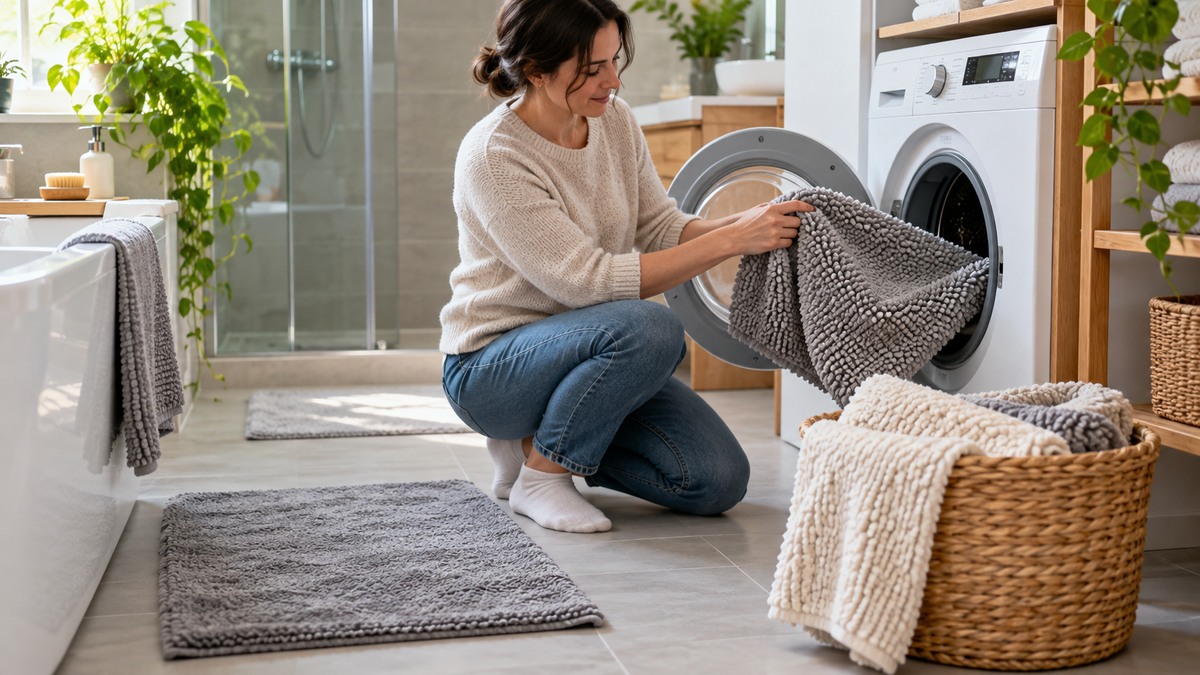
How to clean bathroom rugs in a washing machine
The sources we opened do not give a routine machine setting for an ordinary bathroom rug. Two sources give machine instructions, but they cover different situations and disagree on temperature.
The first is the Ruggable cover instruction above: cold water, a normal cycle, and a mild, non-bleach detergent. That applies to Ruggable’s cover only.
The second is the Iowa Department of Health and Human Services guide for clothing and linens contaminated by floodwater. It says: “Wash the clothing or linens in hot water, heavy-duty detergent, and bleach to fight any bacterial contamination.” It also says that if the washer was affected by flood water, you should “run the machine through one full cycle using hot water and a disinfectant or sanitizer” before washing anything else. This is a flood decontamination instruction. The Iowa page does not say it is the routine wash for a rug that was never flooded, so this guide does not apply it to bath mats.
Neither source gives a temperature for a routine bath rug.
Bleach
The EPA bleach page says the use of chlorine bleach “is not recommended as a routine practice during mold cleanup.” The Iowa page does recommend bleach for flood-contaminated clothing and linens, which is a different situation from routine mold cleanup. The EPA page does not give a bleach method for fabric rugs.
The EPA also says to “Never mix chlorine bleach solution with other cleaning solutions or detergents that contain ammonia,” and that “toxic fumes could be produced.” If you use any disinfectant or biocide during mold cleanup, the EPA advises that you “always ventilate the area and exhaust the air to the outdoors.”
Ruggable adds that “Fabric softener can reduce absorbency, while bleach can weaken the fibers and cause fading.”
How to clean bathroom rugs without a washing machine
None of the sources we opened gives a hand-washing method for an everyday bathroom rug. The NPS article “Saving Wet Textiles After a Flood” lists rugs among heirloom textiles, and says that cottons and linens “can be gently hand-washed with a laundry detergent such as Woolite.” That advice is for salvaging heirloom textiles after a flood, so it is not a standard method for a bath rug.
The NPS article also says that “Textiles soak up water and become about 50% heavier than when they are dry.” It says “DO NOT pick up a wet textile by the corner without support,” and to “Support the textile from the underneath.” A wet rug is heavy and can tear, so support it whenever you move it. The article also advises: “Put on rubber gloves to handle the textiles, and wear a mask if contaminants or molds are present.”
Drying a bath mat or rug
Speed matters most. The NPS article asks: “Can you clean and dry your textiles within 48 hours?” and advises: “Take immediate action when possible.” The EPA brief guide gives the related window for water damage: if wet or damp materials are dried 24-48 hours after a leak or spill, mold will not grow in most cases.
Air drying
The NCPTT fact sheet on saving wet textiles, published in November 2020, says: “Allow the textile to air dry, preferably in a room with a dehumidifier or fan for air circulation to prevent mold.” The EPA brief guide also says to run the bathroom fan or open the window when showering.
The Iowa page says clothing and linens “should be completely dry before putting away to prevent additional mold or mildew growth.” It also says “Clothes or linens can also be hung outside in the sun to dry.” That is a clothing instruction. Ruggable says “Do not dry in direct sunlight” for its pad, so sun drying may not suit every rubber-backed mat.
Dryer use
The sources do not give a dryer temperature or drying time for an ordinary bath mat. The Iowa page says to dry clothing and linens “on the highest heat recommended for the fabric,” which is a clothing rule. The Ruggable page says the cover can be “Tumble dry on air fluff mode or lay flat to air-dry,” and that the pad should not be tumble-dried.
If your mat has a rubber, latex or foam back, the sources we opened do not say whether a dryer is safe for it. Check the label. Where the label is missing, air drying is the only method the sources support for rubber-backed items.
Rubber-backed rugs
The Ruggable page says to “Periodically wipe down the underside of the Bath Mat Pad and the floor beneath it,” and to “Spot clean the bottom of the Bath Mat Pad with a damp cloth.” Its deeper clean for the pad is the soapy-water method above. The sources we opened do not say whether these limits apply to rubber-backed rugs from other makers, or how long a rubber backing lasts with regular washing.
Drying and keeping mold away
The EPA brief guide says “Moisture Control is the Key to Mold Control,” and advises you to “act quickly” when water leaks or spills occur indoors. It also says to “Run the bathroom fan or open the window when showering,” and to use “air conditioners and/or de-humidifiers when needed.”
A bath mat that sits on a damp floor after every shower is a moisture question as well as a cleaning question. The sources we opened do not say how often a bath mat should be washed, or whether a fan or window alone is enough for a particular bathroom.
Health and mold
The EPA mold and health page says that “Inhaling or touching mold or mold spores may cause allergic reactions in sensitive individuals.” It also says that “Molds can also cause asthma attacks in people with asthma who are allergic to mold,” and that “Research on mold and health effects is ongoing.” This guide does not add any health claim beyond those statements. For symptoms, ask a doctor.
When to replace a bath mat or rug
Ruggable recommends replacing its own bath mat: “we recommend replacing your bath mat every 12 to 18 months.” That is the manufacturer’s recommendation for its product, not a general rule.
For mold, the EPA mold cleanup page says: “Absorbent or porous materials, such as ceiling tiles and carpet, may have to be thrown away if they become moldy.” If mold remains after cleaning and drying, consider replacing the rug.
For flood exposure, the NPS article advises throwing away “pillows, stuffed animals, and other non-heirloom clothing that has been in flood waters for an extended period.” That applies to flood-soaked items, not to a mat that was only wet from a shower.
How we chose
This guide was built from pages we opened with curl on 2026-10-23. We looked for official pages first: EPA mold pages, NPS and its National Center for Preservation Technology and Training, the Iowa Department of Health and Human Services, and the FTC Care Labeling Rule text on the Cornell Legal Information Institute site. The one manufacturer page, Ruggable’s, is used only for its own product. Blogs, retail product pages and appliance-maker blogs were not used for cleaning steps. This post contains no product links.
Several pages could not be opened, including the Oklahoma State, University of Georgia and Linn County extension or county guides (403), the Illinois Extension stain page (404), and CDC mold pages (403). None of these was used.
What we could not verify: what the sources do not say
The list below is what the sources we opened do not cover. None of these points is answered in this guide.
- Washing temperatures, cycles and detergent amounts for an ordinary bath mat or bathroom rug, outside the Ruggable cover.
- Whether a dryer is safe for rubber, latex or foam backings on a mat other than Ruggable’s, and what dryer setting to use.
- Drying times for bath mats or bathroom rugs. No source gives a number of hours for a damp mat to dry.
- A hand-washing method for an everyday bath rug. The NPS hand-wash advice is for heirloom textiles after a flood.
- Whether the Iowa flood wash instruction (hot water, heavy-duty detergent and bleach) applies to everyday bath mats.
- Whether bath rugs fall under the FTC care label requirement. The definitions we opened do not mention them.
- How often a bath mat cover should be washed. Ruggable gives a cleaning schedule for the pad, not a wash frequency for the cover.
- Whether mold can be fully removed from a fabric or foam mat. The EPA says it may be difficult or impossible.
Related guides
For where to keep towels and linens off a damp floor, see towel storage options for the bathroom. For wall-mounted storage that keeps items off the floor, see hanging bathroom caddy options.
FAQ
Can I put a bath mat in the dryer?
It depends on the mat. Ruggable says its cover can be tumble dried on air fluff mode or laid flat to dry, and that its pad should not be tumble-dried. For other mats, the sources we opened do not say. Check the care label.
How often should I wash a bath mat?
The sources we opened do not give a wash frequency for a bath mat cover. Ruggable recommends cleaning its pad every 2 to 4 weeks, or right after a major spill.
Is bleach safe for bath rugs?
The EPA says chlorine bleach “is not recommended as a routine practice during mold cleanup.” Ruggable says bleach “can weaken the fibers and cause fading” on its cover. Never mix bleach with ammonia-containing cleaners.
Is mold on a bath rug a health concern?
The EPA says that “Inhaling or touching mold or mold spores may cause allergic reactions in sensitive individuals,” and that “Molds can also cause asthma attacks in people with asthma who are allergic to mold.” For symptoms, ask a doctor.
Should I throw away a moldy bath rug?
The EPA says that “Absorbent or porous materials, such as ceiling tiles and carpet, may have to be thrown away if they become moldy.” If mold remains after cleaning and drying, that is the point to consider replacing the rug.
Bottom line
Follow the care label for washing and drying. Where the label is silent, the sources we opened do not give a routine washing temperature, machine setting or drying time for an ordinary bath mat or bathroom rug. Ruggable’s instructions cover only its own cover and pad. Dry the item completely, keep the bathroom ventilated, and treat persistent mold on a porous rug as a reason to replace it.
Sources
- US EPA, “Mold Cleanup in Your Home”, https://www.epa.gov/mold/mold-cleanup-your-home (opened 2026-10-23). Supports: “Dry all items completely”; “Scrub mold off hard surfaces with detergent and water, and dry completely”; porous materials such as carpet may have to be thrown away; mold can fill crevices of porous materials.
- US EPA, “A Brief Guide to Mold, Moisture, and Your Home”, https://www.epa.gov/mold/brief-guide-mold-moisture-and-your-home (opened 2026-10-23). Supports: 24-48 hour drying window; “in most cases mold will not grow”; mold may hide under carpets and pads; run the bathroom fan or open the window when showering; air conditioners and/or de-humidifiers when needed.
- US EPA, “Mold and Health”, https://www.epa.gov/mold/mold-and-health (opened 2026-10-23). Supports: allergic reactions in sensitive individuals; asthma attacks in people with asthma who are allergic to mold; research ongoing.
- US EPA, “Should I Use Bleach to Clean Up Mold?”, https://www.epa.gov/mold/should-i-use-bleach-clean-mold (opened 2026-10-23). Supports: bleach not recommended as routine practice during mold cleanup; never mix chlorine bleach with ammonia-containing cleaners; toxic fumes; ventilate and exhaust to the outdoors.
- 16 CFR 423.1 Definitions (FTC Care Labeling Rule), Cornell Legal Information Institute, https://www.law.cornell.edu/cfr/text/16/423.1 (opened 2026-10-23). Supports: definition of care label; definition of textile wearing apparel.
- Iowa Department of Health and Human Services, “Cleaning Clothing and Linens Contaminated by Floodwater”, https://hhs.iowa.gov/media/13755/download (opened 2026-10-23). Supports: hot water, heavy-duty detergent and bleach for flood-contaminated clothing and linens; flood-affected washer test cycle; highest heat recommended for the fabric; hung outdoors in the sun; complete drying.
- US National Park Service, “Preservation Matters – Disasters – Saving Wet Textiles After a Flood”, https://www.nps.gov/articles/000/preservation-matters-disasters-saving-wet-textiles-after-a-flood.htm (opened 2026-10-23). Supports: rugs listed among heirloom textiles; hand-washing for cottons and linens; 50% weight gain when wet; support when moving; 48-hour question; gloves and mask; throw away non-heirloom items after extended flood exposure.
- National Center for Preservation Technology and Training, “Preservation in Practice: Disasters Saving Wet Textiles After a Flood” (November 2020), https://home.nps.gov/subjects/ncptt/upload/Preservation-in-Practice_Saving-Wet-Textiles_Nov2020.pdf (opened 2026-10-23). Supports: air dry, preferably with a dehumidifier or fan, to prevent mold.
- Ruggable help center, bath mat care page, https://ruggable.com/help/assembly-and-care/bath-mat-care (opened 2026-10-23). Manufacturer care page for Ruggable’s own bath mat cover and pad only. Supports: cold water and mild non-bleach detergent for the cover; tumble dry on air fluff or lay flat; pad not machine-washed or tumble-dried; pad cleaning every 2 to 4 weeks; replacement every 12 to 18 months.