How to Clean a Loofah and a Shower Caddy
As an Amazon Associate we earn from qualifying purchases.
How to clean loofah: dry it fully after each use, decontaminate it at intervals with bleach only if you follow the bleach label, and never mix bleach with an ammonia-containing cleaner. The main research on loofah sponges is a 1994 laboratory study. It found that loofahs can support bacterial growth and recommends bleach decontamination at regular intervals. For a shower caddy, the sources we opened point to mild soap and warm water on the finish, complete drying, and no abrasive pads. The sources do not give a rust-removal method, a household bleach dilution, or a replacement schedule for loofahs.
Quick answer
- Dry a loofah completely between uses. Kitchen-sponge guidance says to let sponges dry out, and the 1994 study links damp loofahs to bacterial growth.
- If you decontaminate a loofah with bleach, follow the bleach label, ventilate the room, and do not mix bleach with ammonia-containing cleaners.
- Do not microwave a dry sponge. The extension guidance on sponges warns it may catch fire.
- Clean a shower caddy with mild soap and warm water, dry it with a soft cloth, and avoid abrasive or fibrous pads on its finish.
What the 1994 loofah study found
Most loofah-cleaning advice traces back to one paper: Bottone, Perez, and Oeser, in the Journal of Clinical Microbiology, 1994. The authors began with a case of Pseudomonas aeruginosa folliculitis. They traced it to a contaminated loofah, and that case is the only health event the paper describes.
The rest of the paper is laboratory work on bacterial growth. The authors report growth enhancement on sterile loofah fragments for several gram-negative and gram-positive species. The gram-negative species named include Pseudomonas, Xanthomonas, and Klebsiella, and the gram-positive species include Enterococcus and group B Streptococcus. New, hydrated loofahs also shifted from a sparse mix of bacteria, mainly Bacillus and Staphylococcus epidermidis, to one dominated by gram-negative species. The authors add that dead skin cells trapped in the fibers increase that growth-promoting effect.
Put simply, the paper shows that loofah fibers can support bacterial growth, and that a hydrated loofah can shift toward gram-negative bacteria. It does not follow loofahs through a home cleaning schedule, so it cannot show how any routine changes those numbers over time.
The authors conclude that loofahs can act as “a reservoir and a vehicle for the transmission of potentially pathogenic species” to human skin. Read that as a finding about bacteria on sponges in a lab. The paper does not report infection rates in ordinary households, and it does not compare home cleaning routines. A cleaning routine that makes a loofah cleaner is a reasonable goal, but the paper does not show how much any routine lowers the risk to a person.
How to clean loofah, step by step
Step 1: Dry it fully after each use
No opened source gives a loofah-specific rinsing routine or a drying time. The closest opened guidance is from the Brunswick County Center of North Carolina State University Extension. That page covers kitchen sponges. It advises that you “allow them to dry out” and says to get as much moisture out of the sponge as possible. Apply that to a loofah with the limit in mind.
The EPA’s mold cleanup guidance makes the same point more generally: “Dry all items completely.” Practical steps that follow from this advice are to squeeze out as much water as you can and let the loofah air dry in a spot that is out of the spray. Those steps are practical judgments, not findings from a source.
Step 2: Decontaminate at intervals, and follow the bleach label
The 1994 paper recommends “decontamination with hypochlorite (10%) bleach at regular intervals.” It does not explain how to make that solution from household bleach, and it does not say what “regular” means in weeks. This post does not supply a dilution or a contact time. Check the bleach label for both, and do not use a stronger mix than the label states.
The EPA takes a more cautious view for mold. Its bleach guidance says that using chlorine bleach is “not recommended as a routine practice during mold cleanup.” It also says that if you use a disinfectant, you should “always ventilate the area.” The EPA also says: “Never mix chlorine bleach solution with other cleaning solutions or detergents that contain ammonia”. That warning is the most important safety point in this section.
The two sources differ in emphasis. The 1994 paper is about bacteria on loofahs and recommends bleach at intervals. The EPA is about mold on surfaces and advises against bleach as a routine practice. Both sources agree on ventilation and on not mixing bleach with ammonia. Neither source gives a loofah-specific dilution.
Methods the sources do not support
Many consumer sites list vinegar soaks, hydrogen peroxide, dishwasher cycles, and microwaving for loofahs. None of the opened loofah sources covers those methods. For the microwave, the NC State page says that a dry sponge “may cause a fire inside the microwave.” It also notes a risk of burns if a water-filled sponge is heated too long. This post does not recommend microwaving a loofah.
Step 3: Replace it
The NC State page says “Replace your sponge often,” again about kitchen sponges. No opened source gives a loofah replacement interval. Consumer guides often say three to four weeks, but we did not find an opened study or extension page that backs that number, so this post does not give one. Replacing a loofah that smells or breaks apart is a practical judgment, not a sourced rule.
How to clean a shower caddy
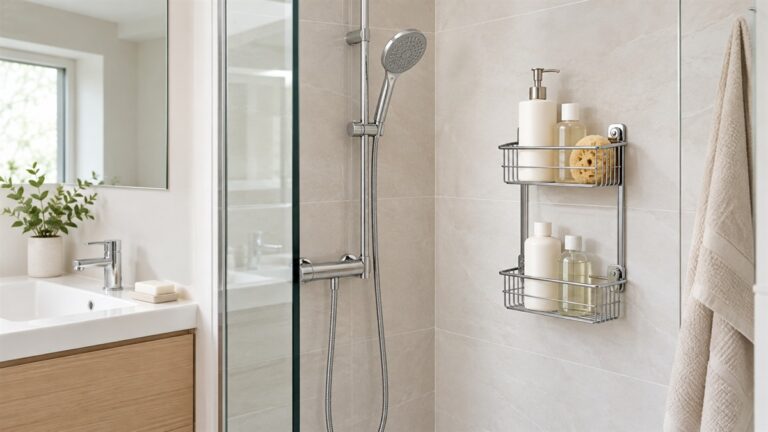
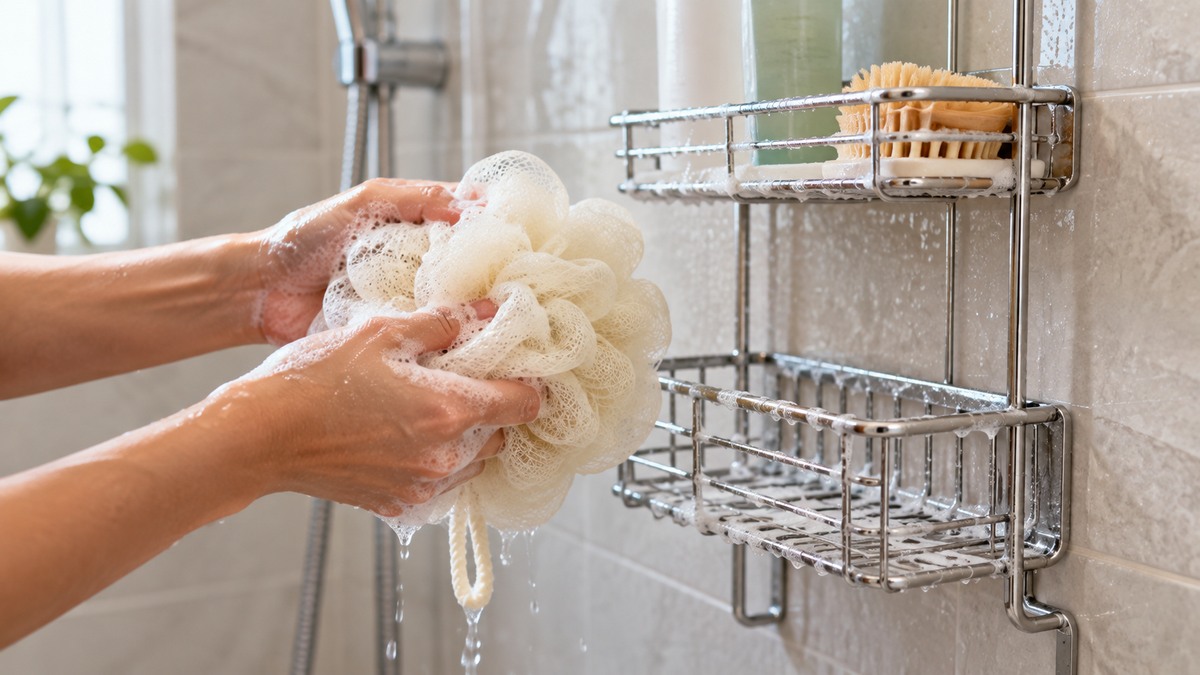
Most shower caddies are plastic, aluminum, or stainless steel with a coated or polished finish. The Moen care page covers showerheads, not caddies, but its finish advice is the closest opened manufacturer guidance. It says to clean the surface with “mild soap and warm water” and then dry it “with a clean, soft cloth.” It also says to avoid “abrasive cleaners or fibrous pads that could scratch or damage the finish.”
Applying that to a caddy is an extension of the Moen guidance, not a caddy-specific source. In practice that means mild soap, warm water, a soft cloth, and no scouring pads. Wipe the caddy down after use so water does not sit in the baskets, and let the parts dry before you load them again. The drying step matches the EPA advice to dry items completely.
Mold on a caddy
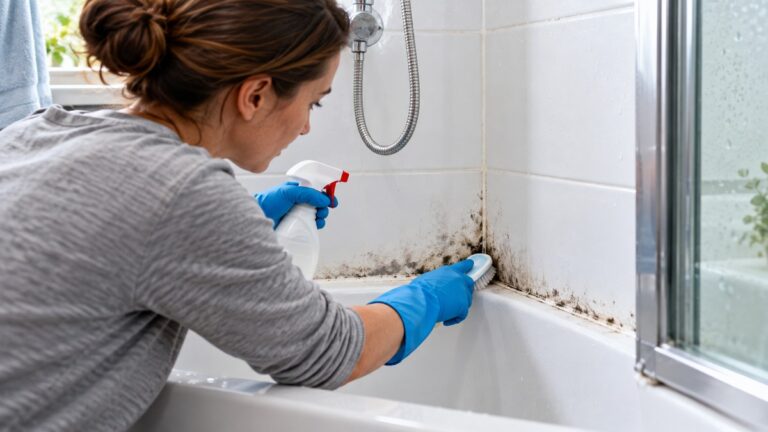
The EPA’s mold cleanup page gives the rule for hard surfaces: “Scrub mold off hard surfaces with detergent and water, and dry completely.” Most caddy frames and baskets count as hard surfaces. Porous materials are different. The EPA says absorbent or porous materials may have to be thrown away if they become moldy, because mold can grow into their empty spaces and crevices. A caddy with fabric or other absorbent parts should be judged on that rule, and so should a loofah.
Rust spots
None of the sources we opened gives a rust-removal method for a shower caddy. Consumer sites list vinegar soaks, baking soda pastes, and citric acid. This post does not include steps for them. Scrubbing rust is also in tension with the Moen warning against abrasive pads, so a scrub that works on bare metal may damage a coated finish. Check the manufacturer’s care sheet or manual before you scrub a coated caddy.
If you are deciding whether a caddy is worth cleaning or replacing, compare the rust-resistant options in stainless steel caddies built for rust resistance, the caddies picked for holding up against rust, or plastic caddies that mount with suction cups.
Health: what the sources say
The EPA mold health page says: “Inhaling or touching mold or mold spores may cause allergic reactions in sensitive individuals.” It lists allergic responses such as hay-fever-type symptoms and skin rash. It also says molds can cause asthma attacks in people with asthma who are allergic to mold. The same page says “Research on mold and health effects is ongoing.”
For loofahs, the only health event in the opened sources is the Pseudomonas folliculitis case in the 1994 paper. No opened source gives an infection rate linked to loofahs in homes. No opened source says a cleaned loofah removes all risk. If you have a skin infection or a rash that does not clear, see a doctor. This post does not make a health claim about exfoliation or skin benefits.
How we chose
We limited this post to sources we opened in this session: one full-text study from PubMed Central, three EPA pages, one university extension page, and one manufacturer care page. We left out search snippets and consumer cleaning blogs as evidence. We also left out any page that returned an error or a block page. Those included the journal’s own site, a Michigan State University Extension sponge page, and the simplehuman homepage, which had no care text. Where two opened sources differ, the post shows both views. The post contains no prices, product rankings, or product links.
What we could not verify
We could not open the journal’s own page for the 1994 paper, so its quotes come from the full-text copy in PubMed Central. We could not open the Michigan State University Extension sponge pages, which blocked access, so the drying and replacement points rest on the NC State page instead. We could not verify any loofah-specific cleaning method from an opened source. We could not verify a caddy-specific care instruction, because the only manufacturer page we opened covers showerheads.
What the sources do not say
- No opened source gives a loofah rinsing routine or a drying time for a loofah.
- No opened source gives a household bleach dilution or a contact time for a loofah.
- No opened source studies microwaving, dishwashing, vinegar, or hydrogen peroxide on a loofah.
- A loofah replacement interval is missing from every source we opened.
- No opened source gives a rust-removal method for a shower caddy.
- No opened source gives the care steps for a specific caddy model.
- No opened source gives an infection rate linked to loofahs in ordinary homes.
Sourced advice at a glance
The table lists only what each opened source says. Where the source is about kitchen sponges or showerheads rather than loofahs or caddies, the table says so.
| Topic | What the opened source says | Source and scope |
|---|---|---|
| Drying a sponge | “allow them to dry out” | NC State Extension, kitchen sponges |
| Drying after mold cleanup | “Dry all items completely.” | EPA, mold cleanup in general |
| Bleach on a loofah | “decontamination with hypochlorite (10%) bleach at regular intervals” | 1994 study, loofahs |
| Bleach on mold | “not recommended as a routine practice during mold cleanup” | EPA, mold |
| Bleach and ammonia | Do not mix; toxic fumes could be produced | EPA, mold |
| Microwaving a sponge | A dry sponge “may cause a fire inside the microwave” | NC State Extension, kitchen sponges |
| Replacing a sponge | “Replace your sponge often” | NC State Extension, kitchen sponges; no interval given |
| Cleaning a finish | “mild soap and warm water”, then a soft cloth | Moen, showerheads |
| Abrasives on a finish | Avoid “abrasive cleaners or fibrous pads” | Moen, showerheads |
| Health effects of mold | “Inhaling or touching mold or mold spores may cause allergic reactions in sensitive individuals.” | EPA, mold and health |
Mistakes to avoid
- Mixing bleach with an ammonia-containing cleaner. The EPA says toxic fumes could be produced.
- Microwaving a dry sponge. The NC State page warns it may cause a fire.
- Scrubbing a caddy finish with abrasive or fibrous pads. The Moen page warns this can scratch or damage the finish.
- Leaving a loofah or caddy wet between uses. The 1994 paper links damp loofahs to bacterial growth, and the EPA advises drying items completely.
- Treating mold on porous items as a surface problem. The EPA says porous materials may have to be thrown away.
FAQ
Can I put a loofah in the dishwasher?
No opened loofah source studies a dishwasher cycle, so this post cannot say whether it works. Dishwashers are listed in kitchen-sponge advice from consumer sites, but those sites are not sources here. Check the loofah manufacturer’s care label before you try it.
How often should I replace a loofah?
The NC State extension page says “Replace your sponge often,” but it covers kitchen sponges. No opened source gives a loofah interval. Replace a loofah sooner if it smells or breaks apart. That is a practical judgment, not a sourced rule.
Is a moldy loofah a health risk?
The EPA says that inhaling or touching mold may cause allergic reactions in sensitive people. It also says mold can trigger asthma attacks in people with asthma who are allergic to mold. The 1994 paper describes one case of folliculitis traced to a contaminated loofah. Those sources do not show how common such problems are. Persistent skin symptoms are a reason to see a clinician.
What can I use on a shower caddy?
The Moen care page advises mild soap and warm water, a soft cloth, and no abrasive cleaners or fibrous pads on the finish. That page covers showerheads, so check the caddy’s own manual before you use anything stronger.
Can I remove rust from a caddy?
No opened source gives a rust-removal method for a caddy. Check the manufacturer’s care sheet first, because scrubbing a coated finish can damage it. If the rust has spread through the frame, the caddy may be due for replacement, which is a judgment call.
Bottom line
Dry a loofah completely after each use, decontaminate it only as the bleach label allows and never with ammonia-containing cleaners, and replace it when it smells or breaks apart. Clean a shower caddy with mild soap, warm water, and a soft cloth, and check the manual before you scrub any rust.
Sources
- Bottone EJ, Perez J, Oeser JL. “Loofah sponges as reservoirs and vehicles in the transmission of potentially pathogenic bacterial species to human skin.” Journal of Clinical Microbiology, 1994. https://pmc.ncbi.nlm.nih.gov/articles/PMC263056/ (opened 2026-10-23). Supports: growth findings, folliculitis case, bleach recommendation.
- US EPA, “Mold Cleanup in Your Home.” https://www.epa.gov/mold/mold-cleanup-your-home (opened 2026-10-23). Supports: drying items completely, hard-surface scrubbing, porous materials.
- US EPA, “Mold and Health.” https://www.epa.gov/mold/mold-and-health (opened 2026-10-23). Supports: allergic reactions, asthma, ongoing research.
- US EPA, “Should I Use Bleach to Clean Up Mold?” https://www.epa.gov/mold/should-i-use-bleach-clean-mold (opened 2026-10-23). Supports: bleach not routine, ventilation, no mixing with ammonia.
- North Carolina State University Extension, Brunswick County Center, “Risky or Not: Microwaving Your Sponge.” https://brunswick.ces.ncsu.edu/news/risky-or-not-microwaving-your-sponge/ (opened 2026-10-23). Supports: microwave fire warning, drying, replacing often. Kitchen sponges only.
- Moen, bathroom care page. https://www.moen.com/pages/bathroom (opened 2026-10-23). Supports: mild soap, warm water, soft cloth, no abrasive or fibrous pads on finishes. Showerhead care only.