shower-grab-bar-installation
As an Amazon Associate we earn from qualifying purchases.
A shower grab bar installation holds up only when the bar is fixed into solid wood or a rated anchor. This guide walks through what to check before you drill, how to find a wall stud, how to handle tile and hollow walls, and where the bar maker’s own instructions set the rules. The steps come from the sources listed at the end of this page. Follow the instructions that come with your bar first, and ask a qualified installer if the wall is unclear to you.
Quick answer
- Fix the bar into wall studs, or use the anchor type the bar maker names for your wall.
- Find the studs with a stud finder, mark the holes, and drill pilot holes. Use a carbide-tip bit when you drill through ceramic tile.
- Seal the back of the mounting flanges with silicone made for wet applications, then tighten every screw.
- Do not use suction-cup bars or towel bars as grab bars. The Kentucky extension bulletin lists suction-cup bars and towel racks as things to avoid.
- Check the weight limit in the maker’s instructions, and talk with a clinician or occupational therapist about the right bar and height for the person who will use it.
How we chose
This post does not recommend a product, and it does not rank bars against each other. We picked three sources that give installation or accessibility guidance. The first is the U.S. Access Board guide text for the ADA standards, including section 609 on grab bars. The second is a University of Kentucky Cooperative Extension bulletin on bathroom accessibility, written for homeowners. The third is an installation manual from a grab bar maker that covers wood-stud mounting step by step.
We chose these because they are independent of any sales page. They come from a government agency, a university, and a manufacturer, and they describe how a bar should be mounted and checked. Where a point comes from only one of them, the text says so. Where none of them say something, the “What we could not verify” section says that too.
Before you drill: check the reason for the bar and the wall
A grab bar is for holding while you enter or exit the tub, or while you sit down or rise from a seat. It is not a towel bar, a shelf, or a step. The Newport Brass manual says to grasp the bar when entering or exiting the bathtub, and it says not to stand, sit, or step on the bar, and not to use it as a step or platform to reach above the tub. Keep that in mind when you choose the spot. The bar must sit where a hand can reach it from the place the person actually stands or sits.
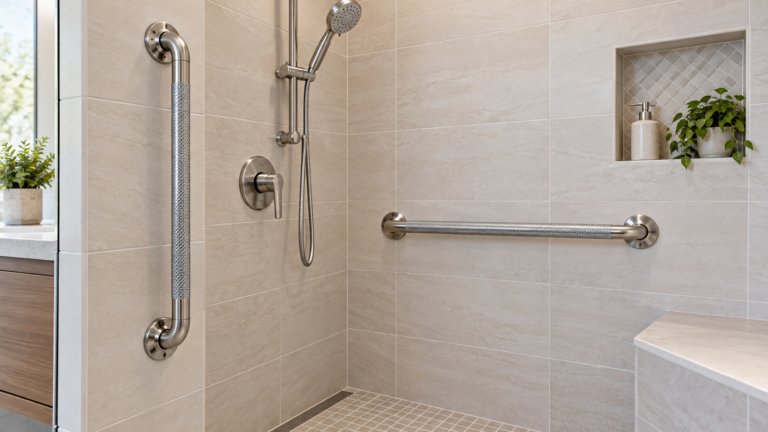
Before you open the drill, look at the wall. Confirm it is solid enough for the bar you have. A drywall wall with no framing behind the spot is a different job from a tiled wall with studs behind it. According to the Kentucky bulletin, a bar needs a solid anchor: a stud, a special grab bar anchor, or a professional install. The bulletin also places grab bars behind and next to the toilet, and inside and alongside the shower or tub.
Also check what runs inside the wall. The Newport Brass manual asks the installer to know where internal wall wiring is located so that no wires interfere with the installation. The same manual notes that older homes do not always follow current housing codes, so look for wiring and pipes before you drill.
Tools and parts you will need
The Newport Brass instructions list the tools for a wood-stud install: safety glasses, a power drill, a 7/64 inch drill bit for the pilot holes, a 1/4 inch carbide-tip drill bit for ceramic tile, a Phillips screwdriver, a level, a stud finder, and a pencil. The kit that comes with the bar includes the bar, the mounting screws, and the flange parts. Check that your kit includes everything before you start, and read the whole instruction sheet first.
Use the screws the maker supplies with the bar. The manual gives the wood-screw steps for its own kit, so follow those steps rather than swapping in other fasteners.
Step 1: Find the studs and mark the holes
Locate the wall studs before you begin. The Newport Brass manual says to do this before installation, and it names a stud finder from a hardware store as the tool. Its diagrams show wood wall studs normally 16 inches center to center, but do not assume that spacing in your own wall. Confirm each stud position before you mark.
Next, decide whether the bar will run horizontally, vertically, or at an angle. The manual says the bar may be installed in any of those positions, as long as at least two of the four mounting screws on each end go into a wall stud. Plan the layout so that at least two screws on each end land in a stud. If the bar cannot reach two studs at each end, do not install it into the drywall alone. Choose a different spot, or ask an installer about blocking or a different anchor.
Mark the holes with a pencil while the bar is held level. Check the level again before you drill.
Step 2: Set the height
Height depends on the person and the room. Start with the ADA reference numbers, then adjust with a clinician or occupational therapist. The Access Board guide text for section 609.4 says grab bars must be installed between 33 inches and 36 inches above the floor in the accessible bathroom cases the standard covers. Those are rules for accessible facilities, and the text does not say what height is right for a particular person at home.
For a shower bar, also think about where the hand will sit when the person steps in or out of the tub. A bar that is too high or too low can be hard to reach from a seated position. This is a fit decision, and the person who will use the bar should be part of it.
Step 3: Drill into the stud
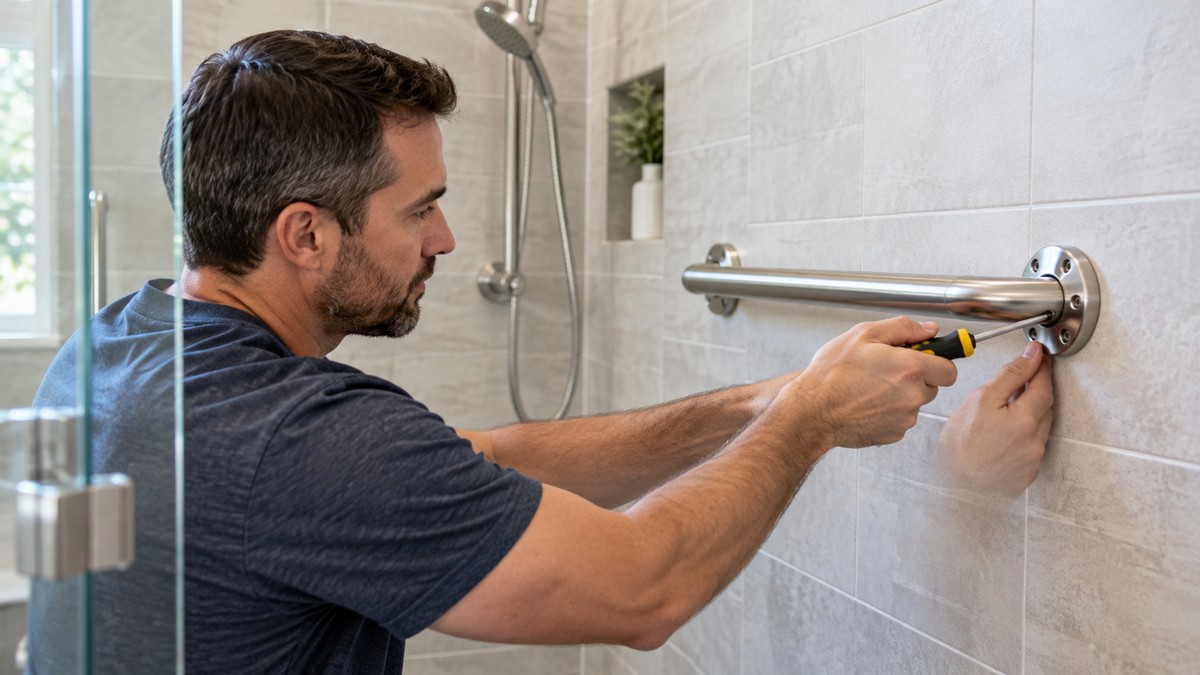
Put on safety glasses before you drill. Use the 7/64 inch bit for the pilot holes in the wall and in the wood stud. The Newport Brass steps say to drill all holes into the wall and the wood stud at the marked positions, then place the bar and align its holes with the holes in the wall.
If you are drilling over ceramic tile, use the 1/4 inch carbide-tip bit to drill through the tile first, so the tile does not crack. Then switch to the 7/64 inch bit to drill the pilot hole into the wood stud behind it. Follow that order exactly as the manual gives it. Drill slowly, keep the bit square to the wall, and stop if the bit starts to slide on the tile.
Clear the dust out of the holes before you insert the screws.
Step 4: Seal and set the bar
Apply a bead of silicone sealant designed for wet applications to the back face of both mounting flanges. The Newport Brass manual says this helps prevent water from bleeding through the mounting holes and damaging the wallboard. Follow the sealant label for curing time before anyone uses the bar.
Place the bar on the wall, align the holes, and insert the wood screws into one end. Hand-tighten, then repeat on the other end. The manual says to hand-tighten first, then securely tighten all the mounting screws with a screwdriver. Install any O-rings, decorative rings, or escutcheons that come with the kit, following the maker’s sequence.
Hollow walls and other wall types
Wood studs are the simplest case. Hollow walls need a different plan. Anchors have to be the kind made for grab bars, and the bulletin’s point about solid anchoring applies here too. Use the anchor type the bar maker names for your wall, and install it exactly as that maker describes. Anchor ratings and wall materials differ, so do not assume a generic hardware-pack anchor will match the load the bar needs to carry.
The Kentucky bulletin also lists wall-blocking for future installation of grab bars as a universal design feature for bathrooms. If you are building or remodeling, ask the contractor about blocking behind the spots where bars might go. Blocking gives the screws wood to bite into, which is the case the manual’s stud steps describe.
Do not use suction-cup grab bars. The Kentucky bulletin lists them as something to avoid, and it also says not to use towel racks as grab bars. Neither product is designed as a grab bar in the way the bulletin describes.
Check the install before anyone uses it
After the bar is in, pull outward and push downward on it with firm force. The bar should not move, creak, or pull away from the wall. If it moves at all, do not use it. Remove the bar, check the studs and screws, and re-mount it with better support.
The Newport Brass manual says to use extreme caution on wet tub or floor surfaces, to grasp the bar when entering or exiting the tub, and not to put your entire weight on the bar. It also says to periodically inspect the bar for damage or looseness, and to stop using it if any damage or looseness exists. Make that a regular check, especially after a bump or a heavy load.
Check the weight limit in the maker’s instructions. The Newport Brass manual for its 10-36 family of bars says the grab bar is rated for persons weighing up to 350 pounds when properly installed. That figure applies to that product and that installation. The sources in this post do not give a weight rating for any bar sold on Amazon, so read the instructions or label that come with the bar you buy.
Shower bar or grab bar? Compare the job
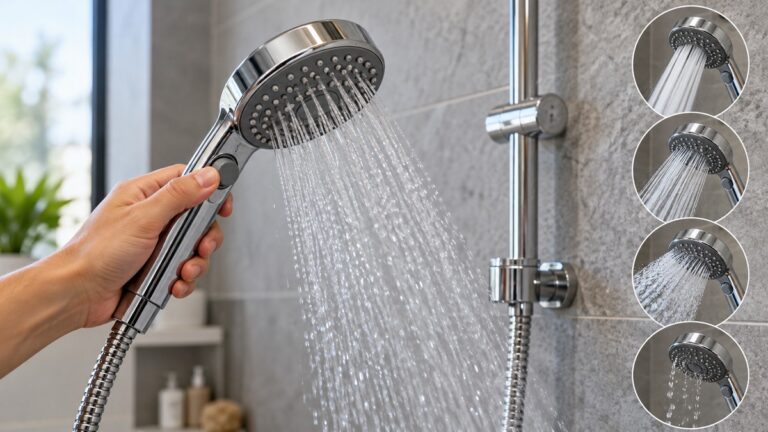
Some bathrooms have a slide bar or a handheld shower mount that people sometimes use as a grab bar. The sources in this post do not cover slide bars, so do not treat one as a grab bar unless the maker’s instructions say it is meant for that use. If you are choosing between a slide bar and a dedicated grab bar, read the maker’s instructions for each and decide based on the job you need done. These related posts on this site cover the showerhead side of that choice:
- Our post on shower bars for a showerhead
- Our post on ADA-compliant shower slide bars
- Our post on handheld shower heads for seniors
Those posts do not replace the installation steps above. Use this page for the mounting work, and check each product’s own rating and instructions before you rely on it.
Keep shelves and caddies off the grab bar
A grab bar should not be crowded by shelves or caddies that hang from it. Keep the grip area open so that a hand can hold the bar without catching a basket or bottle. If you plan shelves near the bar, keep the shelf hardware separate from the grab bar and do not load the bar in any way the maker does not allow. For shelf choices in the same bathroom, see our post on bathroom shower shelves, and our note on floating shower shelves.
Safety checks with a clinician or therapist
The installation rules here are for the bar itself. They do not tell you whether a grab bar is the right aid for the person who will use it, or where they should stand, step, or sit. For that, talk with a doctor, nurse, physical therapist, or occupational therapist. An occupational therapist can look at the bathroom and suggest bar placement for the person’s needs.
If the wall is unclear, or if the bar must hold a load close to its rated limit, ask a licensed installer or contractor to inspect the spot first. The Newport Brass manual says that if you are in doubt, the installation should be done by a qualified professional. That applies to any wall you cannot read clearly.
What we could not verify: what the sources do not say
- The sources we opened do not give a weight rating for any shower grab bar sold on Amazon. The 350-pound figure above applies only to the Newport Brass 10-36 family manual.
- The sources do not say that a grab bar prevents falls, and this post does not make that claim.
- The Access Board text is written for accessible facilities. The sources do not say how it applies to a private home, a rental, or a remodel.
- The sources do not give a stud spacing for every house. Check the framing in your own wall.
- The sources do not say how a particular tile, grout, or wallboard will respond to a particular sealant or screw. Follow the maker’s instructions for those materials.
- The sources do not say how long a particular anchor or wall type will hold under repeated use.
FAQ
Can I install a shower grab bar into drywall only?
The Newport Brass manual says each end of the bar should have at least two of its four mounting screws secured into a wall stud. The Kentucky bulletin says grab bars should be solidly anchored, either into studs, with special anchors made for grab bars, or by a professional. A bar mounted only into drywall, without studs or an anchor rated for that wall, does not match what these sources describe.
Do I need a stud finder?
The Newport Brass manual says to locate the wall studs before you begin, and it names a stud finder from a hardware store as the tool. Confirm each stud position before you drill.
What drill bit should I use for tile?
The Newport Brass manual calls for a 1/4 inch carbide-tip bit to drill through ceramic tile, then a 7/64 inch bit for the pilot hole into the wood stud. Using the carbide bit first is how the manual avoids damaging the tile.
Is a suction-cup grab bar a safe option?
The Kentucky extension bulletin lists suction-cup grab bars among the things to avoid. The sources in this post do not give a safe-use rating for any suction-cup product, so this post does not recommend one.
How high should a shower grab bar be?
The Access Board guide text says grab bars must be installed between 33 inches and 36 inches above the floor in the accessible bathroom cases the standard covers. That range comes from rules for accessible facilities. For a home, the right height depends on the person, so ask an occupational therapist or clinician for a fit decision.
What should I check after the bar is installed?
Pull outward and push downward on the bar. It should not move at all. Then inspect it regularly for damage or looseness, as the Newport Brass manual advises. If the bar moves, stop using it, remove it, and re-mount it with better support.
Bottom line
A shower grab bar installation is a stud-and-anchor job. Find the studs, drill the pilot holes with the right bits, seal the flanges, tighten every screw, and pull on the bar before anyone uses it. Follow the bar maker’s weight limit and instructions, and ask a clinician or occupational therapist to help decide the height and placement for the person who will use it.
Sources
- U.S. Access Board, ADA Standards guide text, Section 609 Grab Bars and section 609.4. https://www.access-board.gov/ada/ (opened 2026-10-27)
- University of Kentucky Cooperative Extension Service, FCS4-416 Home Accessibility: Bathrooms. https://publications.ca.uky.edu/sites/publications.ca.uky.edu/files/FCS4416.pdf (opened 2026-10-27)
- Newport Brass, Grab Bar Installation Instructions, NWP-10-36, EN-2736 Rev -, dated 04/11/2014. https://www.newportbrass.com/documents/dynamicdocuments/NWP-10-36.pdf (opened 2026-10-27)