ADA Compliant Shower Slide Bar: What the Standard Requires
As an Amazon Associate we earn from qualifying purchases.
An ADA compliant shower slide bar is not a product category that the federal standards define. The 2010 ADA Standards for Accessible Design and the U.S. Access Board guide on bathing rooms set rules for the shower itself: whether there is a hand-held shower spray unit, how far up the unit can sit, how long its hose is, and how the bar can be used without blocking the grab bars. A slide bar is one way to meet those rules. This guide explains what the sources require, what they leave open, and what to check on any slide bar before you rely on it for an accessible shower. It does not certify any product.
Quick answer
A slide bar can help a shower meet the ADA rules when it lets the hand-held unit reach a position within 48 inches of the shower floor, when its hose is at least 59 inches long, and when the bar does not block a grab bar. The on/off control on the hand-held unit must have a non-positive shut-off. If any of those four points cannot be confirmed from the product’s own documents, the slide bar should not be treated as compliant. The sources checked for this guide do not give a minimum or maximum height for the bar itself.
How we chose
We opened two federal sources on 29 October 2026. The first is the U.S. Access Board chapter on bathing rooms, which explains the 2010 ADA Standards in plain language and includes question-and-answer notes on hand-held units and adjustable vertical bars. The second is the text of the 2010 ADA Standards for Accessible Design, which we searched for sections 607.6 and 608.6. Both sources were read in full text. We also opened the EPA WaterSense showerhead specification to confirm how the term hand-held shower is defined for flow rules, and we used it only for that point. We did not use retail listings, blogs or contractor pages for any requirement stated here.
What the standard requires for a hand-held shower
The ADA sections for shower compartments require a hand-held head, not a slide bar as such. The 2010 standard text for section 608.6 says that “A shower spray unit with a hose 59 inches (1500 mm) long minimum that can be used both as a fixed-position shower head and as a hand-held shower shall be provided.” The Access Board guide describes the same requirement in its own words: a hand-held shower spray unit that can also be used in a fixed position is required at accessible showers and bathtubs.
Hose length
The hose must be at least 59 inches long. The figure of 59 inches is the minimum set by the standard, so a slide bar kit that comes with a shorter hose does not meet the rule, whatever the bar’s length. Check the hose length in the manufacturer’s specification, not in a listing headline.
Reach height
The Access Board guide says the hand-held unit must be within reach. Its words are: “The hand-held unit needs to be reachable within a height of 48″ above the shower floor, measured to the operable portion.” This is a limit on where the unit can sit, so a slide bar must be able to place the unit inside that band for a person using the shower. The guide adds that a fixed shower head at 48 inches maximum above the shower floor can substitute for a hand-held unit at shower compartments that are not bathtubs and not in medical, long-term care, transient lodging or dwelling settings.
On/off control
The on/off control for the hand-held unit must have a non-positive shut-off. The Access Board describes this as a control that does not fully stop the water: “A non-positive shut-off does not completely stop the flow of water.” It lets a user reduce the flow while the main shut-off remains the only full stop. Section 608.6 gives the same requirement. The sources checked do not say where on the assembly the control must sit, so a slide bar kit should be checked for it in the product documents before purchase.
What a slide bar changes
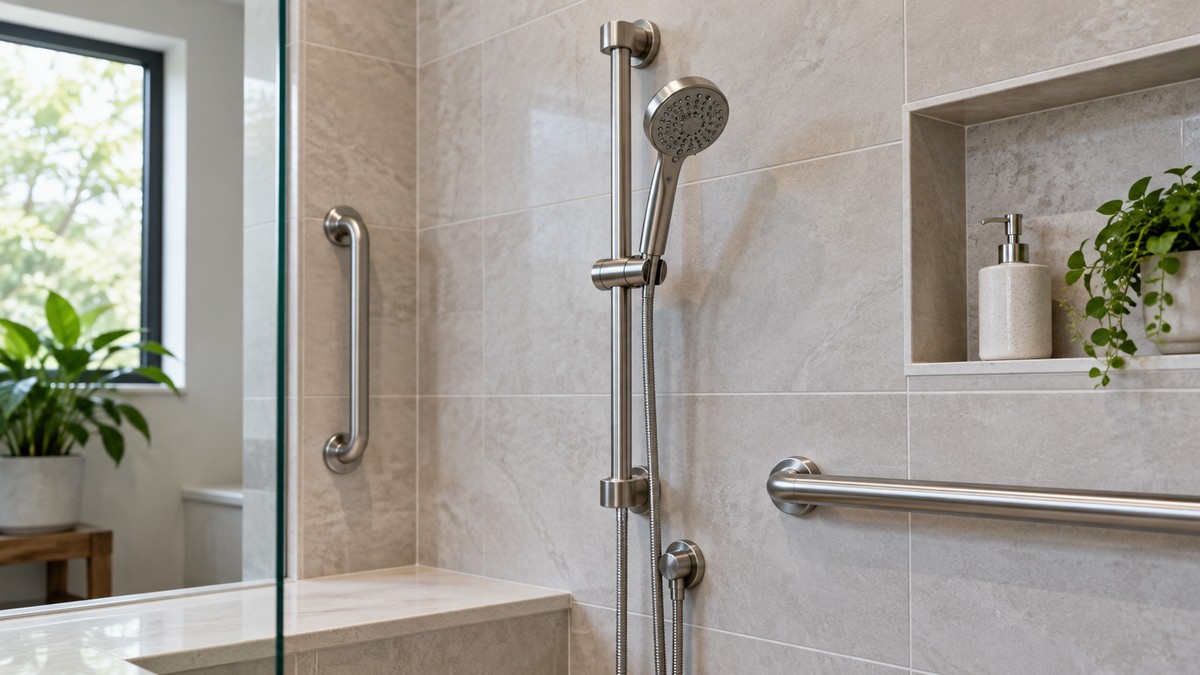
A slide bar is a vertical rail on which the hand-held unit can move up and down. That is useful because it lets the unit sit high for a standing user and low for a seated one. The standard permits this design. Section 608.6 says that “If an adjustable-height shower head on a vertical bar is used, the bar shall be installed so as not to obstruct the use of grab bars.” The bar is therefore allowed, but its position is limited by the grab bars that are already in the shower.
Adjustable bars and grab bars
The Access Board guide states the trade-off directly. Vertical bars with adjustable heights “offer more options for using it in a fixed position and are permitted, but they also may result in the hand-held unit being out of reach unless it is returned to a lower position.” In practice, this means a user who raises the head for a taller person may leave the unit out of reach for the next person. The Board’s answer is that shower spray units should be returned to a lower position so that they remain within accessible reach for other users.
Clearance above the grab bar
The guide describes a clearance zone above a grab bar. Controls and a hand-held unit may sit within that zone, but the bar must still leave room for the grab bar to work. The Access Board text says the vertical bar “must be at least 1½″ above the top gripping surface”, and that it “cannot extend behind the grab bar.” It also states that the bar “cannot obstruct use of grab bars.” A slide bar mounted on a wall where the grab bar runs should be measured on site before it is installed.
Checklist before you buy
Use this list with the manufacturer’s specification in hand. Each point comes from the sources above. If a point is not stated in the document, record it as unverified and do not assume it.
- Hose length: at least 59 inches, as stated in the specification.
- Hand-held unit: can be used in a fixed position as well as by hand.
- Reach: the unit can be placed within 48 inches above the shower floor for the user.
- On/off control: a non-positive shut-off, not a full shut-off valve on the unit.
- Bar position: the bar does not obstruct a grab bar and leaves at least 1½ inches above the top gripping surface.
- Water temperature: the shower delivers water at 120°F maximum at the bathtub or shower, as the Access Board guide states.
- Installation: the bar and its brackets are fixed to a wall that can take the load, using hardware the manufacturer supplies.
The checklist covers the rules that the sources state. It does not test the product, and a manufacturer’s claim of compliance is not a certification.
What we could not verify
The sources checked for this guide do not state a minimum or maximum height for the slide bar itself, so no bar height is given here. They do not state the load a bracket can carry, so we give no weight rating. They do not state a maximum bar length, and we do not claim one. The guide’s reference to a 12-inch clearance above a grab bar comes from the Board’s text on controls and hand-held units, and we did not confirm how that clearance applies to every bar design. We did not verify whether any named product is compliant, and no product is named here. Local building codes can add rules beyond the federal standard, and we did not check any state or city code.
FAQ
Does the ADA require a slide bar?
No. The sources checked require a hand-held shower spray unit at accessible showers, with a hose of at least 59 inches, a non-positive shut-off, and reach within 48 inches. A slide bar is one way to position the unit, and the standard allows it on the conditions described above.
Is a 60-inch hose enough?
The standard minimum is 59 inches, so a 60-inch hose meets it. Check the length in the specification, because listing titles and guides are not always exact.
Can the bar sit above the grab bar?
The Access Board text allows a vertical bar in the clearance zone above a grab bar, but the bar must not obstruct the grab bar, must leave at least 1½ inches above the top gripping surface, and cannot extend behind the grab bar.
What is a non-positive shut-off?
It is an on/off control that reduces or stops the flow without fully closing the supply, so the main shut-off is still needed to stop the water completely. The Access Board describes it as a control that “does not completely stop the flow of water.”
Does this guide cover water flow rates?
Only in the narrow sense of the WaterSense specification, which covers hand-held showers and sets a maximum rated flow. That specification is not an accessibility rule, and this guide does not use it to judge any product.
Related guides
- Best ADA-Compliant Shower Slide Bar: 5 Options Compared
- Shower Arm Extensions Compared: Fit, Height and Finish (12 Listings)
- Shower Arms and Slide Bars Compared: 2 Listed Picks