ADA Grab Bar Load Strength: What the 2010 Standard Requires
As an Amazon Associate we earn from qualifying purchases.
The ADA grab bar load strength rule is not a weight limit printed on a bar. The 2010 ADA Standards for Accessible Design set a force that a grab bar, its fasteners, its mounting device and the wall behind it must be designed to survive, and they describe where that bar must sit, how thick it must be and how it must be fixed. This article walks through the parts of the standard that decide strength, quotes the text word for word, and explains what the numbers do and do not tell a buyer or installer.
Quick answer
- The strength test is in section 609.8: a 250 pound (1112 N) force applied at any point on the bar, fastener, mounting device or supporting structure must not exceed allowable stresses.
- Mounting height is 33 to 36 inches above the finish floor, measured to the top of the gripping surface (section 609.4).
- The wall space is 1 1/2 inches (section 609.3), and a round bar has an outside diameter of 1 1/4 to 2 inches (section 609.2.1).
- The bar must not rotate within its fittings (section 609.6).
- The standard sets a design force, not a body weight rating.
How we chose
Every figure here comes from one source: the 2010 ADA Standards for Accessible Design published by the Department of Justice on ADA.gov. The section numbers are the ones printed in that text. The 2010 Standards are the federal technical standard for newly designed, newly constructed and altered facilities under Titles II and III of the Americans with Disabilities Act, and the text says so directly. Local building codes can add to these requirements or differ from them, so a shower job should be checked against the code that applies to the building.
What the standard covers
The starting point is the scope section. The standard says that “All areas of newly designed and newly constructed buildings and facilities and altered portions of existing buildings and facilities shall comply with these requirements.” That sentence applies to new work and altered areas, which is why a grab bar in a remodeled bathroom can fall under the standard even when the rest of the house does not. The introduction describes the purpose of the rules as making facilities “readily accessible to and usable by individuals with disabilities.”
The standard sorts shower grab bars by the type of shower. Section 608.3 begins with a general rule: “Grab bars shall comply with 609 and shall be provided in accordance with 608.3.” In other words, section 608.3 decides where bars are required for each shower type, and section 609 decides how the bar itself must be built. Load strength belongs to section 609, which is the part this article focuses on.
Residential units have their own rule. Section 233.1 sends residential facilities to section 233: “Facilities with residential dwelling units shall comply with 233.” Section 608.3 also includes an exception for residential dwelling units. The exception says that “In residential dwelling units, grab bars shall not be required to be installed in showers located in bathing facilities provided that reinforcement has been installed in walls and located so as to permit the installation of grab bars complying with 608.3”. A homeowner who only reinforces the wall for a future bar is therefore covered by that exception under the text, but the reinforcement itself has to be placed where a compliant bar could later go.
The 250 pound force test
The strength requirement is in section 609.8, titled Structural Strength. It reads in full: “Allowable stresses shall not be exceeded for materials used when a vertical or horizontal force of 250 pounds (1112 N) is applied at any point on the grab bar, fastener, mounting device, or supporting structure.”
That sentence contains four things a buyer should understand. First, the force is 250 pounds, given in both pounds and newtons (1112 N). Second, the force can be vertical or horizontal. Third, it can be applied at any point along the bar, so the weakest spot counts, not the middle. Fourth, the test is not limited to the bar. It covers the fastener, the mounting device and the supporting structure, which means the wall framing, blocking or backing behind the bar is part of the load path.
The phrase that matters most is “Allowable stresses shall not be exceeded”. The standard does not say how to calculate those stresses, and it does not name a specific anchor, blocking size or bar material. It sets the performance result and leaves the engineering method to the designer and the local code. For that reason a product label that says a bar is rated for a certain weight is not the same thing as the section 609.8 test. A label may describe a manufacturer’s own test, and the standard text is silent on that number. If the bar will be mounted into a wall, the backing matters as much as the bar, because the standard counts the supporting structure in the force path.
The standard also does not describe the force as a body weight. A person leaning or pulling on a bar does not apply a single neat load at one point. The 250 pound figure is a design value that the bar and its support must resist. It is not a promise that a bar can hold any user, and it is not an instruction to lean on a bar to test it. The text gives no body weight rating, so any claim that a bar supports a particular person’s weight goes beyond what section 609.8 says.
Mounting height, spacing and fittings
Strength is only one part of a bar that works. Shower slide bars face the same height and grip questions, and our ADA compliant shower slide bar guide covers that product type. Section 609.4 sets the height: grab bars “shall be installed in a horizontal position, 33 inches (840 mm) minimum and 36 inches (915 mm) maximum above the finish floor” measured to the top of the gripping surface. The height is measured to the top of the gripping surface, so a bar mounted at the right centerline can still be out of range if the grip is thicker than the drawing assumes.
The standard also says how much tolerance applies to such a range. The advisory note to section 104.1.1 gives the example of section 609.4 and states that “the range provides an adequate tolerance and therefore no tolerance outside of the range at either end point is permitted.” A bar set at 32 inches or 37 inches therefore does not satisfy the range by being close. An installer who wants a bar to land inside the range should aim for the middle of the 33 to 36 inch band and check the top of the gripping surface after the fixture is installed.
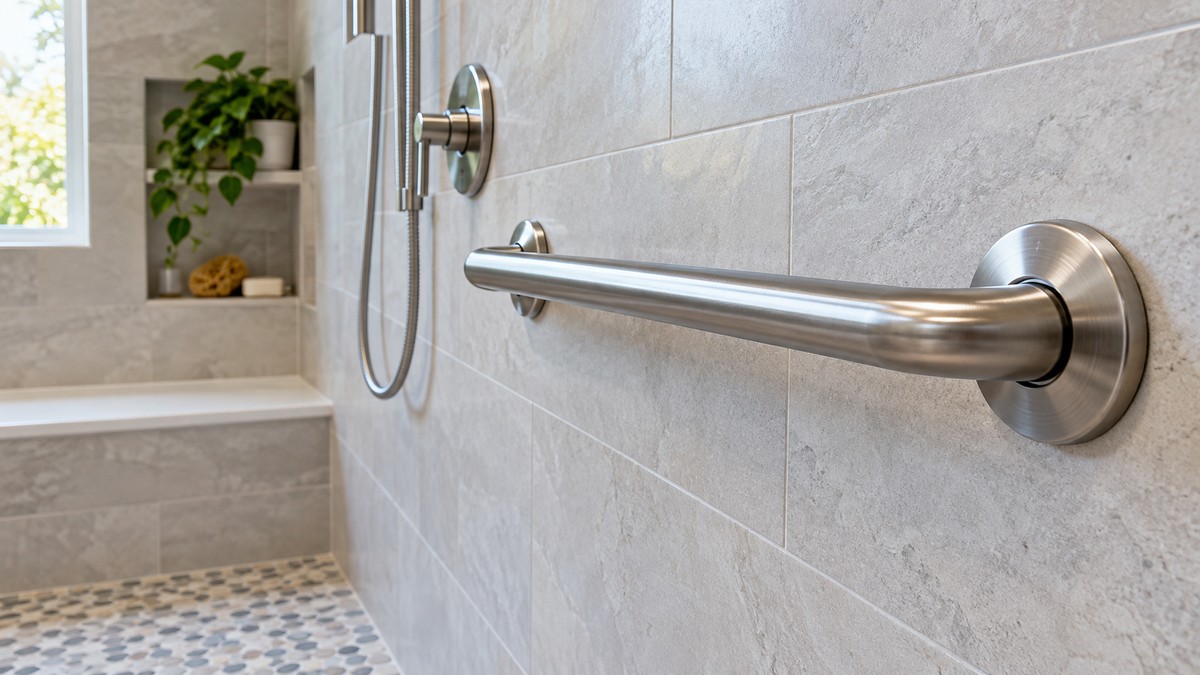
Spacing from the wall is set in section 609.3, which says “The space between the wall and the grab bar shall be 1 1/2 inches (38 mm).” The same section sets a clearance from objects below and at the ends and a larger clearance above. Those spaces keep a hand from being pinched or trapped, and they keep a bar from being blocked by a soap dish, a shelf or a faucet handle.
The bar’s cross section is covered by section 609.2. For a round bar, the text says that “Grab bars with circular cross sections shall have an outside diameter of 1 1/4 inches (32 mm) minimum and 2 inches (51 mm) maximum.” Non-circular bars use a different rule in section 609.2.2, with a cross-section dimension of 2 inches maximum and a perimeter between 4 and 4.8 inches. A bar that is too thick or too thin for the grip can fail the grip requirement even when it holds the 250 pound force.
Section 609.6 adds a simple rule that affects strength in practice: “Grab bars shall not rotate within their fittings.” A bar that turns under a hand is not a bar that resists the force in section 609.8, so a loose flange, a slipping set screw or a spinning sleeve is a failure, not a cosmetic flaw.
Surfaces, installation and the shower walls
Section 609.5 requires that “Grab bars and any wall or other surfaces adjacent to grab bars shall be free of sharp or abrasive elements and shall have rounded edges.” That sentence covers the bar’s ends and the wall next to it. A bar can be strong and still be unusable if its end caps are sharp, if the finish is abrasive, or if a tile edge sits where a hand would grip.
Section 609.7 gives the installation rule: “Grab bars shall be installed in any manner that provides a gripping surface at the specified locations and that does not obstruct the required clear floor space.” The text does not require a particular mounting pattern. It requires a usable grip at the specified height and a floor area that stays clear. A bar that sits in the way of a required clearance has not met this rule even if the bar itself is strong.
Shower layout decides where bars must be fixed. For a transfer type shower, section 608.3.1 says that “grab bars shall be provided across the control wall and back wall to a point 18 inches (455 mm) from the control wall.” For a standard roll-in shower with a seat, section 608.3.2 says that “Where a seat is provided in standard roll-in type shower compartments, grab bars shall be provided on the back wall and the side wall opposite the seat. Grab bars shall not be provided above the seat.” Section 608.3.2 also requires that “Grab bars shall be installed 6 inches (150 mm) maximum from adjacent walls”, which sets the distance from a corner, not from the bar’s center.
Those rules matter for strength because the wall behind the bar is part of the load path. A bar placed at the right height but in a wall with no blocking behind it does not meet the standard’s test, even if the hardware looks sturdy. The standard names the supporting structure in section 609.8, so backing should be planned before the tile goes up. The text does not say what the backing must be made of, which is a question for the designer and the local code.
Bathtub bars follow a related path. Section 607.4 says that “Grab bars for bathtubs shall comply with 609 and shall be provided in accordance with 607.4.1 or 607.4.2.” The bathtub rule adds its own placement, but the strength, cross section, spacing and surface rules of section 609 still apply.
Where the standard stops
For a shower-specific product comparison that follows the same placement logic, see our Ravinte vs. Gotega grab bar comparison. The 2010 Standards are a technical standard for covered facilities. Its text covers the design of grab bars, not the sale of bars at retail, and it does not rate any product. A buyer who reads “250 pounds” on the standard and then looks for a bar with a matching label is comparing two different things. The standard sets a design force for the installed assembly. A product sheet may give a different number from the manufacturer’s own test, and the standard does not endorse that number.
The standard also does not tell a homeowner which bar to buy. It does not name a brand, a finish or a fastener type. It does not give the depth of a stud, the thickness of a backer board or the screw length needed for a particular wall. Those choices depend on the wall, the code and the installer, and the text leaves them open. What the standard does provide is the result the installed assembly must reach.
Finally, the standard describes its dimensions as design values. Section 104.1.1 explains that “All dimensions are subject to conventional industry tolerances except where the requirement is stated as a range with specific minimum and maximum end points.” The 33 to 36 inch height in section 609.4 is a range with end points, so tolerance does not widen it. The 250 pound force in section 609.8 is a single value, and the advisory note explains that designers should not rely on tolerance to reach it. Build with margin, not at the edge of the number.
What to check before you buy or install
- Confirm the building type. The 2010 Standards cover state and local government facilities, public accommodations and commercial facilities, and the text says residential units follow section 233.
- Check the mounting height. Measure to the top of the gripping surface and keep the bar between 33 and 36 inches above the finished floor.
- Check the backing. Section 609.8 counts the fastener, the mounting device and the supporting structure, so confirm the wall can carry the force before the bar goes on.
- Check the grip. Section 609.2 limits the outside diameter of a round bar to 1 1/4 to 2 inches, and a non-circular bar has its own limits.
- Check the fittings and the edges. The bar should not rotate in its fittings, and the ends and the adjacent wall should have rounded edges with no sharp or abrasive elements.
- Check the local code. The standard says local codes can differ, and a permit office may require more than the federal technical text.
A shower grab bar is a small part of a bathroom, but the 2010 Standards treat it as a structural element. The strength rule in section 609.8 is simple to state and harder to meet in practice, because it depends on the wall behind the tile as much as on the bar. A careful installer checks the height, the spacing, the grip and the backing together, and checks the local code before the wall is closed.
What we could not verify
- Product load ratings, anchor types and backing materials. The saved text names the 250 pound test but not any product or fastener.
- Local building code amendments. The standard says local codes can differ.
- Requirements for facilities outside Titles II and III, which the saved text does not cover.
FAQ
Does the ADA set a weight limit for a grab bar?
No. Section 609.8 sets a 250 pound force test for the bar, fastener, mounting device and supporting structure. It does not state a body weight that the bar supports, and a product label that gives a rating is a separate claim.
Does this rule apply to a home bathroom?
Residential dwelling units follow section 233. The grab bar exception in section 608.3 applies in residential dwelling units when reinforcement has been installed in the walls so that compliant bars could be fitted later.
Can the strength test be checked by pulling on a bar?
The standard does not describe a hand test. Section 609.8 sets the design force, and the installer’s check is that the wall, fastener and bar are built for it.
Sources
- 2010 ADA Standards for Accessible Design, U.S. Department of Justice, ADA.gov: https://www.ada.gov/law-and-regs/design-standards/2010-stds/ (opened 2026-10-30). Sections cited: 104.1.1, 201.1, 233.1, 607.4, 608.3, 608.3.1, 608.3.2, 609.2, 609.3, 609.4, 609.5, 609.6, 609.7, 609.8.