Do Low-Flow Shower Heads Lose Spray Force?
As an Amazon Associate we earn from qualifying purchases.
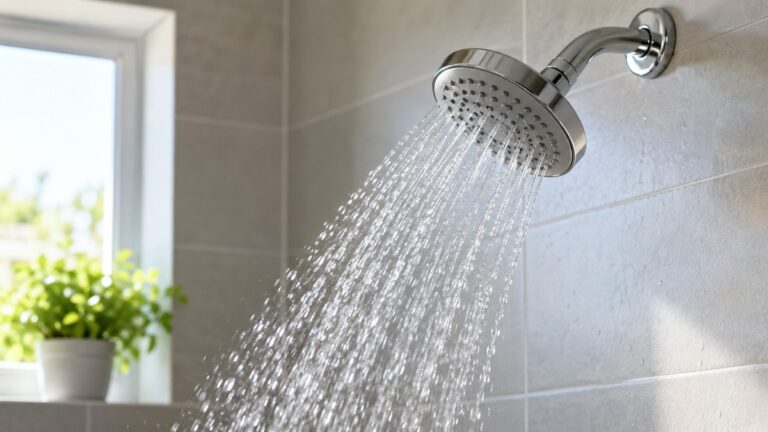
Do low flow shower heads lose spray force? Not by definition. Under EPA’s WaterSense specification, a labeled head must meet a minimum spray force, and that test is separate from its flow rate. The sources we opened do not say how any model feels in use. This guide explains the spray force test, the causes of weak spray that the sources describe, and what to check before you blame the head.
Quick answer
- A WaterSense labeled head must reach a minimum spray force of 2.0 ounces in EPA’s test, and flow is tested separately. A low flow rating alone does not show weaker spray.
- The sources do not say how any model feels in use, so a label cannot promise a strong spray for your shower.
- The causes of weak spray that the sources describe are mineral buildup in the nozzles, hard water, scale in pipes, and house pressure. Check those before you replace a head.
What spray force means in the WaterSense specification
EPA’s technical reference says minimum spray force is what most users refer to as shower pressure. It also says labeled products must be tested across a range of permissible service pressures to keep that minimum. The consumer page adds that spray force and spray coverage were the criteria that most influenced user satisfaction in EPA’s study. In everyday talk, “shower pressure” is a spray measure. It is not the water pressure in your pipes.
EPA says that when it began developing the specification, users generally had poor perceptions of early low-flow models. The criteria were set from the user study to exclude products that most users were dissatisfied with. The rule itself reads “The minimum spray force shall not be less than 2.0 ounces,” tested at 20 psi at the inlet while water is flowing.
How the spray force test works
The specification’s spray force procedure is in its Appendix A. It uses a force balance fixture, not a bucket. The table lists the set-up conditions the appendix gives.
| Test element | What the appendix says |
|---|---|
| Inlet water pressure | 20 psi, plus or minus 1, at the inlet while water flows |
| Water temperature | 100 degrees Fahrenheit, with a tolerance of 10 degrees |
| Distance to the force target | 18 inches, plus or minus 0.25 inch, from the faceplate |
| Flow duration | Water flows for at least one minute before the result is read |
| Pass condition | The fixture rotates within 0.1 degree of zero, or past it |
| Calibration | Balanced against a calibrated force gauge at the minimum force of 2.0 ounces, within 0.05 ounce |
The specimen is flushed first and connected to a smooth pipe. The spray is adjusted only with the head’s standard components, so that the centre of the spray lines up with the centre of the target. If the spray centre cannot reach the target, the head does not meet the criterion. This is a laboratory method. The sources do not describe a home method for spray force, and a bucket test measures gallons, not force.
Flow and spray force are tested separately
The flow rules sit in their own section. The maximum flow must be stated at or below 2.0 gpm, and the maximum is the highest value found across tests at 20, 45 and 80 psi. The spray force test is a different test with its own pass rule. A head can therefore carry a low flow rating and still have to pass the spray force rule. A low flow number on the box does not measure spray force.
The specification also says that if a head has more than one mode, every mode must meet the maximum flow, and at least one mode must meet all requirements as the manufacturer specifies. A head can have a strong mode and a weaker one. The sources do not explain how a maker picks the mode it names, so check the product sheet for that detail.
EPA’s consumer page says that WaterSense labeled heads provide a “satisfactory shower that is equal to or better than conventional showerheads on the market.” That is EPA’s statement about the label. It is not a comparison of how heads feel, and the sources we opened do not give one.
Spray coverage is a separate test
Coverage is a third check, and it is not a force test. The specification’s Appendix B places a set of annular rings under the head, 18 inches from the faceplate, and runs water at 45 psi at the inlet for at least one minute. The water collected in each ring is recorded as a share of the total. Section 5.1 sets two limits: no more than 75 percent of the water may land in the 2- and 4-inch rings combined, and at least 25 percent must land in the 2-, 4- and 6-inch rings combined.
Two points follow from the set-up. The coverage test runs at 45 psi, while the spray force test runs at 20 psi. And a head is checked against both criteria, so passing one does not show that it passes the other. The sources do not explain how the rings relate to what a bather feels. EPA’s consumer page describes coverage as checking that the stream is not too narrow or too wide.
Why spray weakens at home: symptom by cause
The sources describe several causes of weak spray. None of them is a laboratory spray force failure. Use the table to narrow the cause before you buy a new head.
| What you notice | What the sources say | What to check |
|---|---|---|
| Spray weakened over months | Naturally occurring minerals can build up and block the nozzles. The New Jersey guidance says shower heads need routine cleaning to operate at full capacity. | Look for mineral deposits in the nozzle holes. The same guidance suggests clearing clogged holes with a needle or straightened paper clip. |
| Whitish crust on the face of the head | A whitish buildup on the ends of faucets and shower heads is probably the most obvious sign of hard water (North Dakota State University). | The University of Nebraska extension says hardness can be approximated with a home-use water testing kit. |
| Weak at every outlet in the house | Scale in pipes can reduce water flow and pressure (Virginia Tech). The Oklahoma State irrigation sheet gives 40 to 60 psi as the ideal residential pressure. | Check house pressure and pipe scale. The irrigation sheet measures pressure at a hose bib, which is not a shower check. |
| Spray too narrow or too wide | Coverage is a separate WaterSense criterion, with its own ring-based limits. It is not the same as force. | The sources do not give a home coverage test. Compare the pattern across the shower area. |
| One setting feels weaker | Every mode must meet the flow maximum, and at least one mode must meet all requirements. | Test each mode and note which one feels weak. |
Start with the nozzles and the other outlets. If every outlet in the house is weak, the cause is more likely in the plumbing or the supply than in one head. If one head is weak and its nozzles are clogged, cleaning may restore the spray. The sources do not say how much a cleaning restores, or how often cleaning is needed.
What the packaging does and does not show
The marking clauses in the specification cover flow rate. They require the maximum flow in gpm and L/min on the product and packaging, and the minimum flow at 45 psi on the packaging. They do not list spray force. The clauses point to the ASME plumbing standard for other marking rules, and that standard is not among our sources. If spray force matters to you, the sources do not say where a maker must print it.
How we chose
We built this guide from eight sources, all opened on 2026-10-21 and listed at the end. A point went into the guide only when a source stated it. The specification gives the test rules, EPA’s consumer and technical pages give the purpose and the user study, and the university and state pages give the causes of weak spray at home. We did not rank heads or recommend a model, and the guide does not describe how any product feels.
What we could not verify: what the sources do not say
- How any WaterSense head feels in use, or whether lower flow heads feel weaker. EPA’s pages describe criteria, not comparisons of how heads feel.
- Spray force at pressures other than 20 psi. The spray force rule is stated at 20 psi at the inlet.
- A home method for spray force. The specification uses a calibrated force balance fixture.
- A spray force result for any model. The sources give the minimum, not measured results.
- The specification version. The text in our sources is Version 1.0, dated March 4, 2010. EPA’s consumer page says Version 1.1, released in July 2018, revised the spray force test protocol to accommodate water-efficient rain showers. Version 1.1 is not among the sources we opened.
- The ASME plumbing standard that the specification refers to, which is not in our sources.
- The cause in any particular home. The sources list possible causes, not a diagnosis.
- A cleaning schedule for nozzles. The New Jersey guidance says routine cleaning but gives no schedule.
Frequently asked questions
Will a WaterSense shower head feel weaker than a standard one?
The sources do not say how any head feels to a given user. They do say that a labeled head must meet a 2.0 ounce spray force minimum and a 2.0 gpm flow maximum, and EPA states that the label means a satisfactory shower. If you are comparing water-efficient handheld models, see our list of water-efficient handheld heads.
What is the minimum spray force?
The WaterSense specification sets a minimum of 2.0 ounces, which it gives as 0.56 newtons. The figure is measured at 20 psi at the inlet with water flowing, using a force balance fixture calibrated to that force.
Is spray force the same as water pressure?
No. EPA’s consumer page puts “pressure” in quotes when it describes spray force, and the technical reference calls spray force what most users refer to as shower pressure. Water pressure is a property of your plumbing and is measured in psi. The spray force test sets its own inlet pressure of 20 psi. If you are looking at a high-pressure handheld model in particular, our review of one high-pressure handheld is a starting point.
Can I test spray force at home?
Not with the sources we have. The spec uses a force balance fixture, a calibrated force gauge, a target 18 inches from the faceplate, and at least one minute of flow. A bucket measures gallons, so it cannot give a spray force result.
Why did my shower lose spray over time?
The most direct cause in the sources is mineral buildup. Naturally occurring minerals can build up and block the nozzle holes, and New Jersey guidance says routine cleaning keeps a shower head working at full capacity. Hard water can also leave a whitish crust. Scale in pipes can reduce flow and pressure throughout the house, so check the nozzles first, then the other outlets.
Did the spray test change for rain showers?
EPA’s consumer page says Version 1.1 of the specification revised the spray force test protocol, through a reference to the ASME plumbing standard, to accommodate water-efficient rain showers. The text in our sources is Version 1.0, and the sources we opened do not describe that change in detail. For a rain head, read the current version of the specification directly.
Should I replace a head that has weak spray?
Not until you have checked the cause. The sources point to mineral buildup in the nozzles, hard water, scale in pipes, and house pressure. Cleaned nozzles may restore the spray, and a weak result at every outlet points to the supply rather than one head. If the nozzles are clear, the other outlets look normal, and the spray still feels weak, replacing the head is a reasonable next step. The sources do not say which replacement will feel better. For labeled options, check the flow markings on the packaging, and see our water-efficient handheld list for models to compare.
Does a low flow rating mean low spray force?
No. The flow rating and the spray force result come from separate tests in the specification, and each has its own limit a labeled head must meet. The sources do not say which combination feels best. If you want a head built for a stronger spray that also saves water, our guide to high-pressure heads that also save water is the next place to look.
Bottom line
Treat weak spray as a cleaning and pressure question first. Replace the head only after the nozzles are clear and the other outlets in the house look normal.
Sources
- EPA, WaterSense Specification for Showerheads, Version 1.0 (March 4, 2010), including Appendix A. https://www.epa.gov/sites/default/files/2017-01/documents/ws-products-spec-showerheads.pdf (opened 2026-10-21)
- EPA, WaterSense: Showerheads (consumer page). https://www.epa.gov/watersense/showerheads (opened 2026-10-21)
- EPA, WaterSense Homes Technical Reference Manual 4: Showerheads Tech Sheet (July 2023). https://www.epa.gov/system/files/documents/2023-08/ws-homes-TRM-4-ShowerheadsTechSheet.pdf (opened 2026-10-21)
- New Jersey Department of Health, Guidance for Removing and Cleaning a Shower Head. https://nj.gov/health/cd/documents/topics/legion/ShowerHead_Cleaning_Guidance.pdf (opened 2026-10-21)
- North Dakota State University Extension, Water Softening (Ion Exchange). https://www.ndsu.edu/agriculture/extension/publications/water-softening-ion-exchange (opened 2026-10-21)
- Virginia Tech Extension, Hardness in Household Water, publication 442-664. https://www.pubs.ext.vt.edu/442/442-664/442-664.html (opened 2026-10-21)
- University of Nebraska-Lincoln Extension, Drinking Water: Hard Water, G1274. https://extensionpubs.unl.edu/publication/g1274/na/html/view (opened 2026-10-21)
- Oklahoma State University Extension, Managing Pressure in the Home Irrigation System (irrigation fact sheet). https://extension.okstate.edu/fact-sheets/managing-pressure-in-the-home-irrigation-system (opened 2026-10-21)