Water Pressure Above 80 PSI: What It Means for Showers
As an Amazon Associate we earn from qualifying purchases.
Water pressure above 80 psi is high enough that one extension fact sheet suggests considering a whole-house pressure regulator. This guide explains what that number means, how to take a reading at a hose bib, what high pressure can do to plumbing and sprays, and which steps need a licensed plumber. Two of the five sources are irrigation or farm pages, and the 80 psi figure comes from the irrigation sheet, so it is a general guide, not a plumbing code limit.
Quick answer
- The Oklahoma State University fact sheet gives about 40 to 60 psi as the residential figure. It suggests considering a whole-house regulator when pressure is more than 80 psi.
- In irrigation systems, high pressure can break components and turn the spray into a fine mist. The sources do not describe shower heads at high house pressure.
- Installing a whole-house regulator is plumbing work. The sheet says to contact a licensed plumber for it.
What 80 psi means in a house
Pressure is force per unit area, and psi (pounds per square inch) is the unit on a gauge. The Oklahoma State sheet gives about 40 to 60 psi as the target for residential water pressure, and says it can vary significantly based on location. The sheet is written for irrigation systems, so treat that range as a general residential figure.
At 80 psi, a house is above that range. The sheet names 80 psi as the point where a pressure regulation device for the entire house is worth considering, in order to protect the plumbing and appliances. It does not give a code limit, and the sources do not say what happens to fixtures at 70 psi or 90 psi.
The reading also depends on whether water is running. The sheet explains that the pressure of a fluid at rest is called static pressure. When water moves through a pipe, pressure drops along the pipe because of friction, and the pressure of moving water is called dynamic pressure. The sheet does not say whether the 80 psi threshold refers to static or running pressure, so take readings in the same state each time.
How to read your house pressure
The fact sheet recommends measuring at one of the hose bibs on the house as a first step when irrigation problems may come from pressure. Use the steps below. They follow the sheet’s method, which was written for irrigation and is adapted here for a house reading.
- Get a pressure gauge. Some gauges thread directly onto the hose bib, and others need an adapter.
- Attach the gauge to the hose bib and take the reading.
- Note the time of day. The sheet says pressure can vary through the day, and it asks for readings at the time the system runs. The sources do not say which hour is best for a house reading.
- Write down the number and compare it with the table below.
| Reading | What the sources say | Source |
|---|---|---|
| Under 25 psi or over 125 psi | Contact the utility department for further investigation | Oklahoma State sheet |
| About 40 to 60 psi | The residential figure; it can vary by location | Oklahoma State sheet |
| Between 60 and 80 psi | Not stated | Not stated |
| More than 80 psi | Consider a whole-house pressure regulation device; contact a licensed plumber | Oklahoma State sheet |
What high pressure does to plumbing and sprays
The sheet says high pressure causes a different set of problems. The first is possible damage: components can break if pressure becomes too high. The sheet says this is most likely where pipe is joined with a PVC fitting. It describes this for irrigation systems, not for household plumbing in general.
The second problem is lost efficiency. When pressure at a spray nozzle is too high, water leaves the nozzle as a fine mist instead of large droplets. The sheet says wind can carry that mist away, so it evaporates before it reaches the landscape. Shower heads are not covered by this statement, and the sources do not say whether a shower head mists at high pressure.
The sheet also shows that flow rises with pressure. In its example, a sprinkler designed for 30 psi gave an even spray at 3.3 gallons per minute. At 50 psi, the same sprinkler’s spray lost its uniform pattern and its flow rose to 4.8 gallons per minute. This is the irrigation example, and the sheet says flow rate and pressure are directly related.
| Sprinkler pressure | Flow (gallons per minute) | Spray pattern |
|---|---|---|
| 30 psi (the sheet’s optimum) | 3.3 | Evenly distributed |
| 50 psi (above the recommended range) | 4.8 | No longer uniform |
What a shower head is tested against
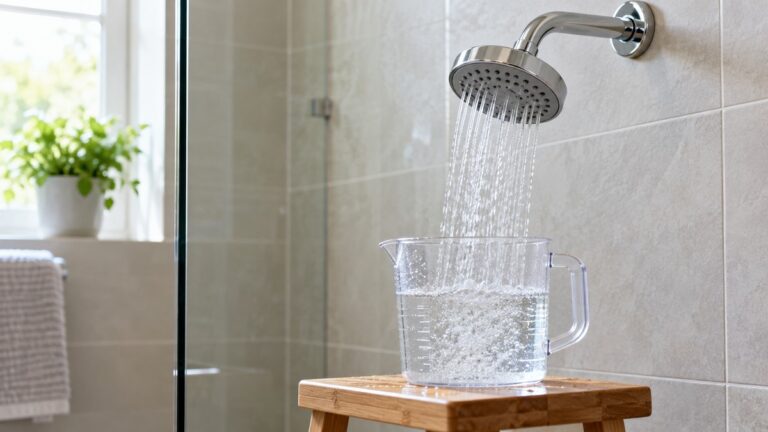
EPA’s WaterSense specification for showerheads does test heads at high pressure. A labelled head’s maximum flow is the highest value measured at flowing pressures of 20, 45 and 80 psi. That maximum may not exceed the rated value, which must be 2.0 gallons per minute or less. The lowest flow measured at 45 and 80 psi must be at least 75 percent of the rated maximum.
These tests show how a labelled head behaves when the test pressure is 80 psi. They do not say that a head is safe on a house supply at that pressure, and they do not say what a house supply is doing. The specification also sets a minimum spray force of 2.0 ounces at 20 psi, which is a different test point.
EPA’s consumer page says independently certified WaterSense showerheads must meet a pressure compensation criterion that ensures a minimum flow across a range of household water pressures. The page does not list that range. Pressure compensation of this kind is a head-level feature. It is not a house-level fix, and the sources do not describe a shower head lowering the pressure a house receives.
The U.S. Department of Energy page describes federal showerhead standards as water use standards that set a maximum flow rate. It also says the water use standards for showerheads have not been amended. The DOE page does not address household supply pressure, so its rules do not help with an 80 psi reading.
What to do when the reading is above 80 psi
The Oklahoma State sheet lists four options for high pressure. Only the first applies to the whole house: a pressure regulation device for the entire house, installed by a licensed plumber, to protect the plumbing and appliances inside the home. The other three are for irrigation equipment.
The other three options in the sheet are for irrigation equipment. One is a regulator at the irrigation connection point. Another is a pressure-reducing device on each zone’s control valve, which the sheet says needs at least a 15 psi reduction to work properly. The last is pressure-reducing spray heads. None of these is a shower head.
The sources do not say whether pressure-reducing shower heads exist, how they would work, or whether they would address a house above 80 psi. If the house reading is high, the next step described by the sources is the regulator, not a different head.
Two steps belong to different people. The homeowner takes the reading and records it. A licensed plumber does the regulator work, which the sheet describes as a plumbing project. The sources do not describe regulator sizing, installation steps, or how to choose between models.
Shower heads and valves: what the sources do show
Restrictions take pressure away downstream. The Alabama Cooperative Extension System ran a flow test on farm valves and hose bibs with the pressure regulator set to 40 psi. The team reports that the general rule is a pressure drop across a restriction, and that the higher the flow through a valve restriction, the greater the pressure drop. The test covered farm valves, not shower valves or heads, and the team says its flow figures are for demonstration only.
That general rule suggests that a restriction in a shower outlet would lower the pressure after it, not raise the supply. The sources do not test that for shower heads, so treat it as a principle, not a measured result.
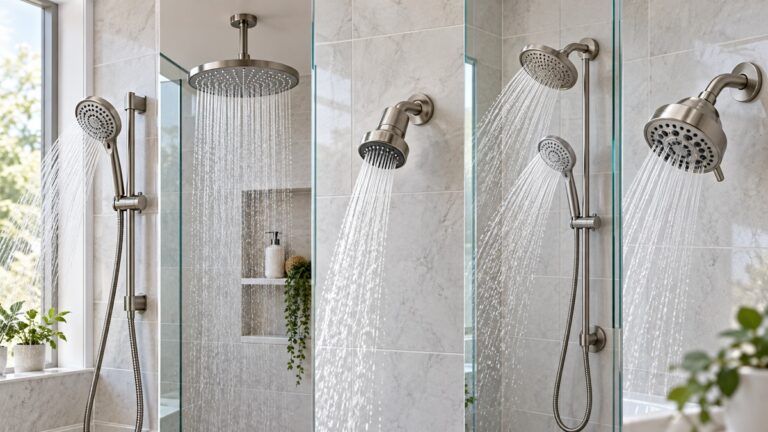
For a shower with a fixed head and a hand-held head on one unit, the EPA specification applies to each showerhead, and the whole device must meet the flow limit in every operating mode. A dual unit is covered by a separate guide on this site: the dual shower head with a slide bar roundup.
When the question is which heads use less water, the sources describe labelled heads with a 2.0 gallons per minute ceiling. For a comparison of water-saving heads with a high-pressure spray, see the water-saving heads with a high-pressure spray roundup. For hand-held choices, the water-efficient hand-held shower heads roundup covers that group, and one high-pressure hand-held model has its own page.
How we chose
This guide uses five sources, all opened on 2026-10-21. The Oklahoma State sheet is the only source that gives a pressure range and an 80 psi threshold, and it is an irrigation fact sheet, so its figures are labelled as general. The EPA specification and EPA consumer page describe showerhead tests at 80 psi and the pressure compensation criterion. The DOE page describes the federal showerhead standard. The Alabama test covers farm valves and is used only for the general pressure-drop rule. The guide does not rank products or methods.
What we could not verify: what the sources do not say
- A shower-specific pressure limit. The 40 to 60 psi and 80 psi figures come from an irrigation fact sheet and are general figures.
- Whether 80 psi refers to static or running pressure. The sheet does not say.
- What to do at a reading between 60 and 80 psi. Not stated.
- Whether a shower head can reduce house supply pressure. No opened source says so.
- Whether pressure-reducing shower heads exist or work. Not stated.
- Regulator sizing, installation steps, and how to choose a model. Not stated.
- Whether high house pressure shortens the life of a hose or head. Not stated.
- Whether damage risk at PVC joints applies to household plumbing. The sheet describes it for irrigation systems.
Frequently asked questions
Is 80 psi too high for a house?
The Oklahoma State sheet gives 40 to 60 psi as the residential figure and says to consider a whole-house regulator above 80 psi, to protect the plumbing and appliances. It is an irrigation fact sheet, so it is not a code limit. The sources do not say what fixtures do at 70 or 90 psi.
Will a high-pressure shower head fix high house pressure?
None of the opened sources says so. The EPA specification tests heads at 20, 45 and 80 psi and sets maximum flow limits, but it does not describe a head lowering the pressure the house receives. The regulator is the option the sheet describes for a house above 80 psi.
Can high pressure damage pipes or appliances?
The sheet says irrigation components can break if pressure becomes too high, most likely where pipe is joined with a PVC fitting. It also says a whole-house regulator protects the plumbing and appliances inside the home. The sources do not give a failure rate or a time to damage.
How do I measure house pressure without a plumber?
Use a pressure gauge at a hose bib. The sheet says some gauges thread directly onto the bib and others need an adapter. Note the time of day, because pressure can vary, and compare the reading with the ranges above.
What should I do between 60 and 80 psi?
The sources do not say. The Oklahoma State sheet gives a range of 40 to 60 psi as residential and a suggestion to consider a regulator above 80 psi, but it does not address readings between those two points.
Who installs a whole-house regulator?
The sheet says to contact a licensed plumber for a whole-house pressure regulation device. The homeowner’s part is the reading and the record of it. The sources do not describe installation steps or regulator choice.
Bottom line
If a hose bib reading is above 80 psi, have a licensed plumber assess a whole-house regulator before you change any shower heads. At or below 80 psi, the sources give no pressure action for showers, so compare heads by their flow ratings and spray specifications instead.
Sources
- Oklahoma State University Extension, Managing Pressure in the Home Irrigation System, HLA-6617. https://extension.okstate.edu/fact-sheets/managing-pressure-in-the-home-irrigation-system (opened 2026-10-21)
- U.S. EPA, WaterSense Specification for Showerheads, Version 1.0 (PDF, March 4, 2010). https://www.epa.gov/sites/default/files/2017-01/documents/ws-products-spec-showerheads.pdf (opened 2026-10-21)
- U.S. EPA, WaterSense: Showerheads (consumer page). https://www.epa.gov/watersense/showerheads (opened 2026-10-21)
- U.S. Department of Energy, Showerheads (program page). https://www.energy.gov/eere/buildings/showerheads (opened 2026-10-21)
- Alabama Cooperative Extension System, Do Your Valves and Hose Bibs Restrict Water Capacity? https://www.aces.edu/blog/topics/farming/do-your-valves-and-hose-bibs-restrict-water-capacity/ (opened 2026-10-21)