How to Clean a Shower Curtain Liner, Including Mold
As an Amazon Associate we earn from qualifying purchases.
This guide explains how to clean shower curtain liner, and the right method depends on what the liner is made of. Wipe a PEVA liner, scrub visible mold off with detergent and water, and dry the liner completely with it fully open. Put a liner in the washing machine only if it is a fabric liner and its sewn-in care label says it can be washed. The sources we opened do not give a washing machine setting, a bleach ratio, or a vinegar method for liners, so this guide does not give one either.
Quick answer
- Check the material first. The packaging or product page names PEVA, vinyl, or fabric.
- For mold, scrub with detergent and water, then dry the liner completely. The EPA gives this method for hard surfaces.
- Machine wash only fabric liners, and only as the sewn-in care label directs. The brand FAQ says PEVA liners are recommended to wipe clean.
- Hang the liner fully open so it can air dry, and keep the bathroom ventilated to slow mold from coming back.
Start by identifying the liner material
The brand site we opened lists recycled PEVA liners, PEVA liners, vinyl shower liners, fabric shower liners, waterproof fabric liners, and recycled fabric liners as separate product types. The page does not explain how to tell them apart by sight, so check the packaging or product description before you pick a cleaning method.
The brand FAQ gives the main cleaning split. For PEVA it says: “PEVA liners, curtains and tub mats are recommended to wipe clean.” For fabric it says: “Most fabric liners are machine washable.” It then points to the label: “Please see your sewn in care label for machine washing instructions.” Vinyl is the gap. The FAQ does not discuss vinyl liners, and the EPA pages discuss mold on surfaces in general. For a vinyl liner, the sources we opened give no specific cleaning method.
Step 1: Fix the water problem first
Mold grows where there is moisture, so cleaning a liner without changing how it dries will not stop the problem. The EPA says: “Fix plumbing leaks and other water problems as soon as possible.” Its brief guide adds: “If wet or damp materials or areas are dried 24-48 hours after a leak or spill happens, in most cases mold will not grow.” That sentence is about leaks and spills. The sources do not say how long a shower liner can stay damp before mold forms, so read the 24-to-48-hour figure as a general limit, not a rule for liners.
The brand’s drying advice points the same way. Its FAQ says: “In order to reduce the accumulation of mildew, fully extend your shower liner so it is fully open to air dry.” That implies a bunched-up liner stays damp longer than one that is spread open. The sources do not measure drying time, so the practical reading is to open the liner fully after each shower.
Step 2: Protect yourself before you scrub
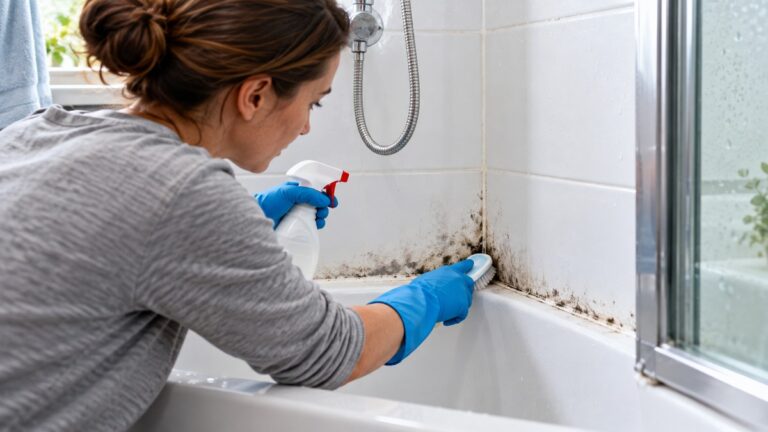
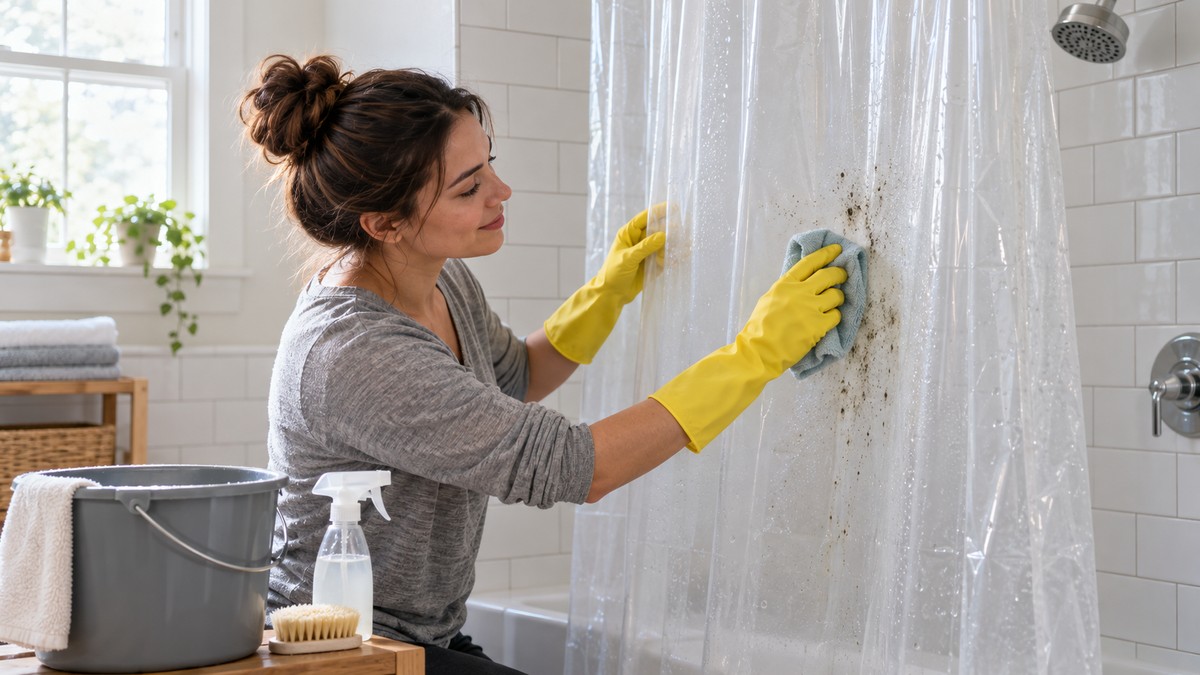
Mold can cause allergic reactions, so the EPA includes basic protection. “Avoid touching mold or moldy items with your bare hands.” For mild cleaning, “When working with water and a mild detergent, ordinary household rubber gloves may be used.” If you use a disinfectant, bleach, or a strong cleaner, the EPA says to “select gloves made from natural rubber, neoprene, nitrile, polyurethane or PVC”. It also recommends goggles: “Goggles that do not have ventilation holes are recommended.”
The EPA brief guide says you “may want to wear an N-95 respirator” when cleaning moldy areas, and that the respirator “must fit properly”. It presents this as an option, not a requirement, and it does not say whether a small patch on a liner needs one.
Step 3: Scrub the mold off
The main EPA method is short: “Scrub mold off hard surfaces with detergent and water, and dry completely.” The sources we opened do not say whether a shower liner counts as a hard surface, or whether this method suits every liner material. Use it together with the material check at the start of this guide.
Some materials may not clean up fully. The EPA says “Absorbent or porous materials, such as ceiling tiles and carpet, may have to be thrown away if they become moldy.” It adds: “Mold can grow on or fill in the empty spaces and crevices of porous materials, so the mold may be difficult or impossible to remove completely.” The sources do not say whether a liner fabric is porous. If the mold will not come off after one careful cleaning, the EPA note suggests replacement may be the only full fix. Expect some marks to remain: “Please note that mold may cause staining and cosmetic damage.”
Step 4: Dry it completely
Drying decides whether the cleaning lasts. The EPA says “Dry all items completely.” The brand says to hang the liner fully open. Neither source gives a drying time for a shower liner. The 24-to-48-hour figure is for water-damaged items, so it is the closest number the sources give but does not describe a routine shower liner. Avoid folding or bunching the liner while it is wet, and keep the bathroom ventilated while it dries.
Step 5: Check the result
The EPA treats cleanup as finished only when the problem is gone. Its brief guide says: “Visible mold and moldy odors should not be present.” Check the liner again after it has dried, for returning spots or an odor. The sources do not set a time for that check. If mold returns in the same place, look for the moisture source again, because cleaning the mold does not fix a water problem.
Machine washing a liner
The brand FAQ says “Most fabric liners are machine washable.” It sends you to the label sewn into the product. We did not open any product’s care label. The sources we opened do not give a washing machine setting, a water temperature, a wash cycle, or a detergent amount for any liner. If the label gives none of those, this guide does not supply them. Do not put a PEVA liner in the washer on the strength of this guide, because the brand’s only cleaning method for PEVA is to wipe it.
Bleach: what the EPA says and does not say
The EPA says: “The use of a chemical or biocide that kills organisms such as mold (chlorine bleach, for example) is not recommended as a routine practice during mold cleanup.” It allows for exceptions when “immune-compromised individuals are present”, and it says that “in most cases, it is not possible or desirable to sterilize an area; a background level of mold spores will remain”. Drying and ventilation do more than killing every spore.
If bleach is used at all, the EPA sets two firm rules. Ventilate the room, since the EPA says to “always ventilate the area and exhaust the air to the outdoors.” And “Never mix chlorine bleach solution with other cleaning solutions or detergents that contain ammonia because toxic fumes could be produced.” The EPA pages we opened do not give a bleach-to-water ratio, and neither does the brand site. This guide does not give one. It also has no source for mixing bleach with any other household product, so it offers no advice on that.
Vinegar: what the sources do not say
Readers often ask about vinegar for liners. None of the six pages we opened gives a vinegar method for shower liners, a ratio, a soak time, or any statement on whether vinegar is safe for PEVA, vinyl, or fabric. That is a gap in the sources, not a finding that vinegar works or fails, so this guide does not recommend it.
Keep mold from coming back
The EPA says: “Places that are often or always damp can be hard to maintain completely free of mold.” For bathrooms it advises that “increasing ventilation (running a fan or opening a window) and cleaning more frequently will usually prevent mold from recurring, or at least keep the mold to a minimum.”
The brief guide also gives a home humidity target: “keep indoor humidity below 60 percent (ideally between 30 and 50 percent)” relative humidity. A basic humidity meter can show whether the home stays in that range. The sources do not say how humid a bathroom gets during a shower, so treat the target as a guide for the whole home.
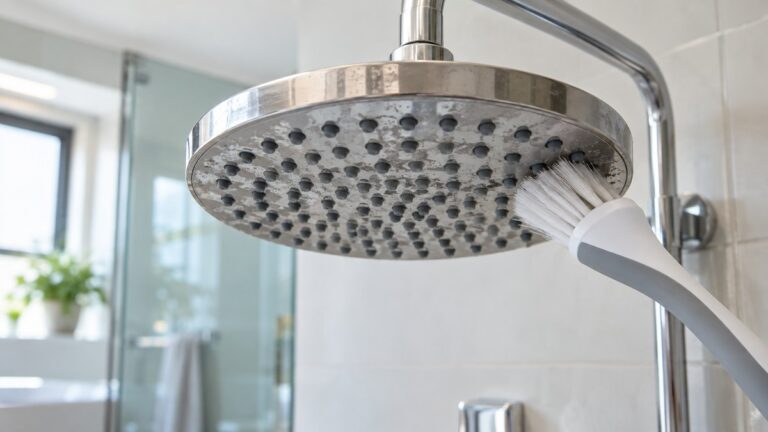
In practice that means opening the liner fully after each shower, running an existing fan or opening a window, and cleaning on a schedule you can keep. If mold is also on the shower head, our shower head cleaning steps cover that part of the shower. For a rain-style head with rubber nozzles, see care for rubber nozzles on a rain shower head.
Health: what the EPA says
The EPA says molds “have the potential to cause health problems”, and that “Inhaling or touching mold or mold spores may cause allergic reactions in sensitive individuals.” Allergic responses can include sneezing, a runny nose, red eyes, and skin rash, according to the EPA’s health page. The same page says “Research on mold and health effects is ongoing.” The sources do not describe any health effect specific to shower liners.
Dead mold is not a safe leftover: “Dead mold may still cause allergic reactions in some people, so it is not enough to simply kill the mold, it must also be removed.” If you have asthma, allergies, or another health concern, the EPA says to “consult a health professional before starting cleanup.”
When to stop and call for help
The EPA says that if “the moldy area is less than about 10 square feet” you can often handle the cleanup yourself. The sources do not say what size of mold patch on a liner would count as a problem, so the 10-square-foot line is a general figure for moldy areas. Call a professional when water came from a source other than clean water. The EPA says: “If the water and/or mold damage was caused by sewage or other contaminated water, then call in a professional”.
How we chose
This guide uses six pages, all opened with curl on 2026-10-23. Four are US Environmental Protection Agency pages on mold cleanup, mold and moisture, bleach, and mold health. Two are pages from a shower liner brand: its FAQ and its shower liner category page. We did not use retail listings, blog posts, or search snippets for cleaning steps, and we did not compare liner brands.
For each page we looked for what it says about cleaning mold off a surface, which materials it names, what it says about bleach and other chemicals, and what it says about drying and humidity. Where a page gave a number, we kept it only if the page itself gave it. The EPA pages are general to mold in homes. The brand pages describe that brand’s liners. We also opened a 1985 Michigan State extension publication on household cleaners. It is marked as an archive copy not for current use, so this guide does not use it for any step.
What we could not verify: what the sources do not say
- A bleach-to-water ratio. None of the EPA pages gives one, and the brand pages do not mention bleach.
- A washing machine setting, water temperature, wash cycle, or detergent amount for any liner.
- A vinegar method, ratio, or soak time for a shower liner.
- A cleaning method for vinyl shower liners.
- Whether a liner fabric counts as porous under the EPA’s guidance.
- A drying time for a shower liner. The 24-to-48-hour figure is for water-damaged items.
- How long a liner lasts before it should be replaced.
- Any health effect specific to mold on a shower liner.
- What the care label on any particular liner says.
Frequently asked questions
Can I put a shower curtain liner in the washing machine?
Some can. The brand FAQ says “Most fabric liners are machine washable.” It tells you to follow the sewn-in label. PEVA liners are recommended to wipe clean, so do not wash a PEVA liner in the machine on the strength of this guide. The sources give no machine setting.
What cleans mold off a shower curtain liner?
The EPA method is to scrub mold off with detergent and water, then dry the surface completely. The sources do not say whether this suits every liner material, so check the label first. Bleach is not a routine step under EPA guidance.
Is vinegar safe for a shower curtain liner?
The sources we opened do not say. None of the pages gives a vinegar method or ratio for liners, so this guide does not recommend vinegar.
How do I stop mold from coming back on a liner?
Open the liner fully so it can air dry, keep the bathroom ventilated, and clean more often. The EPA also gives a home humidity target of below 60 percent. If mold returns in the same place, look for the moisture source.
Is mold on a shower liner dangerous?
The EPA says mold has the potential to cause health problems, and that inhaling or touching it may cause allergic reactions in sensitive people. Research on mold and health effects is ongoing. If you have health concerns, consult a health professional before cleanup.
Bottom line
Identify the liner material before you clean it. Wipe PEVA, scrub mold off with detergent and water, and dry the liner fully open. Machine wash a fabric liner only as its sewn-in label says. Bleach is not a routine step under EPA guidance, and the sources give no bleach ratio and no vinegar method for liners, so this guide gives neither.
Sources
- US EPA, Mold Cleanup in Your Home: https://www.epa.gov/mold/mold-cleanup-your-home (opened 2026-10-23)
- US EPA, A Brief Guide to Mold, Moisture and Your Home (web version): https://www.epa.gov/mold/brief-guide-mold-moisture-and-your-home (opened 2026-10-23)
- US EPA, Should I Use Bleach to Clean Up Mold?: https://www.epa.gov/mold/should-i-use-bleach-clean-mold (opened 2026-10-23)
- US EPA, Mold and Health: https://www.epa.gov/mold/mold-and-health (opened 2026-10-23)
- Zenna Home, FAQs: https://zennahome.com/faqs/ (opened 2026-10-23)
- Zenna Home, Shower Liners: https://zennahome.com/our-products/shower-liners (opened 2026-10-23)