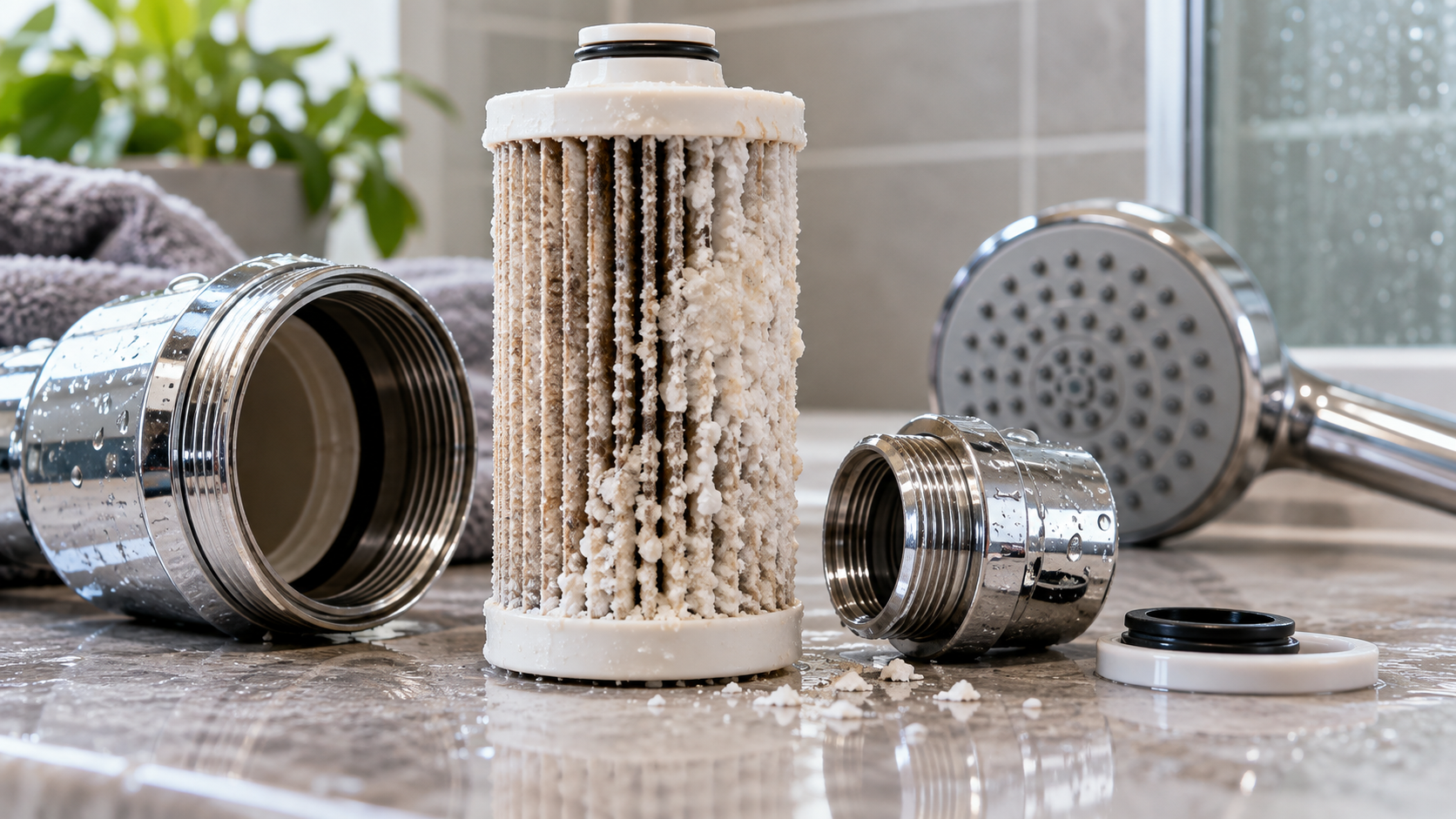
Why Your Filter Cartridge Has Mineral Buildup—Checks in Order
As an Amazon Associate we earn from qualifying purchases.
Why a filter cartridge has mineral buildup usually comes down to one of three things: dissolved hardness minerals precipitating as scale, suspended sediment being trapped as intended, or a cartridge that has stayed in service beyond its model-specific capacity. Do not buy a replacement solely because the surface looks chalky. First identify where the deposit sits, whether shower flow changed, and whether the same residue appears elsewhere. Those observations separate a cartridge issue from a supply-water issue and a simple gasket or housing problem.
Quick answer
- Check the deposit without dismantling the cartridge: chalky crust near hot-water fixtures points toward hardness scale; loose grit or rust-colored particles point toward sediment in the supply.
- Compare current flow with the cartridge’s replacement schedule. One Aquasana shower-filter manual warns that a clogged cartridge can restrict flow or contribute to leaking.
- Inspect only user-serviceable seals and connections described in the manual. Stop if the leak comes from the wall, a concealed valve, a cracked housing, or a connection that will not seal with correct hand-tightening.
Start with the pattern, not the cartridge color
A used cartridge is supposed to collect material, so discoloration by itself does not prove failure. The useful question is whether the material is a hard deposit created by the water chemistry, loose sediment caught by the filter, or residue at a leaking joint. Leave the cartridge in place for the first inspection. Turn the shower off, let the assembly cool, dry the outside, and use a bright light.
| What you see | Check next | What it may indicate |
|---|---|---|
| White or pale, hard crust | Look at the shower head, faucet aerators, and kettle or water-heater scale | Hardness minerals precipitating from the water |
| Loose tan grit | Check whether it appears after utility work or a well disturbance | Suspended sediment being captured |
| Orange-brown particles or staining | Compare cold-water fixtures and ask the water supplier about recent work | Iron-bearing sediment or corrosion products; appearance alone cannot identify the source |
| Residue only around a joint | Dry the fitting, run the shower, and watch the connection | A slow leak evaporating and leaving minerals behind |
| Darkened media with normal flow | Read the exact manual and replacement indicator | Normal captured material may be possible; color alone is not a service-life gauge |
The table is a sorting tool, not a laboratory identification. Color can overlap among sediment, pipe corrosion products, and filter media. If the material is oily, has an unusual odor, or appeared with a broader change in water quality, stop using appearance as the diagnosis and contact the water supplier or a qualified water-treatment professional.
Check 1: decide whether the symptom exists beyond the filter
Look for the same chalky deposit on the shower nozzles and other hot-water fixtures. North Dakota State University Extension explains that calcium and magnesium are the main contributors to hardness and that heated water can make calcium precipitate as scale. That makes a repeated white crust across several fixtures a supply-side clue. The cartridge may be where you noticed it first, but it is not necessarily where the condition began.
If scale is present throughout the home, replacing one shower cartridge may restore flow if that cartridge is clogged, but it will not remove the source minerals from the household supply. A shower filter also should not be described as a softener unless its certification and manual explicitly say it performs ion-exchange softening. For a fuller distinction, see our guide to hard water, shower filters, and actual softening. A home water test is more informative than repeatedly replacing cartridges early.
Check 2: compare hot and cold evidence
Scale often becomes easier to see where water is heated or repeatedly evaporates. Compare the shower residue with a cold-only faucet aerator if you can inspect that aerator without damaging it. Deposits concentrated at hot-water outlets support, but do not prove, precipitation related to heat. Similar grit at hot and cold outlets points more toward suspended material carried by the supply.
This comparison matters because the remedies are different. A sediment event may be temporary and worth discussing with the utility or well-service provider. Persistent hardness is a whole-supply water characteristic. A damaged shower-filter housing is a local component problem. Keep those categories separate before spending money.
Check 3: use flow change as the service clue
Run the shower at its usual control position and note whether flow is evenly reduced, pulsing, or normal. Do not remove a flow restrictor. A slow decline over weeks can fit a cartridge loading with captured material. A sudden change immediately after the housing was opened is more consistent with a misplaced gasket, an incorrectly seated cartridge, or incomplete flushing.
The Aquasana AQ-4100-family manual gives a concrete model example: it rates the replacement cartridge for 10,000 gallons and describes replacement at approximately six months. It also lists a clogged filter as a possible cause of slow flow or leakage. Those numbers belong to that family, not every shower filter. Use the interval printed for your model and shorten no interval merely because another brand uses a different capacity.
Turn a capacity rating into a usage check
If a manual gives gallons rather than months, estimate elapsed use instead of guessing from appearance:
Estimated gallons used = shower flow in GPM × shower minutes per day × days in service.
For example, a 2.0 GPM shower used for 16 total household minutes per day over 180 days would use about 5,760 gallons: 2.0 × 16 × 180 = 5,760. This is an estimate because actual flow, pause-button use, and daily shower time vary. Compare the result only with the rating for the exact cartridge.
Check 4: rule out a seal problem before blaming the media
Mineral residue around the outside of a housing can be the footprint of a tiny leak. Dry the filter body and each accessible connection completely. Run the shower while watching, not touching, the joints. A fresh bead of water at the collar points to sealing or alignment rather than proof that the cartridge media is exhausted.
Follow the product manual because seal designs differ. For the Aquasana example, the inlet uses a gasket and the manual says not to apply plumber’s tape to its threaded components. It calls for the gasket to sit flat and fully seated, hand-tightening first, and only a quarter turn with pliers if the tested connection still leaks. It also warns that overtightening can compress the gasket into the pipe and restrict flow. This is why generic advice to add tape or use more wrench force can create a second problem.
For a general fixture-side comparison, our guide to why shower heads collect mineral buildup explains how evaporation and small openings make deposits visible at the outlet.
Check 5: verify flushing and orientation after recent service
If the symptom began right after installation or cartridge replacement, reread the startup steps. The AQ-4100-family manual calls for two minutes of cold-water flushing, followed by cycling the water off and on three or four times, or until the initial surge runs clear. Other cartridges can have different instructions. Correct flushing removes loose manufacturing fines and air; it does not dissolve established hardness scale.
Also confirm that every washer and O-ring named in the manual is present and flat. Do not open parts the manufacturer labels non-serviceable. A torn, flattened, or displaced O-ring can leak around the housing and leave a mineral ring after the escaping water evaporates.
When replacement is justified
Replacement is the reasonable next step when the estimated use or calendar interval has reached the model’s limit, flow remains restricted after the manual’s allowed seal and flushing checks, or the manufacturer specifically identifies clogging as the likely condition. Use the cartridge part number specified for the housing. A visually similar insert is not enough evidence of compatible seals, dimensions, media, or performance claims.
Do not soak a cartridge in vinegar, bleach, solvent, or descaler unless the exact manual explicitly permits it. The Aquasana manual limits routine system cleaning to wiping the exterior with a damp cloth and excludes strong or abrasive cleaning agents and solvent cleaners. Chemical cleaning could alter media or seals even if it makes a visible surface look cleaner.
Stop conditions: when this is no longer a cartridge check
- Water is leaking from the wall opening, behind the escutcheon, or from a concealed valve.
- The plastic or metal housing is cracked, distorted, or cannot hold the cartridge securely.
- The connection still leaks after the correct gasket is seated and the manual’s tightening limit is followed.
- Pressure may exceed the filter’s rating. The Aquasana manual, for example, specifies 30–80 psi and says not to install where line pressure may exceed 80 psi.
- Several fixtures suddenly show unusual particles, odor, or color, suggesting a supply event rather than an isolated shower component.
For a wall-side leak or suspected excessive pressure, use a licensed plumber. For a neighborhood water-quality change, contact the water utility. Private-well owners should use an appropriate certified laboratory or water-treatment professional rather than selecting treatment from cartridge appearance alone.
How we chose
The checks are ordered from non-invasive observation to model-specific service decisions. The manufacturer manual supplies the allowable actions, seal details, pressure limits, flushing steps, and replacement example. The university extension source supplies the distinction between hardness minerals, precipitated scale, and suspended material. That combination keeps a visible deposit from being mistaken automatically for cartridge failure.
What we could not verify
No universal cartridge color chart, replacement interval, cleaning method, or pressure range applies to every shower filter. The sources do not establish the identity of a deposit from color alone, and they do not show that a standard shower cartridge softens hard water. Your model number, manual, water test, and supplier information remain necessary when the pattern is unclear.
FAQ
Does white buildup mean the filter is removing hardness?
No. White scale shows that minerals were present and precipitated, often where water was heated or evaporated. It does not by itself prove that the filter removed hardness from the water. Check the cartridge’s certified claims and media description.
Can I rinse and reuse a shower-filter cartridge?
Only if the exact manufacturer instructions describe that procedure. Many cartridges are replacement items rather than washable elements. Surface rinsing also cannot be assumed to restore the media’s chemical capacity.
Why did flow fall immediately after I changed the cartridge?
Recheck orientation, flushing, and the position of every gasket or O-ring named in the manual. An over-compressed gasket can obstruct an inlet on some designs. Do not compensate by removing a flow restrictor or forcing the housing tighter.
Will a new cartridge stop scale on the shower head?
Not necessarily. If hardness minerals in the household supply are causing the scale, a cartridge not designed and certified for softening will not change that source condition. A water test and the appropriate whole-supply treatment decision are more relevant.
Is brown material inside the cartridge dangerous?
Appearance alone cannot answer that. Brown material can have more than one source. If it coincides with a sudden water-quality change, contact the utility or test a private well rather than identifying it by sight.
Bottom line
Replace the cartridge when its own schedule, capacity estimate, or documented flow symptoms support replacement; investigate the water supply when the same mineral pattern appears across fixtures; and call a plumber when the leak, pressure, or damage is beyond the filter’s user-serviceable housing.
Sources
- Aquasana, Shower Filter Owner’s Manual, AQ-4100/AQ-4105 family — opened October 27, 2026.
- North Dakota State University Extension, Drinking Water Quality: Testing and Interpreting Your Results — opened October 27, 2026.