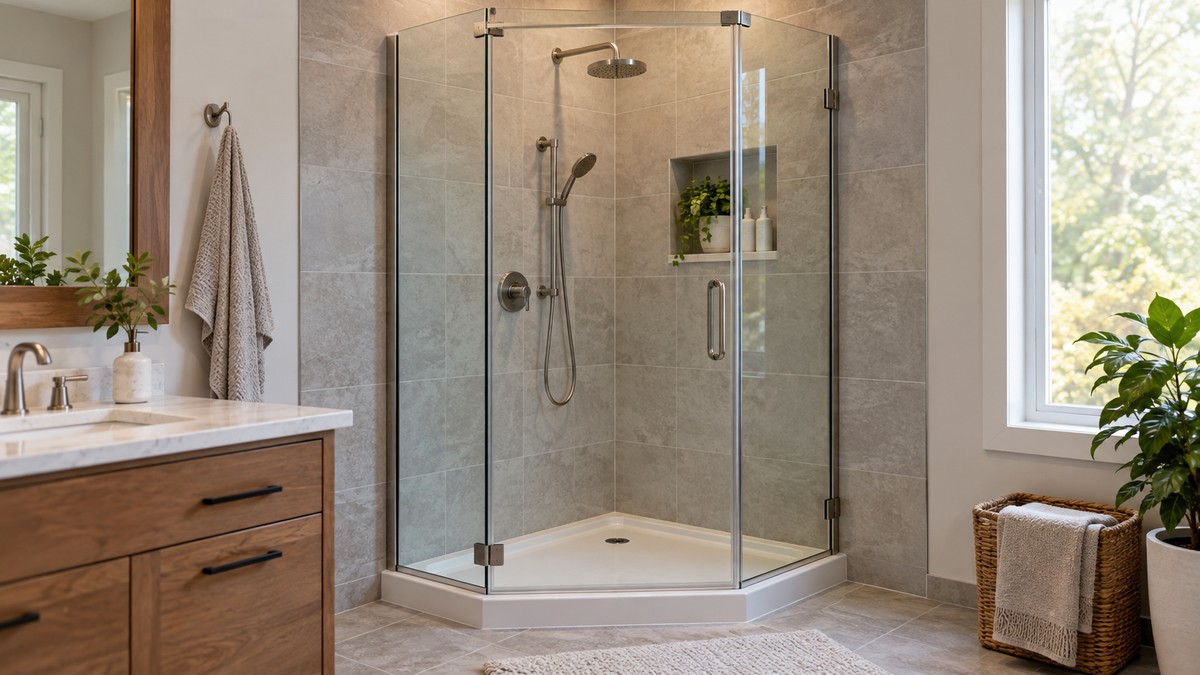
corner-shower-dimensions-standard
As an Amazon Associate we earn from qualifying purchases.
A corner shower dimensions standard is not one number you can apply everywhere. The plumbing code text in the sources we list at the end gives one common rule for any shower compartment, whatever its shape: a minimum finished interior of 1,024 square inches, and room for a 30-inch circle inside. That rule is set by state and local codes, so it applies where those codes apply. This guide explains what the sources state, how to measure a corner shower against them, and what the sources do not cover.
Quick answer
- The sources give one minimum for shower compartments “regardless of shape”: at least 1,024 square inches of finished interior, and able to hold a 30-inch circle.
- The area and circle are measured at the top of the threshold, not at the tile edge or the wall studs.
- A 32-inch by 32-inch square has exactly 1,024 square inches. A 30-inch by 34-inch corner fails the area test even though it is larger than 30 inches on one side.
- These numbers come from California and Oregon code text. Other states, cities and model codes can differ, so check with your local building department before you buy or build.
How we chose
This post only uses documents published by government bodies: the Oregon Building Codes Division and two California cities, Milpitas and San Rafael. Store listings, retailer pages and product pages are not used for any dimension in this post. Each figure below is quoted from a source text, or is simple arithmetic on a figure from that text. Where a source does not state a figure, the post says so.
The Milpitas and San Rafael sources are both California cities, and the Milpitas text cites California Plumbing Code section 408.6. The Oregon text uses the same section number in a state code. The three are therefore not fully independent of each other. Together they show how the rule is written, but they do not show that every US jurisdiction uses the same numbers.
The minimum interior size
The Oregon plumbing code amendments, section 408.6, say that shower compartments, “regardless of shape, shall have a minimum finished interior of 1024 square inches” and “shall also be capable of encompassing a 30 inch circle.” The text adds that the required area and dimensions are measured at a height equal to the top of the threshold, and at a point tangent to its centerline. That last detail matters for a corner, because the usable area at the threshold is often less than the area at shoulder height.
The City of Milpitas bathroom remodel guide, which cites the California Plumbing Code section 408.6, repeats the same two requirements. It states that shower compartments “shall have a minimum finished interior of 1024 square inches and shall also be capable of encompassing a 30-inch circle.” The Milpitas guide also gives an exception: a shower receptor with overall dimensions “not less than 30 inches by 60 inches” is exempt from this requirement.
The City of San Rafael’s residential curbless shower guidelines use the same figures in plainer language. The shower “must have at least 1,024 square inches of interior floor space,” and the space “must be large enough to fit a 30-inch diameter circle.” The San Rafael page is about curbless showers, but its size rule is the same one the other two sources state.
Why the square number is the tighter test
A 30-inch circle has a diameter of 30 inches. Many corner layouts can fit that circle and still fail the area rule. The area rule is the one that catches a narrow, long corner. The table below uses only arithmetic on the two code numbers, not any product size.
| Interior shape (inches) | Area (sq in) | Meets 1,024 sq in? | Fits a 30-inch circle? |
|---|---|---|---|
| 30 x 30 | 900 | No | Yes |
| 30 x 34 | 1,020 | No | Yes |
| 32 x 32 | 1,024 | Yes | Yes |
| 30 x 36 | 1,080 | Yes | Yes |
| 36 x 36 | 1,296 | Yes | Yes |
The table shows that a 30-inch square does not meet the area rule, even though a 30-inch circle fits inside it. A corner shower that looks wide enough can still be short of the code area. Measure the finished interior, not the outside of the walls or the tile on the far side of a curb.
Measuring a corner shower against the rule
Use this check before you buy a kit, replace a pan, or ask a contractor for a quote. The steps follow the measuring points stated in the sources.
- Turn off the water to the bathroom if you are working on the shower, and keep the drain clear while you measure.
- Find the top of the threshold, the curb or the pan edge that people step over. The sources say the measurements are taken there.
- Measure the finished inside width and depth at that height. The Oregon text also says the measurement is taken at a point tangent to the threshold’s centerline.
- Multiply the two inside dimensions to get the area. Compare it with 1,024 square inches.
- Check the circle. Confirm that a 30-inch circle fits without touching the walls, the door or the control valve.
- Check the threshold height and the drain if the shower is curbless. San Rafael’s guidance is covered in the next section.
- Write down the numbers and bring them to the building department or the installer, so everyone uses the same measurements.
A curb, a door track, or a built-in seat can change the finished interior. The sources do not say how a seat or door track is counted in the area, so ask the building department how it treats them before you rely on a figure.
Curbless and low threshold details
The San Rafael guidance gives measurements that apply when a shower has a low or no threshold. The source states that the finished threshold “can be no more than ½ inch above the bathroom floor.” It also says that the top of the drain inlet “must be at least 2 inches below the top of the finished threshold.” The pan must “hold at least 9.6 gallons of water above the drain inlet,” so water does not spill over the threshold during use.
The same page says the waterproof shower liner must extend at least 12 inches past the threshold into the bathroom, and that the liner extension should not be nailed or punctured within 1 inch of the outside edge. It also states that if a compressible or folding threshold is used, the Authority Having Jurisdiction must approve it first. San Rafael describes a slope between one-quarter inch and one-half inch per foot toward the drain, in its diagram notes.
These figures are for residential installations in San Rafael, which takes its guidance from the Marin County Codes Advisory Board diagram. They are not a national standard. A corner shower with a curb may not need the same threshold details, and the sources do not say so.
Common mistakes
- Measuring the tile edge. The code measures the finished interior at the threshold. Tile thickness and wall board can take away space you counted on.
- Using the diagonal. A corner shower can look large on a floor plan. The rule is about the interior area and the circle, not the diagonal.
- Assuming a kit meets the code. The sources state the rule for shower compartments. They do not say that any sold kit meets it. Check the finished interior after install.
- Ignoring the threshold. The Oregon text measures at the top of the threshold. A low pan with a high curb can give a different result from the wall-height measurement.
- Treating one city as the nation. The sources are two California cities and one Oregon state code. A permit office in another state may apply a different code edition or local amendment.
What we could not verify: what the sources do not say
The sources do not give a figure from the International Residential Code, section P2708.1. That section was named in the research, but the page could not be read as text, so this post does not state its number. Do not assume a model code matches the figures above.
The sources do not say which edition of any code applies in a given city, or whether an older house can keep an earlier shower layout. They do not give a rule for corners with a built-in seat, for corner showers with a glass enclosure that uses a different threshold design, or for corner shower kits sold for rental units. They also do not say how the rule applies to a corner shower that is part of a tub, because the Oregon and California texts quoted above are written for shower compartments.
FAQ
Is there one national corner shower dimensions standard?
The sources do not show one. They show a 1,024 square inch minimum interior and a 30-inch circle in Oregon and California codes. Other codes and local amendments may set different figures, so check with your local building department.
Does a 30 by 30 corner shower meet the code?
Not by the area rule in the sources. A 30 by 30 interior has 900 square inches, which is less than 1,024. It can still fit a 30-inch circle, but both tests must be met.
Where is the shower measured?
The Oregon text states that the area and dimensions are measured at a height equal to the top of the threshold. San Rafael says the same. Measure at that point, not at the tile face above it.
Does a 30 by 60 receptor have to meet the area rule?
The Milpitas guide says a shower receptor with overall dimensions not less than 30 inches by 60 inches is exempt from the minimum area requirement. The sources do not say whether this exemption applies in other jurisdictions, so confirm it locally.
What threshold height do the sources allow for a curbless shower?
San Rafael states that the finished threshold can be no more than one-half inch above the bathroom floor. It notes the Authority Having Jurisdiction must approve compressible or folding thresholds. Other places may set different limits.
Do I need a permit to change a corner shower?
The sources do not state permit rules for every project. Permit requirements depend on the state, city and type of work. Ask your local building department before you start a change to the pan, the threshold, or the drain.
Bottom line
For a corner shower, measure the finished interior at the threshold and check two things: at least 1,024 square inches, and room for a 30-inch circle. The Oregon, Milpitas and San Rafael sources state those rules. Confirm your local code before you buy or build, because the sources cover only the places they name.
After you have the size, you can compare caddies and storage that fit the corner you measured. For storage that fits a corner you have measured, see the corner shower organiser guide and the corner shower caddy tension pole guide. Neither guide changes the code figures above.
Sources
- Oregon Building Codes Division, Oregon Plumbing Specialty Code amendments, section 408.6 (opened 2026-10-27): https://www.oregon.gov/bcd/codes-stand/Documents/17opsc-20201001-amendments.pdf
- City of Milpitas, Bathroom Remodel (Residential) guide, CPC 408.6 (opened 2026-10-27): https://milpitas.gov/DocumentCenter/View/966/Bathroom-Remodel-Design-Guideline-PDF
- City of San Rafael, Residential curbless shower guidelines (opened 2026-10-27): https://www.sanrafael.gov/residential-curbless-shower-guidelines