how-to-clean-handheld-shower-head
As an Amazon Associate we earn from qualifying purchases.
If your handheld shower head sprays weakly or unevenly, the usual cause is mineral build-up and debris in the nozzles and in the small screen where the head meets the hose. Knowing how to clean handheld shower head parts properly comes down to a few steps: take the head off the hose, clear the screen and nozzles, soak the parts in vinegar, scrub the holes, and check the joint for leaks when you reconnect. This guide follows the manufacturer and public-health instructions we opened, shows where those sources disagree, and lists what they do not cover, so you know where to check your own model’s manual.
Quick answer
- Unscrew the handheld head from the hose, then remove the filter and screen washer that sit inside the connection.
- Rub the rubber nozzles by hand under running water, then scrub the holes with an old toothbrush.
- Soak the parts in distilled white vinegar. Canopy uses a 50/50 mix with water for at least 30 minutes, while the New Jersey guidance says overnight. The sources do not agree on the time.
- Clear stubborn holes with a needle or straightened paper clip, reinstall the screen, reconnect, and check for leaks.
Why a handheld shower head loses flow
Kohler’s care guide for its handshowers explains the mechanism directly: “Any debris or mineral build-up may cause the flow stream to become distorted or reduce the flowrate.” That single sentence explains both symptoms people usually notice, a spray pattern that looks uneven and a stream that feels thinner than it used to.
The New Jersey Department of Health guidance says something similar about fixed shower heads. Minerals build up over time and block the nozzles, which is why it calls routine cleaning necessary for the head to operate at full capacity.
Knowing the cause helps set expectations. A clean head can only restore flow that was lost to debris or scale in the head itself. The sources we opened do not say how much flow a cleaning will bring back, so treat a cleaning as a check on the head, not a promise about your water pressure. If weak pressure is the main complaint, our guide to handheld shower head water pressure looks at that question from the product side. If the water is still weak after a full cleaning, the cause may sit elsewhere in the plumbing, and the sources in this article do not cover that. Our guide to low pressure shower heads and hoses covers a different set of questions about hose and head combinations.
The EPA WaterSense page adds a flow reference point. It says standard showerheads use 2.5 gallons of water per minute (gpm), and that WaterSense labeled showerheads must use no more than 2.0 gpm. Those are limits set by the product, and the EPA page does not say that cleaning changes them. For a broader comparison of flow and water savings, see our high pressure shower head water saving roundup.
Before you start: what you need
The New Jersey guidance lists a short set of supplies: an adjustable wrench, needle-nose pliers, distilled white vinegar, thread sealant tape, a cloth, a toothbrush, and a bowl. For a handheld head you will probably need fewer of these, because the head usually comes off by hand from a hose rather than from a fixed arm. Keep the cloth and pliers nearby anyway, in case the connection is stiff.
Add a needle or a straightened paper clip for the small holes. The New Jersey guidance names that tool specifically for holes that are still clogged after soaking. You will also want a towel to set parts on, and a small container so the filter and screen do not roll away when you pull them out.
If you own a model from a manufacturer, look for its manual first. The Kohler guide and the Canopy page both point to the owner’s documentation for model-specific steps. Where the manual and a general guide disagree, follow the manual.
Step 1: Check how your head connects
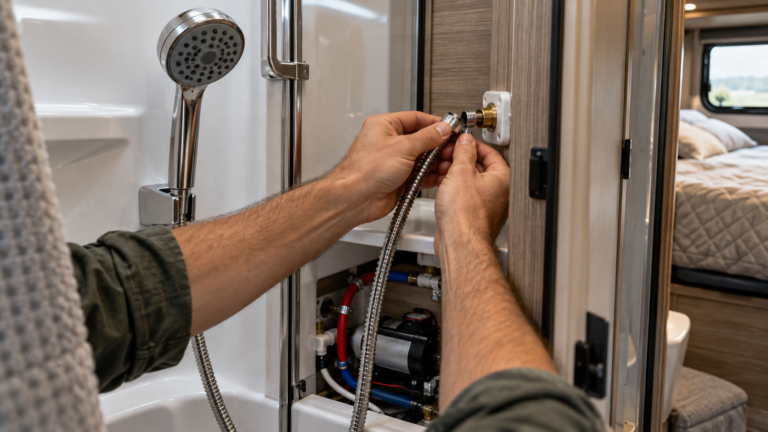
Look at the connection between the handheld head and the hose. Canopy’s cleaning page covers both a fixed head and a handheld head, and for the handheld showerhead it says to unscrew the head from the hose first. The New Jersey guidance describes the fixed-arm version, which is a more involved job.
If the hose itself is the part you are replacing, see our roundup of replacement hoses for Waterpik shower heads before you buy. The Kohler install step follows the same idea. It describes putting the screen washer into the shower hose connector, putting the filter into the handshower, and then connecting the handshower to the hose. That means the small parts that catch debris sit at the joint, not only inside the head. Keep that in mind as you go through the steps, because the screen is where you will find the most grit.
Step 2: Remove the head from the hose
Start by hand. The New Jersey guidance says to try removing the shower head by hand first, gripping either the head or the connecting nut, depending on the design, and turning counterclockwise. If that does not work, the same guidance says to wrap the arm with a rag or cloth and use pliers to hold it in place, then use an adjustable wrench to loosen the connection.
Two cautions apply. First, the New Jersey guidance is written for a fixed shower arm, so use the same gentle approach at the hose connection rather than a strong grip that could crack a plastic fitting. Second, the guidance says to turn off the water before you work on the connection and to dry the threads completely. The guidance uses the phrase “Turn off the water and completely dry” in its section on preparing the arm threads, and that advice applies to any threaded joint you disconnect.
Once the head is loose, unscrew it completely by hand. Set it on the towel with the spray face up so you do not bend the nozzles.
Step 3: Remove the filter and the screen washer
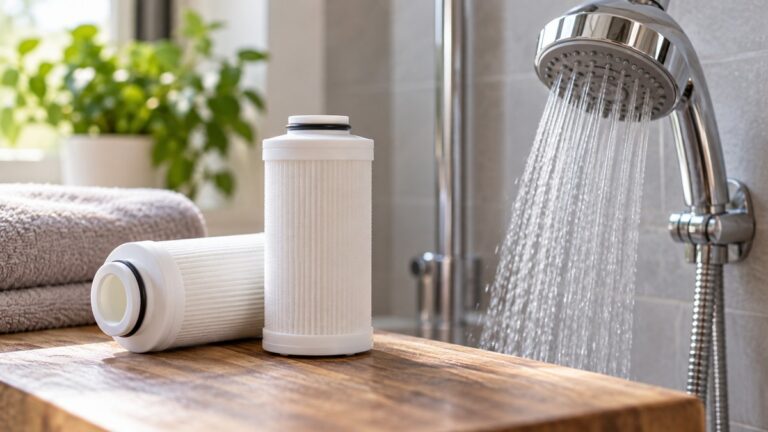
Pull out the small parts at the connection. Canopy says to “remove the filter and set it aside before cleaning.” Kohler lists two parts for its handshower: a screen washer that sits in the hose connector and a filter inside the head. Both can hold grit that would otherwise slow the flow.
The New Jersey guidance adds a useful note: “Shower heads often have a filter screen inside that can be removed with a pair of needle nose pliers.” If the screen is stuck, grip it gently with needle-nose pliers and pull it straight out rather than twisting hard. Note the order and orientation of the pieces, or take a photo before you remove them. The New Jersey guidance recommends that step when the owner’s manual is missing, and it applies equally to a handheld head.
Step 4: Clean the rubber nozzles by hand
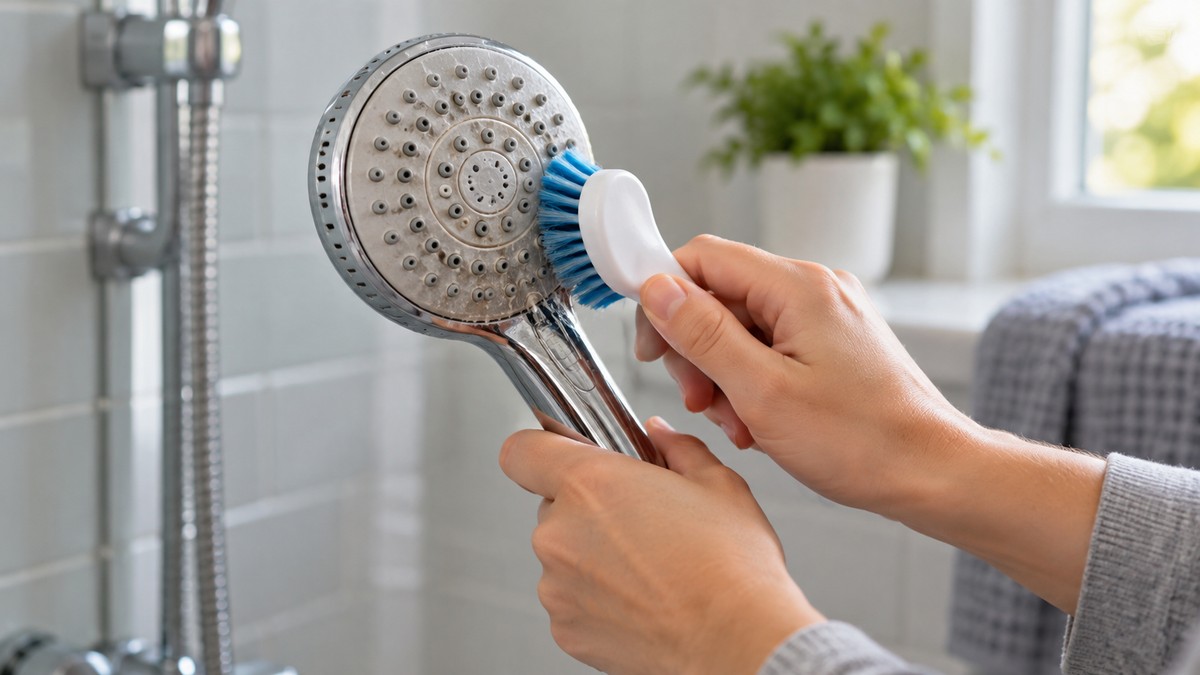
Turn the water on briefly and work on the nozzles while the water runs. Kohler’s instructions are direct: “firmly press or rub your finger back and forth across the rubber nozzles.” This removes loose debris without any tool and is often enough for a head that has only light build-up.
Do this step before any soaking. Loose grit comes off easily under running water, and it keeps the vinegar from carrying debris down into the holes. The Kohler guide gives this as its method for debris and mineral build-up at the nozzles.
Step 5: Soak the head and the filter in vinegar
This is the step where the sources give different instructions, so read it carefully. All three cleaning sources name vinegar, but they disagree on the soak time.
- Canopy says to fill a bowl or bucket with a 50/50 mixture of white vinegar and water, submerge the components, and let them soak “for at least 30 minutes.” Canopy also notes that you can use standard soapy water if you prefer.
- The New Jersey guidance says to fully submerge the shower head in a bowl of distilled white vinegar and “let it soak overnight.”
- Kohler gives a shorter instruction for its handshower parts. It says to clean the filters of the screen washer by soaking them in warm vinegar, and for a separate component, its spray plate, to soak it in warm vinegar for 30 minutes. The Kohler guide does not give a time for the screen washer itself.
Because the sources do not agree, the sensible approach is to start with the shorter soak, usually at least 30 minutes as Canopy describes, and check the result. If the holes are still clogged, a longer soak is what the New Jersey guidance describes. If your head has a brass, nickel, or dark finish, be cautious with long soaks. Kohler’s guidance on finishes is general: “Clean the finish with mild soap and warm water.” The sources we opened do not describe how vinegar affects every finish, so check your model’s manual before a long soak.
Keep the filter and screen in the same vinegar bath as the head, or soak them in a separate small container. Either way, use distilled white vinegar as the sources name it, and avoid mixing it with other cleaning products.
Step 6: Scrub the nozzles and clear the holes
Once the soak is done, scrub the nozzle face. Canopy says to “use an old toothbrush or a small brush to gently scrub the nozzles.” An old toothbrush is the right size for the spray face. Use gentle, short strokes and do not dig into the holes with anything that could scratch the surface.
For holes that stay blocked, the New Jersey guidance says: “Use a needle or straightened paper clip to unblock any holes in the showerhead that are still clogged by mineral deposits.” Push the needle gently into each hole, one at a time, and work across the face in a pattern so you do not miss any. Do not force a needle through a nozzle that resists, because a bent or snapped tip is harder to fix than a slow hole.
If you prefer a dedicated tool, two cleaning sets appear in the product file for this topic. The listings are summarized below for reference only. They are not a ranking. See the product section for their details.
Step 7: Rinse and reinstall the filter
Rinse the head thoroughly after the soak. Canopy says to rinse the showerhead thoroughly once it is clean, and the New Jersey guidance says to rinse the filter with water and, for stubborn sticky debris, to use a toothbrush with an all-purpose cleaner or dish soap. Use clean water for the final rinse so no vinegar stays in the spray face.
Reinstall the filter and screen only after they are fully clean and dry enough to seat properly. The New Jersey guidance says “Reinstall the filter screen when cleaned.” Kohler gives the same order: reinstall the filter and screen washer into the handshower, then reinstall the handshower. Check that the screen sits flat and the o-rings are in place. A pinched o-ring can cause a leak at the joint.
Step 8: Reconnect and check for leaks
Screw the head back onto the hose by turning it clockwise, and tighten it by hand first. The New Jersey guidance says that if a connection leaks, you should “re-wrap the threads with thread sealant tape” and carefully tighten again with an adjustable wrench. The guidance is written for threaded arms, so apply the same care to a threaded hose joint.
Turn the water on and check for leaks at the joint. The New Jersey guidance says to “Turn the water on and check for leaks.” Look at both the hose connection and the head joint while the water runs. Then run the spray through each mode, if your head has more than one, and look for an even pattern.
If the joint leaks after you retighten it, take the head off, check the o-ring and tape, and try again. Do not keep tightening a joint that leaks, because that can crack the fitting.
How often to clean
Canopy gives the most specific guidance in the sources we opened: “This process only needs to be done once or twice a year, or when you notice a buildup affecting the water flow.” That is a useful rule of thumb for most homes, but water hardness and how often you use the shower will change how fast build-up forms. The sources do not give a fixed number of months for every home, so use what you can see and feel, such as the spray pattern and the strength of the stream, as the signal to clean.
Both the New Jersey guidance and the Kohler guide frame cleaning as a routine check rather than a one-time fix. If your head shows build-up on the nozzles every few months, the sources do not say whether that is normal for your water, so ask a plumber or check the water supply information from your utility.
Mistakes to avoid
- Using abrasive cleaners. Kohler says “Do not use abrasive cleaners or solvents on Kohler faucets and fittings,” and that scouring can dull the finish.
- Using harsh chemicals. Kohler warns that “Many cleaners may contain chemicals, such as ammonia, chlorine” and that these can affect the finish. Stick to vinegar, mild soap, and warm water.
- Removing the flow control part. Kohler’s guide says “Don’t remove the flow controller, or the handshower will be damaged.” Clean around it. Do not pull it out to clear a clog.
- Forcing a stuck part. The New Jersey guidance suggests a rag around the arm before using pliers.
- Skipping the leak check. A joint that looks tight can still leak. Run the water and look at the joint before you walk away.
Product tools for the nozzles
The Kohler and New Jersey guidance both rely on a toothbrush and a needle or paper clip, which are free and easy to find. If you would rather use a set made for this job, two listings in the product file describe the kind of tool involved. The listings are summarized here for reference only.
- uadbau Shower Head Cleaner set (30 pieces): the listing describes stainless steel picks and nylon bristles, 10 steel pins from 0.015 to 0.05 inch, and 20 brushes, all kept in a storage case. The listing says the picks are for tiny holes and the brushes for nozzle crevices. View on Amazon
- Lanjiesh Shower Head Cleaner Picks (20 pieces): the listing describes 20 individually packaged brushes with protective caps, a non-slip plastic handle, and a steel wire and nylon brush head. It says the brushes suit holes larger than 0.02 inches, or about 0.5 mm. View on Amazon
Whatever tool you use, match its size to the holes you can see, and keep to the sizes the listing states. The listings do not say how well either set works in a particular head. If you are choosing a whole handheld head rather than a cleaning kit, see our roundup of water efficient hand held shower heads.
How we chose
The steps in this guide come from the cleaning instructions in the four sources listed at the end of the article. We kept the steps that appear in at least one manufacturer or public-health source and that a reader can do with the parts on a handheld head. Where two sources give different instructions, such as the soak time, we show both rather than choosing one silently.
The product section uses only the listing details that the file for this topic records for each item. We chose two of the ten items in that file to illustrate the two kinds of cleaning tool, a larger set and a smaller pack. The choice does not rank them, and it does not say which one is better for any particular head.
What we could not verify: what the sources do not say
The sources we opened are useful, but they leave several questions open. Read this section before you rely on any single instruction.
- Soak time. Canopy says at least 30 minutes and the New Jersey guidance says overnight. The sources do not say which is correct for every head, so the soak time is a judgment you make based on how much build-up you see.
- Finish compatibility. The sources do not describe how vinegar affects every finish. Kohler’s general finish guidance is mild soap and warm water, and that is the only finish advice in the sources we opened.
- Flow after cleaning. No source opened here states how much flow a cleaning will restore, or what pressure a clean head will deliver.
- Cleaning schedule. Only Canopy gives a frequency. The sources do not say how often a handheld head needs cleaning for a given water hardness.
- Thread size and sealant. The sources we opened do not state the thread size for a handheld head, so this guide does not give one. Check the fitting on your head or the manual before buying parts.
- Brand-specific steps. The Kohler and Canopy guides cover their own products. Other brands may differ, and the sources do not cover them.
FAQ
Can I clean a handheld shower head with vinegar?
Yes, according to the sources. Canopy and the New Jersey guidance both use a distilled white vinegar solution, and Kohler says to soak the screen washer and filter in warm vinegar. Check your model’s finish guidance first, because the sources we opened do not cover every finish.
How long should I soak the head?
The sources differ. Canopy says at least 30 minutes in a 50/50 mix. The New Jersey guidance says to let the head soak overnight. Start with the shorter soak, check the holes, and use a longer soak only if build-up remains.
How often should I clean a handheld shower head?
Canopy says once or twice a year, or sooner when you notice a buildup affecting the water flow. The other sources do not give a fixed schedule.
Do I have to remove the head from the hose?
For a clean job, yes. Canopy says to unscrew the handheld showerhead from the hose, and Kohler’s guide shows the screen washer and filter sitting in the connection, so you need to separate the parts to clean them.
Can I use a needle to clear the nozzle holes?
The New Jersey guidance says to use a needle or straightened paper clip for holes still clogged by mineral deposits. Use it gently, one hole at a time, so you do not bend the tip or scratch the face.
When should I call a plumber?
The New Jersey guidance says that if you are unsure, or if the shower head is difficult to service, it is safest to hire a qualified plumber.
Bottom line
To clean a handheld shower head, take it off the hose, clear the screen and filter, rub the nozzles by hand, soak the parts in distilled white vinegar, scrub the face, and check the joint for leaks when you reconnect. Start with the shorter soak the sources describe, and move to a longer one only if the holes stay blocked. Use the manual for your model when it covers the steps differently.
Sources
- New Jersey Department of Health, “Guidance for Removing and Cleaning a Shower Head.” https://nj.gov/health/cd/documents/topics/legion/ShowerHead_Cleaning_Guidance.pdf (opened 2026-10-27)
- Kohler, “Installation and Care Guide: Handshower,” document 1120859-2A-B. https://resources.kohler.com/plumbing/kohlerapac/pdf/1120859-2A_B1.pdf (opened 2026-10-27)
- Canopy, “How do I clean my Showerhead?” https://getcanopy.co/blogs/help/how-do-i-clean-my-showerhead (opened 2026-10-27)
- U.S. Environmental Protection Agency, WaterSense, “Showerheads.” https://www.epa.gov/watersense/showerheads (opened 2026-10-27)