bathtub-grab-bar
As an Amazon Associate we earn from qualifying purchases.
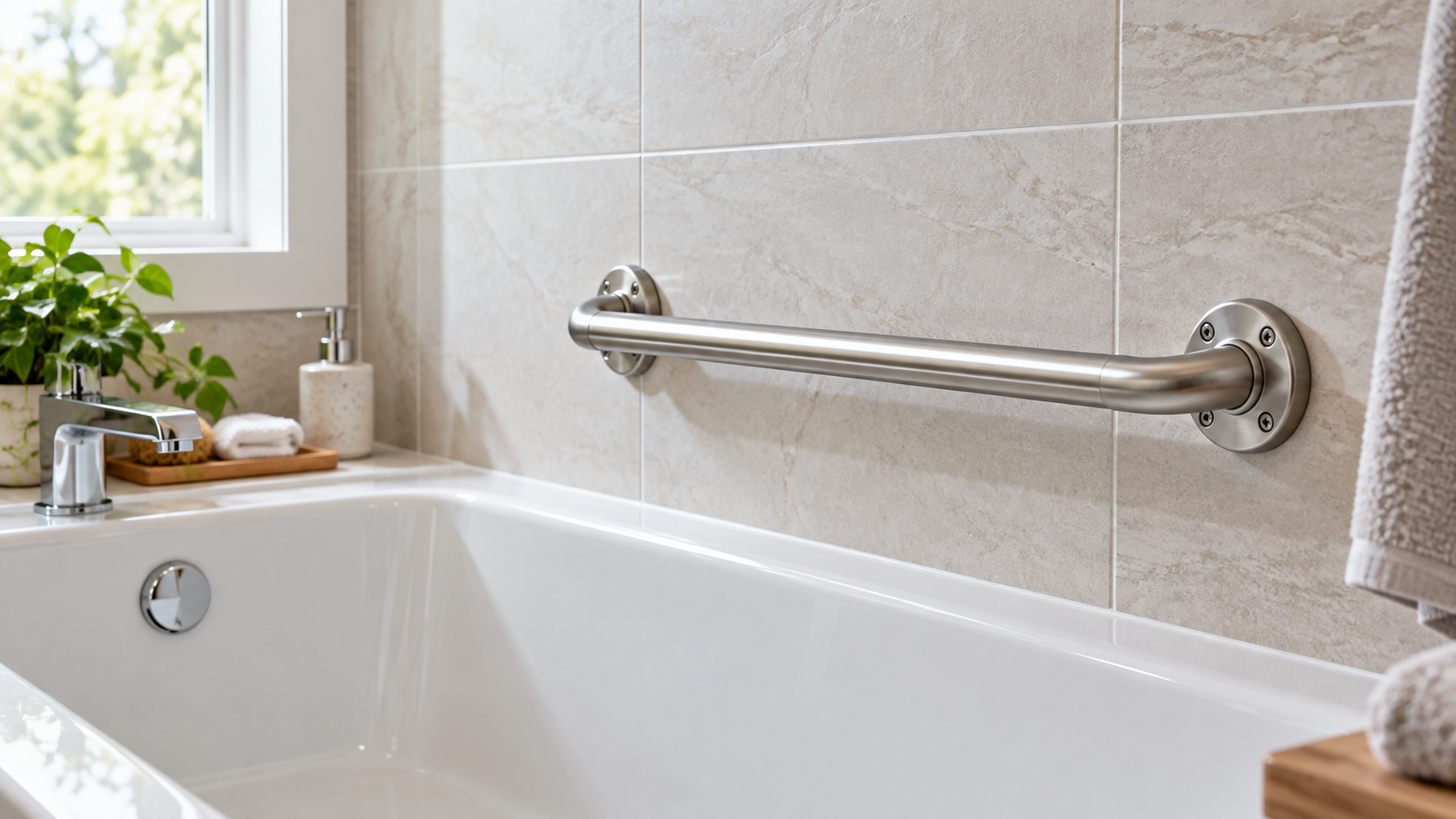
A bathtub grab bar is a rigid bar that mounts on the tub wall or clamps over the tub rim, so a person can hold it while getting in or out of the tub. Most readers want to know which mounting type fits their tub and wall, and whether a listing’s weight figure can be relied on. This post reads three bathtub grab bars from Amazon search results, sets their listing facts side by side, and lists the install and fit checks that the sources we opened do cover. The sources do not rank these products, and none of them says a bar prevents falls. Read the sections below before you buy or install.
Quick answer
- Three bathtub grab bars were read from Amazon listings on 2026-10-27: an 18-inch Amazon Basics bar with a 1.5-inch diameter, a 24-inch Moen bar that mounts to the wall, and a clamp-on Drive Medical bar for the tub rim.
- The listings give different weight figures, and one listing gives two figures. Check the manufacturer’s manual for your exact model before you rely on any number.
- The 2010 ADA Standards text we opened sets a 250-pound structural test for grab bars and a 33 to 36 inch mounting height range. These are design rules for covered facilities, not product ratings.
- Follow the manufacturer’s instructions, anchor a wall-mounted bar into a stud or use rated hardware, check the weight limit and fit, and consider a clinician or occupational therapist for a fit decision.
How we chose
The Amazon search for bathtub grab bar showed more than 1,000 results on 2026-10-27. We limited the set to listings whose product type is a grab bar or tub safety rail for a bathtub. Suction-cup bars were left out of this post, because the sources we opened do not address whether suction-cup bars are safe for weight-bearing. Three listings were opened, covering two mounting types that appear in the results: a bar fixed to the wall with screws, and a bar that clamps over the tub wall.
For each listing we recorded only the title, the brand, the product type, the features the listing states, and any weight limit, dimensions, or material the listing gives. We did not record prices, ratings, review counts, badges, seller names, or account details. Where a listing gives a figure, this post reports it as the listing’s own claim, and says so when two figures on the same listing disagree.
Three bathtub grab bars compared by listing facts
| Listing facts | Amazon Basics (B079L6LY1V) | Moen 8724 (B00084F76K) | Drive Medical (B005JIM2DQ) |
|---|---|---|---|
| Mounting type stated | Wall-mounted bar | Wall-mounted bar; SecureMount anchors sold separately | Clamp-on to tub rim |
| Material | Stainless steel | Stainless steel | Powder-coated steel |
| Length or height | 18 inches long | 24 inches long | Adjustable height 14 to 17 inches |
| Diameter or width | 1.5 inch diameter | 1.25 inch diameter | Adjustable width 3 to 7 inches |
| Weight figure stated | Up to 500 lb when installed in a stud or other secure surface | 500 lb in the bullets; 300 lb in the description | 300 lb in the description |
| Item weight | 1.27 pounds | 1 pound | 7 pounds |
| Warranty stated | 1 year | Limited lifetime | Not stated |
| Fiberglass tub note | Not stated | Not stated | Not for use with fiberglass tubs |
The table shows only what each listing states. “Not stated” means the listing text we read does not give that fact, not that the product lacks it.
Amazon Basics 18-inch stainless grab bar
The listing gives the brand as Amazon Basics and the material as stainless steel, with a brushed stainless finish. It states an 18-inch length and a 1.5-inch diameter, with product dimensions of 18 inches long by 1.5 inches wide and an item weight of 1.27 pounds.
The bullets say the bar can support up to 500 pounds when it is installed in a wall stud or another secure mounting surface. That is the listing’s claim, and the figure depends on the installation. The listing also says the bar meets ADA specifications, that the stainless finish is designed to resist rust and corrosion, and that it carries a one-year warranty. The bullets do not say whether mounting screws are included, so check the package before you plan the install.
Moen 24-inch stainless grab bar, model 8724
The listing gives the brand as Moen and the model as 8724. It describes a 24-inch stainless steel bar with a 1.25-inch diameter, a lightly brushed finish, and an item weight of 1 pound. The bullets say the bar supports up to 500 pounds when it is installed in a stud or used with SecureMount anchors, which the listing says are sold separately. The listing also says the bar complies with ADA specifications and carries a limited lifetime warranty.
The listing does not agree with itself on weight. Its product description says the bar is designed to support 300 pounds, while the bullets say 500 pounds. Do not treat either figure as settled until you read the manufacturer’s manual for the exact model. The listing links to a user guide in PDF form, and that guide is the place to check the mounting instructions.
Drive Medical adjustable clamp-on tub grab bar
The listing gives the brand as Drive Medical and the material as powder-coated steel, in white. It says the height adjusts from 14 to 17 inches and the width from 3 to 7 inches. The bullets describe a clamp-on design with tool-free installation, a stainless steel locking mechanism, and non-wearing rubber pads. The listing gives an item weight of 7 pounds and product dimensions of 8.63 inches long by 6.75 inches wide. Its description gives a weight capacity of 300 pounds.
The listing says the bar is not for use with fiberglass tubs, so check your tub material before you buy. The listing does not say whether the bar works on textured tub walls, and the question is not answered elsewhere on the page. A clamp-on bar depends on a tight clamp, so the listing’s tool-free claim does not remove the need to check the lock before each use.
What the sources say about mounting and load
The 2010 ADA Standards text we opened sets a structural test for grab bars. Allowable stresses shall not be exceeded when a “vertical or horizontal force of 250 pounds (1112 N) is applied at any point on the grab bar, fastener, mounting device, or supporting structure.” This is a design requirement for the whole assembly, which is different from a stated product capacity. A bar that meets the test in the standard is not the same as a bar that holds 250 pounds in your wall. The wall, the fasteners, and the installation all matter.
The same text sets the height range for horizontal grab bars. “Grab bars shall be installed in a horizontal position, 33 inches (840 mm) minimum and 36 inches (915 mm) maximum above the finish floor.” The text we opened is written for facilities covered by ADA Titles II and III, not for private homes. Treat the height range as a reference point when you compare a bar’s length and position with the person’s reach, not as a rule for your bathroom.
The MedlinePlus falls page says that you can reduce fall risk by making your house safer. It advises that you “make sure that you have rails on the stairs and in the bath,” and that you “get rid of tripping hazards.” That supports the idea of a rail in the bath, but the page does not name a product, a mounting method, or a weight rating.
The National Institute on Aging falls page lists many risk factors. It notes that “Conditions that cause rushed movement to the bathroom, such as incontinence, may also increase the chance of falling.” It also advises that you “Use a shoulder bag, fanny pack, or backpack to leave your hands free to hold on to railings.” The page does not address grab bars or bathtub transfers, so it gives context for why a person might want a bar, not guidance on which bar to buy.
Install and fit checks
These steps follow the sources above and the mounting details the listings state. They do not replace the manufacturer’s instructions for your exact model.
- Read the manufacturer’s instructions before you drill. Check the weight figure in those instructions, not only the one on the listing, and confirm which mounting surface it assumes.
- Find the wall studs with a stud finder. For a wall-mounted bar, anchor into a stud, or use hardware the manufacturer rates for that bar and that wall. Tile, fiberglass, and plaster each need a different approach, so check the instructions for the surface you have.
- Check that the bar sits where the person can reach it from inside the tub, and that it does not sit so high or low that it forces an awkward grip.
- Turn off the water before you drill near plumbing, and do not overtighten fasteners. Once the bar is up, push and pull on it in several directions before anyone uses it.
- For a clamp-on bar, confirm the clamp is locked on each use. Look for movement or a loose lock, and stop using the bar if either appears until the fit is corrected.
If the person has balance problems, weakness, or a recent injury, ask a clinician or an occupational therapist to check the bar’s position and the way it will be used. A fit decision is part of that visit, not only a product choice.
Common mistakes to avoid
- Assuming the 500-pound figure applies to every installation. The Amazon Basics and Moen listings state that figure for a stud or secure surface, and the Moen description gives a different figure.
- Buying a clamp-on bar for a fiberglass tub, which the Drive Medical listing advises against.
- Mounting a wall bar into tile with no stud and no rated hardware. The manufacturer’s instructions name the anchor the bar needs.
- Treating the listing’s “ADA compliant” line as a fit decision. The ADA text describes design rules for covered facilities, and the listing does not say how the bar fits a specific tub.
What we could not verify: what the sources do not say
- The sources we opened do not say whether any of these bars prevents falls. This post makes no such claim.
- The sources do not confirm that any listing’s weight figure is accurate for the exact model. The Moen listing gives two different figures.
- The ADA text does not give a product capacity for any of these bars, so the 250-pound test is not a rating.
- The listings do not say whether the Amazon Basics bar fits every tub wall, or whether its screws are included.
- The Drive Medical listing does not say whether the bar works on textured tub walls.
- None of the sources we opened says that a suction-cup bar is safe for weight-bearing, so this post does not describe suction-cup bars as safe for that use.
Frequently asked questions
Can a bathtub grab bar prevent falls?
The sources we opened do not say that. The NIA page lists many risk factors for falls and does not name grab bars as a prevention measure. Talk with a clinician or occupational therapist about whether a bar suits the person who will use it.
Is a suction-cup bar a substitute for a fixed bar?
This post does not cover suction-cup bars for weight-bearing use. The sources we opened do not address that question, so do not assume a suction bar can take the place of a fixed bar. Ask a clinician before you choose.
How much weight can a bathtub grab bar hold?
Use the figure in the manufacturer’s manual for your exact model. The listings in this post state 300 and 500 pounds, and one listing gives both. The ADA text describes a 250-pound structural test for the whole assembly, which is not a product rating.
Do I need to hit a stud?
For a wall-mounted bar, the Amazon Basics and Moen listings say the stated capacity applies when the bar is installed in a stud or another secure surface. Anchor into a stud or use rated hardware, and follow the manufacturer’s instructions for the surface you have.
Does a clamp-on bar work with every tub?
No. The Drive Medical listing says the bar is not for use with fiberglass tubs. Check your tub material and the 3 to 7 inch clamp width before you buy.
Where should the bar go?
The ADA text puts horizontal grab bars between 33 and 36 inches above the finish floor for the facilities it covers. In a home, placement depends on the person’s reach and how they get in and out of the tub. An occupational therapist can help with that decision.
Bottom line
Choose a bathtub grab bar by the mounting method your tub and wall allow, then check the weight figure in the manufacturer’s manual rather than relying on the listing alone. Anchor wall bars into a stud or rated hardware, follow the instructions, and ask a clinician or occupational therapist for a fit decision before the bar goes into daily use.
If you are comparing related options, see our Ravinte and Gotega bath and shower grab bar comparison and our Taili and Ravinte grab bar comparison. For tub transfer seats, our Homland and Drive Medical seating comparison covers a different kind of tub aid. For general bathtub upkeep, see how to clean a bathtub.
Sources
- 2010 ADA Standards for Accessible Design, U.S. Access Board, sections 604, 607, 609 and 610: https://www.access-board.gov/ada/ (opened 2026-10-27)
- National Institute on Aging, Prevent Falls and Fractures: https://www.nia.nih.gov/health/prevent-falls-and-fractures (opened 2026-10-27)
- MedlinePlus, National Library of Medicine, Falls: https://medlineplus.gov/falls.html (opened 2026-10-27)
- Amazon listings, product data only: B079L6LY1V, B00084F76K, B005JIM2DQ (read 2026-10-27)