ADA Compliant Shower Valve: What the 2010 Standard Requires and What It Leaves Out
As an Amazon Associate we earn from qualifying purchases.
The phrase ADA compliant shower valve suggests a product that carries an accessibility approval. The 2010 ADA Standards for Accessible Design do not work that way. The standard never uses the word valve in any shower requirement. It does not name a valve type, a cartridge, a pressure-balance design or a thermostatic design. What it does regulate is the result at the wall: the controls must be operable with one hand, they must sit within reach, the spray unit must have an on/off control, and the water at the spray unit must not exceed 120 degrees Fahrenheit.
Quick answer
- The standard never uses the word valve in a shower requirement, and it does not certify any valve.
- Water at the shower spray unit must be 120°F (49°C) maximum (section 608.6).
- Controls, faucets and spray units must comply with section 309.4, with one-hand operation and 5 pounds of force or less.
- The spray unit needs an on/off control with a non-positive shut-off (section 608.6).
- Control placement depends on the shower type (sections 608.5.1 to 608.5.3).
How we chose
This article uses one source: the 2010 ADA Standards for Accessible Design, published by the Department of Justice on ADA.gov. Every section number and quoted phrase comes from that text. The 2010 Standards set minimum requirements for newly designed and constructed or altered State and local government facilities, public accommodations and commercial facilities under Titles II and III of the ADA, and residential dwelling units follow section 233. A valve that is installed in a plumbing system must also meet the plumbing code that applies to the building, and that code is outside this article. Local codes can add to or differ from these rules.
What the standard regulates in a shower
The shower sections of the standard regulate three things. The first is the operating method of the controls. The second is their location. The third is the water temperature at the spray unit. Section 608.5 covers the controls, faucets and spray unit together, and says: “Controls, faucets, and shower spray units shall comply with 309.4.” Section 309.4 is the one-hand, no-grasp rule, which applies to any operable part.
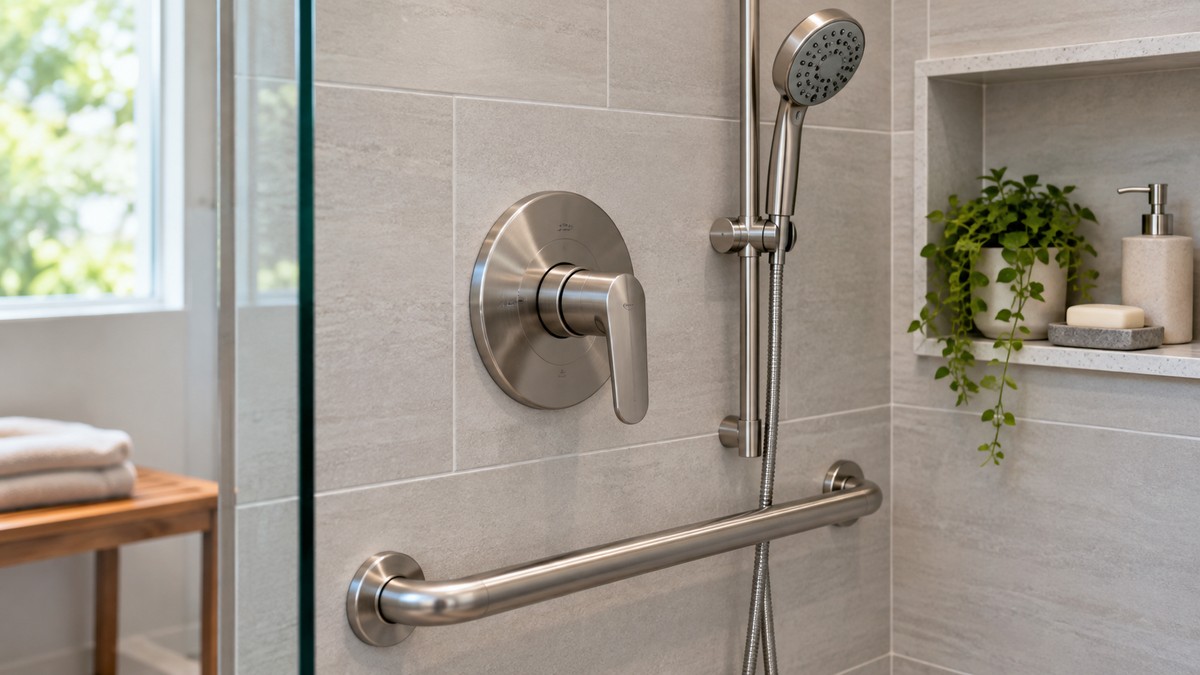
The standard then adds a location rule for each shower type. For a transfer type shower, section 608.5.1 places the controls on the side wall opposite the seat. For a standard roll-in shower with a seat, section 608.5.2 says the controls, faucets and spray unit “shall be located above the grab bar, but no higher than 48 inches (1220 mm) above the shower floor” For an alternate roll-in shower, section 608.5.3 gives its own placement rule. None of these sections describes a valve body, a cartridge or a handle type. They describe where the operable parts sit.
The third regulated item is the water temperature. Section 608.6 says: “Shower spray units shall deliver water that is 120°F (49°C) maximum.” This is the closest the standard comes to a valve-related rule, because the temperature limit is set at the spray unit. The text does not say which device must hold that temperature, so the limit can be met by more than one kind of valve if the water delivered at the spray unit stays at or below 120 degrees.
The 120 degree limit and the spray unit
The 120 degree limit is a maximum, and the standard states it as one. The wording is “120°F (49°C) maximum.” A valve that delivers water above that figure at the spray unit does not meet section 608.6, even if the valve itself is labeled for a different use. The same limit appears for bathtub spray units in section 607.6, which reads: “Bathtub shower spray units shall deliver water that is 120°F (49°C) maximum.”
The standard puts the limit on the spray unit, not on the valve. That matters for a buyer who reads a product label. A label that gives the valve’s maximum output temperature describes the valve. The standard asks about the water that comes out of the spray. A user cannot check the spray temperature from the label alone, so the installation has to be checked, and the setting has to hold after the system is installed.
The standard also states a performance point for hand-held units in an advisory note. It says: “Ensure that hand-held shower spray units are capable of delivering water pressure substantially equivalent to fixed shower heads.” The note is advisory, so it does not carry the force of a mandatory requirement. It still tells a designer that a hand-held unit should not be chosen only for its temperature and then fail on flow.
The on/off control on the spray unit
Section 608.6 also requires the spray unit to have its own control. The sentence reads: “The shower spray unit shall have an on/off control with a non-positive shut-off.” The standard does not define a non-positive shut-off in more detail. The phrase tells a designer that the spray unit needs an on/off control of a stated kind, and it is a separate requirement from the temperature limit.
The spray unit control is tied to the same reach and operation rules as the faucet. The standard says that operable parts shall be “operable with one hand and shall not require tight grasping, pinching, or twisting of the wrist”, and the force limit is “5 pounds (22.2 N) maximum.” A valve or a spray control that needs a pinch to turn fails that rule, even if the temperature at the spray unit is correct.
A designer should check the spray unit control against section 309.3 as well. Section 309.3 says: “Operable parts shall be placed within one or more of the reach ranges specified in 308.” A control that is placed well below or above the reach range for the approach used in the shower fails that section, however good the valve inside the wall may be.
Reach limits and the shower walls
Placement is where most shower valves are judged in the standard. In a transfer type shower, the control wall has its own limit. Section 608.5.1 says the controls “shall be installed on the side wall opposite the seat 38 inches (965 mm) minimum and 48 inches (1220 mm) maximum above the shower floor” The same section says the controls “shall be located on the control wall 15 inches (380 mm) maximum from the centerline of the seat toward the shower opening.” Those two rules set both the height band and the horizontal limit.
For a standard roll-in shower, the controls must be above the grab bar but no higher than 48 inches above the shower floor. Where a seat is provided, section 608.5.2 places the controls on the back wall adjacent to the seat wall and requires them to be “27 inches (685 mm) maximum from the seat wall.” For a roll-in shower without a seat, the advisory note says “the shower head and operable parts can be located on any of the three walls of the shower without adversely affecting accessibility.”
The reach ranges in section 308 apply to these locations. For an unobstructed forward reach, section 308.2.1 says “the high forward reach shall be 48 inches (1220 mm) maximum and the low forward reach shall be 15 inches (380 mm) minimum above the finish floor or ground.” A valve placed where a user must reach over a tub edge or a bench may fall under the obstructed reach rules in section 308.2.2 instead.
Plumbing rules and the limits of this article
The standard does not regulate pipe sizes, mixing devices, anti-scald devices or the internal design of a valve. Those questions belong to the plumbing code, the product standard for the valve and the local permit office. This article does not quote or interpret those sources, because the owner’s rule for this site is one readable source per draft, and that source is the 2010 ADA Standards. A reader who needs the plumbing side should check the code that governs the installation.
The standard also does not give a product list. It does not say that a particular brand of valve is compliant, and any product label that claims ADA compliance for a valve is a claim to check, not a fact the standard supplies. The accessibility text regulates the installed shower: the controls, the spray unit, the temperature at the spray and the reach. A valve can be part of a compliant shower, but the shower is what the standard judges.
Scope matters too. Section 201.1 says the requirements apply to “newly designed and newly constructed buildings and facilities and altered portions of existing buildings and facilities” A valve replaced in an existing shower falls under that scope only where the altered portion is covered. The standard’s exception for residential dwelling units in section 608.3 relates to grab bars, not to valves, so the valve rules apply to residential showers only where the section 233 rules apply to the facility.
A practical check before you buy or install
- Confirm the building type. The shower sections apply to State and local government facilities, public accommodations and commercial facilities, and the text says residential units follow section 233.
- Check the temperature at the spray unit. The water delivered at the spray must be 120°F (49°C) maximum, and a label for the valve alone does not prove that.
- Check the operation. The controls and the spray unit must be operable with one hand, without tight grasping, pinching or twisting of the wrist, and with 5 pounds of force or less.
- Check the spray unit control. It must have an on/off control with a non-positive shut-off.
- Check the location. Keep the controls within the height and horizontal limits for your shower type in section 608.5, and within the reach ranges in section 308.
- Check the plumbing code. The valve and its mixing and anti-scald features are governed by rules outside the ADA text, and the local permit office decides them.
The 2010 ADA Standards do not certify a shower valve. They set the one-hand operation, the reach limits, the on/off control, and the 120 degree maximum at the spray unit, and they leave the choice of valve to the designer and the plumbing code. A shower that meets those tests is compliant in the standard’s terms, whatever valve it uses. For a hand-held spray on these controls, see our hand-held shower head for seniors guide, and for a slide-bar layout see our ADA compliant shower slide bar guide.
What we could not verify
- Which valve types meet the plumbing code, the product standard or any anti-scald rule. The ADA text does not address these.
- Whether a valve label’s temperature rating matches the water delivered at the spray unit.
- Local plumbing permit requirements.
FAQ
Is there an ADA-approved shower valve?
No. The 2010 Standards regulate the installed shower, meaning the controls, the spray unit, the water temperature at the spray and the reach. They do not approve or name a valve.
What temperature limit applies to the shower?
Section 608.6 sets 120°F (49°C) maximum for water delivered by a shower spray unit. Section 607.6 sets the same limit for bathtub spray units.
Which section covers the controls?
Section 608.5 requires the controls, faucets and spray units to comply with section 309.4. Sections 608.5.1 to 608.5.3 set the placement for each shower type.
Sources
- 2010 ADA Standards for Accessible Design, U.S. Department of Justice, ADA.gov: https://www.ada.gov/law-and-regs/design-standards/2010-stds/ (opened 2026-10-30). Sections cited: 201.1, 233.1, 308.2.1, 308.2.2, 309.3, 309.4, 608.3, 608.5, 608.5.1, 608.5.2, 608.5.3, 608.6, 607.6.