Plan a Corner Shower Shelf Installation for Fiberglass Surround
As an Amazon Associate we earn from qualifying purchases.
Corner shower shelf installation planning for a fiberglass surround starts with compatibility, not a drill. Choose a shelf whose manufacturer expressly permits the wall material and follow that shelf’s own adhesive or sealant instructions. A thin surround is not the same as a framed wall: an unsupported panel can flex, and an unapproved hole can become a leak path. Before buying supplies, dry-fit the shelf, inspect the corner, identify the cure time, and decide how the shelf will be braced without loading the panel.
Quick answer
- Do not assume “wall mounted” means safe for fiberglass; obtain compatibility for both the shelf and the surround.
- For a manufacturer-approved no-screw shelf, plan around surface cleaning, dry fitting, runoff slope, bracing and the full cure period.
- Stop if the surround flexes, is cracked or wet behind the surface, or the proposed shelf requires unsupported fasteners.
Decide which installation you are actually planning
“Corner shelf” covers products that attach in very different ways. A molded solid-surface shelf may be bonded to both walls with silicone. A metal basket may use adhesive plates. Another shelf may require screws into blocking. Suction shelves and tension caddies create still different loads. The installation method printed in the shelf manual is the controlling method; a procedure from a similar-looking product is not a substitute.
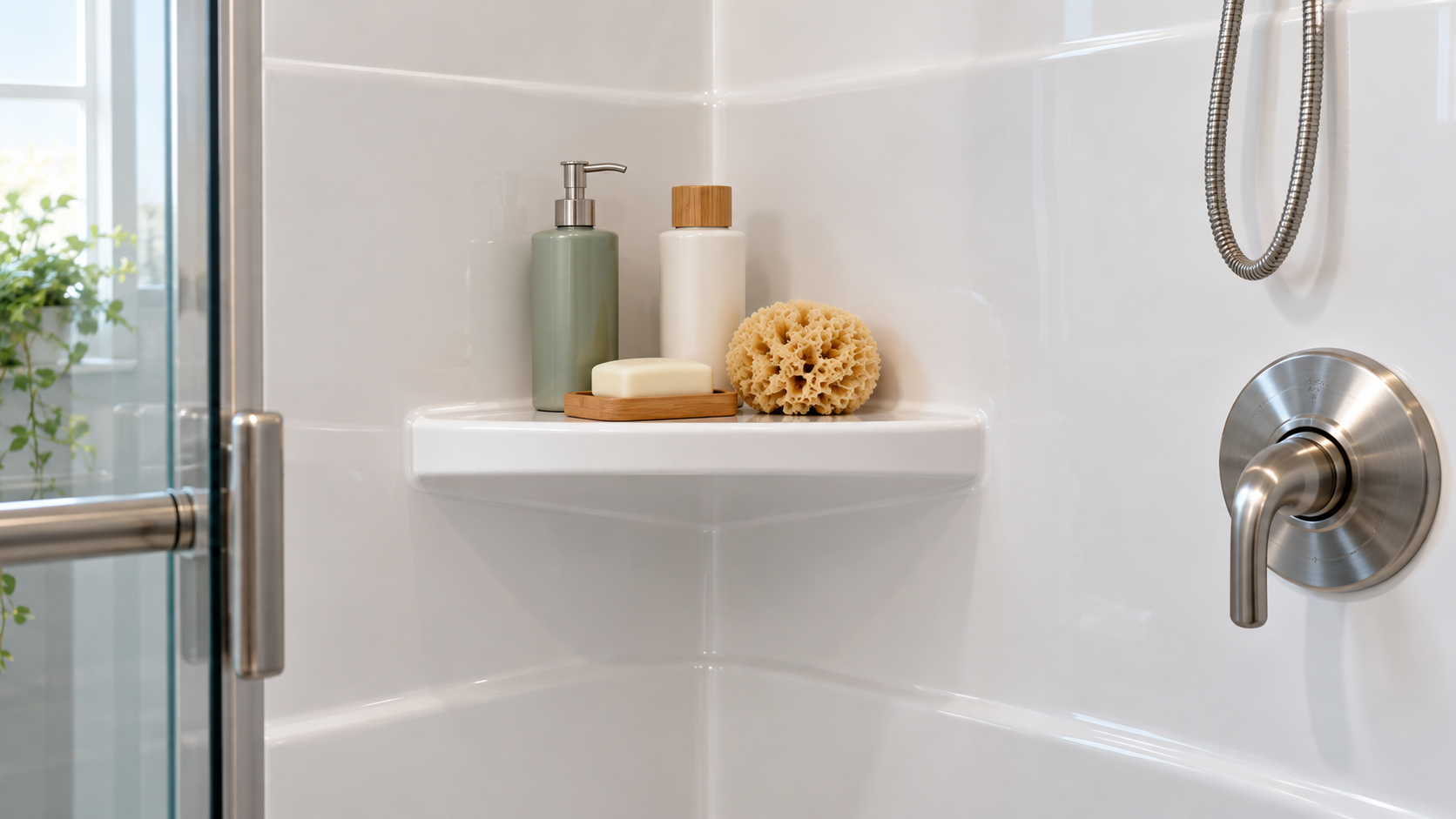
This guide focuses on a manufacturer-approved, no-screw corner shelf. Swan’s ES corner-shelf manual supplies a useful example: clean the wall, dry-fit the shelf, maintain drainage slope, apply silicone at the wall-contact faces, then brace and cure it. Swan’s ES-8 page also calls that specific shelf a no-screw installation. Those facts support planning for that product family, not a blanket claim that every shelf will bond to every fiberglass surround.
If you have not chosen a shelf, compare the mount types in our guide to shelves for fiberglass surrounds. If you want a removable option, a no-drill corner caddy may avoid a permanent bond, provided its own manufacturer approves the surface.
Make a compatibility packet before buying sealant
Collect two documents: the shelf installation sheet and the surround maker’s installation or care sheet. Look for an explicit wall-material statement, required sealant or adhesive, cleaning restrictions, cure time, load limit and any warranty restriction. “Acrylic” and “fiberglass” are sometimes grouped casually by retailers, but they are not interchangeable words in an installation manual. Swan’s ES-8 page lists acrylic, tile, drywall and cultured marble; it does not use the word fiberglass. That gap is a reason to ask the manufacturers, not permission to infer compatibility.
Also identify what is behind the finished panel. A bonded shelf transfers its load through the surface and adhesive area. A screw-mounted shelf needs suitable backing at the fastener locations. If the manual requires blocking and you cannot verify it, the project has moved beyond a surface installation.
Measure the corner as a three-part fit test
Check the angle
Hold a cardboard template or the unloaded shelf in the proposed corner. Both contact faces should meet their walls without rocking. Do not force a rigid shelf into a corner that is tighter or wider than the shelf. Swan says its compatible solid-surface shelf can be sanded to accommodate a non-square angle and specifies coarse 60-grit paper in its manual. That instruction applies to the shelf material, never to the finished surround.
Check reach and clearance
Stand outside the shower and identify the height you can reach safely. Then confirm that bottles will clear controls, doors, grab bars and the spray path. Do not place a shelf where a user must lean on it. A storage shelf is not a grab bar and must never be treated as one.
Check drainage
A corner shelf needs a slight outward fall so water does not pool against the walls. The Swan manual specifically tells the installer to ensure a slope for runoff. During the dry fit, use a small level to understand the shelf geometry; the goal is the manufacturer’s intended drainage, not automatically a perfectly level top.
Plan tools and a clean work zone
For the Swan-style bonded method, the planning list is modest: the shelf and its manual, the manufacturer-approved silicone, a compatible non-oily cleaner, clean lint-free cloths, painter’s tape, a pencil, a small level, two temporary wood braces, and the specified abrasive only if the shelf manual permits shaping. Add eye and hand protection for any sanding. Do not add a drill “just in case.” If the selected shelf requires drilling, pause until the surround maker and shelf maker both support the exact fastener plan.
Empty the shower and keep the floor dry. Protect the base from a dropped shelf or tool. Ventilate the room according to the sealant label. Plan a period when nobody needs the shower: the example manual requires at least 24 hours before shower use and says full silicone cure can take five to seven days, recommending a week before the shelf is used.
Turn the manual into an ordered installation plan
- Inspect the surface. Look for cracks, bulges, movement, open seams, staining and soft areas. Stop if the panel is not sound and dry.
- Confirm the product pair. Match the shelf model, wall material, sealant and cleaning method to written manufacturer instructions.
- Mark the location. Dry-fit the empty shelf, check access and runoff, then mark removable reference points with tape or pencil as the manual permits.
- Fit only the shelf. If the exact shelf manual allows shaping, sand the shelf contact edge gradually. Never sand or thin the surround to make the shelf fit.
- Clean the contact area. Swan specifies alcohol or another non-oil-based cleaning solvent for its wall panels. Use only a cleaner approved by your surround maker, then allow the area to dry.
- Apply the specified bonding material. For the cited Swan shelf, silicone goes on the two sides that contact the walls. Other products may differ.
- Seat and brace. Press the shelf into its marked position without smearing sealant over a broad visible area. Use the planned supports and tape so the shelf cannot creep while curing.
- Respect both clocks. Distinguish “shower may be used” from “shelf may be loaded.” The cited manual gives 24 hours for shower use and five to seven days for full cure.
A simple brace calculation
The Swan procedure calls for two wood supports. If the shelf’s front edge is 8 inches across, placing the supports roughly at the quarter points divides that edge into three smaller spans: 8 inches ÷ 4 = 2 inches from each side for the support centers. This is a layout aid, not an engineering load calculation. The braces should hold the shelf in position without pushing hard enough to bow the surround.
Inspect before storing anything
After the minimum brace period, remove one support and observe the shelf before removing the second, following the sequence in the Swan manual. Look along both wall contacts for a continuous bond, gaps, movement or fresh separation. After the shower-use cure period, run water nearby without loading the shelf. Confirm that water drains away from the corner and that no seam opens as the wall warms.
Wait through the full load cure stated by the manufacturer before adding bottles. Start with light items and watch for movement. Remove the load immediately if the shelf shifts, the sealant pulls away, the wall flexes, or moisture appears where it should not. Do not solve movement by driving an unplanned screw through the surround.
When this becomes a professional job
Call the surround manufacturer or a qualified bathroom installer when the wall is cracked, delaminated, soft, visibly flexing or damp; when the corner is too irregular for the approved adjustment; when the shelf requires drilling but backing is unknown; or when a pipe, wire or waterproofing detail may lie behind the proposed location. A professional should also handle repairs to an existing leak before any shelf is installed. For a broader look at fixed mounts, see our guide to permanent shower shelves.
How we chose
We based the sequence on a shelf manufacturer’s installation sheet and cross-checked the matching product page for mount type and dimensions. We separated product-specific instructions from general planning so readers do not transfer one shelf’s silicone, sanding or cure requirements to a different shelf.
What we could not verify
The opened sources do not establish that the cited Swan shelf is approved for every fiberglass surround, and they do not provide a universal shelf load limit. They also do not identify hidden blocking in an existing wall. Those facts must come from the exact shelf and surround manufacturers or an on-site inspection.
FAQ
Can I screw a corner shelf directly into a fiberglass surround?
Only if the shelf instructions, surround instructions and verified backing plan all permit it. A fastener through an unsupported panel can flex the wall and create a water path. Do not drill based only on a retailer photo.
Can construction adhesive replace silicone?
Not unless the shelf maker specifies it and the surround maker confirms chemical compatibility. Adhesives differ in cure, flexibility and their effect on finished plastics.
Should the shelf be perfectly level?
Follow the shelf geometry and manual. The cited Swan instructions call for a slope that lets water run off, so a drainage check matters more than forcing the top to read level in every direction.
How long before I put bottles on the shelf?
Use the shelf manual’s full-cure time. In the cited Swan instructions, silicone may take five to seven days to cure fully, and the manufacturer recommends waiting one week before using the shelf.
What is the clearest sign to stop?
Stop when the surround moves under light hand pressure, shows damage or moisture, or when the chosen mount depends on backing you cannot verify. Those conditions need diagnosis, not more adhesive.
Bottom line
Install only when the exact shelf and fiberglass surround are a documented match; if compatibility, backing or wall condition is uncertain, choose a non-penetrating alternative or bring in a qualified installer.
Sources
- Swan — Installation Guide Corner Shelves (ES) (opened October 27, 2026)
- Swan — ES-8 Aerie Corner Shelf (opened October 27, 2026)